You Were Named Executor. Now the Court Expects Filings You've Never Seen, Deadlines Nobody Explained, and Personal Liability If You Get It Wrong.
Someone you love just died in Kansas, and the will names you as executor. Or maybe there's no will at all, and the family is looking at you to figure out what comes next. Either way, you've just been handed a job you never trained for -- and the Kansas district court system doesn't care that you're grieving. It has deadlines. It has forms. And if you miss them, you don't just lose time -- you become personally liable for the estate's debts.
You start looking for help. The Kansas Judicial Council website has blank probate forms -- Petition for Probate, Inventory and Valuation, Notice to Creditors -- but every page carries the same warning: "Court staff cannot provide legal advice or assist you in completing these forms." The forms arrive without instructions, without context, without any explanation of what to write in the blanks or when to file them. You download Form 545 for the inventory, but you have no idea what "full and fair value" means in practice or whether you need a professional appraiser. You find the Small Estate Affidavit and realize there's a $75,000 threshold -- raised from $40,000 in July 2023 -- but the form doesn't tell you what counts toward that number or explain that it can't transfer real estate.
Meanwhile, the clock is running. Kansas law says the will must be filed within six months of death or it becomes entirely ineffective to pass property under K.S.A. 59-617. Once you're appointed, you have exactly 30 days to file the inventory. Creditors get a four-month window to file claims after you publish notice. And no estate can be legally closed before six months from the date of death. Miss the inventory deadline, and the court can remove you. Distribute assets before the creditor window closes, and you're personally responsible for every dollar the estate owes.
Every probate attorney you call quotes $200 to $400 per hour -- or flat fees starting at $2,500 for a straightforward estate and climbing to $15,000 or more for anything complicated. For a $250,000 estate, attorney fees alone can reach $7,400. And the national probate software tools start at $175 -- with monthly subscriptions that keep charging long after you need them.
The Four-Track Navigator: Your Kansas Probate Roadmap
This guide does what the Kansas Judicial Council forms, county clerk offices, and free legal aid websites cannot: it translates the blank government forms into a complete, executable court strategy -- with plain-English instructions for every filing, every deadline, and every decision point from initial petition through final discharge.
It's built exclusively for Kansas. Not a generic national overview with "consult local rules" footnotes. Every section addresses the exact procedural requirements of Kansas district courts -- the four distinct probate tracks, the county-specific docket fees ($110 to $195 depending on the jurisdiction), the 125% bond requirement and the conditions for waiver, the 30-day inventory mandate, the creditor publication rules, the payment priority hierarchy under K.S.A. 59-2236, and the trap doors that generate personal liability for executors who don't know the sequence.
The guide is organized around Kansas's four probate tracks -- because the single biggest mistake executors make is filing for full formal probate when a simpler, faster, cheaper path exists. For estates under $75,000 in personal property with no real estate, the Small Estate Affidavit under K.S.A. 59-1507b bypasses the court entirely. When real estate is involved but the estate is still under $75,000, the Refusal to Grant Letters process under K.S.A. 59-2287 creates marketable title without formal administration. The Simplified Estates Act under K.S.A. 59-3201 reduces ongoing court supervision for straightforward estates. And Informal Administration under K.S.A. 59-3301 provides a one-step process when all heirs agree and assets transfer "as is." Full formal probate is the last resort, not the starting point.
What You Get
The Complete Probate Guide
- Track selection framework -- a diagnostic that determines which of the four Kansas probate tracks applies to your estate, based on estate value, asset types, and whether all heirs agree. This decision saves hundreds in filing fees and months of unnecessary court supervision
- Petition for Probate instructions -- line-by-line guidance for the initial filing: what goes in each blank, which supporting documents the judge expects, the docket fee for your county, and the hearing timeline from filing to appointment
- Letters Testamentary and Letters of Administration -- what they are, how to obtain them, who needs to see them, and the critical difference between them (Letters Testamentary when there's a will, Letters of Administration when there isn't)
- Bond requirements under K.S.A. 59-1101 -- the 125% of estate value requirement, the conditions under which the court will waive the bond (when the will includes a bond waiver clause or all heirs consent in writing), and how to obtain a surety bond when one is required
- 30-day inventory and valuation -- how to complete Form 545, what "full and fair value" means in practice (not what you paid for it, not what you hope to sell it for), why professional appraisals are not required unless an interested party requests one, and how to handle items with uncertain value
- Creditor notification and the four-month claim window -- publishing notice for three consecutive weeks in a county newspaper, mailing actual notice to known creditors, the exact statutory priority for payment under K.S.A. 59-2236 (court costs first, then administration expenses, then funeral expenses, then federal taxes, then medical expenses of the last illness, then state taxes, then Medicaid, then general creditors), and why paying out of order creates personal liability
- Real estate transfers through probate -- how the court order authorizes transfers, the difference between testate and intestate distribution, recording requirements at the Register of Deeds ($21 first page, $17 each additional under K.S.A. 28-115), and the Determination of Descent process under K.S.A. 59-2250 for families who delayed beyond six months
- Vehicle title transfers -- when you need Letters versus when a KDOR affidavit suffices: TR-82 for TOD beneficiaries, TR-83a when a will exists but you're not using it for probate, TR-83b for intestate estates under $75,000, and the additional forms (TR-128 lienholder consent, TR-12 one and the same name affidavit)
- Final accounting and petition to close -- what the court requires in the final accounting, the six-month minimum before any estate can be closed, how to prepare the petition for final settlement and distribution, and the order of discharge that releases you from all fiduciary liability
- Medicaid estate recovery traps -- how the KanCare program under K.S.A. 39-709 uses the "expanded estate" definition to pursue assets that bypass probate (TOD deeds, joint tenancy, living trusts, POD accounts), the deferral rules when a surviving spouse or disabled child survives, and the personal liability warning for executors who distribute before clearing the Medicaid claim
- Spousal elective share -- K.S.A. 59-6a202 allows a surviving spouse to claim a percentage of the augmented estate regardless of the will, scaling from 3% to 50% for marriages of 15+ years, with a $100,000 supplemental floor. What this means for distribution planning and why it must be addressed before final accounting
- When to hire an attorney -- the specific triggers that mean DIY probate is no longer safe: contested wills, Medicaid recovery disputes, spousal elective share claims, complex real estate holdings, out-of-state property, and creditor disputes. So you don't waste money on a lawyer for tasks you can handle yourself, but don't accidentally mishandle the ones that require professional help
5 Standalone Printable Tools
- Probate Track Decision Tree -- a visual flowchart covering all four Kansas tracks: Small Estate Affidavit, Refusal to Grant Letters, Simplified Estates Act, and Full Formal Probate. Answer the questions, follow the arrows, know your path in under five minutes
- Statutory Deadline Calendar -- every Kansas probate deadline on one page: six-month will filing cutoff, 30-day inventory mandate, three-week publication requirement, four-month creditor claim window, six-month minimum before estate closure, and fiduciary tax return due dates
- Creditor Payment Priority Card -- the K.S.A. 59-2236 hierarchy as a pocket reference: court costs, administration, funeral, federal taxes, last illness, state taxes, Medicaid, general creditors. Keep it with your estate folder so you never pay out of order
- Court Filing Checklist -- every document the district court needs at each stage: initial petition, supporting documents for Letters, inventory filing, creditor notices, interim accountings, and final petition for discharge. Check items off as you file them
- Notification Contacts Sheet -- every agency that needs to hear from you: district court clerk, Social Security, KPERS, KDOR, KDHE, banks, insurance companies, the Register of Deeds, and the IRS -- with phone numbers, websites, and space for your own notes
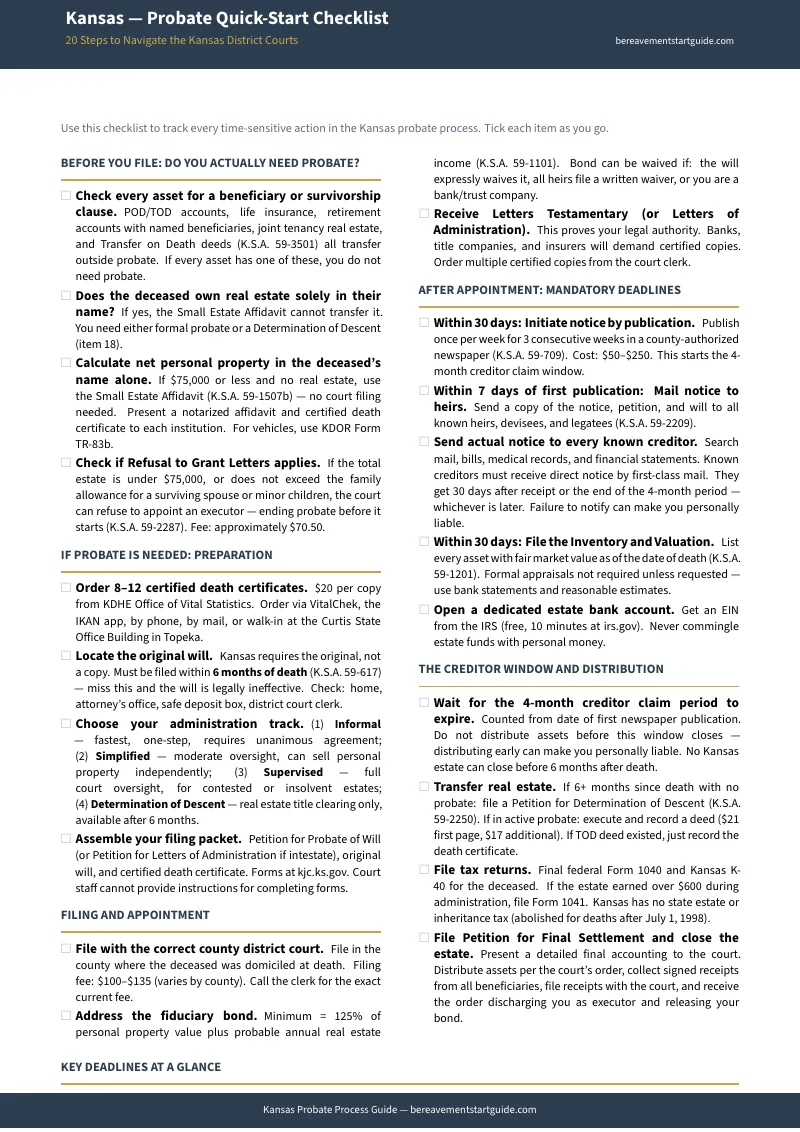
The Free Kansas Probate Quick-Start Checklist
A printable checklist covering the most critical early decisions: determining whether the estate qualifies for a simplified track, understanding the six-month will filing deadline, identifying whether a bond will be required, and noting the 30-day inventory clock that starts the moment you're appointed. Available as a free download so you can orient yourself immediately.
Who This Is For
- First-time executors who were named in a will and have never interacted with the Kansas district court system -- you need to understand what the court expects, in what order, and by when
- Administrators of intestate estates who must petition for Letters of Administration, post a bond, and navigate the intestate succession rules under KSA Chapter 59 to determine who inherits
- Out-of-state executors handling a parent's Kansas estate remotely -- especially those dealing with real property, agricultural land, or mineral rights that require court authorization to transfer
- Cost-conscious families managing modest estates who want to determine whether the Small Estate Affidavit or Refusal to Grant Letters can bypass formal probate entirely -- saving thousands in attorney fees and months of court supervision
- Executors worried about personal liability who understand that distributing assets before clearing creditors, missing the inventory deadline, or paying debts out of the statutory order can make them personally responsible for the estate's obligations
Why Not Just Use the Free Kansas Judicial Council Forms?
Every probate form referenced in this guide is available for free from the Kansas Judicial Council website. The Petition for Probate, the Inventory and Valuation, the Notice to Creditors, the Petition for Final Settlement -- all downloadable at no cost.
What's not available -- anywhere, for free -- is the translation. The Judicial Council provides forms but explicitly states that court staff cannot help you complete them. The forms arrive as legal blanks with no instructions explaining what information goes where, what supporting documents the judge expects to see, what mistakes cause rejections, or what order to file them in. County clerks will accept your filing and stamp it -- but they cannot tell you whether you filled it out correctly, whether you filed the right form for your situation, or whether you just triggered a deadline you didn't know existed.
Kansas Legal Services offers high-level overviews of the probate process but doesn't provide executable, step-by-step filing instructions. Local law firms publish content designed to demonstrate how complex probate is -- steering you toward a retainer, not helping you complete the process yourself. And national probate apps charge $175 or more while lacking the hyper-local specificity that Kansas requires: the four distinct tracks, the county-by-county docket fees, the 125% bond calculation, the Refusal to Grant Letters shortcut, the Medicaid expanded estate trap.
This guide sits in the gap between blank government forms and expensive professional services. It gives you the instructions the forms are missing -- the sequence, the deadlines, the common mistakes, and the plain-English explanations that turn raw legal blanks into completed, court-ready submissions.
-- Less Than One Hour of Attorney Time
A Kansas probate attorney charges $200 to $400 per hour. A flat-fee engagement for a straightforward estate starts at $2,500. For complex estates, you're looking at $7,000 to $15,000 before it's over. This guide covers the procedural knowledge that would otherwise consume your first several billable hours -- understanding which track applies, completing the initial petition correctly, knowing what the court expects at each stage, and avoiding the errors that generate delays, rejections, or personal liability. Even if you eventually hire an attorney for a specific issue, completing the administrative groundwork first saves the estate hundreds in intake time.
If the guide doesn't save you at least ten hours of frustrating research across the Kansas Judicial Council, county court websites, Kansas Legal Services, and KDOR pages, email us at any time for a full refund. No questions asked.
Frequently Asked Questions
What if the rules change after I buy?
We update the guide when the rules change. Email us any time, even years later, and we'll send you the current edition free.