The Bank Froze the Checking Account. KPERS Said the Pension Election Is Irrevocable. The State Filed a Medicaid Recovery Claim Against a House You Thought Was Protected by a Transfer on Death Deed. You Are Grieving, and Kansas Assumes You Already Know How All of This Works.
You called the bank to pay the mortgage. They told you the account was in your spouse's name only and they cannot release funds without Letters of Administration from the district court. You asked about the small estate affidavit you read about online. They said they do not accept those and suggested you consult an attorney.
You called KPERS to ask about the survivor pension. They told you your spouse elected the joint-survivor option at retirement and that the election is irrevocable. They could not explain whether you qualify for fifty percent, seventy-five percent, or one hundred percent of the monthly benefit, or how the $50,000 lump-sum death benefit works for service-connected deaths. They said KPERS does not provide advisory services. You searched online. You found the Kansas Department of Revenue website with dense PDF forms for property tax relief. You found three law firm blogs that explained the dangers of Medicaid estate recovery and ended with "schedule a consultation at $350 per hour." You found a Reddit thread where someone said the state took their parent's house through a TOD deed. You do not know what is true, what applies to your situation, or what to do first.
Meanwhile, you may be missing benefits you do not know exist. A workers' compensation death benefit capped at $500,000 under the 2024 SB 430 legislation if the death was work-related. A $60,000 immediate initial payment that bypasses the standard lump-sum discount. Three separate property tax relief programs with different eligibility rules and income thresholds. A Kansas Mini-COBRA continuation law that protects employees of small businesses with fewer than twenty workers. A statutory interest penalty you can demand from life insurance companies that delay payment beyond ten days. A $75,000 statutory allowance under K.S.A. 59-403 that shields cash and property from creditors. Every one of these programs is administered by a different agency, with different forms, different deadlines, and different eligibility rules. None of them tells you about the others.
The Kansas Survivor Benefits Navigator is a Multi-Agency Benefit Roadmap for every pension, exemption, insurance continuation, death benefit, and government program available to surviving spouses and dependents in Kansas. Not a generic national checklist repurposed with Kansas's name. Not a law firm blog designed to convince you that $350 per hour is your only option. A plain-English, Kansas-specific manual that tells you what the pension offices, county treasurers, and state agencies cannot: which benefits exist, who qualifies, which agency administers each one, what forms to file, in what order, and which deadlines will cost you money if you miss them.
What's Inside the Multi-Agency Benefit Roadmap
A step-by-step guide, a survivor benefits checklist, and standalone reference sheets covering every benefit available to surviving spouses and dependents in Kansas, built on the Kansas Statutes Annotated, the KPERS pension system, the Kansas Department of Revenue tax code, and the state agency procedures that make this process different from any other state:
KPERS Survivor Pensions: Joint-Survivor Options Decoded
If the deceased was a state employee, teacher, or municipal worker enrolled in KPERS, their retirement option determines exactly what you receive. The joint-survivor election — fifty, seventy-five, or one hundred percent — was selected at retirement and cannot be changed. The guide explains every option, details the $50,000 lump-sum death benefit for service-connected deaths, walks you through the documentation KPERS requires, and addresses the critical offset rule: KPERS monthly benefits are statutorily reduced by any Workers' Compensation payments received, with a floor of one hundred dollars per month. Missing this interaction means planning your budget around a number you will never receive.
Workers' Compensation Death Benefits: The 2024 SB 430 Changes
If the death resulted from a workplace injury or occupational disease, Kansas provides one of the strongest death benefit structures in the country — and it changed significantly in 2024. The maximum death benefit cap increased from $300,000 to $500,000 under SB 430. The law requires an immediate $60,000 initial payment designed to bypass the standard 8% lump-sum discount rate. The guide covers the new benefit calculations, the weekly compensation formula, the dependency rules that determine the fifty-fifty split between surviving spouses and children, and the fact that Kansas is a minority state where spousal workers' compensation benefits continue for life, even upon remarriage.
Property Tax Relief: Three Programs, Three Sets of Rules
Kansas administers three distinct property tax relief programs, each with different eligibility thresholds, income caps, and valuation limits. The SAFESR refund program covers surviving spouses aged sixty-five or older with household income under $25,380 and a home valued at no more than $350,000. The general Homestead Refund covers incomes under $43,389. The K-40SVR Valuation Stabilization program provides refunds for survivors of disabled veterans or persons sixty-five and older. The guide maps each program's eligibility criteria, explains the documentation the Department of Revenue requires, identifies the filing deadlines, and provides worksheets so you can determine which programs you qualify for before you contact a single agency.
Medicaid Estate Recovery: What the State Can and Cannot Take
This is the chapter that replaces fear with facts. Kansas uses an "Expanded Estate" definition under KEESM 1725.1 that reaches beyond probate assets into TOD deeds, joint tenancy, living trusts, and payable-on-death accounts. The widespread panic about the state taking your home is understandable but legally incomplete. Kansas cannot enforce recovery while a surviving spouse is alive and residing in the home. It cannot enforce recovery while a child under twenty-one or a blind or permanently disabled child is in the home. Hardship waivers exist. The guide explains the exact scope of KDHE's recovery authority, the priority of funeral expenses over Medicaid claims under KEESM 1725.5, the specific exemptions that protect you, and how to respond to a recovery notice from Health Management Systems.
Health Insurance Continuation: Federal COBRA and Kansas Mini-COBRA
The death of a spouse who carried the family health insurance triggers an immediate coverage crisis. For employers with twenty or more employees, federal COBRA applies. For employers with fewer than twenty employees — common throughout Kansas — the state Mini-COBRA law under K.S.A. 40-2209 mandates coverage continuation for up to eighteen months. The guide explains both pathways, details the 102% premium responsibility, clarifies that the insurance carrier bears the legal burden of notifying the survivor within thirty days, and maps the Medicare coordination rules for eligible survivors.
Small Estate Shortcuts and Statutory Allowances
Kansas provides two powerful mechanisms to avoid or minimize probate. The K.S.A. 59-1507b Small Estate Affidavit allows heirs to claim bank accounts and personal property without court involvement when the total estate value does not exceed $75,000. The K.S.A. 59-403 statutory allowance lets the surviving spouse petition for up to $75,000 in cash or property, plus furniture and one automobile, shielded from all general creditors. The guide provides the exact sequence for executing both strategies, explains when the K.S.A. 59-2287 Refusal of Letters of Administration applies, and identifies the vehicle transfer forms — TR-12 and TR-83b — needed at the county treasurer's office.
Federal Benefits with Kansas-Specific Coordination
Social Security survivor benefits, VA Dependency and Indemnity Compensation, and federal employee survivor pensions all interact with Kansas state-level benefits in ways generic federal guides do not address. The guide covers the federal benefits and explains how they coordinate with Kansas-specific programs — which state benefits are offset by federal payments, which are independent, what the repeal of the Windfall Elimination Provision and Government Pension Offset now means for KPERS survivors — including the retroactive back pay owed to January 2024 and why survivors who never applied still have to file — and how to sequence your claims to avoid triggering reductions or overpayment recovery.
Who This Guide Is For
- The surviving spouse who just lost a state employee, teacher, or municipal worker — who needs to understand what the KPERS joint-survivor election means for their income starting next month, how the $50,000 lump-sum works, and why the Workers' Compensation offset could reduce their monthly pension to the statutory floor of one hundred dollars
- The surviving spouse terrified about Medicaid estate recovery — who executed a TOD deed believing the home was protected and now needs to understand Kansas's Expanded Estate recovery rule under KEESM 1725.1, the specific exemptions for surviving spouses in the home, and when a hardship waiver applies
- The fixed-income senior worried about property taxes — who may qualify for SAFESR, the Homestead Refund, or the K-40SVR Valuation Stabilization program but cannot determine which programs apply, what documentation is needed, or when the filing deadlines are
- The family of a worker killed on the job — who needs to claim the $60,000 immediate payment, understand the new $500,000 cap under SB 430, and know that Kansas guarantees lifetime spousal benefits regardless of remarriage
- The adult child helping a surviving parent from out of state — who is coordinating federal, state, and county benefits for a parent in Kansas remotely and needs every agency, form, deadline, and eligibility rule in one document instead of calling a dozen offices
- The surviving spouse whose health insurance just ended — who works at a small Kansas employer with fewer than twenty employees and has a narrow window to invoke the Mini-COBRA continuation rights under K.S.A. 40-2209 before coverage lapses
Why Free Resources Will Not Get You Through This
Kansas survivor benefit information exists. The Kansas Judicial Council publishes probate forms, KPERS publishes pension handbooks, and the Department of Revenue publishes tax forms. Here is what you actually encounter when you try to navigate benefits using free sources:
- The Kansas Judicial Council provides blank forms — and zero strategic guidance. You can download the Small Estate Affidavit for free. The form does not tell you that Kansas law has no mandatory waiting period after death before you can use it. It does not explain how the affidavit interacts with the $75,000 statutory allowance under K.S.A. 59-403. It does not warn you that a TOD deed will not protect the home from Medicaid recovery. It is a blank form. You need the picture on the box and the order in which to assemble the pieces.
- KPERS publishes pension handbooks — written for administrators, not widows. The handbook explains the joint-survivor options in actuarial language and assumes you understand the difference between a service-connected death benefit and a standard survivor annuity. It does not explain what happens to your income next month in plain language. It does not tell you about the Workers' Compensation offset that could reduce your monthly benefit to a hundred dollars. It says to contact member services, and member services says they cannot advise you on your specific situation.
- The Department of Revenue publishes dense PDF forms — not eligibility guides. Form K-40SVR and the SAFESR application exist online. Understanding whether you qualify for one, two, or all three property tax programs requires reading the statute, calculating income against the $25,380 SAFESR threshold versus the $43,389 Homestead threshold, and verifying your home valuation against the $350,000 cap. The form tells you what to fill in. It does not tell you whether you qualify.
- Law firm blogs explain the danger — and end with a phone number. Every probate and elder law firm in Wichita, Topeka, and Kansas City publishes blog posts about Medicaid estate recovery, TOD deed traps, and probate costs. They are accurate, alarming, and deliberately incomplete. The post explains the risk. It never explains the solution in enough detail to act on. It always ends with "call for a consultation." Those consultations run $350 per hour.
- No free resource synthesizes all of these programs into one action plan. KPERS handles pensions. The county treasurer handles vehicle transfers. The Department of Revenue handles property tax relief. KDHE handles Medicaid recovery. The Workers' Compensation Division handles death claims. The SSA handles Social Security. Each agency knows its own program and nothing about the others. No free resource tells you which benefits you are owed, which agency administers each one, what forms to file, in what order, and which deadlines will cost you money if you miss them.
Free resources give you blank forms from the Judicial Council, pension handbooks in actuarial language, and law firm blogs that end with a billable-hour phone number. The Multi-Agency Benefit Roadmap puts every Kansas survivor benefit, form, deadline, and eligibility rule into one document, in the order you actually need them.
— Less Than Fifteen Minutes With a Kansas Probate Attorney
A consultation with a Kansas probate or elder law attorney runs $350 per hour. A single session to review your benefit eligibility and explain the KPERS pension options, property tax programs, Medicaid recovery rules, and workers' compensation changes will consume that first hour and often a second. Kansas probate administration typically costs three to five percent of the estate's gross value — meaning a $300,000 estate could lose $15,000 to legal fees. This guide costs less than fifteen minutes of professional legal time and gives you the complete Kansas-specific benefit roadmap — every program, every agency, every form, every deadline, and the coordination rules that determine how state and federal benefits interact.
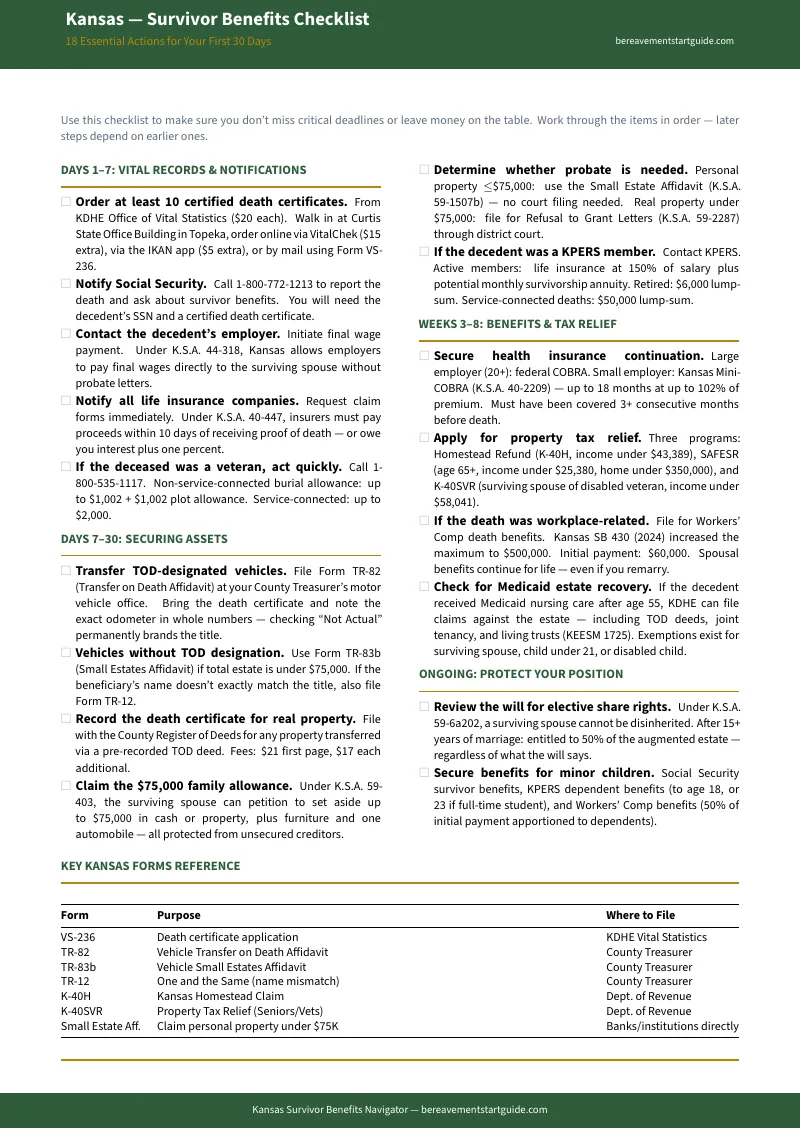
Your download includes the complete step-by-step guide covering every survivor benefit category, the standalone Kansas Survivor Benefits Checklist, and printable reference sheets: the Benefit Eligibility Decision Tree, the KPERS Pension Options Comparison Chart, the Property Tax Relief Worksheet (SAFESR, Homestead, and K-40SVR), the Health Insurance Transition Pathway, the Workers' Compensation Claim Checklist with 2024 SB 430 updates, the Medicaid Estate Recovery Quick Reference, the Small Estate and Statutory Allowance Guide, and an Agency Contact Directory with every relevant state, county, and federal office. Instant download, no account required.
Money-back guarantee, no time limit. If this guide does not save you hours of hold time with state agencies and make the benefit claims process immediately clearer, email us for a full refund. No questions asked.
Not ready for the full guide? Download the free Kansas — Survivor Benefits Checklist — an overview of the benefits available, the key agencies, the 2026 thresholds, and the critical deadlines. Enough to understand what you may be owed and whether you need the full guide.
Nobody trained you for this. KPERS assumes you understand actuarial tables. The county treasurer assumes you brought the right form. The Department of Revenue assumes you can read the statute. You have something none of them provide — a single roadmap that connects every Kansas survivor benefit into one sequence, with plain-English instructions for each one.
Frequently Asked Questions
What if the rules change after I buy?
We update the guide when the rules change. Email us any time, even years later, and we'll send you the current edition free.