
The Bank Froze the Account. The County Clerk Handed You a Stack of AOC Forms. And Nobody Can Tell You Whether You Need Probate or a $30,000 Dispensation.
Someone you love just died in Kentucky. The bank locked the checking account the moment they found out. You need that money for the funeral, but the teller says you need "Letters Testamentary" -- and you have no idea what those are or how to get them from the District Court. The County Clerk's office handed you a pile of forms -- AOC-805, AOC-830, AOC-841 -- without explaining which ones apply to your situation. There's a house involved, and you've heard that Kentucky just passed a new Transfer-on-Death deed law in 2026, but you're also hearing that the state can still come after the property if the deceased was on Medicaid.
You start looking for help. The Kentucky Court of Justice website has a pro-se probate guide, but it warns you in bold that you're acting as your own attorney and gives you no strategic advice on what to do next. The Department of Revenue has inheritance tax forms but doesn't explain the difference between Class A, Class B, and Class C beneficiaries -- or that your siblings are completely exempt while your niece owes 4% to 16% on everything she receives. The KPPA website mentions a $5,000 post-retirement death benefit but doesn't explain how to file for it or that overpayments after death get clawed back. And every probate attorney you call quotes $200 to $350 per hour -- thousands of dollars for an estate that might qualify for a streamlined process costing under $76 at the courthouse.
Meanwhile, someone mentioned that a surviving spouse can petition to withdraw up to $2,500 from a frozen bank account before probate even opens, but you can't find step-by-step instructions anywhere. The 2026 legislative changes -- Senate Bill 34 for Transfer-on-Death deeds and Senate Bill 50 for sealed inventories and modernized inheritance rules -- have made most of the existing online advice obsolete. And you're terrified of paying debts out of order, distributing assets too early, or missing the 60-day inventory deadline and facing personal liability.
The Kentucky Estate Settlement Roadmap
This guide does what no single Kentucky government website, legal aid page, or attorney consultation does: it puts the entire estate settlement process into one chronological sequence, from the hour of death through final distributions and estate closure -- with every form name, court requirement, statutory deadline, and agency contact in one place.
It's built specifically for Kentucky. Not a generic national probate overview with "check your state laws" footnotes. Every chapter addresses the exact thresholds, timelines, and traps that make Kentucky different -- the $30,000 small estate dispensation that increases when the surviving spouse paid funeral costs, the $2,500 emergency bank withdrawal that most families never learn about, the six inheritance tax classes with rates from 0% to 16%, the Medicaid estate recovery exemptions that protect surviving spouses and children, the new 2026 Transfer-on-Death deed law, and the sealed inventory rules that now shield estate finances from public view.
What You Get
The Complete Guide
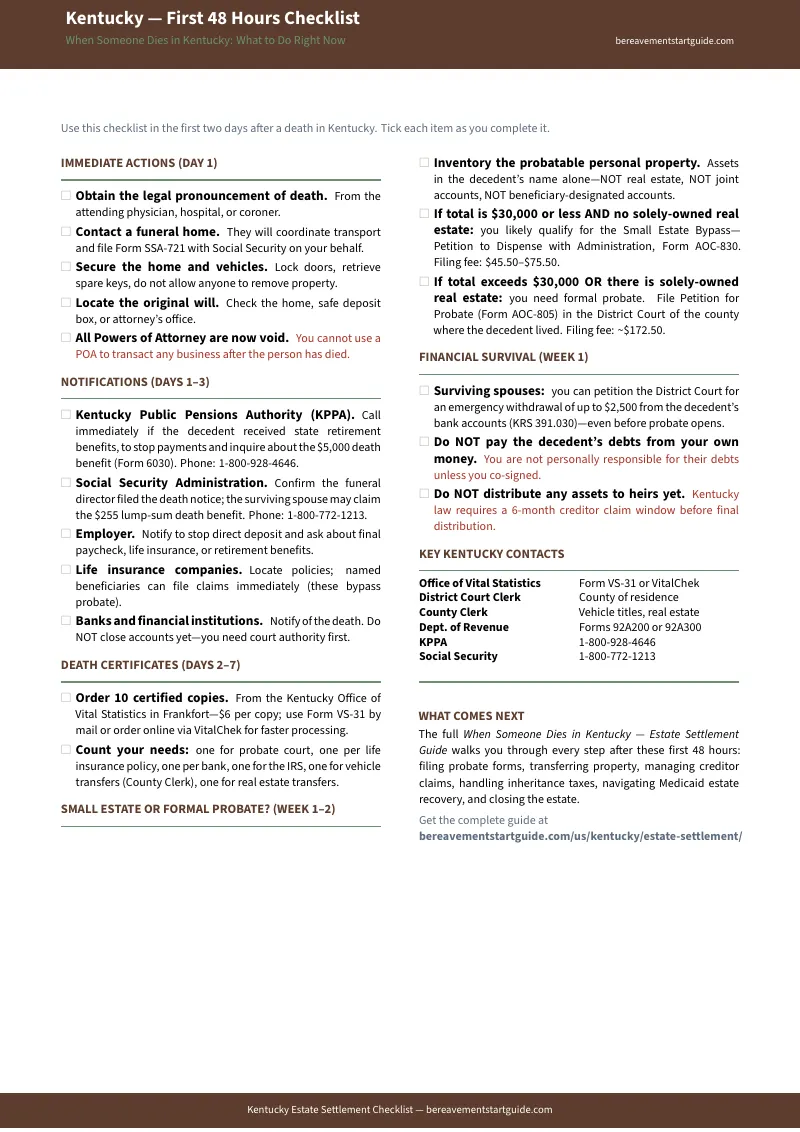
- First 48 Hours protocol -- understanding that all Powers of Attorney are immediately and irrevocably void at the moment of death, securing the residence and vehicles, maintaining insurance coverage, and the one rule that prevents the most common financial mistake: do not pay the deceased's debts from your own money
- Death certificate strategy -- ordering through the Office of Vital Statistics in Frankfort at $6 per certified copy, using Form VS-31 by mail or VitalChek for expedited orders, Kentucky's restricted access rules that limit who can request copies, how many to order (minimum 10 for most families), and which institutions demand certified copies versus photocopies
- KPPA notification -- if the deceased was a Kentucky public employee or retiree, the $5,000 post-retirement death benefit available through Form 6030, and why you must notify KPPA immediately to stop pension payments -- because overpayments after death must be repaid
- The $2,500 emergency bank withdrawal -- the provision under KRS 391.030 that allows a surviving spouse to petition the District Court for an early withdrawal from the decedent's bank account before probate opens, applied against the spouse's share of the estate
- Small estate bypass (Form AOC-830) -- the Petition to Dispense with Administration for estates with $30,000 or less in personal property, the critical detail that the threshold increases when the surviving spouse or children paid preferred debts like funeral costs, the $45.50-$75.50 filing fee, why real estate cannot be transferred through this process regardless of value, and the step-by-step filing procedure
- Formal probate administration -- filing Form AOC-805 at the District Court in the county where the decedent resided, the approximately $172.50 filing fee, the AOC-825 fiduciary bond requirement and when the will waives it, self-proved wills versus wills requiring witness testimony, and how Letters Testamentary give you legal authority over every asset in the estate
- The 60-day inventory deadline -- filing Form AOC-841 within 60 days of appointment, fair market value rules for real estate (PVA assessments), financial accounts (date-of-death balances), and vehicles (NADA/Kelley Blue Book). Plus the 2026 change under Senate Bill 50: inventories are now filed under seal, protecting family privacy
- Creditor claims and the 6-month window -- the strict priority of claims (administrative costs and funeral first, then taxes, then medical expenses of last illness, then unsecured debts), why paying out of order creates personal liability for the executor, and the absolute statutory bar on claims filed after 6 months
- Kentucky inheritance tax -- the three beneficiary classes and their rates: Class A (spouse, parents, children, siblings) completely exempt since 1998, Class B (nieces, nephews, in-laws) at 4-16% over a $1,000 exemption, Class C (friends, cousins, entities) at 6-16% over a $500 exemption. Form 92A300 for all-Class-A estates (filed with District Court only) versus Form 92A200 for estates with Class B/C beneficiaries (filed with the Department of Revenue). The 5% discount for paying within 9 months and the interest trigger at 18 months
- Real estate transfers -- three paths: rights of survivorship (death certificate to County Clerk), probate transfer via executor's deed, and intestate Affidavit of Descent under KRS 382.120 (two disinterested witnesses, $50 recording fee). Plus the new 2026 Transfer-on-Death deed law under Senate Bill 34, allowing real estate to bypass probate entirely with a recorded beneficiary designation
- Vehicle title transfers -- Form TC 96-182 at the County Clerk, the difference between "OR" titles (survivorship, no probate needed) and "AND" titles (probate documents required), the $9 title fee plus $8 transfer fee, and the family usage tax exemption (Form 71A101) that saves immediate family members the 6% usage tax -- a $1,200 savings on a $20,000 vehicle
- Medicaid estate recovery -- the three absolute exemptions (surviving spouse, child under 21, disabled child of any age), the $10,000 estate value waiver, the hardship exemption application (Form MAP-708), and Kentucky's broad definition of "estate" that can reach jointly held property, life estate interests, and certain trust assets
- Surviving spouse protections -- the right to renounce the will within 6 months under KRS 392.080, the elective share (one-half of surplus personal property plus one-third of real estate in fee simple), exempt personal property, family allowance, and homestead rights during administration
- Final settlement and estate closure -- the two paths: Formal Settlement (Form AOC-846, court hearing, detailed accounting) and Informal Settlement (Form AOC-850 affidavit plus Form AOC-851 signed by every beneficiary). Why no estate can close earlier than 6 months after appointment, and the complete checklist for closing
- When to hire a professional -- the exact triggers for an attorney, CPA, or elder law specialist, so you don't pay thousands for tasks you can handle yourself but don't accidentally mishandle tasks that require professional help
- Complete forms directory -- every form referenced in the guide (AOC-830, AOC-805, AOC-806, AOC-825, AOC-841, AOC-846, AOC-850, AOC-851, VS-31, TC 96-182, 71A101, 92A200, 92A205, 92A300, Form 6030, MAP-708) with the exact agency, filing location, and context
6 Standalone Printable Tools
- Estate Inventory Worksheet -- fillable worksheet for cataloging every asset by category, title type, estimated value, and probate status. Bring it to the courthouse or your first attorney meeting.
- Probate Decision Tree -- one-page flowchart: does the estate qualify for the $30,000 small estate bypass, or do you need formal probate? Follow the arrows and know your track in minutes.
- Inheritance Tax Reference -- Kentucky's three beneficiary classes on one page: who is exempt (Class A), who pays 4-16% (Class B), who pays 6-16% (Class C), with the correct form and filing location for each.
- Creditor Priority Reference -- the strict statutory payment order for estate debts. Print this and keep it with your executor files -- paying out of order creates personal liability.
- Statutory Deadline Calendar -- every Kentucky estate deadline on one page: 60-day inventory, 6-month creditor window, 9-month tax discount, 18-month interest trigger. Post it where you'll see it daily.
- Vehicle Title Transfer Guide -- step-by-step instructions for Form TC 96-182, the OR-versus-AND title distinction, and the family usage tax exemption that saves immediate family members the 6% usage tax.
The Free Kentucky First 48 Hours Checklist
A printable emergency checklist covering the most urgent tasks -- from understanding that all Powers of Attorney are now void and securing the residence through ordering death certificates, notifying KPPA, and determining whether the estate might qualify for Kentucky's $30,000 small estate bypass. Available as a free download so you can start immediately while deciding whether the full guide is right for your situation.
Who This Is For
- Surviving spouses who need to access frozen bank accounts using the $2,500 emergency withdrawal, understand the elective share and right to renounce the will, determine whether the family home is shielded from Medicaid recovery, transfer the car title at the County Clerk using the family usage tax exemption, and file the right inheritance tax form
- Adult children settling a parent's estate for the first time -- especially those living out of state who need to understand Kentucky's District Court system, the difference between the small estate dispensation and formal probate, and whether they can handle the estate without hiring a local attorney
- Executors and personal representatives who want to fulfill their fiduciary duties correctly, protect themselves from personal liability for the decedent's debts, meet the strict 60-day inventory deadline, pay creditors in the exact statutory order, and close the estate using the right settlement path
- Families dealing with Medicaid recovery who need to know whether the three absolute exemptions apply, whether the $10,000 waiver threshold protects them, and when Kentucky's broad definition of "estate" means they should consult an elder law attorney before distributing any assets
- Cost-conscious administrators of modest estates who want to determine whether the $30,000 dispensation can bypass the court entirely -- saving thousands in attorney fees that would otherwise consume a significant portion of the estate's value
Why Not Just Use the Free Government Forms?
Every form referenced in this guide is available for free from a Kentucky government office. The AOC-830 is on the Kentucky Court of Justice website. The inheritance tax forms are on the Department of Revenue site. The death certificate application is available from the Office of Vital Statistics in Frankfort.
What's not free -- and what no government website provides -- is the sequence. The District Court clerk can hand you form AOC-805 but is legally prohibited from telling you whether your estate actually needs it, or whether AOC-830 would save you months of time and hundreds of dollars in fees. The Department of Revenue website lists inheritance tax forms but doesn't explain that Class A beneficiaries file with the District Court only (Form 92A300) while Class B and C beneficiaries file with the Department itself (Form 92A200) -- and filing with the wrong office delays everything. No state website explains the $2,500 emergency bank withdrawal, warns you about the 6% vehicle usage tax that the family exemption eliminates, or connects the 60-day inventory deadline to the 6-month creditor window to the 9-month tax discount deadline into a single timeline you can actually follow.
Each agency handles its piece. None of them tell you what the next agency in line requires, or warn you about the traps hiding between the steps. This guide connects the dots -- putting every form, every deadline, every calculation, and every agency into the order you actually need them.
-- Less Than One Hour of Attorney Time
A single consultation with a Kentucky probate attorney runs $200 to $350 per hour. A flat-fee retainer for a straightforward estate starts at $2,000 to $5,000. And for a moderately complex estate, attorney fees can consume thousands before executor compensation, bond premiums, and court costs. This guide covers the administrative fundamentals that would otherwise consume your first several billable hours -- ordering certificates, qualifying for the small estate process, organizing your documents, understanding the inheritance tax classes, and meeting every statutory deadline. Even if you ultimately hire an attorney, completing these steps first saves the estate hundreds of dollars in billable intake time.
If the guide doesn't save you at least ten hours of frustrating research across scattered government websites, email us at any time for a full refund. No questions asked.
Frequently Asked Questions
What if the rules change after I buy?
We update the guide when the rules change. Email us any time, even years later, and we'll send you the current edition free.