
The Funeral Home Is Waiting for Your Answer
Someone you love just died in Kentucky. The funeral home is asking what you want — embalming, casket, vault, viewing, cremation — and you have 48 hours to decide. The total will land between $7,000 and $12,000 unless you know what Kentucky law actually requires and what is a business upsell disguised as a legal obligation.
You searched online and found two kinds of advice: federal consumer protection overviews that gloss over Kentucky-specific rules, and local attorney blogs that explain just enough to make you call for a $300-an-hour consultation. Neither one tells you what to say in the arrangement conference tomorrow morning.
The gap between free information and paid professional help is where families lose money — paying for embalming they did not need, buying a vault the state does not require, or signing a preneed contract without understanding the trust protections they are entitled to under KRS 367.934.
The Kentucky Funeral Rights Playbook
This guide bridges that gap. It translates every Kentucky funeral statute, every FTC Funeral Rule protection, and every administrative regulation into plain-English instructions you can use before, during, and after the arrangement conference — from the moment of death through estate settlement and tax filing.
Kentucky funeral law has its own rules that differ from neighboring states. Embalming is not required by law for standard burial or viewing. The provisional death certificate doubles as the burial-transit permit. Home burials are legal on private property with specific depth requirements under 901 KAR 5:090. The Funeral Planning Declaration under KRS 367.93117 lets a designee override the surviving spouse on all disposition decisions. None of this appears in a generic national checklist.
The guide maps these rules in the order you actually encounter them, with the exact form numbers, agency contacts, and statute citations at every step.
What's Inside —
The First 48 Hours
Who to call, in what order, depending on how the death occurred — expected hospice death, unexpected death at home, hospital death. How to interact with the county coroner. How many certified death certificates to order (8 to 12 minimum, at $6.00 each from the Office of Vital Statistics) and why running out mid-process causes expensive delays.
Right to Control Disposition
The statutory priority hierarchy under KRS 367.93117 — from the Funeral Planning Declaration designee at the top to next of kin at the bottom. How to use Form FPD-1 to establish legally binding control before a death occurs. What happens when siblings disagree on cremation versus burial and one party is unreachable. Why Power of Attorney dies with the person and cannot be used to make funeral arrangements.
Embalming Rights and Alternatives
Kentucky does not require embalming for standard burial, viewing, or cremation. The guide details the rare, narrow exceptions — reportable contagious disease and interstate common carrier transport — so you can decline the service confidently. Refrigeration under 201 KAR 15:110 is a legally accepted alternative. This chapter alone can save $800 to $1,500.
Cremation Authorization
The coroner's cremation permit under KRS 213.081, the authorization form requirements, who qualifies as the legally authorized agent, and the priority order when family members disagree. No casket is required for cremation — an alternative container is your legal right under the FTC Funeral Rule.
Home Funerals and Private Burial
The specific depth requirements (3 feet for non-sealed containers, 2 feet for hermetically sealed containers under 901 KAR 5:090), the burial-transit permit process for families handling transport without a funeral director, recording a cemetery plat with the county clerk, and the zoning checks you must complete before breaking ground.
The FTC Funeral Rule
The federal right to receive an itemized General Price List before discussing arrangements. The right to buy a casket from any source without handling fees. The right to decline bundled packages and select services individually. How to connect these federal protections to Kentucky's enforcement mechanism through the Kentucky Board of Embalmers and Funeral Directors and 201 KAR 15:080.
Filing a Complaint
The exact process for filing a complaint under 201 KAR 15:080 — the two-year filing window, the requirement for a signed written complaint, the funeral home's 20-day response period, and how to structure your narrative for maximum investigative priority.
Preneed Contract Protections
How the trust fund requirements under KRS 367.934 protect your prepaid funeral money. The difference between irrevocable and revocable funeral trusts for Medicaid planning. What to demand before signing any preneed contract and how to verify that the funeral home is actually trusting the funds as required by statute.
Estate Settlement and Small Estate Fast Track
If the probatable personal estate is $30,000 or less, Form AOC-830 lets you bypass formal probate entirely. The guide walks through the calculation under KRS 395.455, including the preferred claims deduction that can push borderline estates below the threshold. Updated for the 2026 changes under Senate Bill 50, which fundamentally rewrote surviving spouse inheritance rules and added stepchildren to the default succession order.
Inheritance Tax
Class A beneficiaries (spouse, children, parents, siblings) are fully exempt. Class B beneficiaries (nieces, nephews, aunts, uncles) are exempt for deaths after January 1, 2026 under House Bill 726. Class C beneficiaries (cousins, unrelated friends) face 6 to 16 percent rates with a $500 exemption. The guide covers the nine-month deadline and the five percent early-payment discount.
Medicaid Estate Recovery
Kentucky's expanded estate definition reaches beyond probate into joint tenancies, revocable trusts, and life estates. The guide maps the statutory exemptions — surviving spouse, child under 21, disabled child, estates under $10,000 — and explains how to respond to a recovery claim using Form MAP-708.
Green Burial and Alternative Disposition
Outer burial vaults are cemetery policies, not state laws. The guide identifies Kentucky natural and hybrid cemeteries, explains the regulatory landscape for shroud and pine box burials, and covers the scattering of ashes on private land and in waterways.
Who This Is For
- Families in the first 72 hours after a death — who need to know their rights before sitting down with a funeral director
- The person handling arrangements — whether named in a Funeral Planning Declaration, the surviving spouse, or an adult child who stepped up
- Pre-planners — aging parents or adult children setting up a Funeral Planning Declaration and evaluating preneed contracts
- Executors and administrators — who need the estate settlement chapters after the funeral is over
- Home funeral families — navigating private burial, transport permits, and depth regulations without a funeral director
Why Free Resources Fall Short
The Kentucky Board of Embalmers and Funeral Directors publishes its regulations. The FTC publishes the Funeral Rule. The Funeral Consumers Alliance has a Kentucky fact sheet — last updated around 2016, before the 2026 legislation that rewrote inheritance law and eliminated Class B taxation.
The rules exist. The instructions do not. The state board can tell you that 201 KAR 15:080 governs complaints, but not how to structure your narrative for maximum impact. The FTC can tell you that funeral homes must provide a price list, but not what to do when a Kentucky funeral director implies that embalming is required for a viewing. The court can give you Form AOC-830, but not how to calculate whether you qualify.
Law firm blogs deliberately stop short of actionable detail because their business model is the consultation call. National directories charge monthly subscriptions for documents that are free on kycourts.gov.
This guide fills the space between free regulations and expensive attorneys — every right explained, every form identified, every Kentucky-specific trap flagged — for less than one hour of professional time.
What You Get — 10 Printable PDFs
- Kentucky Funeral Laws & Consumer Rights Guide — 18-chapter PDF covering every phase from the first 48 hours through estate settlement, with statute citations and form references at every step
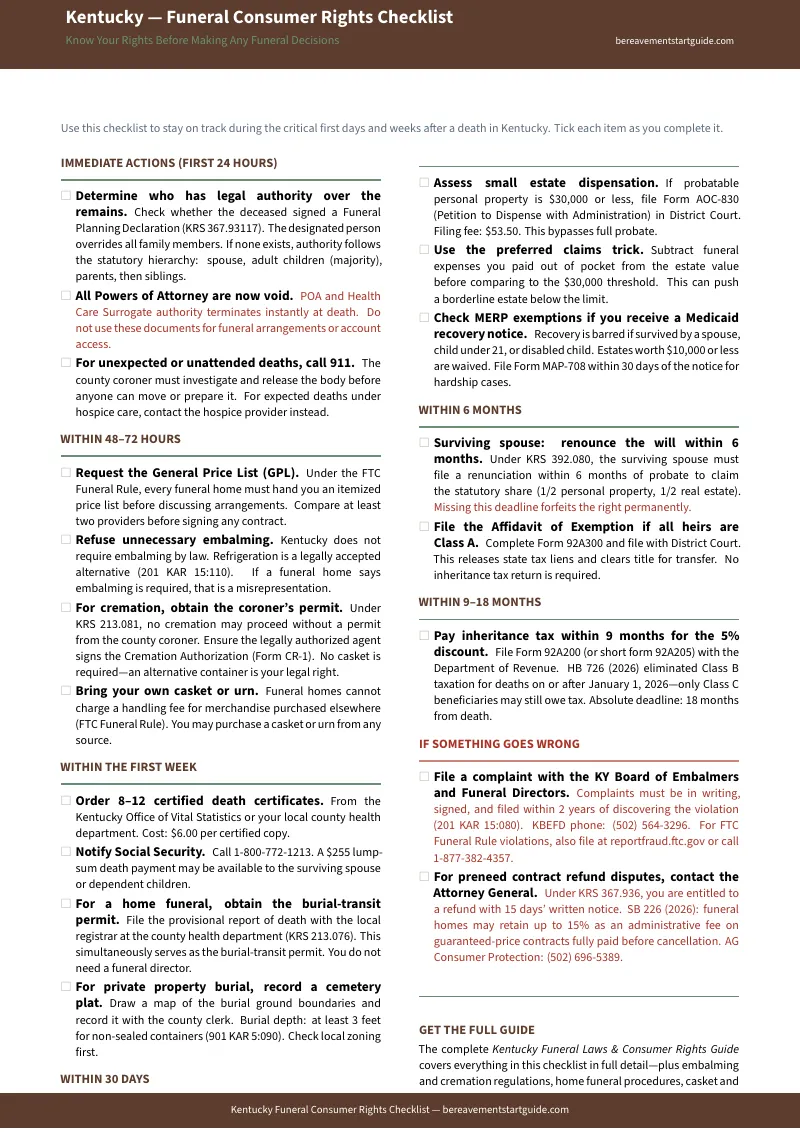
- Funeral Consumer Rights Checklist — printable 19-item action plan organized by timeline (first 24 hours, first week, 30 days, 6 months, 9-18 months)
- Arrangement Conference Rights Card — one-page fridge sheet with embalming refusal rights and FTC Funeral Rule protections to bring to the funeral home
- Disposition Authority Worksheet — fill-in form mapping the KRS 367.93117 priority hierarchy to determine who has legal authority over the remains
- Small Estate Calculator — AOC-830 eligibility worksheet to determine if the estate qualifies for the $30,000 probate bypass
- Home Burial Compliance Checklist — zoning, depth requirements, burial-transit permits, and county clerk recording steps for private property burial
- Preneed Contract Evaluation — KRS 367.932 trust protection checklist for evaluating prepaid funeral contracts before signing
- Complaint Filing Template — structured 201 KAR 15:080 complaint form with narrative guidance for the Kentucky Board of Embalmers and Funeral Directors
- Inheritance Tax Worksheet — Class A, B, and C beneficiary calculation sheet with exemption thresholds and the five percent early-payment discount
- Forms, Deadlines & Contacts — combined reference card with every form number, filing deadline, and agency contact from the guide
Instant download. Updated for 2026 Kentucky law including Senate Bill 50 and House Bill 726.
Frequently Asked Questions
What if the rules change after I buy?
We update the guide when the rules change. Email us any time, even years later, and we'll send you the current edition free.