You Just Inherited a Legal Process Nobody Taught You
The bank account is frozen. The county clerk handed you a stack of AOC forms and said she cannot tell you what to do with them. The will names you as executor — or there is no will and the family expects you to handle it.
You searched "Kentucky probate" and found two options: hire an attorney for three to seven percent of the estate's value, or wade through the Kentucky Revised Statutes and figure it out alone. The attorneys' websites explain just enough to scare you into calling. The free government guide is 20 pages of bureaucratic language with no roadmap for what to do first.
Neither option answers the question you actually have: what do I file, in what order, and by when?
The Kentucky Probate Sequencing System
This guide does what the county clerk cannot and the attorney charges thousands for: it translates every statutory deadline, every required form, and every Kentucky-specific trap into a step-by-step workflow — from the day you walk into District Court to the day the judge signs your final settlement.
Kentucky probate runs on a rigid clock. You have 60 days to file the estate inventory (Form AOC-841). You must wait a full six months for the creditor claim window to close (KRS 396.011). You need inheritance tax clearance before the court will accept your final settlement. Miss any of these and you breach your fiduciary duty — which means the estate's debts become your personal debts.
The guide maps this entire sequence in the order you actually encounter it, with the exact form numbers and statute citations at every step.
What's Inside —
The Small Estate Fast Track
If the probatable personal estate is $30,000 or less, you may be able to bypass formal probate entirely using Form AOC-830. The guide walks through the exact calculation under KRS 395.455 — including how to deduct preferred claims you paid out of pocket (like funeral expenses) to bring the total below the threshold. Most qualifying families close the process in 60 to 90 days instead of six to twelve months.
The 60-Day Inventory Blueprint
Form-by-form walkthrough of AOC-841, with clear rules for what goes on the inventory (solely owned assets at fair market value) and what stays off (joint accounts, life insurance with beneficiaries, retirement accounts with beneficiaries, trust property). Miss the 60-day deadline and you are in breach. Include a non-probate asset and you inflate the estate's apparent value, potentially triggering unnecessary tax obligations.
Creditor Claims Priority Chart
The six-month creditor window is the most dangerous phase of probate. Pay a credit card bill before the funeral home and you owe the difference personally. The guide lays out the exact payment hierarchy under KRS 396.095 — administration costs first, funeral expenses second, taxes third, unsecured debts last — so you never pay out of order.
Real Estate Transfer Instructions
If the deceased owned a home and died without a will, you need an Affidavit of Descent (KRS 382.120) — a notarized document tracing marital history and lineage, recorded at the county clerk where the property sits. If there is a will, the executor signs an executor's deed. The guide covers both paths, the $50.00 recording fee, and the spousal elective share trap that can derail a sale.
Vehicle Title Transfers
The conjunction on the title matters: "OR" titles transfer with just a death certificate, "AND" titles require probate documents. The guide covers Form TC 96-182 from the Kentucky Transportation Cabinet, the spouse exception, title fees ($9.00 standard, $25.00 speed title), and what to do when no probate was filed.
Kentucky Inheritance Tax Calculator
Kentucky is one of six states that still levies an inheritance tax. Class A beneficiaries (spouse, parents, children, grandchildren, siblings) are completely exempt. Class B and C beneficiaries face rates up to 16%. The guide includes the exemption thresholds, the nine-month deadline, and the five percent early-payment discount — a detail that can save hundreds or thousands of dollars.
Medicaid Estate Recovery Defense
If the deceased was over 55 and received Medicaid long-term care, the state can come after the estate for reimbursement. Kentucky's expanded estate definition under 907 KAR 1:585 reaches beyond the probate estate into joint tenancy and survivorship assets. The guide covers the exceptions (surviving spouse, minor child, disabled child, estates under $10,000) and how to respond to a recovery claim.
Estate Closing Playbook
Two paths to closure. Informal Settlement (Form AOC-850) is faster, but every beneficiary must sign a waiver (Form AOC-851). Formal Settlement (Form AOC-846) requires penny-perfect accounting with canceled checks and receipts. Both require an inheritance tax clearance letter from the Department of Revenue. The guide explains which path fits your situation and walks through the filings step by step.
Who This Is For
- Executors and administrators appointed by a Kentucky District Court — whether you are named in the will or stepped up to manage an intestate estate
- Surviving spouses trying to understand the small estate dispensation, the elective share, and Medicaid exemptions that protect the family home
- Beneficiaries who want to understand the timeline, their rights, and what the executor is doing
- Families managing estates under $30,000 who want to use the AOC-830 fast track to unlock assets in days, not months
Why Free Resources Fall Short
The Kentucky Court of Justice publishes all the forms for free. The 20-page official guide explains the basics. Law firm blogs cover the highlights. So why do executors still make costly mistakes?
The forms exist. The instructions do not. The county clerk can hand you Form AOC-841 but cannot tell you which assets to include, how to value them, or that non-probate assets stay off the list. The official guide mentions the creditor window but does not explain the payment priority hierarchy that determines who gets paid first — and makes you personally liable if you get it wrong.
Law firm blog posts deliberately withhold actionable detail because their business model depends on you calling for a consultation. National form aggregators charge monthly subscriptions to download documents that are free on kycourts.gov.
This guide fills the gap between free forms and expensive attorneys: every step sequenced, every deadline mapped, every Kentucky-specific trap flagged — for a fraction of one hour of attorney time.
What You Get
- Complete Kentucky Probate Guide — 15-chapter PDF covering every phase from first actions through estate closure
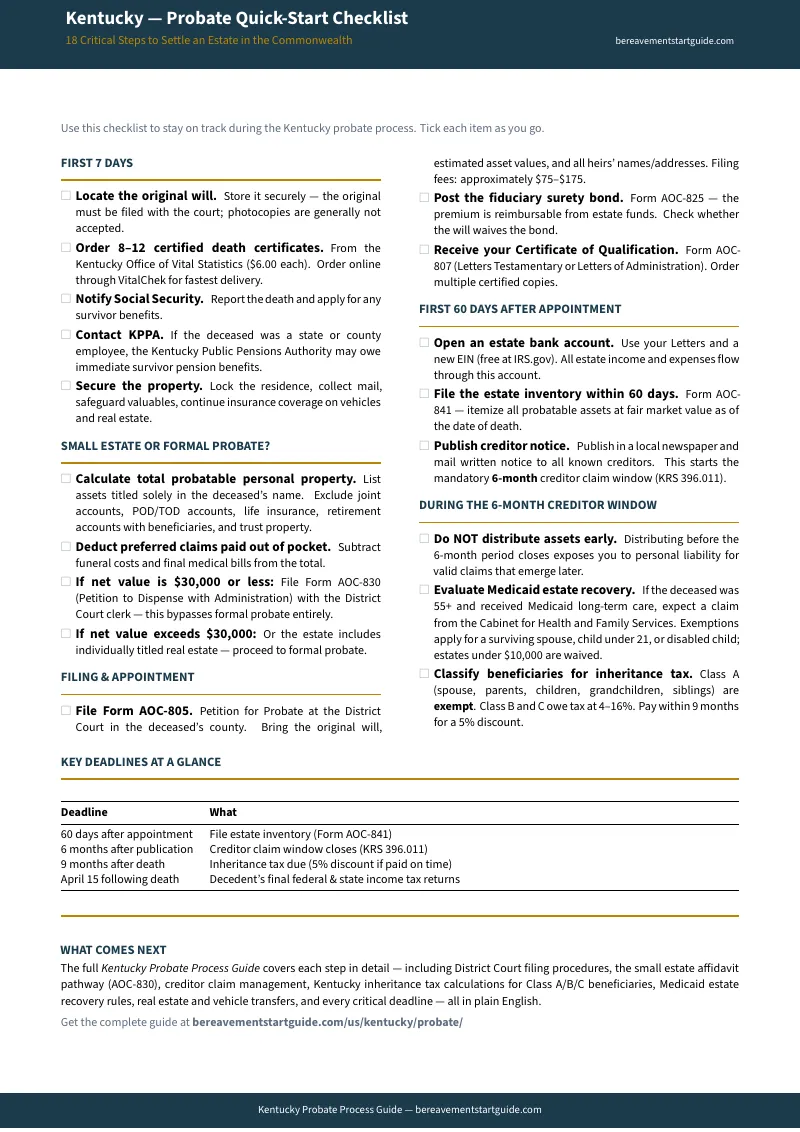
- Quick-Start Checklist — printable 20-item action plan organized by phase (first 7 days, filing, 6-month window, closing)
- Form Reference Card — all 19 AOC and Department of Revenue forms with purpose, filing sequence, and common workflows
- Deadline Summary — every statutory deadline on one fridge-sheet page with a fill-in date column
- Costs Summary — all probate fees and expenses on one page with a quick-estimate calculator
- Creditor Priority Chart — the KRS 396.095 payment hierarchy that keeps you out of personal liability
- Inventory Worksheet — fillable asset tracker organized by category to prepare your Form AOC-841 filing
- Small Estate Checklist — step-by-step qualification test for the $30,000 AOC-830 fast track
- Inheritance Tax Worksheet — beneficiary classification table, decision tree, and tax calculation worksheet
9 printable PDFs. Instant download. Start tonight.
Frequently Asked Questions
What if the rules change after I buy?
We update the guide when the rules change. Email us any time, even years later, and we'll send you the current edition free.