Someone You Love Just Died in Louisiana. The Bank Froze the Accounts. The Funeral Director Wants a Number for Death Certificates. And Everything You Know About Probate Is Wrong Here.
You are standing in the worst week of your life, and the paperwork is already piling up. Maybe you were named in a will you barely skimmed, and now the funeral home needs decisions you have never made before. Maybe there was no will at all, and as the eldest child or surviving spouse, the family is looking at you for answers you do not have. Maybe the bank told you this morning that every account is frozen — and the person who would have known what to do is the person who just died.
Now here is the part nobody warned you about: Louisiana does not have a probate system. It has a succession system — built on French and Spanish civil law instead of the English common law that governs every other state. The executor is called a "succession representative." The court order that transfers property is a "Judgment of Possession." Joint tenancy with right of survivorship does not apply to real estate. If you show up to a Louisiana bank with probate documents from another state, they will turn you away. And if the decedent had children under 24 or a permanently disabled child, Louisiana's forced heirship rules may override the will entirely.
This is not a state where generic estate checklists from national websites will work. The terminology is different. The rules are different. The forms are different. And getting it wrong — paying a creditor out of priority, distributing assets before debts are settled, or filing the wrong affidavit for a home transfer — can create personal liability that did not exist before you made the mistake.
The When Someone Dies in Louisiana — Estate Settlement Guide is a Civil Law Succession System built entirely for the state that follows none of the rules. Not a generic probate kit. Not a checklist that treats Louisiana like Mississippi with better food. A structured, Louisiana-specific manual that translates civil law concepts — succession, usufruct, naked ownership, forced heirship, the legitime — into plain English and puts every step in the exact order you need to follow, from the funeral home through final distribution.
What's Inside the Civil Law Succession System
A 14-chapter guide, the First 48 Hours Checklist, and a comprehensive forms directory — covering every stage from the moment of death through final asset distribution, built for Louisiana's civil law statutes, parish courts, and the succession-specific rules that make settling an estate here unlike any other state:
Chapter 1: Why Louisiana Is Different — and Why It Matters for Every Decision You Make
Before you touch a single form, you need to understand four things that will derail you if you learn them the hard way. Louisiana does not recognize joint tenancy with right of survivorship for real estate — even if both spouses are on the deed, the decedent's share must go through succession. Powers of attorney die the instant the person dies — any transaction attempted after death is void and potentially fraudulent. Louisiana is a community property state, which means classifying every asset as community or separate property is one of the most important steps in the entire process. And the terminology itself will trip you up: say "probate" or "executor" or "Letters Testamentary" at a Louisiana bank or parish clerk's office, and you will be corrected or turned away.
Chapter 2: Forced Heirship, Usufruct, and Naked Ownership
Louisiana is the only state in America that restricts a parent's ability to disinherit certain children. If the decedent had a child under 24 or a permanently disabled child at the time of death, that child is a "forced heir" entitled to a minimum share — the "legitime" — that the will cannot override. One forced heir gets 25% of the estate. Two or more get 50%. And when a married person dies without a will, the children receive "naked ownership" of the decedent's half of community property while the surviving spouse receives a "usufruct" — the right to use the property and spend the bank accounts, but with a hidden debt that comes due when the usufruct ends. If you are settling an estate with a blended family, this chapter may be the most important thing you read.
Chapter 3: The First 48 Hours — What to Secure, What to Order, What Not to Do
The funeral director is going to ask how many death certificates to order. Most families guess wrong. You need 8 to 12 certified originals — not photocopies — one for every bank account, insurance company, the parish court, the Office of Motor Vehicles, and the IRS. The Louisiana Department of Health charges $7.00 per copy; participating Clerks of Court charge $26.00 but hand them to you immediately instead of mailing them weeks later. This chapter covers the exact count based on your situation, what to secure at the home before anyone removes anything, how to inform mandate holders that their authority is void, and the single most important rule: do not pay any of the decedent's debts with your own money.
Chapter 4: The First 30 Days — Financial Triage and Asset Inventory
Before you can determine which succession path applies, you need a complete picture of what exists. This chapter walks through identifying every asset, classifying each one as community or separate property, separating succession assets from non-succession assets (life insurance with a named beneficiary, POD accounts, and retirement accounts with designated beneficiaries all bypass succession entirely), and building the descriptive list that forms the foundation of whatever comes next. It also covers the surviving spouse's emergency cash access: La. R.S. 9:1513 allows the surviving spouse to withdraw up to $20,000 from the decedent's accounts at any federally insured bank using a sworn affidavit — no court order, no attorney, no waiting period beyond having a death certificate in hand.
Chapter 5: The Small Succession Affidavit — Settling an Estate Without Court
This is the chapter that can save your family thousands in attorney fees. If the estate is valued at $125,000 or less (or $200,000 for deaths on or after August 1, 2026) and involves no will combined with real estate, Louisiana allows the entire succession to be handled by a notarized affidavit instead of a court proceeding. No judge. No Judgment of Possession. No attorney required. But the details matter: the affidavit must wait 45 days after death, requires dual signatures and notarization, and the $125,000 threshold does not count assets that bypass succession like life insurance payouts or retirement accounts with beneficiaries. The guide walks through every requirement, every disqualifying condition, and exactly how to present the affidavit to banks and the OMV without getting rejected at the counter.
Chapter 6: Formal Judicial Succession — When You Need the Court
If the estate includes real estate with a will, exceeds the small succession threshold, or is contested, you need a formal judicial succession and a Judgment of Possession from the district court. This chapter covers both Independent Administration — which lets the succession representative sell property and pay debts without seeking a judge's permission for every transaction, cutting the timeline from 12+ months down to 3-6 months — and Ordinary Administration, which requires court approval for every major action. It includes filing procedures, notice requirements, the descriptive list (Louisiana's version of an inventory), and the timeline milestones that determine when heirs can finally receive their inheritance.
Chapter 7: Debts, Creditors, and the Rule That Protects You
Credit card companies and medical billing offices are already calling. Here is what they will not tell you: under Louisiana Civil Code Article 1416, heirs are only obligated to pay the decedent's debts up to the value of what they inherit. You are not personally liable — unless you make the mistake of distributing assets to heirs before paying creditors, or paying a lower-priority creditor before a higher-priority one. The guide maps the strict statutory payment hierarchy: funeral expenses first, then administration costs, then secured debts, then taxes, then unsecured creditors last. Community property debts add another layer for surviving spouses — the guide explains exactly where that line falls.
Chapter 8: Vehicle Title Transfers Through the OMV
Transferring a vehicle in Louisiana requires the Affidavit of Heirship (DPSMV 1696) and the Vehicle Application Form (DPSMV 1799), along with a certified death certificate and the original title. For estates using the small succession affidavit, no court order is needed. For estates going through formal succession, you need the Judgment of Possession. The guide covers both paths, the specific documents you need at the OMV window, and what to do when the name on the death certificate does not match the name on the title.
Chapter 9: Real Estate — Why There Is No Shortcut in Louisiana
If you searched for "transfer on death deed Louisiana," you already found the bad news: Louisiana does not recognize TOD deeds for real estate. And because Louisiana does not recognize joint tenancy with right of survivorship for immovable property, even a jointly-owned family home must go through succession to clear the title. The only way to transfer real property is through a recorded Small Succession Affidavit (if no will is involved and the estate qualifies) or a court-issued Judgment of Possession. This chapter explains exactly what that means, what the recording process involves at the parish conveyance office, and when a title attorney is non-negotiable.
Chapter 10: Medicaid Estate Recovery — What the State Can and Cannot Take
If the decedent was 55 or older and received Medicaid-funded long-term care, the Louisiana Department of Health will seek to recover those costs from the succession estate. But recovery is not automatic and it is not unlimited. It is prohibited entirely if there is a surviving spouse, a child under 21, or a blind or disabled child of any age. The homestead exemption protects the first $15,000 of home equity (or half the parish median, whichever is higher). And the undue hardship waiver creates a presumption of hardship if recovery would push the heir's family income below 300% of the Federal Poverty Level. This chapter walks through every exemption, every protection, and exactly how to respond to a MERP notice.
Chapter 11: Taxes — Federal and Louisiana Returns for the Deceased
The deceased's final federal Form 1040 is due by April 15 of the year after death. Louisiana requires a final state income tax return (Form IT-540) on the same timeline. If the estate generates income during administration — rent from real property, interest, dividends — it needs its own federal EIN and must file Form 1041. Louisiana does not impose a separate state estate tax or inheritance tax, but the guide covers the federal estate tax threshold and the specific Louisiana tax forms that apply to successions.
Chapter 12: When to Hire a Succession Attorney — and When the Guide Is Enough
This guide does not pretend every estate can be settled without professional help. If there are forced heirship disputes, contested wills, complex real estate transactions, business interests in the estate, or blended family conflicts over usufruct, you need a licensed Louisiana succession attorney. Typical attorney fees range from $1,500 to $2,000 for a straightforward succession and $3,000 to $5,000+ for complex matters. For the many families whose estate qualifies for the small succession affidavit, or whose assets pass entirely through non-succession channels, this guide handles the entire process.
Chapter 13: The Complete Timeline — Every Deadline in One Calendar
From Day 1 through Month 12 and beyond, every Louisiana statutory deadline in one sequential reference. The immediate death certificate order. The 45-day wait for the small succession affidavit. The federal and state tax filing deadlines. The Medicaid response window. The creditor notification periods. Every deadline that matters, in the order it arrives, with clear language about what happens if you miss it.
Chapter 14: Forms Directory and Key Contacts
A compiled reference of every form, agency, and contact you will need: OMV forms (DPSMV 1696, DPSMV 1799), Department of Revenue Form R-3318, Small Succession Affidavit requirements, Social Security contact information, Louisiana Department of Health Vital Records, and parish-specific resources.
Who This Guide Is For
- The surviving spouse whose accounts were frozen this morning — who needs to know about La. R.S. 9:1513 (the $20,000 emergency withdrawal affidavit), how community property works, what usufruct means for the family home, and how to access funds without waiting months for a court order
- The adult child named as succession representative who has never navigated Louisiana's civil law system, may live out of state, and needs the complete sequence of duties, deadlines, and forms in one document — without paying a $2,000 retainer just to understand the process
- The family with no will who just learned that Louisiana's intestate succession laws, forced heirship rules, and usufruct rights will determine everything — who needs to understand exactly who inherits what, whether forced heirs exist, and which succession path applies to their situation
- The person dealing with a small estate who wants to avoid the cost and complexity of formal judicial succession — who needs to know whether the small succession affidavit applies, what the $125,000 threshold includes and excludes, and how to execute the affidavit without having it rejected by the bank or OMV
- The family facing Medicaid recovery who received a letter from the Louisiana Department of Health demanding reimbursement for nursing home costs — who needs to understand the exemptions, the hardship waiver, and the assets that are protected from recovery
- The out-of-state executor who understands probate in their home state but has never dealt with a civil law succession — who needs to learn that "probate" documents from other states will not be accepted in Louisiana and that every concept they know has a different name, a different rule, and a different form here
Why Generic Probate Resources Fail in Louisiana
There is no shortage of free information about settling an estate. There is a severe shortage of free information that is accurate in Louisiana. Here is what happens when you try to settle a Louisiana succession using national resources:
- National estate guides explicitly exclude Louisiana. Nolo's "Executor's Guide" — one of the most popular resources in the country — states on its cover that it "applies in all states except Louisiana." FindLaw and similar aggregators use common-law terms like "probate," "life estate," and "joint tenancy" that do not exist or work differently under Louisiana civil law. Following their advice here can result in rejected filings, frozen accounts, and title defects.
- Louisiana law firms withhold the sequence to sell retainers. Local succession attorneys publish accurate, detailed blog posts about civil law concepts. Every one of them is designed to convince you the process is too complex to handle without a $2,000 engagement. For contested estates and complex real property, that is true. For the majority of estates that qualify for a small succession affidavit, it is not.
- Government portals provide forms with no instructions. The OMV offers the DPSMV 1696 and DPSMV 1799 as free downloads. The Department of Revenue provides Form R-3318. But no state website explains the 45-day waiting period for small successions, the difference between consumable and non-consumable usufruct property, or the creditor payment priority that protects you from personal liability. The forms are available. The strategy is not.
- Funeral home checklists stop where the hard questions start. Bereavement pages from Louisiana funeral homes tell you to order death certificates and cancel subscriptions. They do not explain forced heirship, the small succession threshold, the Medicaid recovery process, or the strict creditor hierarchy. Their advice ends at the cemetery gates.
- National estate software misses Louisiana-specific procedures. Platforms that charge $149 per year for generic estate administration tools do not cover the DPSMV 1696 vehicle transfer form, the $20,000 spousal withdrawal statute, the forced heirship legitime calculation, or the distinction between independent and ordinary administration. Louisiana is not a footnote — it is an entirely different legal system.
Free resources give you fragments from a dozen sources that contradict each other. The Civil Law Succession System puts every Louisiana-specific statute, form, deadline, and procedure into one document, in the order you actually need them — translated from civil law terminology into plain English.
— Less Than One Hour With a Louisiana Succession Attorney
A single consultation with a Louisiana succession attorney costs $150 to $300 per hour. A straightforward succession engagement runs $1,500 to $2,000. Complex matters with real estate and forced heirship disputes can exceed $5,000. National estate software platforms charge $149 per year in recurring subscription fees for tools that explicitly exclude Louisiana. This guide costs less than one hour of professional legal time and gives you the complete Louisiana-specific roadmap — every statute, every deadline, every form, and the decision tree that tells you whether you even need an attorney at all.
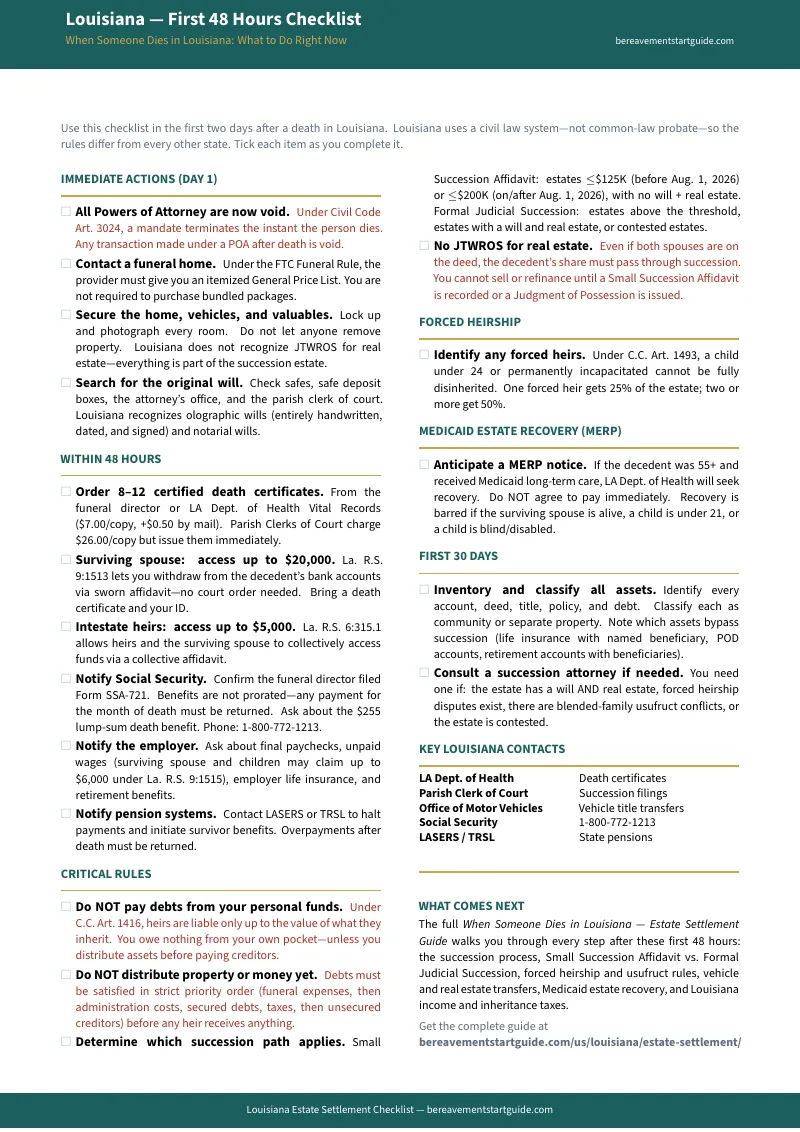
Your download includes 8 PDFs: the complete 14-chapter guide with forms directory, the standalone Louisiana First 48 Hours Checklist with 17 action items, plus 6 printable reference cards — emergency cash access (bring to the bank), forced heirship and usufruct explainer, succession path decision tree, creditor priority and debt protection reference, vehicle title transfer walkthrough (bring to the OMV), and the Medicaid estate recovery guide. Instant download, no account required.
Money-back guarantee, no time limit. If the guide does not give you clarity on what to do next and confidence that you are doing it in the right order, email us for a full refund. No questions asked.
Not ready for the full guide? Download the free Louisiana First 48 Hours Checklist — 17 items covering everything that must happen in the first two days after a death in Louisiana: securing the home, ordering death certificates, the $20,000 emergency withdrawal statute, notifying Social Security, what not to pay, and the critical first-month steps including asset classification, forced heirship determination, and succession path selection.
You did not ask for this job. But you can do it — even in the only state with a civil law system. The guide shows you how, one step at a time.
Frequently Asked Questions
What if the rules change after I buy?
We update the guide when the rules change. Email us any time, even years later, and we'll send you the current edition free.