
Louisiana Is the Only State That Bars You from Handling Your Own Family's Funeral. The Funeral Home Knows That. Now You Will Too.
Someone you love has died in Louisiana. Within 30 hours, the body must be embalmed, refrigerated, or disposed of — and you are legally prohibited from handling any of it yourself. Louisiana Revised Statute 37:848 requires that every dead human body be prepared and disposed of through a licensed funeral establishment. No exceptions. No family-led alternatives. No home funerals without a funeral director's involvement.
This means that within hours of your worst day, you will be sitting across from a funeral director — someone who understands every line of Title 37 and Title 8 while you are still trying to process what happened — signing contracts for services totaling $7,000 to $10,000. They are not required to tell you that embalming is optional. They are not required to explain that you can buy a casket online and they cannot charge a handling fee. They are certainly not going to volunteer that the coroner cannot legally charge you for a cremation permit, even though many parish coroners still try.
Meanwhile, the bank has frozen the deceased's accounts. The funeral bill is due now. And the legal process to access estate funds — Louisiana's Small Succession Affidavit — imposes a 45-to-90-day waiting period before heirs can touch a dollar.
You are trapped between an immediate bill and a locked bank account. The funeral home knows this. The bank knows this. The only person who does not know the way out is you.
The Louisiana Funeral Defense System
This guide consolidates every Louisiana funeral regulation, federal consumer protection, and financial access procedure into one plain-English manual — organized around the decisions you actually face, in the order you face them. It functions as a regulatory shield: you read it before (or during) the arrangement conference, and you walk in knowing exactly what the funeral director is required to provide, what you can legally decline, and what recourse you have if they push back.
The result: you stop paying for services you do not need, you stop signing authorizations you do not understand, and you stop deferring to an industry whose revenue depends on your grief.
The 30-Hour Clock
Louisiana imposes one of the shortest disposition timelines in the country. If a body is not embalmed or continuously refrigerated below 45 degrees Fahrenheit, it must be buried, cremated, or otherwise disposed of within 30 hours of death. Funeral homes routinely use this clock as a sales tool — framing embalming as urgent and necessary when refrigeration is the legal alternative at a fraction of the cost. The guide maps this timeline, explains what triggers it, and tells you exactly how to respond when a funeral director leverages it against you.
The $10,000 Bank Account Lifeline
When bank accounts freeze, most families assume they need a succession attorney to access funeral funds. They do not — not always. Louisiana R.S. 9:1513 allows a surviving spouse to withdraw up to $10,000 from the deceased's bank accounts immediately via a sworn affidavit, bypassing the succession timeline entirely. If there is no surviving spouse, R.S. 6:315.1 allows intestate heirs to collectively withdraw up to $5,000. And R.S. 9:1515 permits spouses and children to claim up to $6,000 in unpaid wages directly from the employer. The guide walks you through each process step by step — the same procedures attorneys charge $300 an hour to explain.
The Cremation Permit Trap
Louisiana requires the parish coroner to approve every cremation — even natural deaths under hospice care. For years, many coroners charged families $50 or more for this permit. But Attorney General Opinion 23-0040 ruled that issuing a cremation permit is a statutory duty of the coroner, and coroners do not have the legal authority to charge families or funeral homes for it. The cost must be borne by the parish government. If your funeral home's cash advance list includes a coroner permit fee, you are being improperly billed. The guide shows you exactly how to catch this and push back.
The Complaint Notarization Trap
If a funeral home violates your rights and you want to file a formal complaint with the Louisiana State Board of Embalmers and Funeral Directors, your complaint must be signed and notarized. That is not a suggestion — it is a statutory requirement under R.S. 37:846(B). Complaints that arrive without notarization are not investigated. Most consumers discover this requirement only after mailing an unnotarized complaint and waiting weeks for a response that never comes. The guide flags this before you waste time and walks you through both the state complaint process and the parallel federal FTC path.
What You Get — 10 PDFs
- The Complete Louisiana Funeral Law Guide (60 pages) — every chapter from the first 30 hours through filing a complaint, written in plain English with every relevant statute cited. Covers the funeral director mandate, embalming rules, cremation authorization, home burial regulations, disposition hierarchy, scattering ashes, green burial options, and prepaid contract protections.
- FTC Funeral Rule Defense Checklist — a standalone printable checklist to bring to the arrangement conference, listing every right the federal Funeral Rule gives you: phone pricing, itemized billing, third-party casket acceptance, the right to decline embalming, and the right to a simple container for direct cremation
- Disposition Authority Hierarchy Chart — a standalone one-page reference with the complete priority list for who controls funeral decisions under R.S. 8:655, the majority-of-adult-children rule, and the homicide exception
- Cremation Authorization Roadmap — a standalone step-by-step reference covering the coroner permit process, signature requirements (witnessed, notarized, or two independent witnesses), visual identification requirements, pacemaker removal protocols, and the AG opinion that eliminates the coroner's fee
- Bank Account Access Templates — a standalone printable reference with the three Louisiana statutory bypasses: $10,000 spousal withdrawal (R.S. 9:1513), $5,000 intestate heir withdrawal (R.S. 6:315.1), and $6,000 unpaid wages claim (R.S. 9:1515)
- Family Burial Ground Application Guide — a standalone reference covering the $250 application, zoning certificate, Act of Dedication, 10-year mortgage certificate, and 180-day deadline that the Cemetery Board enforces
- Prepaid Contract Protection Guide — a standalone reference covering the 10-day cancellation window, certified mail procedures for revocable contracts, the $10,000 irrevocable funeral trust cap for Medicaid planning, and the death certificate requirement before trust funds are released
- Medicaid Estate Recovery Defense — a standalone reference covering the 30-day hardship waiver window, the 300% FPL presumption of undue hardship, the $10,000 funeral expense offset, spousal deferral rules, and minor/disabled child exemptions that protect the family home
- Complaint Filing Procedures — a standalone one-page reference with parallel state and federal complaint paths, including the LSBEFD notarization requirement and the FTC complaint process
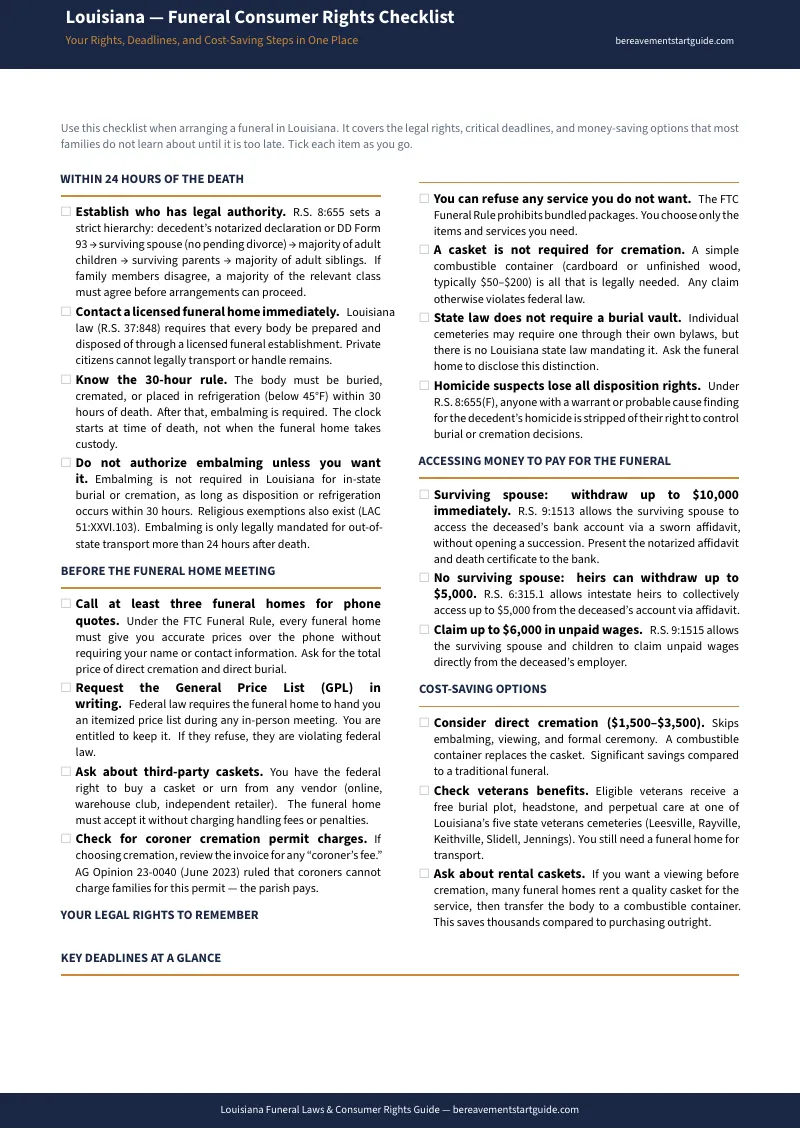
- Louisiana Funeral Consumer Rights Checklist — a printable quick-reference covering the most critical deadlines, rights, and action items (also included free)
Who This Is For
- Families arranging a funeral right now who need to know their rights before the first meeting with a funeral director — especially those facing a $7,000+ price quote and a 30-hour clock and wondering what they can decline
- Surviving spouses or adult children dealing with frozen bank accounts, cremation disputes among siblings, or pressure to purchase services they suspect are unnecessary
- Families considering home burial on private property who need to understand the Cemetery Board requirements, the permanent property dedication, and the fact that a funeral director is still legally required even for private land burial
- Pre-planners evaluating prepaid funeral contracts and wanting to understand cancellation rights, irrevocable trust caps, and Medicaid spend-down implications before signing
- Family members of Medicaid recipients who need to act within 30 days to protect the family home from estate recovery
Why Free Information Falls Short
Louisiana's funeral and succession laws are scattered across five different legal codes — Title 37 (occupational licensing), Title 8 (cemeteries), Title 40 (vital records and public health), the Civil Code (succession and community property), and the Code of Civil Procedure (small successions). The statutes contradict each other, cross-reference the Louisiana Administrative Code, and vary by parish in practice. The coroner in Orleans Parish operates differently from the coroner in Caddo Parish. A national legal blog will tell you home funerals are "sometimes possible" without mentioning that Louisiana flatly prohibits independent family disposition.
Law firm blogs provide excellent analysis of forced heirship and usufruct — then tell you to call for a $1,500 consultation. The funeral home's website explains only the rules that increase their revenue. The Funeral Consumers Alliance's Louisiana guide was last updated in 2016. And the state board's complaint form page does not mention the notarization requirement until you have already mailed it.
This guide bridges the gap — not by replacing legal counsel, but by giving you the complete regulatory picture so you can make decisions from knowledge rather than grief-driven urgency.
What This Guide Does Not Do
This guide is an educational and administrative tool — not legal representation. It does not constitute legal, tax, financial, or medical advice, and purchasing it does not create an attorney-client relationship. When you need a succession attorney, an elder law specialist, or intervention from the State Board of Embalmers and Funeral Directors, the guide tells you exactly which professional and why.
— Less Than One Funeral Home's Embalming Fee
Louisiana funeral homes charge $700 to $1,200 for embalming — a service that is never legally required if the body is refrigerated or disposed of within 30 hours. If this guide prevents just one unnecessary line item on your funeral contract, it has paid for itself many times over. If it gives you the confidence to demand an itemized General Price List before signing anything, and to challenge a coroner's cremation fee that the Attorney General has ruled illegal, the savings compound from there.
Every purchase includes a money-back guarantee, no time limit. If the guide does not give you the clarity and confidence you need to navigate Louisiana's funeral system, email us for a full refund.
The free Consumer Rights Checklist covers the most critical actions — the ones with hard deadlines and immediate financial consequences. The full guide covers every chapter in depth: the disposition authority hierarchy, cremation rules, the 30-hour clock, home burial regulations, bank account access procedures, prepaid contract protections, Medicaid estate recovery defense, complaint filing, and every Louisiana-specific regulation that families need to know.
Frequently Asked Questions
What if the rules change after I buy?
We update the guide when the rules change. Email us any time, even years later, and we'll send you the current edition free.