The Bank Froze the Account. The Title Company Rejected the Sale. And Every Form You Find Online Uses Legal Terms That Do Not Exist in Louisiana.
You walked into the bank with the death certificate and the will, and the branch manager told you the account is frozen until you produce "Letters Testamentary" from a Louisiana court. You went to the parish clerk's office, and the clerk handed you a blank petition and said she cannot tell you how to fill it out. You went home and searched for Louisiana probate forms online, and every result used words like "informal probate," "personal representative," and "joint tenancy with right of survivorship" — terms that have no legal meaning in Louisiana. The national form vendor charged you $39 for templates built on the Uniform Probate Code. Louisiana does not follow the Uniform Probate Code. Louisiana does not even call this process "probate." In Louisiana, this is a "succession," and it runs on a civil law system rooted in the Napoleonic Code that works nothing like the common law rules governing the other 49 states.
So now you are holding a will that means nothing until a judge validates it, a frozen bank account you cannot access, a house you cannot sell because the title company requires a "Judgment of Possession" you have never heard of, and a growing stack of forms that may be legally invalid in your parish. Maybe the estate is small enough to skip court entirely with a Small Succession Affidavit — but nobody told you that was an option, and you do not know if the $125,000 threshold includes life insurance or retirement accounts. Maybe the surviving spouse has a legal "usufruct" over the house that prevents the children from forcing a sale — or maybe they do not, and you are about to make promises you cannot keep. Maybe the deceased's child under 24 is a "forced heir" who is legally entitled to a share of the estate regardless of what the will says — and you are about to distribute assets in a way that triggers a lawsuit. Or maybe you are just trying to transfer a vehicle title at the OMV and nobody told you that you need two specific state forms — DPSMV 1696 and DPSMV 1799 — signed by every legal heir.
The Louisiana Probate Process Guide is a Civil Law Navigator for every filing, deadline, and decision in a Louisiana succession — from the initial petition through the final Judgment of Possession and estate closing. Not a generic guide written for common law states and loosely adapted with a Louisiana label. Not a law firm blog post designed to convince you that succession is too dangerous to attempt without a $5,000 retainer. A plain-English, Louisiana-specific manual that tells you exactly what the parish clerk cannot: which documents to file, which path applies to your estate, what the civil law terms actually mean, and which mistakes will cost you months of delays or expose you to personal liability.
What's Inside the Civil Law Navigator
A step-by-step guide, a filing-readiness checklist, and standalone reference sheets — covering every phase of succession in Louisiana from opening the case through final discharge, built on the Louisiana Civil Code and Code of Civil Procedure, and adapted for the civil law system that makes this state unlike any other:
Before You File: Does the Estate Actually Need a Court Succession?
This is the question that determines whether you spend months in district court or weeks completing a simplified process. Louisiana allows estates valued at $125,000 or less to bypass formal court proceedings entirely through a Small Succession Affidavit under La. C.C.P. art. 3432. Both movable property (bank accounts, vehicles, investments) and immovable property (real estate) can be transferred through this affidavit — Louisiana is unusual in allowing real estate transfers without a court hearing for qualifying estates. But the calculation has hard rules. You need to know which assets count toward the $125,000 limit — and which do not. Life insurance with a named beneficiary does not count. Certain retirement accounts do not count. The guide includes a decision tree that walks you through the exact criteria, so you do not file a full succession petition for an estate that qualifies for the affidavit, and you do not attempt the affidavit on an estate that exceeds the threshold.
Three Paths Through Succession: Small Affidavit, Independent Administration, or Full Administration
Louisiana succession is not one process — it is three, and the differences in cost, timeline, and court involvement are enormous. The Small Succession Affidavit can be completed in days. Independent Administration — available when the will authorizes it or all heirs unanimously consent — typically takes three to six months and frees the executor from court approval for most decisions. Full Ordinary Administration requires a judge's permission for virtually every action — selling property, paying debts, distributing assets — and can take six to twelve months or longer. The guide covers all three paths end to end, because the forms are different, the powers are different, the timelines are different, and the fees are different. It also explains how to request Independent Administration even if the will does not mention it, potentially saving thousands in legal fees and months of court delays.
The Sworn Detailed Descriptive List: What to Include and What to Leave Off
Louisiana requires the succession representative to file a Sworn Detailed Descriptive List of every asset and liability in the estate. This document has largely replaced the old-fashioned formal notary inventory, but the legal requirements are just as rigid. Here is what most executors do not realize: including the wrong assets on this list — such as life insurance policies with named beneficiaries, certain IRAs, or payable-on-death accounts — artificially inflates the estate's gross value. If your attorney charges a percentage-based fee, that inflation directly increases your legal bill. The guide provides a structured template with clear guidance on what must be listed, what must be excluded, and how to organize valuations so the list matches what the district court and your attorney expect to see.
Usufruct and Forced Heirship: The Two Concepts That Blindside Every Louisiana Family
In every other state, you can leave your estate to whoever you want. In Louisiana, you cannot — not entirely. If the deceased had children under 24 years old, or children of any age who are permanently incapable of caring for themselves, those children are "forced heirs" under Civil Code Article 1493. They are legally entitled to the "legitime" — one-quarter of the estate for one forced heir, one-half for two or more — regardless of what the will says. A no-contest clause cannot override this. Meanwhile, the surviving spouse may hold a legal "usufruct" over the deceased's share of community property — the right to live in the house, collect the income, use the assets — while the children hold "naked ownership" and cannot force a sale or eviction until the usufruct terminates. The guide translates both concepts into plain English, explains the math for calculating the forced portion, and maps the specific scenarios where these rules create family conflict so you can address them before they escalate.
Community Property: What the Surviving Spouse Already Owns
Louisiana is a community property state. Assets acquired during the marriage generally belong equally to both spouses. When one spouse dies, only the deceased's half of the community property enters the succession — the surviving spouse already owns their half outright. But identifying which assets are community property and which are separate property (inherited, donated, or owned before the marriage) is where families make costly errors. The guide includes a classification worksheet that helps you sort every asset into the correct legal category before you file anything with the court.
Creditor Claims and Medicaid Estate Recovery
Under Louisiana law, the state acquires a legal privilege over the entire succession of a deceased Medicaid recipient to recoup nursing home and medical expenses incurred after age 55. In many cases, the Medicaid claim exceeds the total estate value, leaving beneficiaries with nothing. Executors who distribute assets before satisfying this claim face personal financial liability. The guide explains the specific exemptions — including the $15,000 or half the median parish homestead value exclusion — the undue hardship waiver process, and the strict creditor priority hierarchy that determines who gets paid first when the estate cannot cover everything.
Letters Testamentary, Letters of Administration, and Letters of Independent Administration
These are the court-issued documents that unlock frozen bank accounts, authorize real estate transactions, and prove your legal authority to every institution that currently will not talk to you. Louisiana wills are considered self-proving, which means the court can issue letters based on the written pleadings without a formal hearing — if the paperwork is flawless. The guide explains the prerequisites for each type of letter, what delays issuance, and the expanded powers that come with Letters of Independent Administration versus standard Letters Testamentary.
Vehicle Transfers at the OMV
Transferring a deceased person's vehicle in Louisiana requires the original title, a certified death certificate, the Vehicle Application Form (DPSMV 1799), and the notarized Affidavit of Heirship (DPSMV 1696) signed by all legal heirs. This specific administrative process can often be handled entirely outside of a full court succession. The guide provides the exact checklist so you do not make multiple trips to the Office of Motor Vehicles.
Closing the Succession: The Tableau of Distribution and Final Discharge
The succession does not end when you distribute assets. The executor must prepare a Tableau of Distribution — the formal accounting that shows the court exactly how debts were paid according to legal priority and how assets were distributed to heirs. Then you file a Petition to Close Succession and obtain a formal discharge from the judge. Until you complete this step, your personal liability as succession representative never technically ends. The guide covers the accounting format, what the judge examines, and how to petition for discharge.
Who This Guide Is For
- The executor holding a will that means nothing until a Louisiana judge validates it — who needs to understand that the will is legally inactive until the court issues a Judgment of Possession, and that the process between "holding the will" and "having legal authority" involves specific filings, potentially a bond, and a judicial decree granting Letters Testamentary
- The surviving spouse whose bank accounts were frozen this morning — who needs Letters Testamentary or Letters of Administration to unlock those accounts and cannot afford to wait months because the petition was filed incorrectly or used common law forms that a Louisiana court will not accept
- The family with no will navigating intestate succession — who needs to understand Louisiana's strict intestate hierarchy, how the surviving spouse's usufructuary rights interact with the children's naked ownership, and how community property rules determine what is actually in the succession versus what the surviving spouse already owns
- The out-of-state heir who just learned that Louisiana uses a different legal system — who discovered that the deceased's property in Louisiana requires an ancillary succession in a Louisiana court, even if the will was already probated in another state, and that the common law terms they understand do not apply here
- The executor managing a blended family with forced heirship concerns — who needs to calculate the legitime, understand which children qualify as forced heirs, and navigate the tension between what the will says and what Louisiana civil law requires
- The family trying to determine whether the estate can skip court entirely — who needs the decision tree that maps the $125,000 Small Succession Affidavit threshold, the asset calculation rules, and the criteria that separate a days-long simplified process from months of court administration
Why Free Resources Will Not Get You Through This
Louisiana succession information exists. It is scattered across 64 parish clerk websites, law firm blogs optimized to generate $2,500-$10,000 retainer clients, national form vendors that do not understand civil law, and academic legal manuals written by lawyers for lawyers. Here is what you actually encounter when you try to navigate succession using free sources:
- Parish clerk offices hand you forms and tell you they cannot help you fill them out. This is not rudeness — it is the law. Clerks cannot provide legal advice. The Orleans Parish Civil District Court publishes a few scattered PDFs. Jefferson Parish posts a fee schedule. But no parish provides step-by-step instructions, a sequential filing order, or any guidance on which path applies to your estate. You leave with blank paperwork and no idea what to do with it.
- National form vendors sell templates built for common law states. LegalZoom, Nolo, and EstateExec provide decent frameworks for executors in the other 49 states. They do not work in Louisiana. They use terms like "informal probate" (does not exist in Louisiana), "joint tenancy with right of survivorship" (not recognized under the Civil Code), and "personal representative" (the correct term is "succession representative"). Their forms reference the Uniform Probate Code. Louisiana has never adopted the Uniform Probate Code. Filing these templates in a Louisiana district court is a guaranteed rejection.
- Law firm blogs are accurate, detailed, and designed to sell you representation. The best Louisiana succession content online comes from firms that charge $2,500 to $10,000 for standard successions and $10,000 to $20,000 or more for complex ones. Their articles explain how intricate and dangerous the process is — for contested estates with forced heirship disputes, that is true. For the straightforward succession where the heirs agree and the will is clear, the articles never quite tell you that you can handle this without a five-figure retainer. They always end with "schedule a consultation."
- Academic resources are written for attorneys, not for executors. The Loyola Pro Bono Desk Manual is legally meticulous and cites every relevant civil code article. It is also written for licensed lawyers representing indigent clients. It does not provide a consumer-friendly sequence of actions, fillable templates, or plain-English explanations of usufruct and forced heirship. It assumes you already understand civil procedure.
- The one direct competitor in this space appears to be abandoned. MyLouisianaSuccession.com previously offered an ebook targeting this exact niche. The site currently displays broken links and unrelated content. The market void is real.
Free resources give you fragments from dozens of sources that use conflicting terminology, do not sequence the steps, and routinely apply common law concepts that Louisiana courts do not recognize. The Civil Law Navigator puts every Louisiana-specific statute, form, deadline, and procedural path into one document, in the order you actually need them, using the terms your parish court actually uses.
— Less Than One Hour With a Louisiana Succession Attorney
A consultation with a Louisiana succession attorney runs $200 to $350 per hour. Full succession representation costs $2,500 to $10,000 for standard estates and $10,000 to $20,000 or more for complex ones. A Small Succession Affidavit prepared by an attorney costs $750 to $2,000. Court filing fees alone run $200 to $500 depending on the parish. This guide costs less than one hour of professional legal time and gives you the complete Louisiana-specific succession roadmap — every filing requirement, every deadline, every procedural path, and the decision tree that tells you whether you need formal court proceedings at all.
Your download includes the complete step-by-step guide covering all three succession paths, the standalone Louisiana Succession Filing-Readiness Checklist, and printable reference sheets: the Small Succession vs. Court Succession Decision Tree, Succession Representative Duties Timeline (every statutory deadline from Day 1 through final discharge), Creditor Notification and Priority Guide, Sworn Detailed Descriptive List Template, Community Property Classification Worksheet, Usufruct and Forced Heirship Quick Reference, and OMV Vehicle Transfer Checklist. Instant download, no account required.
Money-back guarantee, no time limit. If the guide does not give you clarity on which succession path applies to your estate, what to file, and what happens next — email us for a full refund. No questions asked.
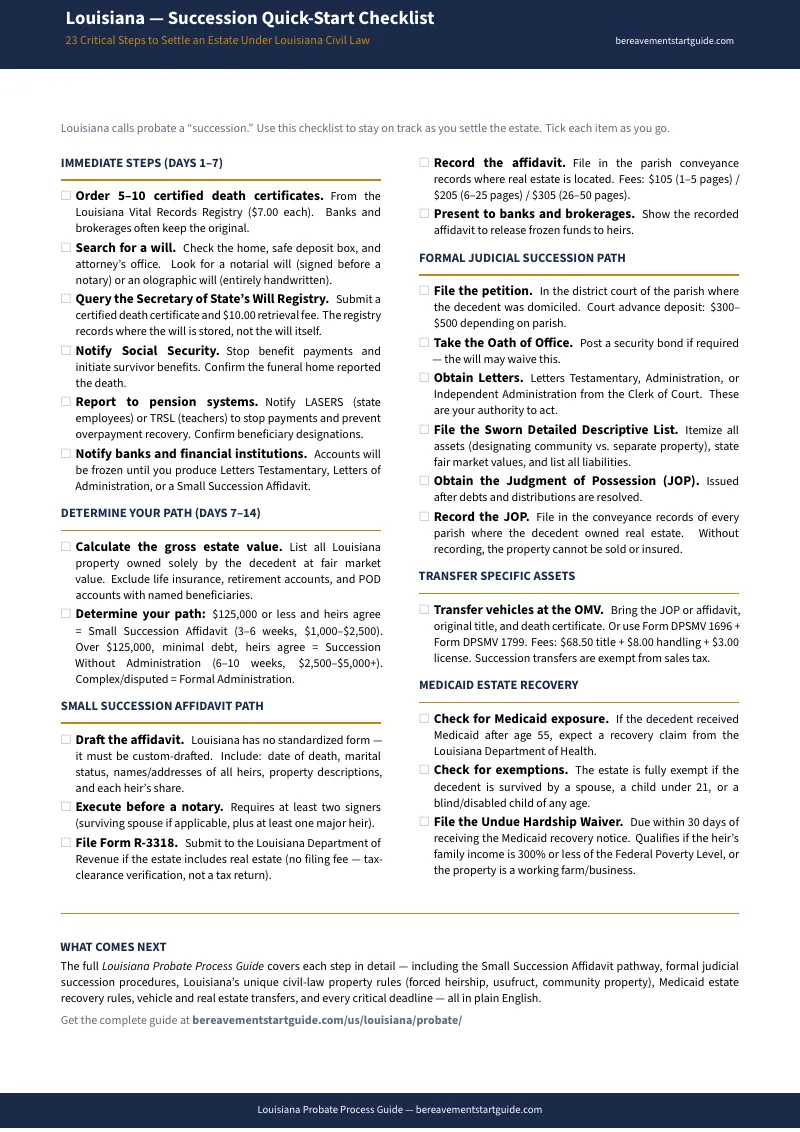
Not ready for the full guide? Download the free Louisiana Probate Quick-Start Checklist — an overview of the succession process and the key deadlines, decisions, and civil law concepts you need to understand before you walk into the parish courthouse. Enough to know what you are facing and whether you need the full guide.
Louisiana succession law was not designed to explain itself to you. The Civil Code assumes you have a lawyer. The parish clerk is prohibited from helping you fill out the forms. This guide bridges the gap — one filing at a time, in the language Louisiana courts actually use.
Frequently Asked Questions
What if the rules change after I buy?
We update the guide when the rules change. Email us any time, even years later, and we'll send you the current edition free.