The Funeral Director Handed You a Contract and the Clock Is Already Running
Someone has died in Maine and you are standing in a funeral home. The director slides a contract across the desk before you have had time to think. You do not know whether embalming is required, whether you can bring your own casket, or why the cremation cannot happen for another 48 hours. The itemized bill includes services you did not ask for, and you have no idea which ones are legally required and which ones are optional markups.
You searched online and found two kinds of answers: raw Maine statutes written in language no one uses in conversation, or national articles that cover Maine in a single paragraph and get the details wrong. The funeral home's website talks about "celebrating life" but says nothing about your right to decline a $3,000 casket in favor of a $200 alternative container.
You need to know what Maine law actually requires, what the funeral home is legally required to tell you, and what you can refuse — before you sign anything you cannot undo.
The Maine Funeral Rights Navigation System
This guide does what no funeral home will do for you and no free website does well: it translates every Maine funeral statute, federal consumer protection rule, and administrative deadline into a step-by-step sequence — from the hour of death through final disposition, scattering, or burial.
Maine funeral law operates on specific timelines that most families discover only after missing them. Cremation cannot begin until 48 hours after the time of death — a mandatory statutory waiting period with only one narrow exception. Every cremation requires a Medical Examiner review and a $25 release fee. The burial-transit permit must be endorsed and returned to the municipal clerk within 21 days or the state Board of Funeral Service opens an investigation. If you are establishing a family burial plot on private land, Title 13 requires registration at the county Registry of Deeds and mandates specific setback distances from wells and water supplies.
The guide maps this entire sequence in the order you actually encounter it, with every statute citation, deadline, and fee at every step.
What's Inside —
The Custody Hierarchy — Who Actually Decides
Before any arrangement begins, Maine law (Title 22 §2843-A) determines who holds legal authority over the remains. It is not automatically the executor of the will. The hierarchy runs from a written pre-death designation through the surviving spouse, adult children by majority vote, parents, and siblings. If three siblings disagree, the majority rules — and if no majority exists, the funeral director can legally refuse to proceed until the family produces a written agreement or a court order. The guide lays out every level of this hierarchy and explains the estranged-spouse exception that most families do not know exists.
Your Federal Consumer Rights Under the FTC Funeral Rule
Every funeral home in Maine must hand you a written General Price List at the start of any in-person discussion — not after you sit down, not after the first meeting, at the start. They must give prices over the phone if you call. You cannot be forced to buy bundled packages. You can bring your own casket or urn from any source and the funeral home cannot charge a handling fee. If they embalm without your authorization, they cannot charge you. These are federal requirements enforced by the FTC, and the guide covers each one with the exact regulatory citation so you can push back with confidence.
Cremation Rules and the 48-Hour Waiting Period
Maine imposes a mandatory 48-hour waiting period before any cremation. The only waiver comes from the Medical Examiner, in writing, and only when the death resulted from an infectious or contagious disease. Every cremation also requires a Medical Examiner review and release certificate at a $25 fee — payable by the person requesting the certificate, not the funeral home. The guide covers the complete cremation authorization chain so you know exactly what to expect and what the timeline looks like.
Home Burial and Family Burying Grounds
Home burial is entirely legal in Maine. Title 13, Chapter 83 allows families to establish a burying ground on private property — up to one-quarter acre, with boundaries marked or fenced, and formally recorded at the county Registry of Deeds. But the statute also requires specific setback distances: 100 feet from dwellings, 200 feet from domestic wells, 300 feet from small public water supplies, and 1,000 feet from large ones. Miss the deed registration and you create a hidden liability for any future property sale. The guide covers every requirement so a family burial stays legal and does not complicate the real estate.
Green Burial, Natural Organic Reduction, and Scattering Ashes
Green burial — forgoing embalming, skipping the concrete vault, using a biodegradable shroud or softwood casket — is legal under Maine state law. The complication is that many conventional cemeteries require vaults in their own bylaws. The guide identifies the distinction between state law and cemetery policy and points you toward dedicated natural burial grounds in Maine. It also covers Maine's legalization of natural organic reduction (human composting) and the rules for scattering cremated ashes — private property with landowner consent, state parks with manager permission, and ocean scattering under the federal Clean Water Act (three nautical miles from shore, EPA notification within 30 days).
Death Certificates and Burial-Transit Permits
The death certificate must be filed with the municipal clerk within 3 days of death and before the body leaves the state. The first certified copy costs $15, each additional copy $6. The burial-transit permit — separate from the death certificate — must accompany any movement of remains and must be endorsed and returned to the clerk within 21 days. The guide walks through who is authorized to request copies, how corrections work, and the timeline for every permit and filing.
Veterans Burial Benefits in Maine
Eligible veterans can be buried at one of three Maine Veterans' Memorial Cemeteries — Augusta, Caribou, or Springvale — with no-cost benefits including the plot, opening and closing, double-depth liner, and perpetual care for both the veteran and their spouse. The guide covers eligibility requirements, the DD214 documentation, and why pre-application before death dramatically reduces friction for the surviving family.
Prepaid Funeral Contracts and MaineCare Protection
All funds paid for prearranged funerals must be deposited into a separate mortuary trust account within 10 days of receipt (Title 32 §1401). For seniors planning ahead, an irrevocable mortuary trust can shelter assets from MaineCare countable resources without triggering the five-year transfer penalty — a legitimate planning tool that most families discover too late. The guide covers the mechanics of revocable versus irrevocable trusts, the consumer protections, and the intersection with Medicaid eligibility.
Filing Complaints When Something Goes Wrong
If a funeral home fails to provide a General Price List, charges for unauthorized services, or pressures you into purchases, you have two enforcement paths. The Maine Board of Funeral Service (under the Office of Professional and Occupational Regulation) handles state licensing violations and can issue warnings, civil penalties, or license revocations. The FTC handles federal Funeral Rule violations. The guide provides step-by-step instructions for both complaint processes.
Who This Is For
- Families arranging a funeral in Maine who need to understand their legal rights before signing contracts or agreeing to services
- Next-of-kin navigating family disagreements over burial versus cremation, who makes the decision, and what happens when siblings cannot agree
- Families considering home burial or green burial who need the exact property requirements, setback distances, and deed registration rules
- Seniors and adult children planning ahead who want to lock in prepaid funeral arrangements and understand how irrevocable trusts protect assets from MaineCare recovery
- Veterans' families seeking burial at a Maine Veterans' Memorial Cemetery and needing the eligibility documentation and pre-application process
Why Free Resources Fall Short
The raw statutes are public. Title 22, Title 32, and Title 13 are all available on the Maine Legislature website. The FTC Funeral Rule is published on ftc.gov. The Board of Funeral Service complaint forms are downloadable from the state OPOR website. So why do families still make expensive mistakes?
The rules exist. The sequence does not. You can find the 48-hour cremation waiting period in one place, the burial-transit permit timeline in another, the home burial setback distances in a third, and the FTC consumer rights on a completely different federal website. No free source tells you what to do first, what to do second, and which deadlines are running simultaneously. A funeral director knows the system — and that information asymmetry is exactly how unnecessary charges happen.
Law firm blog posts explain just enough to make you call their office. National sites like Nolo cover Maine in a paragraph, often missing the Medical Examiner cremation fee or the 21-day permit return deadline entirely. The Funeral Consumers Alliance of Maine provides excellent advocacy but scattered across blog posts and meeting notes rather than a single actionable document.
This guide fills the gap between free but fragmented government data and expensive legal counsel: every right, every deadline, and every Maine-specific requirement in chronological order — for less than the cost of one unnecessary funeral home add-on.
What You Get
- Maine Funeral Laws & Consumer Rights Guide — 16-chapter PDF covering the complete legal landscape from the first hour after death through final disposition, with statute citations, fee schedules, and step-by-step instructions
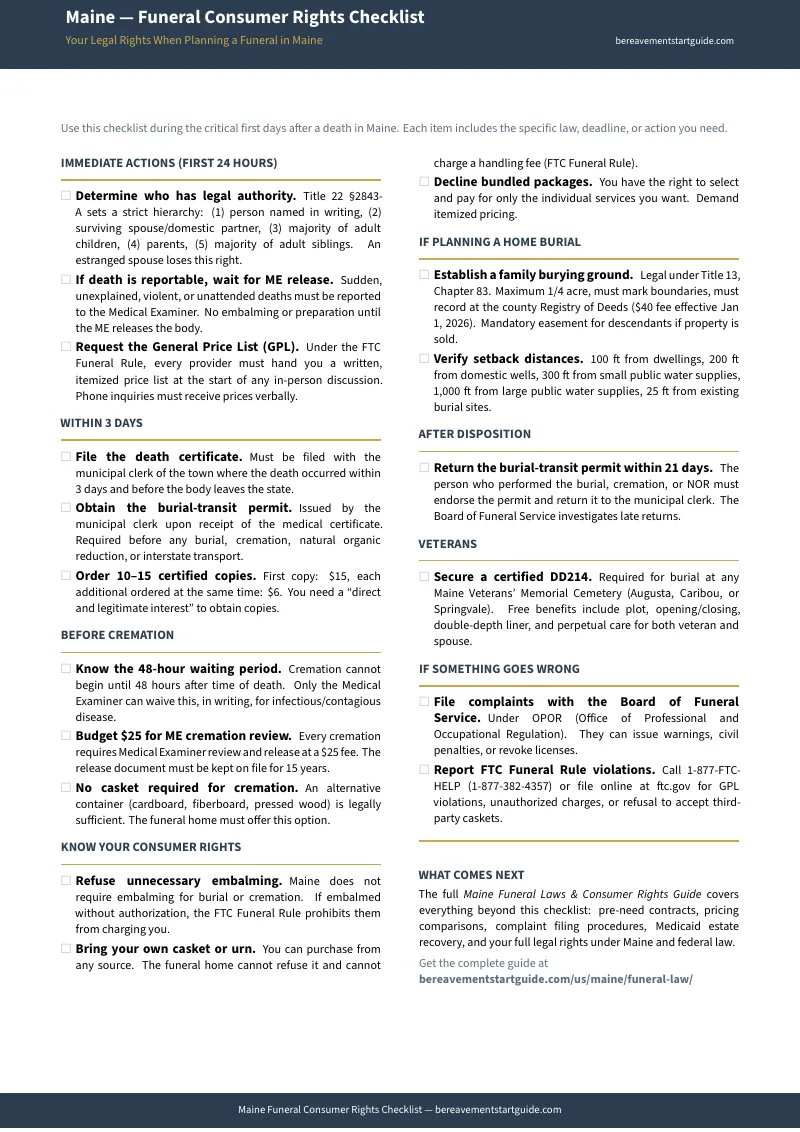
- Funeral Consumer Rights Checklist — printable 19-item action plan organized by timeline (first 24 hours, within 3 days, before cremation, after disposition) so nothing falls through the cracks
Two printable PDFs. Instant download. Know your rights before you sign anything.
Frequently Asked Questions
What if the rules change after I buy?
We update the guide when the rules change. Email us any time, even years later, and we'll send you the current edition free.