The Bank Froze the Account and the Courthouse Gave You a Stack of Forms
Someone has died in Maine and you are now responsible for their estate. The bank will not release funds without Letters of Authority. The county Register of Probate handed you a pile of DE-numbered forms and told you she cannot explain what to do with them. The funeral director said "you need to open probate" and left it at that.
You searched online and found two options: hire a Maine attorney at $150 to $400 per hour, or figure out Title 18-C of the Maine Revised Statutes on your own. The law firm websites explain just enough to make you panic. The state's maineprobate.net portal gives you the raw forms in an alphabetical database with zero instructions on which one comes first.
Neither answers the question keeping you awake: what do I file, in what order, and by when — before I become personally liable for getting it wrong?
The Maine Probate Sequencing System
This guide does what the Register of Probate cannot and the attorney charges thousands for: it translates every statutory deadline, every required court form, and every Maine-specific trap into a step-by-step workflow — from the day you walk into the county courthouse to the day you file your closing statement.
Maine probate runs on a rigid clock. You must provide the estate inventory (Form DE-405) to all beneficiaries within three months of your appointment. You must wait out a mandatory four-month creditor claim window after publishing notice in a local newspaper. The estate cannot close until at least nine months after the date of death. And before you can sell or transfer any real property, you must clear the automatic statutory estate tax lien through Maine Revenue Services — a step most executors do not discover until a title company blocks the sale.
The guide maps this entire sequence in the order you actually encounter it, with every form number and statute citation at every step.
What's Inside —
The Small Estate Fast Track
If the deceased's personal property is worth $52,500 or less (the inflation-adjusted 2026 threshold under 18-C M.R.S. section 3-1201), you may be able to skip probate court entirely using the Small Estate Affidavit (Form AF-102). The guide walks through the exact calculation, the mandatory 30-day waiting period, and the critical limitation that the affidavit cannot transfer real estate — so you know immediately whether you qualify or need to file for informal probate.
Informal Probate — The Standard Path
Most uncontested Maine estates pass through informal probate, handled administratively by the Register of Probate without a judge. The guide provides a form-by-form walkthrough of the Application for Informal Probate of a Will (Form DE-201(I)) or Intestate (Form DE-101(I)), including what to bring to the courthouse, the sliding-scale filing fees ($40 for estates under $10,000 up to $1,200+ for estates over $2 million), and how to obtain your Letters of Authority — the document every bank and institution demands before releasing funds.
The MaineCare Estate Recovery Threat
If the deceased was 55 or older and received MaineCare benefits for nursing home care, assisted living, or home-based services, the Department of Health and Human Services can file a claim against the estate for reimbursement. The guide covers the surviving spouse exemption, the disabled child exemption, joint tenancy protections, and the exact steps to respond to a recovery notice — so you do not accidentally distribute assets that the state has a legal claim against.
Creditor Claims Priority Chart
The four-month creditor window is the most dangerous phase of probate. Pay a credit card before the funeral home and you owe the difference personally. The guide lays out the exact payment priority under the Maine Uniform Probate Code — homestead allowance and family allowances first ($22,500 homestead, $27,000 family, $15,000 exempt property), administration costs second, funeral expenses third, general debts last — so you never pay out of order.
Clearing the Estate Tax Lien — The Step Most People Miss
Maine places an automatic statutory lien on all real property owned by the deceased at death. Even if the estate is well below the $7,160,000 estate tax exclusion, you must file a Statement of Value (Form 700-SOV) with Maine Revenue Services and obtain a Certificate of Discharge before any real estate can be sold or the title cleared. Skip this step and the title company blocks the sale months down the road. The guide walks through both the probate track and the tax track in parallel so neither one surprises you.
Real Estate Transfer Instructions
Two paths to getting the house into the heir's name. If there is a will, the personal representative executes a Deed of Distribution under the Maine Short Form Deeds Act and records it at the county Registry of Deeds. If there is no will, intestate succession rules determine who inherits. Both paths require the Certificate of Discharge from Maine Revenue Services. The guide covers recording fees, deed format, and the intersection of probate authority with tax clearance that trips up most executors.
Vehicle Title Transfers
The Bureau of Motor Vehicles requires Form MVT-22 (Affidavit of Surviving Spouse or Rep) plus a certified death certificate and Letters of Authority. The guide covers the spouse exception, what to do when no probate is open, and the specific documents the BMV requires depending on whether the deceased was the sole owner or a joint owner.
Estate Closing Playbook
Two paths to closure. The Sworn Statement of Personal Representative Closing Estate (Form DE-602) is the standard method — you file it after nine months from death and six months from your appointment, once the creditor window has closed, all debts are paid, and final tax returns are filed. If you want a formal court discharge releasing you from all future liability, you file Form DE-605. The guide explains which path fits your situation and walks through the requirements step by step.
Who This Is For
- Personal representatives and executors appointed by a Maine probate court — whether you are named in the will or stepped up to manage an intestate estate
- Surviving spouses trying to understand the statutory allowances, MaineCare exemptions, and estate tax lien procedures that protect the family home
- Remote adult children managing a parent's estate from out of state and navigating Maine's 16 county probate courts by phone and mail
- Families with small estates who want to determine whether they qualify for the $52,500 affidavit shortcut or need to file for informal probate
Why Free Resources Fall Short
Maine provides every probate form for free on maineprobate.net. The state's EZ-File system lets you submit electronically. Pine Tree Legal Assistance publishes a basic overview. So why do executors still make costly mistakes?
The forms exist. The instructions do not. The Register of Probate can hand you Form DE-405 but cannot tell you which assets go on the inventory, how to value them, or that the three-month deadline starts from the date of your appointment — not the date of death. The legal aid overview mentions creditor claims but does not explain the payment priority hierarchy that determines who gets paid first and makes you personally liable if you get it wrong.
Law firm blog posts deliberately stop short of actionable detail because their business model depends on you calling for a $300-per-hour consultation. National sites like Nolo cover Maine in a paragraph, missing the estate tax lien entirely.
This guide fills the gap between free forms and expensive attorneys: every step sequenced, every deadline mapped, every Maine-specific trap flagged — for a fraction of one hour of attorney time.
What You Get
- Complete Maine Probate Guide — 15-chapter PDF covering every phase from first actions through estate closure, with form-by-form walkthroughs, deadline maps, and Maine-specific instructions
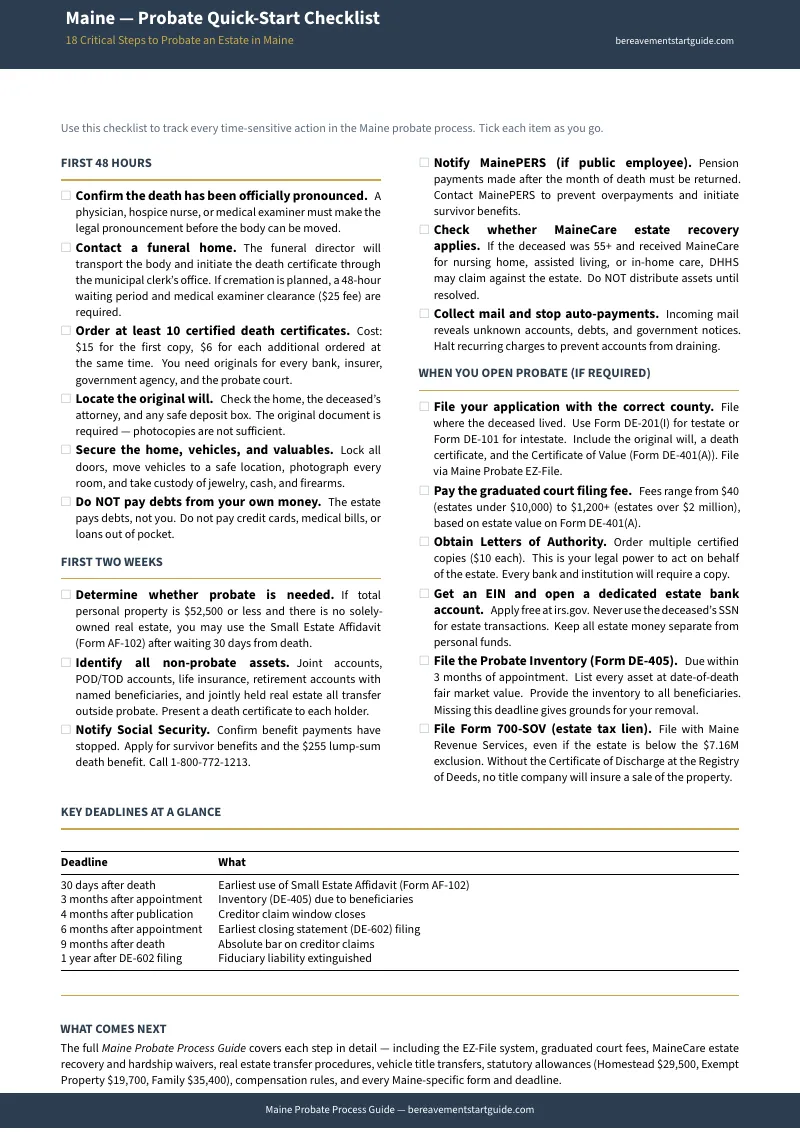
- Quick-Start Checklist — printable action plan organized by phase (first 48 hours, first two weeks, filing, four-month creditor window, closing)
- Probate Path Decision Tree — one-page flowchart to determine whether you need the small estate affidavit, informal probate, or formal probate
- Small Estate Affidavit Guide — standalone walkthrough of the AF-102 process for estates under $52,500
- Creditor Priority Chart — printable payment hierarchy showing the exact order debts must be paid to avoid personal liability
- Probate Inventory Worksheet — fillable worksheet for listing and valuing estate assets before filing Form DE-405
- Estate Tax Lien Clearance Guide — step-by-step 700-SOV filing and Certificate of Discharge procedure for clearing real property titles
Seven printable PDFs. Instant download. Start tonight.
Frequently Asked Questions
What if the rules change after I buy?
We update the guide when the rules change. Email us any time, even years later, and we'll send you the current edition free.