The Bank Froze the Account. The Pension Office Put You on Hold. Three Agencies Want Three Different Forms. Nobody Told You What to File First.
Someone you love has died in Maine. You are trying to keep the household running while simultaneously navigating a bureaucratic system that was not designed to help you. Social Security does not mention MainePERS. The Bureau of Motor Vehicles does not tell you about property tax exemptions. The probate court does not explain the homestead allowance. Each agency operates in isolation, assumes you already know about the others, and gives you a form number, a phone number, and a hold queue.
You searched online. Federal sites describe national rules that skip Maine's specific programs entirely. Law firm websites explain just enough to make you anxious, then offer a consultation at $300 an hour. Funeral home aftercare brochures cover the first week but nothing beyond it. Nobody has assembled the complete picture — every benefit you are owed, every form you need, every deadline that is running — in one place.
Meanwhile, benefits are going unclaimed. Deadlines are passing. And every day you spend hunting for the right form on the wrong website is a day you are not grieving, not recovering, and not getting paid what the State of Maine says you are owed.
The Maine Benefits Recovery System
This guide does what no single agency, attorney, or free website does: it maps every survivor benefit available to you in the State of Maine — federal, state, employer, and municipal — into a single chronological sequence. From the first 72 hours through final property transfers, every form, every deadline, every phone number, and every dollar amount is laid out in the order you actually encounter it.
The reason no free resource does this well is structural. Government agencies are siloed by design. The Social Security Administration does not coordinate with the Maine Public Employees Retirement System. Maine Revenue Services does not communicate with the Bureau of Motor Vehicles. Municipal tax assessors operate independently from the Department of Health and Human Services. The information exists — scattered across dozens of websites, buried in PDFs written for attorneys, and hidden behind bureaucratic nomenclature that assumes you already know what Form CL-0720 is.
The Maine Survivor Benefits Navigator stitches all of those separate systems into one linear sequence, translates the jargon into plain English, and tells you exactly what to do, in what order, with which agency, bringing which documents.
What's Inside —
The First 72 Hours — Securing the Foundation
The immediate actions that protect everything downstream. Registering the death through Maine's DAVE system. Ordering 10–15 certified death certificates ($15 first copy, $6 each additional). The critical warning that all authority under a Financial Power of Attorney ceases immediately upon death — and what happens if you keep using one. Locating the DD-214, marriage certificate, insurance policies, and pension statements you will need for every claim that follows.
Your Rights as a Surviving Spouse Under Maine Law
Maine's Uniform Probate Code (Title 18-C) provides three statutory allowances specifically designed to protect you from creditors during estate settlement. The $22,500 homestead allowance. The $15,000 exempt property allowance covering household furniture, vehicles, and personal effects. The family allowance for reasonable maintenance during administration. These take priority over nearly all unsecured creditor claims — and most surviving spouses never learn they exist. The guide explains qualification criteria and exactly how to claim each one.
The Elective Share — Protection Against Disinheritance
If you were left out of the will or given less than what Maine law entitles you to, you have the right to claim an elective share — up to 50% of the marital-property portion of the augmented estate. The percentage scales based on length of marriage (3% for less than one year, up to 100% at fifteen years). This is not a theoretical right — it is a concrete statutory protection with specific filing procedures and deadlines. The guide walks through the calculation and the process.
Transferring Property Without Probate
Not every asset requires a court proceeding. The guide walks through the Small Estate Affidavit (Form AF-102) for personal property under $52,500, the MVT-22 Affidavit for transferring vehicles at the Bureau of Motor Vehicles without probate, Transfer on Death deeds for real property, and joint tenancy assets that pass automatically. Each path includes the exact form, the waiting period, the documentation required, and the situations where it does not apply.
Clearing the Automatic Estate Tax Lien
Maine imposes a statutory lien on every parcel of real estate from the moment of death — even if the estate is far below the $7,160,000 exclusion threshold. You cannot sell, refinance, or transfer property until you file Form 700-SOV (Statement of Value) with Maine Revenue Services and obtain a Certificate of Discharge. Title companies will block any transaction until this certificate is recorded. The guide walks through both the probate track and the tax track so you can clear them simultaneously rather than discovering this obstacle six months later.
Social Security Survivor Benefits
The federal rules, applied to your Maine situation. Who qualifies (surviving spouses at age 60, or age 50 if disabled; dependent children under 18). The one-time $255 lump-sum death benefit. How to coordinate your SSA appointment with the documentation from Maine vital records. The interaction between Social Security benefits and Maine property tax programs that federal websites never mention.
MainePERS Pension Survivor Benefits
If the deceased was a teacher, state employee, or municipal worker enrolled in the Maine Public Employees Retirement System, you may be entitled to ongoing pension survivor benefits. The guide decodes the difference between ordinary death benefits and accidental death benefits (two-thirds of average final compensation for deaths arising from employment). It walks through Forms CL-0720, CL-0722, and CL-0065, and explains the diminishing retiree group life insurance schedule that reduces by 15% per year until it reaches 40% of the original value.
Workers' Compensation Death Benefits
If the death resulted from a workplace injury or occupational disease, Maine law mandates specific compensation: up to $4,000 for burial expenses, a $3,000 incidental payment directly to the estate, and weekly survivor benefits at 80% of the worker's after-tax earnings (capped at $622.20 per week for up to 500 weeks). The guide covers eligibility, the claims process, and the interaction with other benefits.
Health Insurance Continuation — Including Mini-COBRA
Federal COBRA applies to employers with twenty or more employees. But a significant portion of Maine's economy runs on small businesses. Maine's mini-COBRA law requires small group carriers covering employers with fewer than twenty employees to offer continuation coverage for up to twelve months. This state-specific right does not appear on any federal website and could be the difference between health coverage and a devastating gap. The guide explains both tracks and the enrollment deadlines for each.
MaineCare Estate Recovery Defense
If the deceased received MaineCare (Medicaid) long-term care, home care, or assisted living benefits after age 55, the Maine DHHS may file a recovery claim against the estate. The guide explains which assets are vulnerable, which exemptions protect you — including the surviving spouse exemption that prevents a forced home sale while you are living there — and a protection found nowhere in national guides: Maine's unique joint tenancy exception, which shields real estate held in joint tenancy from estate recovery. DHHS has tried to repeal this provision repeatedly. It remains intact.
Property Tax Relief — Every Program You Qualify For
The guide consolidates every property tax reduction available to a surviving spouse in Maine: the $25,000 homestead exemption, the $6,000 veteran exemption (which transfers to the unremarried surviving spouse of an eligible veteran), and the Property Tax Fairness Credit — a refundable credit on your state income tax return of up to $2,000 if you are 65 or older (up to $1,500 if under 65). These programs are administered by your municipal assessor (exemptions) and Maine Revenue Services (credit), and the application deadline is April 1.
Who This Is For
- Surviving spouses in Maine who need to know exactly which benefits they qualify for, which forms to file, and in what order — without paying an attorney $300 an hour for information that should be accessible
- Adult children managing a parent's affairs who need a single, consolidated action plan instead of calling six agencies and getting six different partial answers
- Families of Maine veterans who need to claim both federal VA benefits and Maine-specific programs like the property tax exemption and state cemetery benefits
- Survivors of workplace fatalities who need to understand Maine workers' compensation death benefits, claim timelines, and how those benefits interact with Social Security
- Fixed-income survivors worried about MaineCare recovery who need to understand their legal protections before the DHHS recovery notice arrives
Why Free Resources Fall Short
Every form mentioned in this guide is available for free. The Social Security website explains its own rules. MainePERS publishes its own benefit summaries. The Maine Legislature website hosts the full text of Title 18-C. So why do surviving spouses in Maine routinely miss benefits they are legally owed?
The information exists. The sequence does not. You can find the homestead allowance in one place, the MVT-22 vehicle affidavit in another, the mini-COBRA rules in a third, the MaineCare estate recovery exemptions in a fourth, and the property tax fairness credit in a fifth. No free source tells you what to do first, what to do second, which deadlines are running simultaneously, and which benefits interact with each other.
Law firm blog posts explain just enough to make you call their office. National sites like Nolo cover Maine in a paragraph, typically missing the mini-COBRA threshold, the joint tenancy estate recovery exception, and the specific MainePERS form numbers entirely. Legal Services for Maine Elders publishes excellent handbooks, but they are structured as dense legal references — not as step-by-step action plans you can follow during the worst week of your life.
This guide fills the gap between free but fragmented government data and expensive legal counsel: every benefit, every form, every deadline, and every Maine-specific protection in chronological order — for less than the cost of fifteen minutes with an attorney.
What You Get
- Maine Survivor Benefits Navigator (guide.pdf) — 14-chapter PDF covering the complete benefits landscape from the first 72 hours through final property transfers, with statute citations, form numbers, dollar amounts, and step-by-step instructions
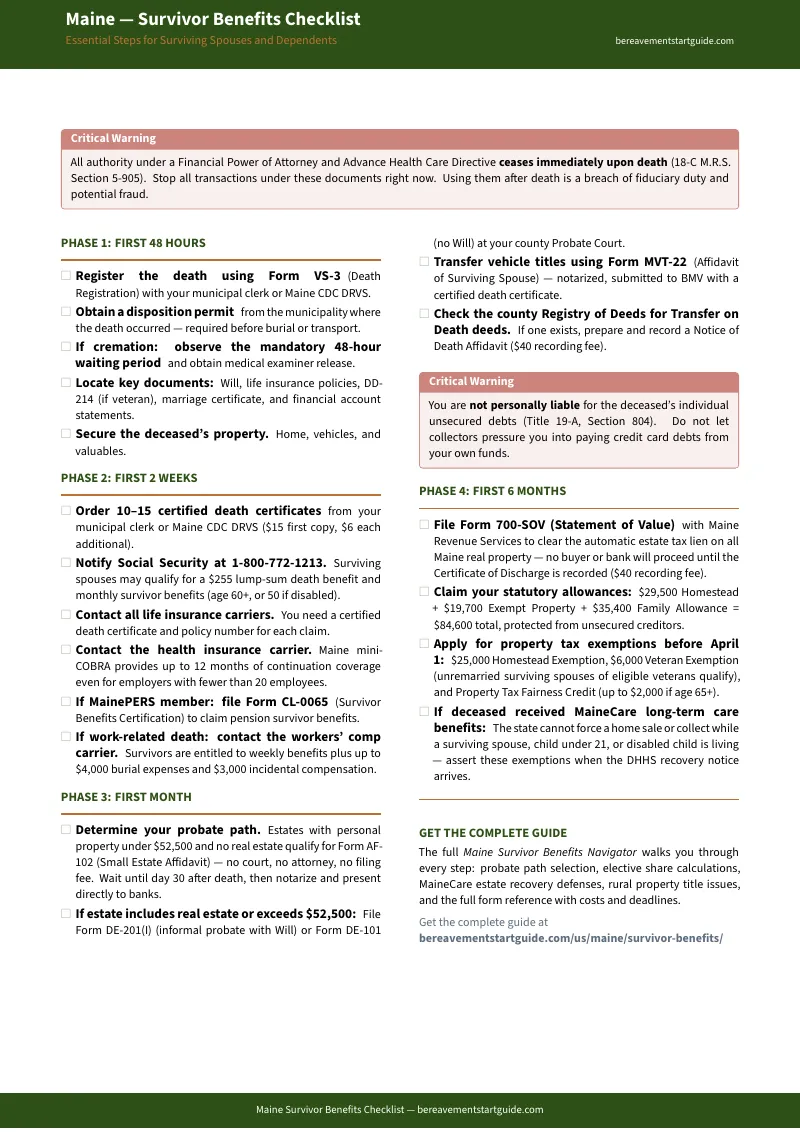
- Maine Survivor Benefits Checklist (checklist.pdf) — printable 19-item action plan organized by timeline (first 48 hours, first 2 weeks, first month, first 6 months) so nothing falls through the cracks
- Statutory Allowances Worksheet (statutory-allowances-worksheet.pdf) — fillable worksheet to calculate and claim your $22,500 homestead allowance, $15,000 exempt property allowance, and family allowance under Title 18-C
- Probate Path Decision Tree (probate-path-decision-tree.pdf) — visual flowchart to determine whether you qualify for the Small Estate Affidavit, informal probate, or need formal probate
- Property Transfer Reference (property-transfer-reference.pdf) — quick-reference guide covering vehicle transfers (MVT-22), Transfer on Death deeds, joint tenancy, and Small Estate Affidavit paths
- Property Tax Relief Worksheet (property-tax-relief-worksheet.pdf) — fillable worksheet for the homestead exemption, veteran exemption, and Property Tax Fairness Credit with the April 1 deadline
- MaineCare Recovery Defense (mainecare-recovery-defense.pdf) — reference sheet covering estate recovery exemptions, the surviving spouse protection, and Maine's joint tenancy exception
- Form Reference Card (form-reference-card.pdf) — one-page quick-reference listing every form number, agency, phone number, and filing deadline mentioned in the guide
Eight printable PDFs. Instant download. Start claiming benefits tonight.
Frequently Asked Questions
What if the rules change after I buy?
We update the guide when the rules change. Email us any time, even years later, and we'll send you the current edition free.