
Someone You Love Just Died in Maryland. The Bank Froze the Accounts. The Register of Wills Requires Forms You Have Never Seen. And You Just Discovered That Maryland Is the Only State in the Country That Charges Both an Estate Tax and an Inheritance Tax on the Same Death.
You are standing in the middle of something no one prepared you for. Maybe you were named personal representative in a will you barely remember signing as a witness. Maybe there was no will at all, and the family has turned to you because you are the surviving spouse, the eldest child, or simply the person who answered the phone. The funeral director is asking how many death certificates you need. The bank told you the accounts are frozen until you produce something called "Letters of Administration." Your brother is asking about the house. And somewhere in the back of your mind, a question keeps circling: if I pay the wrong bill first, miss a deadline I do not know about, or file the wrong form with the Register of Wills — can they come after me personally?
Yes, they can. Maryland Estates and Trusts Article Section 8-105 establishes a strict statutory priority for paying debts. If you pay a credit card company before you pay the Register of Wills fees, the funeral allowance, or the family allowances — and the estate later runs short — you are personally liable for the difference. That is not a warning label. That is the law. And it is just one of the traps waiting in a state that runs probate through 24 independent Registers of Wills, splits estates into Small and Regular categories at precise dollar thresholds, and then imposes two separate death taxes that run in parallel on different groups of people.
The When Someone Dies in Maryland — Estate Settlement Guide is a Dual-Track Command Center for every legal, financial, and administrative step between the funeral home and final distribution. Not a law textbook. Not a generic national checklist that cannot tell Maryland from Michigan. A structured, Maryland-specific manual built around Titles 1 through 16 of the Maryland Estates and Trusts Article — the actual statute that governs everything — that separates what must be done in the first 48 hours from what can safely wait months, so you stop guessing and start working through this in the right order.
What's Inside the Dual-Track Command Center
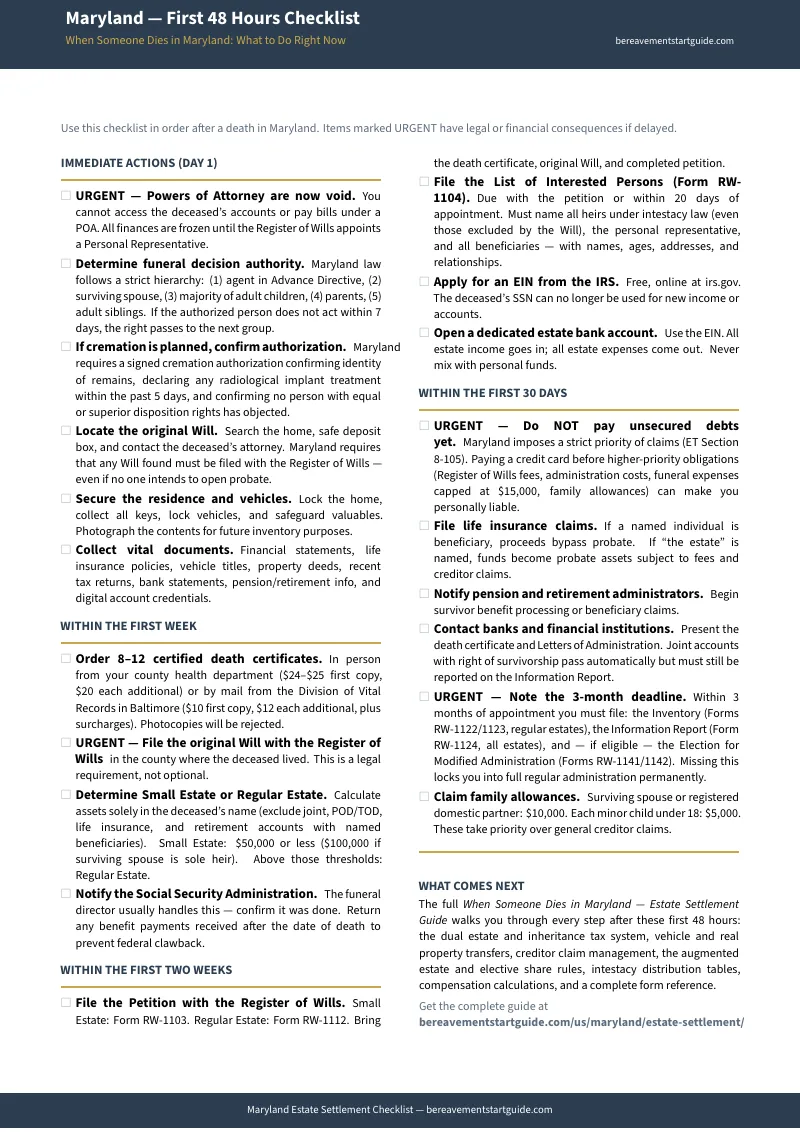
A comprehensive guide and the First 48 Hours Checklist — covering every stage from the moment of death through final asset distribution, built specifically for Maryland statutes, the Register of Wills system, the Orphans' Court, and the state-specific rules that make settling an estate here different from any other state:
The First 48 Hours: Death Certificates and Immediate Actions
The funeral director is going to ask how many certified death certificates to order, and most families guess wrong. Maryland practitioners advise 6 to 12 certified copies — not photocopies — because the Register of Wills, every bank, every insurance company, the MVA, and the IRS will each demand an original with the raised seal from the Maryland Department of Health. The guide gives you the exact calculation based on the deceased's assets so you order the right number now instead of waiting weeks for additional copies later. This chapter also covers what to do today, what to do tomorrow, and the single most important rule in this entire guide: do not pay any of the deceased's bills with your own money.
The First Week: Securing the Estate and Setting Family Expectations
Before the Register of Wills gives you legal authority over the estate, you have a duty to prevent assets from being lost, stolen, or damaged. This chapter covers locking the home, securing vehicles and valuables, rerouting mail (your best forensic tool for discovering unknown accounts and debts), canceling subscriptions that drain the estate, and the family meeting where you set one critical expectation: no one takes anything until the court says so. It also addresses Maryland's specific property concerns — securing row homes in Baltimore neighborhoods, managing seasonal properties on the Eastern Shore, and preserving the estate's largest asset until the legal process catches up.
Banking and Financial Accounts: Unlocking Frozen Money
When a bank receives notice that an account holder has died, individual accounts are frozen immediately. Being the surviving spouse does not override the freeze. But not every account is locked. Payable-on-Death accounts transfer directly to named beneficiaries with just a death certificate — though they must still be reported on the Information Report for inheritance tax purposes. Joint accounts with right of survivorship stay open. And if the total estate is under the right threshold, the Small Estate process can unlock accounts with streamlined paperwork. The guide maps every account type, what unlocks it, and what paperwork you need — including what to present to local institutions like M&T Bank — so you stop getting turned away at the counter.
Vehicle Title Transfers: The MVA Process
Vehicles are often the first asset families try to transfer — and the first place they get rejected. Maryland requires specific MVA forms for vehicle title transfers after death, including Form VR-181 (Bill of Sale) and VR-103 (Gift Certification). But here is the detail most families miss: surviving spouses and immediate family members transferring a vehicle within the family are exempt from the standard $100 title fee and the 6.5% excise tax, and do not need a Maryland safety inspection. The guide walks you through every scenario, the exact documents to bring to the MVA, and what to do when the name on the death certificate does not match the name on the title.
The Big Decision: Small Estate vs. Regular Administration
Not every estate needs the full probate process. Maryland's Small Estate procedure applies when the gross value of the estate is $50,000 or less — or $100,000 if the surviving spouse is the sole heir. For estates opened after October 1, 2022, small estates under $50,000 have zero probate fees. The guide includes a decision tree that walks you through the exact criteria and tells you definitively whether you qualify. If you do, it saves months of proceedings and potentially thousands in attorney fees. If you do not qualify, the guide explains exactly why and lays out the next steps for Regular Administration — including the Modified Administration shortcut that most families never hear about.
The Modified Administration Shortcut: The 90-Day Window
This is the chapter that saves months for qualifying families. Maryland offers a streamlined alternative called Modified Administration that replaces the formal inventory and accounting requirements with a single Final Report due within 10 months. But the eligibility criteria are rigid — the estate must be solvent and every residuary heir must be exempt from the inheritance tax — and the election must be filed within exactly three months of appointment. Miss that 90-day window by a single day and the estate defaults to the full Regular Administration process. The guide walks you through the qualification criteria and the election deadline so you make this decision with full information, not by accident.
Maryland's Dual Tax System: Estate Tax and Inheritance Tax
This is the chapter that justifies the entire guide. Maryland is the only state in the nation that imposes both an estate tax and an inheritance tax. They are different taxes, paid by different people, calculated on different bases, and they run in parallel. The estate tax applies to estates exceeding $5,000,000 with progressive rates up to 16% — most families will not hit this. But the inheritance tax is a flat 10% on every dollar inherited by collateral heirs — nieces, nephews, cousins, and friends — starting from the first dollar. Surviving spouses, children, grandchildren, parents, and siblings are exempt. Here is the trap: even assets that bypass probate entirely — payable-on-death accounts, jointly owned property, retirement accounts with named beneficiaries — must still be reported on the Information Report filed with the Register of Wills within three months of appointment, specifically for inheritance tax assessment. The guide explains who owes what, which assets get reported where, and how to file without triggering an audit from the Maryland Comptroller.
Creditor Management: The Debt Priority That Protects You
The estate pays the debts, not the family. But when the estate does not have enough money to pay everyone, Maryland law under Estates and Trusts Article Section 8-105 dictates a strict priority order: Register of Wills fees first, then costs of administration, then funeral expenses (statutorily capped at $15,000 unless the Orphans' Court grants a special order), then the personal representative's compensation, then family allowances, then taxes, and only then general unsecured creditors. If you pay lower-priority debts before satisfying higher-priority obligations and the estate later runs short, you can be held personally liable for the deficiency. The guide maps this hierarchy in plain language and gives you the framework for managing creditor demands during the six-month formal claim period without making mistakes that the Orphans' Court will hold against you.
Government Notifications: SSA, IRS, Maryland Comptroller, and Medicaid
Each agency operates on its own timeline with its own forms and its own penalties for delay. Social Security benefits deposited for the month of death will be clawed back if you do not act. The IRS needs a final Form 1040 filed for the deceased. The Maryland Comptroller handles the inheritance tax returns. And Maryland Medicaid estate recovery — the program that terrifies families into thinking "the state will take the house" — has specific rules that most families misunderstand entirely. Recovery applies to individuals who received long-term care benefits after age 55, and Maryland generally limits recovery to the probate estate, meaning assets properly transferred outside of probate are often protected. The guide covers every agency, every form, every deadline, and the specific exemptions that may protect your family.
Spousal Protections and the Augmented Estate
Maryland law protects surviving spouses with specific statutory rights that sit above creditor claims. The $10,000 spousal allowance applies regardless of what the will says. Beyond this, Maryland's 2020 augmented estate law fundamentally changed spousal protections — revocable trusts, qualifying joint interests, and certain lifetime transfers are now pulled back into the calculation pool for the elective share, preventing spouses from being disinherited through non-probate transfers. The deadline to file the elective share election using Form RW-1126 is the later of 9 months after death or 6 months after appointment of the representative. The guide explains how the augmented estate calculation works and the strict deadlines for asserting these rights — critical information for blended families.
Registered Domestic Partners: The New Law Most Guides Miss
As of late 2023, Senate Bill 792 allows qualifying domestic partners to register and receive the same probate rights as married spouses — including priority to serve as personal representative, the $10,000 allowance, and full exemption from the 10% inheritance tax. If you are a registered domestic partner, the guide explains exactly which protections apply and which limitations remain, including the fact that registered partners cannot claim the elective share of the augmented estate. If you are not registered, the guide explains what that means for your rights and your tax exposure.
The Complete Timeline: Every Statutory Deadline in One Calendar
From Day 1 through Month 12 and beyond, every Maryland statutory deadline in one sequential reference. The three-month window for the Inventory and Information Report. The three-month deadline for electing Modified Administration. The six-month creditor claim period. The nine-month deadline for the First Account and for filing the elective share election. Every deadline that matters, in the order it appears, with clear language about what happens if you miss it.
Who This Guide Is For
- The surviving spouse whose partner just died and whose bank accounts were frozen this morning — who needs to know which accounts stay accessible, which ones require Letters of Administration, and how to claim the $10,000 spousal allowance and the statutory protections that Maryland law guarantees before any creditor gets paid
- The adult child named as personal representative who lives in Virginia or Pennsylvania and is trying to manage a Maryland estate remotely — who needs to know that out-of-state representatives must appoint a Maryland Resident Agent using Form RW-1106, and who needs the complete sequence of fiduciary duties, court deadlines, and the 3-6-9-12 month timeline in one document
- The family with no will who just learned that Maryland's intestate succession laws will decide everything — who needs to understand exactly who inherits what, whether the estate qualifies for the Small Estate process, and whether Modified Administration is available
- The person who just got rejected at the bank trying to access their deceased parent's checking account — who needs to know whether a POD designation, a joint account, or the Small Estate threshold can bypass full probate, or whether Letters of Administration are the only path forward
- The collateral heir — a niece, nephew, cousin, or friend — who just discovered that their inheritance is subject to a flat 10% Maryland inheritance tax starting from the first dollar, and who needs to understand how the Information Report works and what assets are included in the calculation
- The registered domestic partner navigating a system that most guides still assume is limited to married spouses — who needs to know exactly which rights Senate Bill 792 provides, which limitations remain, and how to assert their legal authority at the Register of Wills without being turned away
- The family terrified about Medicaid who heard that "the state will take the house" because the deceased received nursing home benefits — who needs to understand the actual recovery rules, that Maryland generally limits recovery to the probate estate, and which asset arrangements may provide protection
Why Free Resources Will Not Get You Through This
The information exists. It is scattered across the Register of Wills website, the Orphans' Court rules, the Maryland Comptroller's office, the MVA, funeral home aftercare pages, and a dozen federal agency portals that do not reference each other. Here is what you actually encounter when you try to settle a Maryland estate using free sources alone:
- The Register of Wills gives you forms and tells you not to rely on them for legal advice. The free booklet "Administering Estates in Maryland" provides all official forms and descriptions. But every page states it "does not constitute legal advice," the interface is outdated and difficult to navigate, and the material is written in dense legalese that assumes you already understand the bifurcated Small/Regular estate system, the dual tax structure, and the difference between an Inventory and an Information Report. It hands you the blank paperwork without telling you the sequence.
- Maryland probate law firms write blog posts designed to sell $300-per-hour retainers. Frame and Frame, Stouffer Legal, and similar practices produce accurate, detailed content — and every article is designed to convince you the process is too dangerous to attempt without representation. They offer free PDF downloads that are essentially lead-generation brochures, intentionally omitting the procedural how-to so you book a consultation. For contested estates, professional representation is essential. For the majority of straightforward estates, the answer costs a fraction of a retainer.
- People's Law Library of Maryland provides excellent legal information in academic prose. Their step-by-step timelines are accurate and well-sourced. But the content reads like a law school textbook, not a crisis management tool. There are no printable checklists, no decision trees, no fillable worksheets, and no way to track your personal progress through a 12-month timeline. The information is right, but the format fails people in crisis.
- National platforms miss Maryland-specific details that cause real harm. Nolo, FindLaw, and EstateExec offer polished overviews of probate. They consistently fail to accurately differentiate Maryland's dual estate-and-inheritance tax system, the $50,000/$100,000 Small Estate thresholds, the 90-day Modified Administration election window, the three-month Information Report deadline for non-probate assets, and the registered domestic partner protections under Senate Bill 792. Maryland is not a footnote — it is the only state in the country with both death taxes, and generic tools miss that entirely.
- Local funeral homes give you surface-level checklists for the first 72 hours. They tell you to "notify the bank" and "contact Social Security." They do not mention the statutory debt priority under Section 8-105, the inheritance tax exposure for collateral heirs, the Modified Administration deadline, or the Information Report requirement for non-probate assets. Their advice ends where the hard questions begin.
Free resources give you fragments from a dozen sources that do not reference each other. The Dual-Track Command Center puts every Maryland-specific statute, form, deadline, and procedure into one document, in the order you actually need them.
— Less Than Fifteen Minutes With a Maryland Probate Attorney
A single consultation with a Maryland probate attorney costs $250 to $400 per hour. Standard probate representation runs $2,000 to $5,000 as a flat fee. National estate software platforms charge $149 per year in recurring subscription fees. This guide costs less than fifteen minutes of professional legal time and gives you the complete Maryland-specific roadmap — every statute, every deadline, every form, and the decision trees that tell you whether you even need an attorney at all.
Your download includes 8 PDFs: the complete guide, the First 48 Hours Checklist, and six standalone reference sheets — the Small Estate vs. Regular Administration Decision Tree, the Dual Tax Reference card, the Creditor Priority guide, the Statutory Deadline Calendar, the Vehicle Title Transfer Reference, and the Spousal and Domestic Partner Protections sheet. Instant download, no account required.
Money-back guarantee, no time limit. If the guide does not give you clarity on what to do next and confidence that you are doing it in the right order, email us for a full refund. No questions asked.
Not ready for the full guide? Download the free Maryland First 48 Hours Checklist — covering everything that must happen in the first two days after a death in Maryland: death certificates, securing the home, notifying Social Security, what not to pay, and what to gather. It is enough to get through tonight and tomorrow.
You did not ask for this job. But you can do it. The guide shows you how, one step at a time.
Frequently Asked Questions
What if the rules change after I buy?
We update the guide when the rules change. Email us any time, even years later, and we'll send you the current edition free.