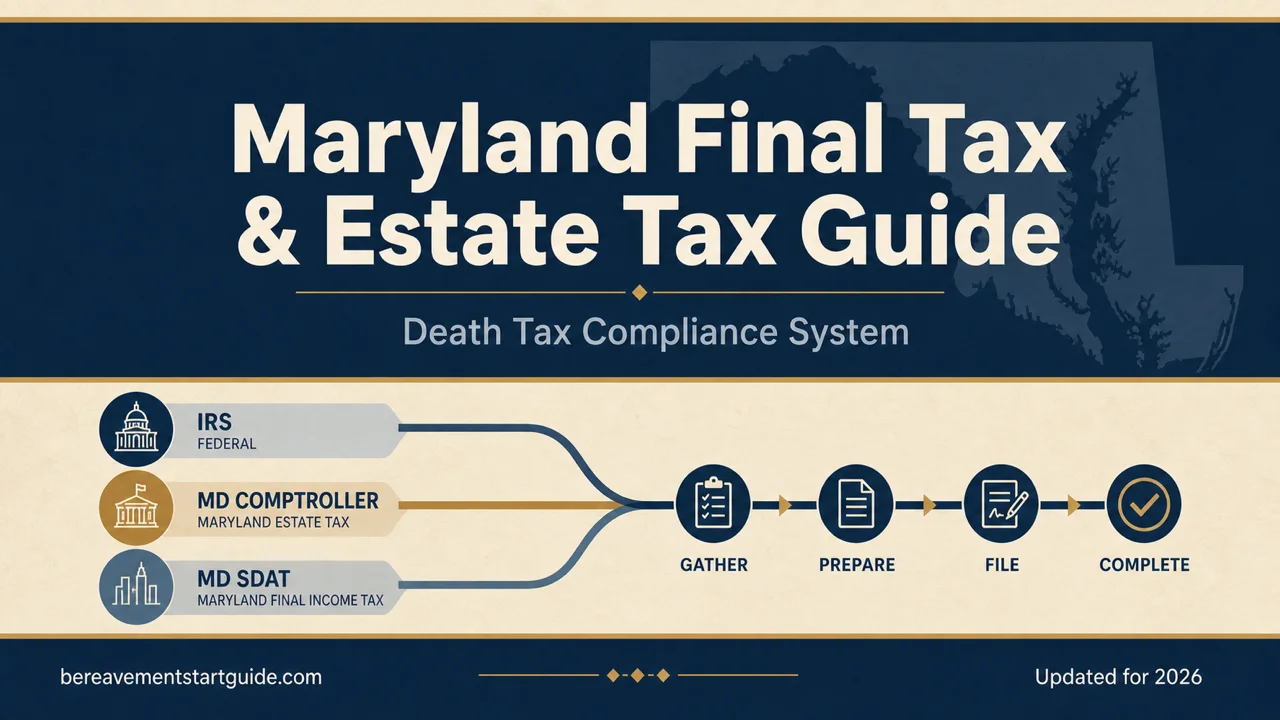
Maryland Is the Only State That Levies a State Estate Tax, a Separate Inheritance Tax, and Falls Under the Federal Estate Tax — Simultaneously. The State Froze Its Exemption at $5 Million While the Federal Exemption Jumped to $15 Million. You Just Became Responsible for Navigating All Three.
You called the Maryland Comptroller's office to ask about taxes after the death. They told you the estate might owe a state estate tax if the gross estate exceeds $5 million and an inheritance tax at 10% on bequests to certain beneficiaries. You asked whether the $15 million federal exemption protects you from the state tax. They said it does not — Maryland decoupled from the federal threshold years ago. You asked what forms to file. They said Form MET-1 for the estate tax, and the Register of Wills handles inheritance tax assessments separately. You asked the Register of Wills about the inheritance tax. They sent you a form and told you to consult a tax professional.
You searched online. You found three law firm blogs that explained the "Death Tax Trifecta" and ended with "call us for a consultation at $350 per hour." You found the Comptroller's website with Form MET-1 instructions that assume you already understand the unified credit calculation, the Maryland adjustment, and how to complete a pro forma federal Form 706 for an estate that does not actually owe federal estate tax. You found a Reddit thread where someone said the personal representative is personally liable for unpaid inheritance taxes. You do not know what is true, what applies to your situation, or what to file first.
Meanwhile, critical tax decisions are compounding. The $10 million gap between the federal exemption ($15 million) and the Maryland exemption ($5 million) means hundreds of estates that owe zero federal tax still face a Maryland estate tax bill graduated up to 16%. The inheritance tax applies at a flat 10% to every dollar received by non-exempt beneficiaries — nieces, nephews, friends, unmarried partners — regardless of the total estate size. The fiduciary income tax requires its own return (Form 504) for any income the estate earns after the date of death. The surviving spouse's elective share must be claimed within a strict nine-month deadline or it is lost forever. And the Register of Wills probate fees on a $500,000 estate can reach $1,000 before you even factor in statutory attorney fees of $19,080 under Estates and Trusts Section 7-601. Every one of these obligations is governed by a different section of the Maryland code, administered by a different agency, with different deadlines and different consequences for getting it wrong.
The Maryland Final Tax & Estate Tax Guide is a Maryland Death Tax Compliance System for every tax return, form, deadline, and filing obligation an executor or beneficiary faces after a death in Maryland. Not a generic national estate tax primer with Maryland's name attached. Not a law firm blog designed to generate $350-per-hour consultations. A plain-English, Maryland-specific manual that tells you what the Comptroller's Form MET-1 instructions, the Register of Wills pamphlets, and IRS Publication 559 cannot: which taxes actually apply to your estate, which forms to file, in what order, by which deadlines, and which common mistakes create personal liability for the personal representative.
What's Inside the Maryland Death Tax Compliance System
An 18-chapter guide, a tax obligations checklist, and standalone reference sheets covering every tax return, filing obligation, and asset transfer decision an executor or beneficiary faces after a death in Maryland, built on the Maryland Estates and Trusts Article, the Comptroller of Maryland instructions, and IRS Publication 559 — not a generic template repurposed with Maryland terminology:
The Death Tax Trifecta: Federal Estate Tax, Maryland Estate Tax, and Maryland Inheritance Tax
Maryland is the only state that imposes all three death taxes simultaneously. The guide decodes each one: the federal estate tax ($15 million exemption, permanently elevated by the One Big Beautiful Bill Act), the Maryland estate tax ($5 million exemption, frozen and unindexed for inflation, graduated rates up to 16%), and the Maryland inheritance tax (0% for spouses, children, parents, siblings, and registered domestic partners — 10% flat for everyone else). The guide explains the $10 million gap, how the inheritance tax credit works against the estate tax, and why an estate can owe zero federal tax while facing a six-figure Maryland estate tax bill.
Final Income Tax Returns: Federal 1040 and Maryland Form 502
The deceased's final individual tax returns cover income from January 1 through the exact date of death. The guide walks you through the federal Form 1040 and Maryland Form 502 filing process — how to mark the return as filed by a personal representative, when a surviving spouse can file jointly for the final year, how to handle income received after death but earned before death (income in respect of a decedent), and the documentation the Comptroller requires. The April 15 deadline applies regardless of probate status.
Fiduciary Income Tax: Form 1041 and Maryland Form 504
If the estate earns any income after the date of death — rental payments, stock dividends, bank interest, business distributions — the estate is a separate tax entity that requires its own federal return (Form 1041) and its own Maryland return (Form 504). This is the filing most executors miss entirely, because nothing in the probate process alerts you to its existence. The guide explains the trigger, the deadline, how income flows from the estate to the beneficiaries, and why the federal 1041 must be completed before the Maryland 504.
The Maryland Estate Tax Return: Form MET-1 Decoded
The MET-1 is the form that determines what the estate owes to the Maryland Comptroller. It requires a complete pro forma federal Form 706 — even for estates that owe zero federal estate tax — plus the Maryland-specific adjustments, the unified credit calculation, and the inheritance tax credit offset. The guide walks through the entire form, line by line, and explains why the nine-month filing deadline is absolute for payment even though paperwork extensions are available via Form MET-1E.
Inheritance Tax: Who Pays, How Much, and What Happens if You Do Not
The inheritance tax is the one most families learn about too late. It is not a tax on the estate — it is a tax on the privilege of receiving property, assessed against each non-exempt beneficiary individually. The Register of Wills calculates the assessment and sends an invoice directly to the beneficiary. If the beneficiary does not pay within 30 days, a 10% penalty accrues. After 90 days, the CCU (Central Collection Unit) adds an 18% surcharge. The guide covers exempt versus non-exempt beneficiary classifications, how the tax applies to both probate and non-probate assets, and how inheritance tax payments credit against any estate tax owed.
Step-Up in Basis: Protecting Inherited Property from Capital Gains
The step-up in basis is the single most valuable tax protection available to Maryland beneficiaries — and the one most frequently mishandled. When you inherit property, the tax basis resets to fair market value on the date of death. A house purchased in 1985 for $80,000 that is worth $600,000 at death carries a new basis of $600,000. An immediate sale generates zero capital gains tax. But this protection requires proper appraisal documentation at the time of death, not years later when you decide to sell. The guide covers how to document the step-up for real estate, investment accounts, and business interests.
Real Property Transfers, Transfer Taxes, and Recordation Taxes
Transferring a house through a Maryland estate involves the Register of Wills, the county Land Records office, the State Department of Assessments and Taxation (SDAT), and the county tax authority — each with their own requirements. The guide covers how to prepare and record a personal representative's deed, the 0.5% state transfer tax, the county-specific recordation taxes (which vary by jurisdiction), and the Homestead Tax Credit implications for inherited property. A house cannot be transferred or sold until Letters of Administration are issued, and holding real property generally prevents Small Estate qualification.
Spousal Protections: The Elective Share and the Augmented Estate
Maryland's 2020 augmented estate rules give surviving spouses powerful protection against disinheritance. The elective share is calculated against the augmented estate — pulling non-probate assets (joint accounts, life insurance, trust distributions, TOD designations) back into the calculation. The surviving spouse gets one-third if there are children, one-half if there are not. But the election must be filed within nine months of death or six months of the will's admission to probate, whichever is later — miss this deadline and the right is gone permanently. The guide explains the full calculation, the assets included in the augmented pool, and the election procedure.
Medicaid Estate Recovery Defense
If the deceased was over 55 and received nursing care or long-term services through Maryland Medical Assistance, the Department of Health (DHMH) can file a recovery claim against the probate estate. The guide covers the exemptions that protect families — surviving spouse, child under 21, blind or disabled child — and explains why Maryland's general restriction of recovery to the probate estate makes certain non-probate asset strategies effective. The six-month DHMH claim window runs from the third publication of the Notice to Creditors, and the guide shows you exactly how to track it.
The Complete Maryland Deadline Calendar
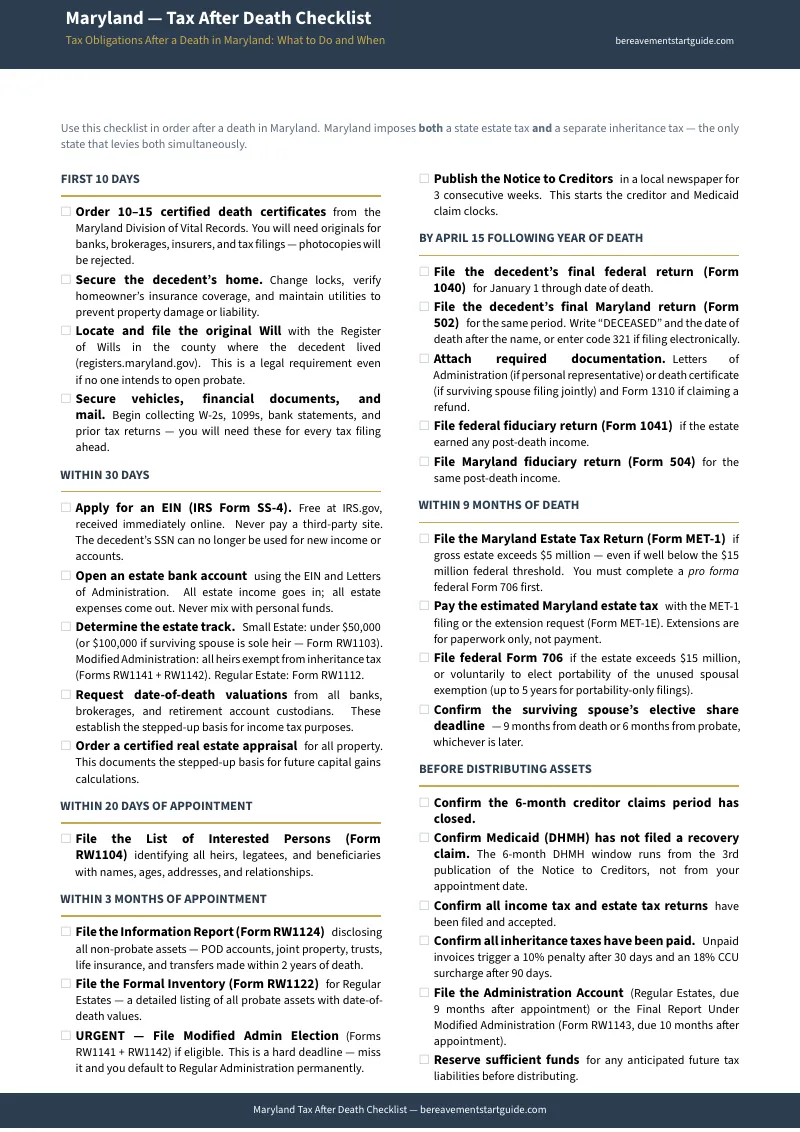
Every federal and Maryland tax deadline mapped to a timeline: the 20-day List of Interested Persons deadline, the 3-month inventory and Information Report deadlines, the April 15 final income tax deadline, the nine-month estate tax and first account deadlines, the 10-month modified administration final report deadline, and the elective share election window. Printable reference so no deadline is missed and no filing triggers personal liability through delay.
Who This Guide Is For
- The personal representative who just discovered the $10 million gap — who assumed the $15 million federal exemption protected the estate, and now must file Form MET-1 with a pro forma federal 706 for an estate that owes zero federal tax but faces a five-figure Maryland estate tax bill at graduated rates up to 16%
- The executor who did not know the estate earns its own income — who has never heard of Form 504, does not know that rental payments and stock dividends received after the date of death trigger a separate Maryland fiduciary return, and cannot determine whether the estate's post-death income requires filing before or after the final individual return
- The collateral beneficiary facing a 10% inheritance tax invoice — who just received an assessment from the Register of Wills, does not understand why their inheritance is being taxed when the estate already paid taxes, and needs to verify the exemption classifications and payment deadlines before the 10% late penalty kicks in
- The surviving spouse who does not know the elective share deadline — who needs to understand the augmented estate calculation, the one-third versus one-half split, and the nine-month filing window that cannot be extended — before the right to override the will disappears permanently
- The family selling the inherited house — who knows the step-up in basis exists but does not know how to document the date-of-death fair market value, how the Maryland transfer tax applies at settlement, or which county recordation taxes will reduce the net proceeds
- The adult child settling a parent's estate from out of state — who is coordinating final income tax returns, fiduciary returns, estate tax filings, inheritance tax payments, property transfers, and beneficiary distributions across Maryland and federal jurisdictions and needs every form, deadline, and filing sequence in one document
Why Free Resources Will Not Get You Through This
Maryland tax and estate information exists. The Comptroller of Maryland publishes forms and instructions, the Register of Wills publishes pamphlets, and the IRS publishes Publication 559 on estate taxes. Here is what you actually encounter when you try to navigate estate taxes using free sources:
- The Comptroller publishes Form MET-1 instructions — in statutory language for CPAs. The instructions assume you already understand the unified credit calculation, the Maryland adjustment, the pro forma federal Form 706 requirement, and the interaction between the estate tax and the inheritance tax credit. They tell you which lines to complete. They do not tell you whether your estate needs to file in the first place, how to value the gross estate, or how the $5 million threshold applies to joint property and life insurance.
- The IRS publishes Publication 559 — covering federal rules only. Publication 559 explains federal estate tax, final income tax, and fiduciary returns. It has zero information about Maryland-specific filings: no Form MET-1, no Form 504, no inheritance tax assessments, no augmented estate calculations. A federal guide cannot navigate a state-level death tax system that operates under entirely different thresholds.
- The Register of Wills provides pamphlets — organized by form, not by timeline. You can download every probate form at registers.maryland.gov. But the forms are organized alphabetically, not chronologically. No pamphlet tells you that the Information Report (Form RW1124) must be filed within three months, that it directly affects the inheritance tax assessment, and that the inheritance tax assessment directly credits against the estate tax. You discover these connections by making mistakes.
- Law firm blogs explain the dangers — and end with a phone number. Every estate planning and probate firm in Baltimore, Bethesda, Annapolis, and Columbia publishes blog posts about the Death Tax Trifecta, executor liability, and the $10 million gap. The posts are accurate, alarming, and deliberately incomplete. They explain the risk in enough detail to frighten you. They never explain the solution in enough detail to act on it. Every post ends with a consultation invitation at $300 or more per hour.
- No free resource connects all three tax regimes into one filing sequence. The Comptroller handles the estate tax. The Register of Wills handles the inheritance tax. The IRS handles the federal returns. Each agency knows its own forms and nothing about the others. No free resource tells you that the pro forma Form 706 feeds into the MET-1, that the inheritance tax payments credit against the estate tax, that the Form 504 fiduciary return starts from the federal 1041, or that the elective share calculation pulls non-probate assets into a pool that also affects the inheritance tax assessment.
Free resources give you Comptroller instructions written for CPAs, IRS publications that ignore Maryland filings entirely, and law firm blogs that end with a billable-hour phone number. The Maryland Death Tax Compliance System puts every tax return, form, deadline, and filing sequence into one document, in the order you actually need them.
— Less Than Fifteen Minutes With a Maryland Estate Attorney
A consultation with a Maryland probate attorney runs $300 to $400 per hour. A CPA preparing the federal 1041 and Maryland Form 504 fiduciary returns charges $500 to $2,000 depending on estate complexity. Statutory attorney fees under Maryland Estates and Trusts Section 7-601 can reach $19,080 on a $500,000 estate. This guide costs less than fifteen minutes of professional legal time and gives you the complete Maryland-specific tax roadmap — every return, every form, every deadline, and the filing sequence that determines whether the personal representative faces personal liability or not.
Your download includes the complete 18-chapter step-by-step guide covering every tax obligation category, the standalone Maryland Tax After Death Checklist, and printable reference sheets: the Death Tax Trifecta Decision Flowchart, the Maryland Estate Tax (MET-1) Quick Reference, the Inheritance Tax Assessment Guide, the Fiduciary Income Tax (Form 504) Quick Reference, the Step-Up in Basis Valuation Guide, the Elective Share and Augmented Estate Calculator, the Medicaid Estate Recovery Quick Reference, and the Complete Maryland Deadline Calendar with every federal and state deadline mapped to a timeline. Instant download, no account required.
Money-back guarantee, no time limit. If this guide does not save you hours of confusion with the Comptroller, the Register of Wills, and the IRS — and make the estate tax filing process immediately clearer — email us for a full refund. No questions asked.
Not ready for the full guide? Download the free Maryland — Tax After Death Checklist — an overview of the tax obligations that apply after a death in Maryland, the key forms and deadlines, and the most common executor mistakes. Enough to understand what you need to file and whether you need the full guide.
Nobody trained you for this. The Comptroller assumes you understand the unified credit calculation. The Register of Wills assumes you know how the inheritance tax assessment works. The IRS assumes you can navigate Publication 559 without Maryland-specific context. You have something none of them provide — a single system that connects every federal and Maryland tax obligation into one sequence, with plain-English instructions for each one.
Frequently Asked Questions
What if the rules change after I buy?
We update the guide when the rules change. Email us any time, even years later, and we'll send you the current edition free.