The Funeral Home Just Handed You a Price List With 16 Line Items You Have Never Seen. Maryland Law Says You Can Legally Refuse Embalming, Handle the Funeral Yourself, and Cremate After 12 Hours. But Nobody at the Funeral Home Mentioned Any of That.
Someone you love just died. Within hours, you are sitting across a table from a funeral director who is walking you through packages, explaining that embalming is "required" for the viewing, that the casket must be purchased through their facility, and that cremation cannot happen for 48 hours. Every sentence sounds like law. None of it is. Maryland does not require embalming under any circumstance. Maryland allows families to act as their own funeral directors without a license. And the mandatory cremation waiting period is 12 hours from the time of death, not 48 — a fact that national websites routinely get wrong.
But you do not know this. You are grieving, exhausted, and making financial decisions under pressure that will cost your family $8,000 to $15,000 in the next three days. The funeral home's internal policies sound identical to state law, and there is no practical way to tell the difference while you are sitting in that arrangement room. The FTC's Funeral Rule requires every funeral home to hand you a General Price List with 16 itemized categories — but the rule does not require them to tell you which items you can legally decline.
The Maryland Funeral Laws & Consumer Rights Guide is a Consumer Protection System for every decision between the moment of death and the final disposition of remains. Not a grief handbook. Not a generic funeral planning template that treats Maryland like every other state. A structured, Maryland-specific manual built around COMAR Title 10, the Health-General Article, and the FTC Funeral Rule — covering the exact laws, the exact consumer rights, the exact regulatory agencies, and the exact steps that protect your family from spending thousands of dollars on services that Maryland law never required.
What's Inside the Consumer Protection System
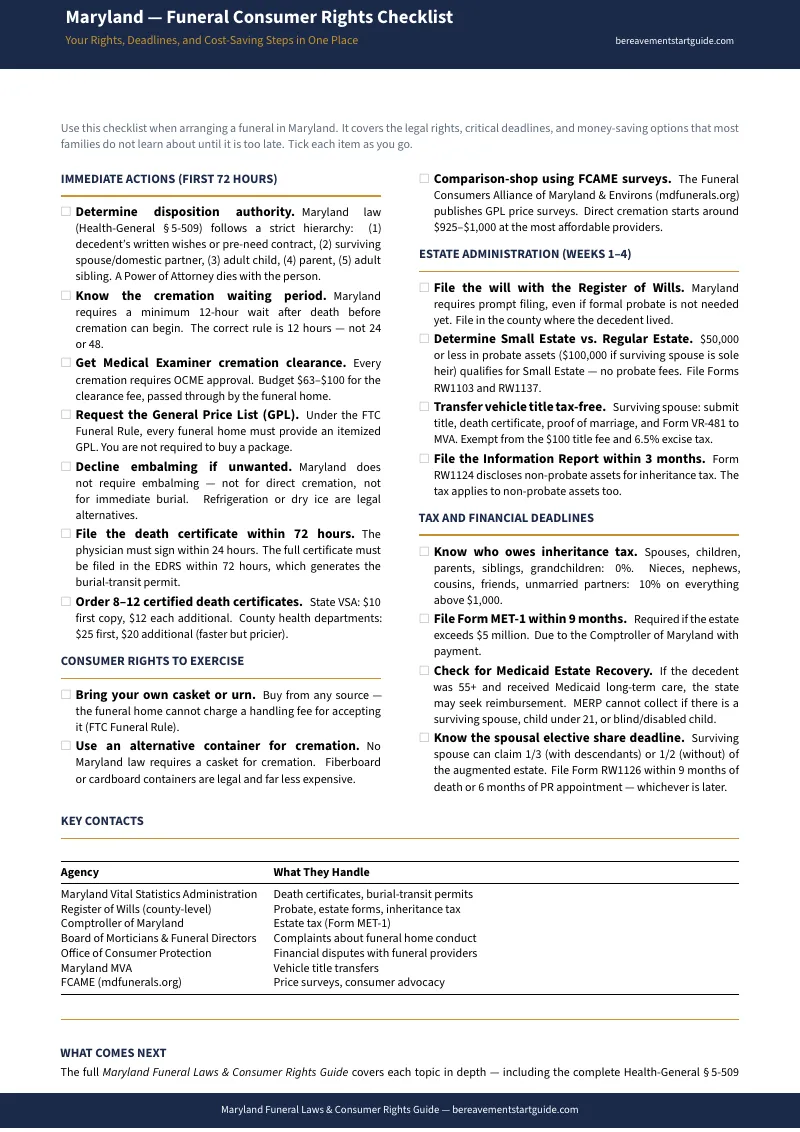
A comprehensive guide, a Funeral Consumer Rights Checklist, and standalone reference tools — covering every stage from the moment of death through final disposition and complaint resolution, built specifically for Maryland's deathcare regulatory system and the consumer rights that funeral homes are not obligated to explain to you:
Your Legal Rights in a Maryland Funeral Home: What They Must Tell You and What They Will Not
Every Maryland funeral home must provide a General Price List containing 16 itemized categories the moment you ask — in person or over the phone. That is federal law under the FTC Funeral Rule. What the Funeral Rule does not require is for the funeral director to volunteer that you can legally purchase a casket from a third party and the funeral home cannot charge you a handling fee, that you can decline embalming entirely even for a public viewing, or that direct cremation in Maryland averages $925 when the state funeral consumers' alliance surveys local providers. The guide maps every FTC-mandated disclosure against your corresponding Maryland consumer rights, so you know what questions to ask and what services to refuse before you sign anything.
Embalming in Maryland: What the Law Actually Says Versus What Funeral Homes Claim
Maryland does not require embalming. Period. No state law, no Department of Health regulation, no COMAR provision mandates embalming under any circumstance — not for viewing, not for transport, not for delayed burial. What funeral homes do is establish internal corporate policies requiring embalming for public viewings, then present those policies in language that sounds like state regulation. The guide explains the exact legal status of embalming in Maryland, documents the fully legal preservation alternatives — refrigeration, dry ice, Techni Ice — that maintain a body for one to three days in a 65-degree room, and provides the specific statutory citations you need to decline this service with confidence.
The 12-Hour Cremation Rule: Correcting the Record
Multiple national funeral directories claim that Maryland requires a 24-hour or even 48-hour waiting period before cremation. The actual requirement under COMAR 10.29.19.07 is 12 hours from the time of death. The guide documents the exact regulatory citation, explains the Medical Examiner authorization requirement that must be completed before any cremation can proceed, and covers the "10-day rule" governing what a crematory may do with uncollected cremated remains. When a funeral home tells you cremation cannot happen yet, you will know whether that is state law or their scheduling preference.
Home Funerals in Maryland: Your Right to Care for Your Own Dead
Maryland is one of a minority of states that legally allows families to handle the complete funeral process without hiring a licensed funeral director. You can wash and dress the body, hold a vigil at home, transport the remains to a crematory or cemetery, and oversee the entire process yourself — all without violating any state law. But exercising this right requires navigating a strict bureaucratic sequence: the attending physician must sign the death certificate within 24 hours, the certificate must be filed in the state's electronic death registration system (EDRS) within 72 hours, and only upon that filing does the burial/transit permit generate — the document you must have before the body can be moved to its final destination. The guide walks through every step of this sequence, distinguishing between what families can do themselves and what requires interaction with state agencies.
Who Controls the Body: Maryland's Authorizing Agent Hierarchy
When family members disagree about burial versus cremation, traditional versus green burial, or which funeral home to use, the question becomes: who has the legal right to decide? Maryland follows a strict statutory hierarchy for the "authorizing agent" who controls the disposition of remains. A pre-need designated agent or legally executed advance directive supersedes all family relationships. After that, the hierarchy moves from spouse to adult children to parents to siblings, with specific rules for when multiple people at the same level disagree. The guide documents the full priority chain, explains how disputes are resolved, and covers the scenarios — estranged spouses, blended families, absent next-of-kin — that cause the most conflict.
Burial, Cremation, and Green Burial: Every Disposition Option Under Maryland Law
The guide covers every legally available disposition method in Maryland: traditional casket burial, direct cremation, immediate burial, green burial without embalming or vault, water cremation (alkaline hydrolysis), and human composting (natural organic reduction). For each option, the guide documents the specific Maryland regulations, the paperwork required, the typical cost range from local provider surveys, and the consumer rights that apply. For green burial specifically, it explains the critical difference between "natural burial" — simple unvaulted interment — and "conservation burial," where the burial funds long-term land restoration. No Maryland law requires burial vaults or liners, but many cemeteries impose them as a matter of private policy. The guide tells you which requirement is law and which is business preference.
Scattering Ashes: Maryland Rules for Land, Water, and Public Spaces
Cremated remains are entirely sterile and pose no public health risk. The guide covers the rules for scattering on private land (written permission from the property owner), in Maryland state parks (permit requirements vary by park), over the Chesapeake Bay (state and federal waterway rules), and at sea (EPA requires scattering at least three nautical miles from shore). It also covers the increasingly popular option of keeping cremated remains at home, which Maryland places no restriction on.
The Death Certificate and Transit Permit: The 72-Hour Timeline That Controls Everything
Nothing happens — no cremation, no burial, no transport — without a completed death certificate filed in Maryland's EDRS and the corresponding burial/transit permit. The guide breaks down the exact administrative sequence: attending physician signs within 24 hours, funeral director or family member completes the demographic section, the full certificate is filed within 72 hours, and the transit permit is generated. It explains how many certified copies to order (more than you think), where to order them from, how much they cost, and why insurance companies, banks, and the Register of Wills each need their own original. This is the paperwork bottleneck that delays everything else, and the guide eliminates the guesswork.
Prepaid Funeral Contracts: What Maryland Requires and What Sellers Hide
Maryland law mandates that funeral homes place 50% to 55% of the total preneed contract price for services, and 80% of the casket selling price, into a federally insured trust. The guide explains the exact trust requirements, the critical difference between revocable and irrevocable prepaid contracts (irrevocable contracts are used strategically to shelter assets during Medicaid spend-down), the consumer's right to transfer a prepaid contract to a different funeral home, and what happens to the trust funds if the funeral home goes bankrupt. If you or a family member is considering a prepaid contract, this chapter tells you exactly what to demand and what to verify before signing.
Filing a Complaint: The Regulatory Map Most Families Never Find
Maryland splits funeral oversight across multiple agencies, and families who feel they were overcharged, misled, or mistreated rarely know where to file. The guide provides the complete jurisdictional map: the Board of Morticians and Funeral Directors handles complaints about licensed funeral directors, embalming negligence, and unlicensed mortuary activity. The Office of Cemetery Oversight handles burial goods, cemetery maintenance, and plot disputes. The Office of Consumer Protection handles deceptive pricing, contract fraud, and Funeral Rule violations. Each agency has its own complaint form, its own process, and its own enforcement powers. The guide tells you which agency handles your specific issue, how to file, and what to expect.
The $15,000 Funeral Expense Cap: What Executors Must Know
Maryland law caps the amount of funeral expenses that can be paid from a solvent estate without a special court order at $15,000. If you are the executor and you authorize a $20,000 funeral, you may be personally liable for the $5,000 difference. The guide explains the statutory limit, how it interacts with the estate's probate process, and how to ensure funeral expenses stay within the protected amount. This is the chapter that prevents executors from making a $5,000 mistake they cannot undo.
Veterans Burial Benefits: Maryland-Specific Execution
Federal VA burial benefits — headstone, flag, Presidential Memorial Certificate, plot allowance at a national or state veterans cemetery — are widely documented. What is not well documented is how to execute these benefits within Maryland's specific system. The guide covers all five state veterans cemeteries (Crownsville, Eastern Shore, Garrison Forest, Rocky Gap, and Cheltenham), the eligibility requirements, the paperwork for securing a plot, and how VA reimbursements interact with the $15,000 estate funeral expense cap. For families eligible for both VA benefits and estate reimbursement, the sequencing matters.
Who This Guide Is For
- The family member sitting in the funeral home arrangement room right now — who was just told that embalming is required for the viewing, that the casket must be purchased through the funeral home, and that cremation cannot happen for 48 hours. None of those statements are Maryland law. You need to know what you can legally refuse before you sign the contract.
- The next-of-kin who wants to handle the funeral without a funeral director — who knows Maryland allows home funerals but does not know the exact sequence for the death certificate, the EDRS filing, and the transit permit. One missed step in the 72-hour bureaucratic chain and the body cannot be legally moved.
- The executor who just got the funeral bill — who authorized $18,000 in funeral expenses and just learned that Maryland law caps estate funeral reimbursement at $15,000. The difference comes out of the executor's pocket or triggers a court petition. You need to know this before the funeral, not after.
- The adult child planning cremation for a parent — who is being told conflicting information about waiting periods, Medical Examiner authorization, and whether the crematory can scatter ashes or whether the family must retrieve them. The guide has the exact COMAR citations so you can verify every claim the crematory makes.
- The family fighting over what happens to the body — siblings who disagree about burial versus cremation, or a blended family where the surviving spouse and the adult children from a prior marriage have different wishes. Maryland's authorizing agent hierarchy determines who has the legal right to decide, and it is not always who the family assumes.
- The pre-planner comparing prepaid funeral contracts — who wants to lock in prices or shelter assets for Medicaid eligibility but does not know what percentage of the contract price Maryland law requires the funeral home to place in trust. The guide documents the exact trust requirements so you can verify compliance before signing.
Why Free Resources Will Not Get You Through This
The information exists. It is scattered across the FTC website, the Maryland Board of Morticians, the Office of Cemetery Oversight, the Department of Health vital records portal, and volunteer consumer advocacy organizations. Here is what you encounter when you try to navigate Maryland funeral rights using free sources alone:
- National funeral directories get Maryland law wrong. US-Funerals.com claims Maryland requires a 48-hour cremation waiting period. The actual requirement under COMAR 10.29.19.07 is 12 hours. Nolo and similar aggregators provide generic overviews that consistently omit Maryland's home funeral rights, the authorizing agent hierarchy, and the specific trust percentages for prepaid contracts. When a national site tells you embalming is "usually not required," that is not the same as knowing it is never required under Maryland law and having the citation to prove it.
- The Funeral Consumers Alliance of Maryland publishes invaluable local price surveys but no procedural guides. FCAME's volunteer-driven research shows that direct cremation in Maryland averages $925 — essential comparison data. But their website provides no sequential checklists, no explanation of the death certificate timeline, no guidance on filing complaints with the correct agency, and no integration with the estate administration process. Price data without a procedural roadmap leaves families knowing what things should cost but not how to enforce that knowledge.
- The Maryland Board of Morticians handles complaints but does not educate consumers. The Board's website provides blank PDF complaint forms and lists of licensed funeral homes. It does not explain your FTC Funeral Rule rights, does not distinguish between state law and funeral home policy, and does not tell you which of Maryland's three oversight agencies handles your specific grievance. The regulatory system is designed for compliance enforcement, not consumer education.
- Funeral home websites produce content designed to sell $8,000 packages. Local funeral home blogs offer helpful-sounding articles about "planning a meaningful service" that carefully omit your right to decline embalming, your right to supply your own casket, and the legal availability of direct cremation at a fraction of the full-service price. Every article ends with a "Contact Us" button. The content serves the business model, not the consumer.
Free resources give you fragments from six different agencies that do not reference each other. The Consumer Protection System puts every Maryland-specific statute, consumer right, regulatory contact, and procedural step into one document, in the order you actually need them.
— Less Than the Markup on a Single Casket Accessory
A full-service funeral in Maryland averages $8,000 to $15,000. Direct cremation averages $925 from surveyed Maryland providers. The difference is not the dignity of the service — it is whether you know what you are legally entitled to decline. A single "required" embalming you did not need costs $700 to $1,200. A casket purchased through the funeral home instead of a third-party supplier costs $2,000 to $5,000 more than the identical model online. One consultation with an elder law attorney about prepaid contracts costs $300 to $500 per hour. This guide costs less than the markup on a single casket accessory and gives you the complete Maryland-specific system — every consumer right, every regulatory citation, every procedural step, and the decision frameworks that tell you what to accept, what to refuse, and where to file a complaint if something goes wrong.
Your download includes the complete guide, the standalone Maryland Funeral Consumer Rights Checklist, and printable reference tools — the FTC Funeral Rule Rights Summary, Embalming Refusal Reference, Cremation Rules and Timeline, Disposition Options Comparison, Authorizing Agent Hierarchy, Death Certificate and Transit Permit Checklist, Prepaid Contract Verification Worksheet, Complaint Filing Guide, Funeral Cost Comparison Worksheet, and Veterans Burial Benefits Reference. Every tool you need to walk into a funeral home or crematory knowing exactly what the law says. Instant download, no account required.
Money-back guarantee, no time limit. If the guide does not give you clarity on your consumer rights and confidence that you are making informed decisions about funeral arrangements, email us for a full refund. No questions asked.
Not ready for the full guide? Download the free Maryland Funeral Consumer Rights Checklist — a printable summary of your core legal rights when dealing with funeral homes, crematories, and cemeteries in Maryland. Enough to know what you can legally refuse before your next conversation with a funeral director.
You should not have to learn consumer protection law while you are grieving. But the rights are real, the savings are significant, and the guide puts them in your hands before anyone else can take advantage of the fact that you did not know.
Frequently Asked Questions
What if the rules change after I buy?
We update the guide when the rules change. Email us any time, even years later, and we'll send you the current edition free.