You Were Just Named Executor in Maryland. The Register of Wills Needs Forms You Have Never Seen. The Estate Might Qualify for a Shortcut That Could Save You Six Months. And Nobody Told You That Maryland Charges a 10% Inheritance Tax on Certain Heirs Starting From the First Dollar.
You did not plan for this. Maybe you were named in the will as personal representative. Maybe there was no will, and the family turned to you because you are the surviving spouse, the eldest child, or the one who lives closest. Either way, the funeral is barely over and the paperwork has already started. The bank froze the accounts until you produce something called "Letters of Administration." The Register of Wills wants an Inventory, an Information Report, and a filing fee calculated on a schedule you have never seen. Your sister is asking about the house. And you just read somewhere that Maryland does not allow Transfer-on-Death deeds for real property — meaning the house cannot change hands without going through probate first.
Welcome to Maryland probate. Not one process, but three possible tracks — Small Estate, Regular Estate, and a Modified Administration shortcut that most families never hear about — each with its own forms, deadlines, and consequences for missing them. The Register of Wills has the forms but is legally prohibited from telling you which ones to file, in what order, and what happens if you get it wrong. Local probate attorneys will happily guide you, at the statutory rate of 9% on the first $20,000 plus 3.6% on everything above that — which on a $500,000 estate comes to $19,080 in legal fees alone.
The Maryland Probate Process Guide is a Three-Track Navigation System for every procedural step between the death certificate and the final distribution order. Not a law textbook. Not a generic probate overview that treats Maryland like every other state. A structured, Maryland-specific manual built around the Estates and Trusts Article and the 24 county Registers of Wills — covering the exact forms, the exact deadlines, the exact fee schedules, and the exact decision points that determine whether this takes 4 months or 18.
What's Inside the Three-Track Navigation System
A comprehensive 15-chapter guide and a Quick-Start Probate Checklist — covering every stage from locating the will through closing the estate, built specifically for Maryland's three-track probate system, the Register of Wills procedures, and the state-specific rules that make probate here different from any other state:
How Maryland Probate Actually Works: The System Before the Paperwork
Before you file a single form, you need to understand the machine you are feeding. Maryland runs probate through two offices — the Register of Wills handles routine Administrative Probate, the Orphans' Court handles contested Judicial Probate — and your estate will follow one of three tracks depending on a single number: the value of assets held solely in the decedent's name. The guide explains the distinction between probate and non-probate assets, why that distinction controls everything, and how to sort every account, property, and vehicle into the right category before you walk into the Register's office.
Opening the Estate: The Petition and What Comes With It
Filing the Petition for Administration is not one form — it is a package. Form RW1112, plus Schedule A or Schedule B depending on the estate size, plus the bond determination, plus the List of Interested Persons due within 20 days. The guide walks through each component: which forms go with which estate track, how to handle the bond requirement (including the Waiver of Bond on Form RW1117 that can save you the cost of a corporate surety), and exactly what the Register of Wills will ask you when you walk in.
Track 1 — The Small Estate Process
If the probate assets total $50,000 or less — or $100,000 if the surviving spouse is the sole heir or legatee — the estate qualifies for Small Estate administration. This means no formal inventory, no published creditor notice, no detailed accountings, and for estates opened after October 1, 2022, zero probate fees. The guide includes a decision tree that walks you through the qualification criteria step by step, explains the Small Estate Petition (Form RW1103) and Schedule B (Form RW1137), and tells you exactly what supporting documents the Register requires.
Track 2 — The Regular Estate Process: The Full Timeline
For estates above the Small Estate thresholds, this is the complete procedural roadmap. The Inventory and Information Report within 3 months. The newspaper notice to creditors. The 6-month creditor claim window. The First Account within 9 months. The Final Account when debts and taxes are settled. Each deadline is explained with the form number, the filing location, and what happens if you miss it — because in Maryland, missing a deadline does not just delay things. It can trigger court intervention by the Orphans' Court and personal liability for the personal representative.
Track 3 — Modified Administration: The Shortcut Most Families Miss
This is the chapter that can save qualifying families six months of paperwork. Maryland offers Modified Administration for solvent estates where every residuary beneficiary is exempt from the inheritance tax — meaning spouse, children, grandchildren, parents, or siblings. If you qualify and elect within 90 days of appointment, you skip the formal Inventory and all interim Accountings entirely. One Final Report at 10 months, final distribution by 12 months, done. But miss the 90-day election window by a single day and you are locked into the full Regular process. The guide explains the exact qualification criteria, the election forms (RW1141 and RW1142), and the deadline math.
Maryland's Dual Death Tax System
Maryland is the only state in the country that imposes both an estate tax and a separate inheritance tax on the same death. The estate tax hits estates over $5,000,000 with progressive rates up to 16% — most families will not reach this. But the inheritance tax is a flat 10% on every dollar passing to collateral heirs — nieces, nephews, cousins, unmarried partners, and friends — with no exemption amount. Spouses, children, grandchildren, parents, and siblings pay nothing. The trap: even non-probate assets — POD accounts, joint property, retirement accounts with named beneficiaries — must be reported on the Information Report within three months for inheritance tax assessment. The guide explains who owes what, which assets get reported where, and how to avoid triggering a Comptroller audit.
Probate Fees: The Exact Numbers
Maryland's probate fee schedule changed in October 2022 and many online resources still cite the old rates. The guide provides the current fee table — $0 for small estates, $100 for estates between $50,000 and $100,000, $200 for $100,000 to $500,000, and up through $1,000 for estates up to $1,000,000 — plus the miscellaneous fees that catch people off guard: $5 for will safekeeping, $20 for caveat filings, $1 per copy of Letters of Administration. Every dollar the estate will pay, documented before you start.
Transferring Real Estate Through Probate
Maryland does not recognize Transfer-on-Death deeds for real property. Unless the house was held in a trust or as joint tenants with right of survivorship, it must go through probate. The guide covers the complete process: listing the property on the Inventory, obtaining the date-of-death appraisal, executing a Personal Representative's Deed, getting SDAT certification, and recording the deed at the county Land Records office. If the house needs to be sold before closing the estate, the guide covers that sequence too.
Transferring Vehicles Through Probate
The MVA has its own paperwork and its own rules. Surviving spouses can often transfer a solely owned vehicle without full probate using Form VR-481 — bypassing the Register of Wills entirely, skipping the $100 title fee, and avoiding a safety inspection. For everyone else, the guide covers the standard probate transfer: Letters of Administration plus Form VR-005 plus the original title plus the death certificate. Every scenario, every form, every document to bring to the MVA window.
Medicaid Estate Recovery: What the State Can Actually Claim
If the decedent was 55 or older and received Medicaid long-term care benefits, the Maryland Department of Health can file a recovery claim against the probate estate. Families hear "the state will take the house" and panic. The reality is more nuanced: Maryland limits recovery to the probate estate, and specific exemptions apply when a surviving spouse, a child under 21, or a blind or disabled child survives. The guide explains the actual recovery rules, the hardship waiver process, and how non-probate asset arrangements may provide protection.
The Spousal Elective Share and Augmented Estate
Maryland's 2020 augmented estate law changed the math for surviving spouses. Revocable trusts, qualifying joint interests, and certain lifetime transfers now get pulled back into the calculation for the elective share — one-third if there are surviving children, one-half if there are none. The deadline to file is the later of 9 months after death or 6 months after appointment. The guide explains the calculation, the deadline, and why this matters especially in blended families where a will may attempt to leave the surviving spouse less than the statutory minimum.
When You Need a Lawyer and When You Do Not
This chapter is honest. For small, uncontested, solvent estates with exempt heirs — the majority of estates that pass through the Register of Wills — the guide and the checklist are designed to get you through the process without a retainer. For contested wills, hostile family disputes, complex business interests, or insolvent estates, the guide tells you so plainly and explains how to use its checklists to reduce the attorney's billable hours by organizing everything before the first consultation.
Essential Forms Reference
Every critical Register of Wills and MVA form, annotated in plain English: what it does, when it is due, who files it, and which track requires it. RW1103, RW1112, RW1115, RW1116, RW1117, RW1122, RW1123, RW1124, RW1136, RW1137, RW1141, RW1142, VR-005, VR-481 — all referenced with their filing deadlines and the consequences of late or missing filings.
Who This Guide Is For
- The executor who just got rejected at the bank trying to access the deceased's checking account — who needs Letters of Administration from the Register of Wills but does not know which forms to file, whether the estate qualifies for the Small Estate process, or whether there is a faster path through Modified Administration
- The out-of-state adult child who lives in Virginia, Pennsylvania, or DC and was named personal representative for a parent who died in Maryland — who needs to know that out-of-state representatives must appoint a Maryland Resident Agent using Form RW1106, and who needs the complete sequence of fiduciary duties in one document so they can manage the process without repeated trips to the Register of Wills
- The surviving spouse navigating the $100,000 threshold who needs to know whether the estate qualifies as a Small Estate with zero fees, or whether it tips into Regular Administration — and if so, whether Modified Administration can cut six months off the timeline
- The collateral heir — a niece, nephew, cousin, or friend — who just discovered their inheritance is subject to a flat 10% Maryland inheritance tax from the first dollar, and needs to understand how the Information Report works and what non-probate assets are included in the calculation
- The family terrified of Medicaid recovery who heard "the state will take the house" because the decedent received nursing home benefits — who needs to understand the actual recovery rules, the exemptions for surviving spouses and dependents, and which assets are actually at risk
- The executor trying to transfer a house or car who just learned that Maryland does not allow TOD deeds for real property and that the MVA has its own set of forms and exemptions for vehicle title transfers after death
Why Free Resources Will Not Get You Through This
The information exists. It is scattered across the Register of Wills website, the Orphans' Court rules, the Maryland Comptroller's office, the MVA, and a dozen federal agency portals. Here is what you encounter when you try to navigate Maryland probate using free sources alone:
- The Register of Wills gives you forms but is legally prohibited from telling you what to do with them. The "Probate in Maryland" pamphlet provides every form number and a summary of the requirements. But it reads as a reference manual for people who already understand the system. It does not tell you which track applies to your estate, what to file first, or how the three-month Modified Administration election window works. It hands you the pieces without the sequence.
- Maryland probate law firms write content designed to sell $300-per-hour retainers. Local firms produce accurate blog posts that carefully omit the procedural how-to. Every article is structured to convince you the process is too dangerous to attempt alone, then closes with a "Contact Us" button. For contested estates, they are right — you need an attorney. For straightforward, uncontested estates, the statutory attorney fee of $19,080 on a $500,000 estate is buying organization you can build yourself.
- People's Law Library of Maryland provides excellent explanations in academic prose. Their timelines are accurate and well-sourced. But the content reads like a law school textbook, not a crisis management tool. There are no printable checklists, no decision trees for choosing between estate tracks, and no way to track your progress through a 12-month timeline.
- National platforms miss the details that make Maryland different. Nolo, FindLaw, and similar sites offer polished overviews that consistently fail to cover Modified Administration, the dual estate-and-inheritance tax system, the $50,000/$100,000 Small Estate thresholds, and the fact that Maryland does not allow TOD deeds for real property. Maryland is not a footnote — it is the only state in the country with both death taxes, and generic tools miss that entirely.
Free resources give you fragments from a dozen sources that do not reference each other. The Three-Track Navigation System puts every Maryland-specific statute, form, deadline, and procedure into one document, in the order you actually need them.
— Less Than Fifteen Minutes With a Maryland Probate Attorney
A single consultation with a Maryland probate attorney costs $250 to $400 per hour. Standard probate representation runs $2,000 to $5,000 as a flat fee — and the statutory fee schedule allows attorneys to charge 9% on the first $20,000 plus 3.6% on everything above. National estate software charges $149 per year in recurring subscriptions. This guide costs less than fifteen minutes of professional legal time and gives you the complete Maryland-specific roadmap — every track, every form, every deadline, and the decision trees that tell you whether you even need an attorney at all.
Your download includes the complete 15-chapter guide, the standalone Maryland Probate Quick-Start Checklist, and 10 printable reference tools — the Estate Track Decision Tree, Asset Sorting Worksheet, Modified Administration Decision Worksheet, Dual Tax Reference, Probate Fee Schedule, Essential Forms Reference, Real Estate and Vehicle Transfer Checklist, Creditor and Medicaid Recovery Reference, Complete Probate Timeline, and Intestate Succession Reference. Every tool you need to walk into the Register of Wills with confidence. Instant download, no account required.
Money-back guarantee, no time limit. If the guide does not give you clarity on which track your estate follows and confidence that you are filing the right forms in the right order, email us for a full refund. No questions asked.
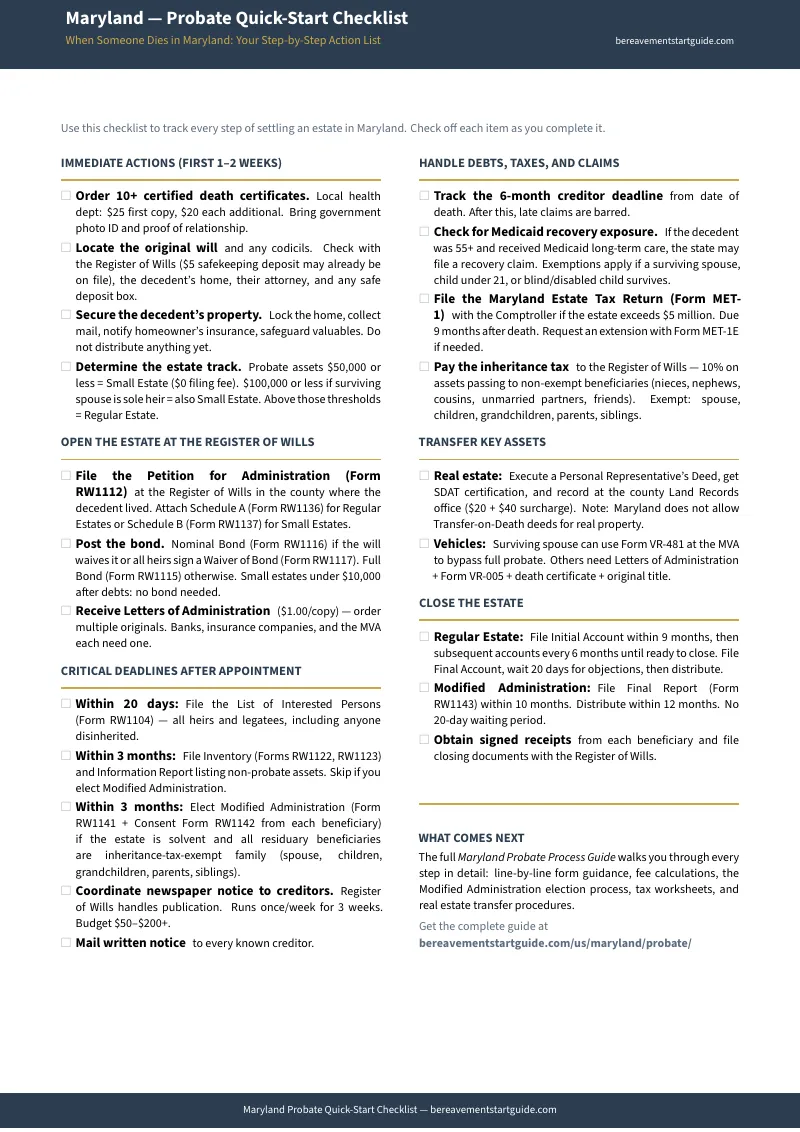
Not ready for the full guide? Download the free Maryland Probate Quick-Start Checklist — a printable action list covering death certificates, securing the estate, determining your estate track, and the critical deadlines for the first 90 days. Enough to get started tonight.
You did not ask for this job. But the process is knowable, the forms are finite, and the deadlines are clear. The guide shows you the path through it, one step at a time.
Frequently Asked Questions
What if the rules change after I buy?
We update the guide when the rules change. Email us any time, even years later, and we'll send you the current edition free.