Your Spouse Just Died in Maryland. Social Security Sent a Letter About Overpayment. The Health Insurance Expires in 45 Days. And No One Told You That Maryland Has a $50,000 Line-of-Duty Death Benefit, a Mini-COBRA Law Most Widows Never Hear About, and a Scholarship That Pays Your Children's College Tuition.
You are sitting at the kitchen table with a stack of mail that arrived before you were ready for it. The bank froze the checking account. The employer's HR department left a voicemail about "COBRA election deadlines." Social Security sent a notice saying the last month's deposit was an overpayment and must be returned. Your daughter's health insurance was on your spouse's plan, and you have no idea what happens to it now. The mortgage is due in twelve days. And somewhere underneath all of this, a thought keeps surfacing: there must be benefits I am entitled to — survivor pensions, death benefits, tax exemptions — but I do not know what they are, where to apply, or how long I have before the deadlines pass.
That thought is correct. Maryland survivors are routinely entitled to benefits from five or more separate agencies — Social Security, the Maryland State Retirement and Pension System, the Workers' Compensation Commission, the State Department of Assessments and Taxation, the Department of Human Services — and not one of those agencies will tell you about the others. Each operates on its own timeline, its own forms, and its own eligibility rules. Miss the 45-day window for Maryland's mini-COBRA health coverage and it is gone permanently. Fail to file for the $10,000 spousal allowance before creditors line up and you lose your statutory priority. Never learn about the Edward T. Conroy Memorial Scholarship and your children pay full tuition at a Maryland college when they could have attended for free.
The Maryland Survivor Benefits Navigator is a Benefits Triage System — a single, chronological roadmap that maps every federal and Maryland-specific benefit you may be owed, tells you exactly which agency controls it, which form to file, and which deadline will lock you out if you miss it. Not a sympathy pamphlet. Not a generic national checklist. A structured, Maryland-specific command center built for the person who just lost a spouse or parent and cannot afford to discover a missed benefit six months from now.
What's Inside the Benefits Triage System
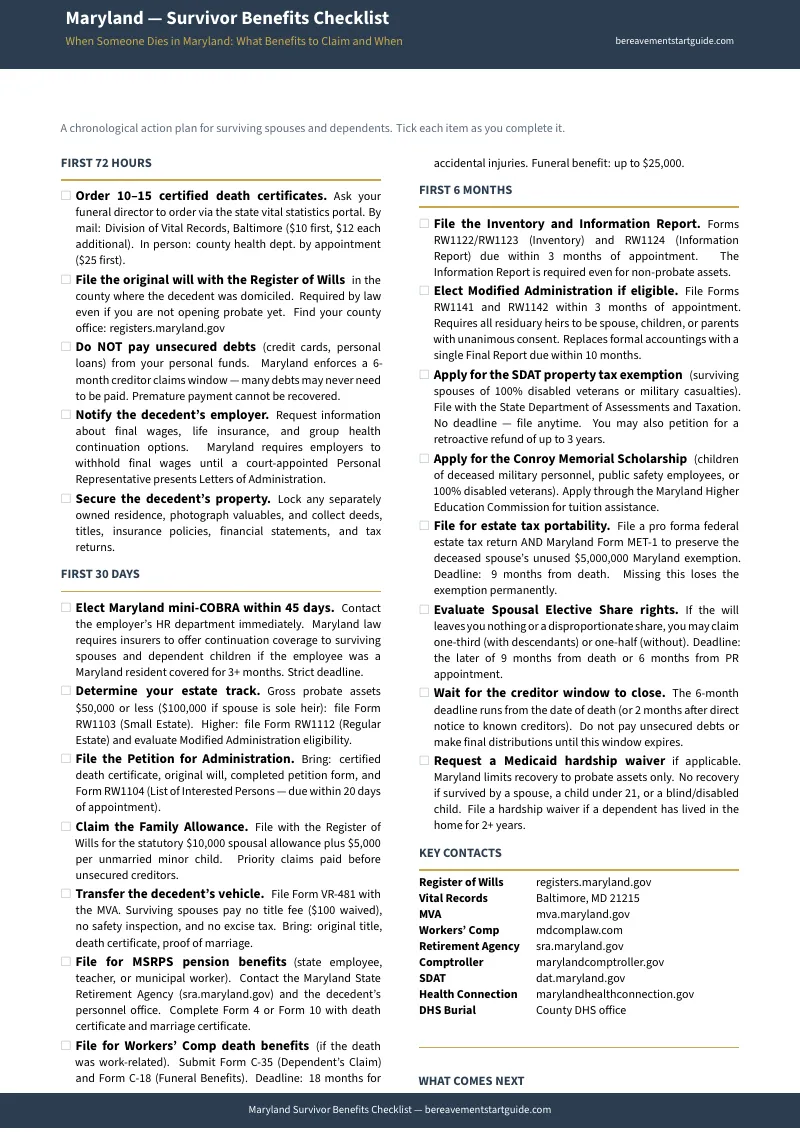
A comprehensive guide and the Maryland Survivor Benefits Checklist — covering every benefit stream from the moment of death through long-term financial recovery, built specifically for Maryland statutes, agencies, and the state-specific rules that make claiming benefits here different from any other state:
The First 72 Hours: Documentation and Damage Control
Before you can claim a single benefit, you need certified death certificates — and most families order too few. Maryland practitioners advise 10 to 15 certified copies because Social Security, the Register of Wills, every insurance company, and the MVA each demand an original with the raised seal. The guide gives you three ordering methods ranked by speed, tells you exactly how many you need based on your situation, and covers the single most expensive mistake surviving spouses make in the first three days: paying the decedent's unsecured debts from personal funds before the six-month creditor window even opens.
Social Security Survivor Benefits: The Federal Foundation
Social Security survivor benefits are federal, but the interaction with Maryland law creates traps that generic guides miss entirely. If your spouse was a Maryland state employee, teacher, or police officer, the Government Pension Offset used to cut your Social Security survivor benefit against your state pension --- but the Social Security Fairness Act repealed the GPO in January 2025, retroactive to January 2024, so you can now collect both in full. The guide explains exactly how to report the death to SSA, which family members qualify for monthly benefits, how the lump-sum $255 death payment works, how to check that SSA actually applied the repeal and paid the retroactive amount it owes you, and the specific interaction between federal survivor benefits and Maryland public employee pensions that catches thousands of Maryland widows off guard every year.
Maryland State Pension and Retirement Death Benefits
If your spouse worked for the State of Maryland, a county, a municipality, or a Maryland public school system, the Maryland State Retirement and Pension System owes you money — but the amount depends on whether the death was ordinary or line-of-duty. An ordinary death triggers a refund of accumulated contributions plus a lump sum equal to one year's salary. A line-of-duty death triggers the Special Death Benefit: 66 2/3% of the employee's final average salary paid to the surviving spouse or minor children. And if the decedent was a public safety employee killed in the performance of duty, there is an additional $50,000 state death benefit that most families never learn about because it is administered by a separate state office. The guide maps every tier, every form, and every agency involved.
Workers' Compensation Death Benefits
If the death was work-related — on the job, during a commute covered by the employer, or from an occupational disease — Maryland's Workers' Compensation Commission owes surviving dependents two-thirds of the deceased's average weekly wage, capped at 100% of the State Average Weekly Wage. Payments continue for up to 144 months. Funeral expenses are covered up to $25,000. But the filing deadlines are strict and the forms are not intuitive. The guide walks you through the exact claim process, the specific forms (C-35 for dependents, C-18 for funeral certification), and the 18-month filing deadline that the Commission does not remind you about.
Health Insurance: The 45-Day Deadline That Cannot Be Extended
This is the chapter that prevents a medical emergency from becoming a financial catastrophe. Maryland law requires employers, insurers, and HMOs to offer continuation coverage to surviving spouses and dependent children — but only if you elect it within 45 days of the death. This is Maryland's own mini-COBRA law, separate from federal COBRA, and it applies even to small employers that federal COBRA does not cover. If you miss this window, your next option is the Maryland Health Connection's Special Enrollment Period, which has its own 60-day deadline. The guide maps both pathways, explains which one applies to your situation, and gives you the exact steps to avoid a gap in coverage.
Property Tax Relief: Exemptions Most Widows Never Claim
Maryland offers property tax exemptions that can save thousands of dollars per year, but the State Department of Assessments and Taxation does not send you an application when your spouse dies. If your spouse was a veteran with a 100% service-connected disability, the full property tax exemption transfers to you as the surviving spouse. If your spouse was a military casualty, a separate exemption applies. And every Maryland homeowner should verify their Homestead Tax Credit enrollment — it caps annual assessment increases and requires a one-time application that many families never file. The guide covers every exemption, every form, and every agency involved.
Life Insurance Claims and the Augmented Estate Trap
Filing a life insurance claim seems straightforward — until Maryland's 2020 augmented estate law enters the picture. Under the revised Estates and Trusts Article Section 3-404, certain life insurance payouts can be pulled into the augmented estate calculation if a surviving spouse claims the elective share. This means assets that everyone assumed were "outside probate" may suddenly be part of a spousal protection claim in blended families. The guide explains how to file the claim efficiently, how Maryland's augmented estate law changes the math, and when to report bad-faith delays to the Maryland Insurance Administration.
Funeral Assistance and Burial Benefits
When liquidity is the immediate crisis, Maryland offers two lifelines that most families discover too late. The DHS Burial Assistance Program provides up to $650 toward funeral expenses — but only if the total funeral cost does not exceed $2,500 (excluding the burial lot, vault, and grave digging), and it cannot reimburse expenses already paid. For veterans and their spouses, Maryland's state veterans cemeteries at Crownsville, Garrison Forest, and Eastern Shore offer interment at zero cost for the plot and opening/closing. The guide details both programs, the eligibility requirements, and the exact application process.
The Family Allowance: Priority Claims That Come Before Creditors
Maryland law guarantees the surviving spouse a $10,000 allowance and $5,000 for each unmarried minor child, paid from the estate before any unsecured creditor receives a dollar. These are not discretionary — they are statutory entitlements under the Estates and Trusts Article. But you must file for them. The guide explains how to claim these allowances through the Register of Wills, the priority structure that protects them from creditor interference, and how they interact with the broader estate settlement process.
The Conroy Scholarship: Free College Tuition Most Families Miss
The Edward T. Conroy Memorial Scholarship provides tuition and mandatory fee assistance at Maryland colleges and universities for the children and surviving spouses of military personnel who died in service, public safety employees killed in the line of duty, and veterans with a 100% service-connected disability. This is not a partial discount — it covers tuition at any Maryland public institution. The guide explains the eligibility criteria, the application process through the Maryland Higher Education Commission, and the documentation requirements.
Medicaid Estate Recovery: What the State Can and Cannot Take
Families of deceased individuals who received Medicaid long-term care benefits after age 55 are often terrified that "the state will take the house." Maryland's actual rules are more nuanced than the fear suggests. Maryland generally limits recovery to probate-only assets. No recovery is permitted if the decedent is survived by a spouse, a child under 21, or a blind or disabled child. And a hardship exception protects homes where a dependent has lived continuously for two or more years and has no alternative housing. The guide explains the actual recovery rules, the exemptions, and how to request a hardship waiver.
The Transfer-on-Death Deed: Maryland's Brand-New Probate Avoidance Tool
Until May 2026, Maryland did not allow Transfer-on-Death deeds for real property. Senate Bill 651 changed that. Starting October 1, 2026, Maryland homeowners can execute a TOD deed that transfers real property directly to a named beneficiary upon death — bypassing probate entirely. The guide explains how this new law works, who should consider it, and the specific requirements that must be met for the deed to be valid. Many Maryland law firm websites still incorrectly state that TOD deeds are not available in the state.
Every Deadline in One Calendar
From the 45-day mini-COBRA election to the 9-month elective share deadline, every Maryland-specific statutory deadline in one sequential reference. The guide maps what must happen in the first 72 hours, the first 30 days, and the first 6 months — with clear explanations of what you lose if you miss each one.
Who This Guide Is For
- The surviving spouse whose partner just died and whose health insurance expires in 45 days — who needs to know about Maryland's mini-COBRA law, the $10,000 spousal allowance, the property tax exemptions, and every other benefit they are entitled to before the deadlines pass
- The surviving spouse of a Maryland state employee or teacher navigating the State Retirement and Pension System — who needs to know the difference between the Ordinary Death Benefit and the Special Death Benefit, whether the $50,000 line-of-duty payment applies, and what the repeal of the Government Pension Offset means for their Social Security --- including the retroactive money SSA may still owe them
- The family of a worker killed on the job facing the Workers' Compensation Commission for the first time — who needs the exact forms, the filing deadlines, and the benefit calculations that law firm websites deliberately obscure to force a consultation
- The surviving parent with school-age children who needs to secure Social Security child benefits, evaluate the Conroy Scholarship, and ensure health coverage continues without a gap
- The family facing a liquidity crisis who cannot afford funeral expenses and needs the DHS Burial Assistance Program, veterans cemetery benefits, or the family allowance before any other claim is processed
- The adult child managing a deceased parent's benefits from out of state — who needs every agency, every form, and every deadline in one document instead of navigating fifteen different Maryland government websites
Why Free Resources Will Not Get You Through This
The benefits exist. The information is scattered across Social Security's national portal, the Maryland State Retirement Agency's PDF handbooks, the Workers' Compensation Commission's form library, the SDAT property tax application repository, and a dozen other agency websites that do not reference each other. Here is what you actually encounter when you try to claim Maryland survivor benefits using free sources alone:
- Social Security tells you about Social Security. The SSA website explains federal survivor benefits thoroughly. It says little about what the repeal of the Government Pension Offset means for Maryland state employees in practice --- whether SSA has recalculated your benefit, whether the retroactive payment back to January 2024 has landed, or what to do if you never applied because the old offset would have zeroed you out. It says nothing about state pension death benefits that exist alongside SSA, and nothing about the mini-COBRA health coverage deadline that is running simultaneously.
- The Maryland State Retirement Agency buries critical details in 200-page PDF manuals. The information about death benefits is accurate but distributed across multiple handbook chapters organized by pension tier, not by what a surviving spouse needs to do right now. The $50,000 line-of-duty death benefit is administered by a separate state office and does not appear in the retirement agency's materials at all.
- Workers' compensation law firms write blog posts designed to sell contingency-fee retainers. They provide just enough statutory detail to confirm the benefit exists, then deliberately withhold the exact filing procedures and benefit calculations so you call their office. The guide gives you the exact numbers they leave out.
- SDAT provides application forms without explaining eligibility in plain language. The property tax exemption applications are available online as PDFs. But understanding which exemption applies to your situation — disabled veteran, military casualty, general homestead — requires reading scattered statutory references that SDAT does not consolidate for the public.
- No single state or federal resource connects all five benefit streams into one timeline. Social Security, state pensions, workers' compensation, property tax relief, and health insurance each operate in their own silo. The Benefits Triage System is the only document that maps all of them in the order you need them.
Free resources give you one agency at a time. The Benefits Triage System gives you every Maryland-specific benefit in one document, in the order the deadlines arrive.
— Less Than Fifteen Minutes With a Maryland Attorney
A single consultation with a Maryland probate or elder law attorney costs $250 to $400 per hour. Benefits consultants charge $150 to $300 for a session that covers one or two programs. This guide costs less than a quarter-hour of professional time and maps every federal and Maryland-specific benefit you may be owed — Social Security, state pensions, workers' compensation, property tax exemptions, health insurance continuation, funeral assistance, educational scholarships, and the statutory protections that Maryland law guarantees before creditors.
Your download includes the complete guide, the Maryland Survivor Benefits Checklist, a printable Deadline Calendar with a fillable "Your Date" column, an Essential Forms Reference card listing every form by filing stage, and a Health Insurance Continuation Worksheet that walks you through the Mini-COBRA vs. marketplace decision. Five PDFs total. Instant download, no account required.
Money-back guarantee, no time limit. If the guide does not give you clarity on which benefits you are entitled to and confidence that you are claiming them in the right order, email us for a full refund. No questions asked.
Not ready for the full guide? Download the free Maryland Survivor Benefits Checklist — a one-page overview of every benefit stream, the key deadlines, and the agencies to contact first. It is enough to know what you are dealing with tonight.
You did not ask for this. But the benefits are there, and they do not claim themselves. The guide shows you where to look, what to file, and when.
Frequently Asked Questions
What if the rules change after I buy?
We update the guide when the rules change. Email us any time, even years later, and we'll send you the current edition free.