The Funeral Home Just Told You Embalming Is "Required," the Cremation Wait Is 48 Hours, and the Casket Must Come From Them. Massachusetts Law Says Otherwise on All Three. But Nobody at the Funeral Home Is Going to Explain That.
Someone you love just died. Within hours, you are sitting in a funeral home arrangement room listening to a director walk through service packages, explain that embalming is necessary for the viewing, and suggest that cremation cannot proceed for several days. Every sentence sounds like law. None of it is. Massachusetts does not require embalming under any circumstance. The FTC Funeral Rule guarantees your right to purchase a casket from any third-party vendor with no handling fee. And while there is a mandatory 48-hour cremation waiting period under M.G.L. c. 114, the reason it exists — and the sole statutory exception for highly contagious disease — is something the funeral home will never volunteer.
You are grieving, exhausted, and being asked to make financial decisions that will cost your family $8,000 to $15,000 in the next three days. The funeral home's internal policies sound identical to state law, and there is no practical way to tell the difference while sitting in that room. The FTC Funeral Rule requires every funeral home to hand you a General Price List with 16 itemized categories — but the rule does not require them to tell you which items you can legally decline. Meanwhile, Massachusetts is the only state in the country without a codified right of disposition statute, meaning the question of who controls the funeral is governed by a probate code workaround that most families do not discover until they are already in a dispute.
The Massachusetts Funeral Laws & Consumer Rights Guide is a Consumer Protection System for every decision between the moment of death and the final disposition of remains. Not a grief handbook. Not a generic funeral planning template that treats Massachusetts like every other state. A structured, Massachusetts-specific manual built around M.G.L. c. 114, 505 CMR 4.03, 239 CMR 3.10, and the FTC Funeral Rule — covering the exact laws, the exact consumer rights, the exact hidden fees, and the exact steps that protect your family from spending thousands of dollars on services that Massachusetts law never required.
What's Inside the Consumer Protection System
A comprehensive 19-chapter guide, a Funeral Consumer Rights Checklist, and standalone reference tools — covering every stage from the moment of death through final disposition, estate basics, and complaint resolution, built specifically for Massachusetts's unique regulatory framework and the consumer rights that funeral homes are not obligated to explain to you:
The First 48 Hours: The Disposition Permit, Cremation Wait, and the Decisions You Cannot Undo
Massachusetts ties every subsequent step — cremation, burial, transport — to a single document: the Disposition Permit issued by the local Board of Health under M.G.L. c. 114, Section 45. Without it, nothing moves. The guide walks through the exact sequence for obtaining this permit, explains the mandatory 48-hour cremation waiting period (and why the sole exception for highly contagious disease matters), covers what happens at the hospital or care facility, and tells you exactly how many certified death certificates to order and why the number is higher than you think. This chapter prevents the most expensive mistakes — the ones made in the first two days while you are still in shock.
Who Controls the Funeral: Massachusetts's Unique Legal Vacuum
Massachusetts is the only state without a codified right of disposition statute. There is no dedicated law that designates a specific person to make funeral decisions. Instead, authority flows through a probate code workaround: M.G.L. c. 190B, Section 3-701 gives a named Personal Representative pre-appointment authority to carry out written disposition instructions. If there is no will, authority follows customary next-of-kin order — surviving spouse, adult children, parents, siblings. Health care proxies terminate at death and do not carry over into funeral decision-making. The guide documents the complete authority hierarchy, the limits of the probate code workaround, and the specific scenarios — blended families, estranged relatives, no will — that cause the most devastating disputes at the worst possible moment.
Your FTC Funeral Rule Rights: What the Funeral Home Must Tell You and What They Will Not
Every funeral home must provide a General Price List containing 16 itemized categories the moment you ask — in person or over the phone without identifying yourself. That is federal law. What the Funeral Rule does not require is for the funeral director to volunteer that you can legally purchase a casket from Amazon, Costco, or any third-party vendor and the funeral home cannot charge you a handling fee. The guide maps every FTC-mandated disclosure against your corresponding Massachusetts consumer rights, including the non-declinable service fee, casket rental under 239 CMR 3.10, and the specific items you can refuse in any bundled package.
Embalming: What Massachusetts Law Actually Requires
Massachusetts does not require embalming. No state law, no Department of Health regulation, no Board of Registration rule mandates embalming under any circumstance — not for viewing, not for transport, not for delayed burial. What funeral homes do is establish internal policies requiring embalming for open-casket viewings, then present those policies in language that sounds like regulation. The guide explains the exact legal status of embalming in Massachusetts, documents the fully legal preservation alternatives — refrigeration at 38-42 degrees, dry ice, cooling blankets — and provides the specific basis you need to decline this $500-$1,000+ service with confidence.
Cremation: The 48-Hour Wait, the $200 Medical Examiner Fee, and the Structural Split You Were Not Told About
The mandatory 48-hour cremation waiting period is state law under M.G.L. c. 114 — not a funeral home policy. The guide documents the exact statute and sole exception. But the hidden cost is the $200 Medical Examiner fee required under 505 CMR 4.03 before any cremation can proceed. This mandatory state fee appears on your funeral home bill as a pass-through charge, and many funeral homes roll it into their base cremation price without itemizing it. Additionally, Massachusetts prohibits funeral homes from operating their own crematories — every cremation is contracted to an independent facility, typically within a cemetery, leading to fragmented billing that catches families off guard. The guide separates state-mandated costs from funeral home markups so you know exactly what you are paying for and why.
Scattering Cremated Remains: Massachusetts Rules
The Massachusetts Department of Public Health imposes no specific restrictions on keeping, burying, or scattering cremated remains. You can keep ashes at home, bury them on private property with the landowner's permission, or scatter them in most outdoor locations without a permit. The guide covers the practical rules — private land permission, state park and waterway considerations, environmental guidance on concentrated scattering — and separates fact from the myths that circulate on national funeral websites.
Home Funerals and Caring for Your Own Dead
Massachusetts law allows families to care for their own dead without hiring a licensed funeral director. You can wash and dress the body, hold a vigil at home, and transport the remains to a crematory or cemetery yourself. But exercising this right requires navigating a specific bureaucratic sequence: obtaining the death certificate through the Town Clerk, securing the Disposition Permit from the local Board of Health, and coordinating with the municipal burial agent. The guide walks through every step of this sequence and distinguishes between what families can do themselves and what requires interaction with state agencies.
Green Burial and Natural Burial Options
Green burial — without embalming, without a concrete vault, in a biodegradable container — is entirely legal in Massachusetts. No state law requires burial vaults or liners. But individual cemetery bylaws may impose their own requirements. The guide distinguishes between state law and private cemetery policy, covers the conservation burial options available in the state, and documents the specific regulatory steps for families who want a home burial on private land — including the site plan, soil evaluation, hydrogeology assessment, and Board of Health hearing required under M.G.L. c. 114.
Prepaid Funeral Contracts: What the Law Protects and What It Does Not
Irrevocable prepaid funeral contracts serve a critical dual purpose in Massachusetts: they lock in funeral prices at today's rates and they are exempt from MassHealth countable asset calculations under 239 CMR 4.00. For families engaged in Medicaid spend-down planning, this is one of the few legal mechanisms to preserve assets while securing exact end-of-life wishes. The guide covers the trust requirements, the critical difference between revocable and irrevocable contracts, your right to transfer a contract to a different funeral home, and what happens to the trust funds if the original funeral home closes.
The $25,000 Voluntary Administration Shortcut
If the estate consists entirely of personal property valued at $25,000 or less — excluding one motor vehicle — Massachusetts allows a streamlined "Voluntary Administration" that bypasses formal probate entirely. File Form MPC 170 with the Probate and Family Court after 30 days from death, pay $115, and close the estate without the year-long probate process. This threshold also falls below MassHealth's automatic estate recovery waiver line. The guide explains the exact eligibility criteria, the forms required, and the strategic timing that maximizes protection for small estates.
MassHealth Estate Recovery: The 60-Day Clock Your Family Cannot Miss
MassHealth recovers the costs of long-term care from the probate estates of members who were 55 or older or permanently institutionalized at any age. The Personal Representative must notify MassHealth via certified mail before petitioning the Probate Court — failure to do so creates personal liability. If MassHealth files a recovery claim, the estate has exactly 60 days to file a hardship waiver. Three waivers exist: Residence and Financial Hardship (heir lived in home 2+ years, income below 133% FPL), Care Provided (heir's care delayed institutionalization for 2+ years), and Income-Based (protects up to $50,000 per heir if income is below 400% FPL). Missing the 60-day deadline forfeits all waiver rights permanently. The guide provides the exact parameters, documentation requirements, and filing instructions for each waiver.
Massachusetts Estate Tax: The $2,000,000 Threshold That Catches Middle-Class Families
The Massachusetts estate tax applies at $2,000,000 — while the federal exemption approaches $15,000,000 by 2026. That gap catches families who assume the federal threshold protects them. The $2,000,000 threshold includes the federal taxable estate plus adjusted taxable gifts. A $99,600 uniform credit eliminates tax on the first $2,000,000, but estates exceeding the threshold face rates from 0.8% to 16%. Form M-706 is due nine months after death. The guide explains the calculation, the filing requirements, and how home equity plus retirement accounts push ordinary Massachusetts families above the threshold.
Vehicle Title Transfer Without Probate
Surviving spouses can transfer a vehicle title at the RMV using the Affidavit of Surviving Spouse (Form MVU-28 or TTL103) with a certified death certificate. The RMV waives the title fee and sales tax entirely. New plates cost up to $60; keeping the existing plate is free. The guide covers the complete process for spousal transfers, transfers for vehicles with active loans, and the specific documents required at the RMV counter.
Homestead Protections: $125,000 Automatic vs. $1,000,000 Declared
Massachusetts automatically protects $125,000 in home equity from unsecured creditors. But if the homeowner filed a Declaration of Homestead at the County Registry of Deeds, that protection increases to $1,000,000. The declared protection extends to surviving spouses and minor children after death and survives as long as an eligible family member lives in the home. The guide documents both levels of protection, the filing process, and the specific creditor types the homestead does and does not shield against.
Veterans Burial Benefits: Massachusetts-Specific Execution
Federal VA burial benefits are widely documented. What is not documented is how to execute them within Massachusetts. The guide covers the two state veterans cemeteries (Agawam and Winchendon), the eligibility requirements, the specific paperwork, and the costs: eligible veterans receive a free burial plot, grave opening/closing, and headstone. Spouse burial is $150 for cremated remains or $300 for casketed burial. The guide maps how VA reimbursements interact with estate probate obligations and the timing that matters.
Filing a Complaint: The Regulatory Map Most Families Never Find
The Board of Registration in Embalming and Funeral Directing handles complaints about funeral director conduct, licensing violations, and industry practices. The Office of Investigations (617-701-8600) is the direct enforcement contact. For pricing fraud and Funeral Rule violations, the Massachusetts Attorney General's Office handles consumer protection complaints. The guide provides the complete jurisdictional map, the direct contacts, and the documentation process for each agency.
Common Mistakes That Cost Massachusetts Families Thousands
Ten documented mistakes that drain estates and create personal liability: paying for embalming you did not need, not requesting the GPL, ignoring the $200 Medical Examiner fee, missing the 30-day Voluntary Administration window, failing to notify MassHealth before filing probate, missing the 60-day hardship waiver deadline, distributing assets before the one-year creditor window closes, not recording a Homestead Declaration, assuming the federal estate tax threshold applies to Massachusetts, and not having a will with explicit disposition instructions. Each mistake includes the specific cost, the Massachusetts citation, and the corrective action.
Who This Guide Is For
- The family member sitting in the funeral home arrangement room right now — who was just told that embalming is required for the viewing, that the casket must be purchased through the funeral home, and that cremation cannot happen for several days. None of those statements are Massachusetts law. You need to know what you can legally refuse before you sign the contract.
- The next-of-kin in a family disagreement over what happens to the body — who does not know that Massachusetts is the only state without a codified right of disposition statute. The authority hierarchy runs through the probate code, not a dedicated disposition law. Whether you have the legal right to decide depends on the will, the next-of-kin order, and whether a Health Care Proxy included disposition language that terminated at death.
- The executor who does not know about the $25,000 threshold — who is about to spend months in formal probate when a $115 Voluntary Administration filing would close the estate in weeks. Or worse, the executor who does not know that MassHealth must be notified via certified mail before petitioning the Probate Court — creating personal liability from a procedural mistake they did not know existed.
- The adult child planning cremation for a parent — who is being told conflicting information about waiting periods, Medical Examiner fees, and who must authorize the cremation. The guide has the exact statutory citations so you can verify every claim the funeral home or crematory makes.
- The family member watching a parent's home equity approach $2,000,000 — who assumes the federal estate tax exemption of $15,000,000 protects them and does not realize Massachusetts starts taxing at $2,000,000. Or who does not know that a $1,000,000 Homestead Declaration at the Registry of Deeds protects home equity from unsecured creditors both before and after death.
- The pre-planner evaluating prepaid funeral contracts for Medicaid spend-down — who needs to understand that irrevocable prepaid contracts are exempt from MassHealth countable assets under 239 CMR 4.00. The guide documents the trust requirements, the revocable vs. irrevocable distinction, and the transfer rights that protect the consumer.
Why Free Resources Will Not Get You Through This
The information exists. It is scattered across Mass.gov, the FTC website, the Board of Registration in Embalming and Funeral Directing, the Registry of Vital Records, the Probate and Family Court, and the Funeral Consumers Alliance of Massachusetts. Here is what you encounter when you try to navigate Massachusetts funeral rights using free sources alone:
- Mass.gov is comprehensive but fragmented by design. The death certificate process lives on the Registry of Vital Records page. The cremation rules are under the Board of Registration in Embalming and Funeral Directing. MassHealth estate recovery is on the Executive Office of Health and Human Services site. The Probate Court has its own portal for every MUPC form. The estate tax is on the Department of Revenue. Five separate agencies, five separate websites, no cross-references between them, and all written in legislative language without step-by-step guidance. The forms are available — the sequence for using them is not.
- National funeral directories get Massachusetts-specific facts wrong. Multiple national sites list the wrong cremation waiting period for Massachusetts, omit the $200 Medical Examiner fee entirely, and provide generic "next-of-kin" hierarchies that miss the fact that Massachusetts has no codified right of disposition statute. When a national site tells you embalming is "usually not required," that is not the same as knowing it is never required under Massachusetts law and having the specific regulatory basis to decline it.
- The Funeral Consumers Alliance of Massachusetts provides invaluable price survey data but no procedural roadmap. FCAME publishes local funeral home pricing comparisons — essential data for negotiation. But their website does not provide sequential checklists, does not explain the death certificate timeline, does not integrate with probate navigation or MassHealth recovery, and does not cover the disposition authority vacuum. Price data without a procedural system leaves families knowing what things should cost but not how to enforce that knowledge.
- Elder law firms use educational content to sell $300+/hour consultations. Massachusetts probate and elder law firms publish excellent explainers about Voluntary Administration, MassHealth recovery waivers, and estate tax thresholds. The content is designed to highlight complexity and drive the reader toward a "Schedule a Consultation" button. By the time a family realizes they need to understand the 60-day hardship waiver deadline, the consultation itself costs more than the guide.
Free resources give you fragments from six different agencies that do not reference each other. The Consumer Protection System puts every Massachusetts-specific statute, consumer right, regulatory contact, hidden fee, and procedural step into one document, in the order you actually need them.
— Less Than the $200 Medical Examiner Fee They Did Not Tell You About
A full-service funeral in Massachusetts averages $8,000 to $15,000. A single "required" embalming you did not need costs $500 to $1,000+. The mandatory $200 Medical Examiner fee that funeral homes roll into their base cremation price without itemizing it. A casket purchased through the funeral home instead of a third-party supplier costs $2,000 to $5,000 more than the identical model online. One consultation with an elder law attorney about MassHealth estate recovery costs $300 to $500 per hour. This guide costs less than a single hidden fee and gives you the complete Massachusetts-specific system — every consumer right, every regulatory citation, every procedural step, and the decision frameworks that tell you what to accept, what to refuse, and where to file a complaint if something goes wrong.
Your download includes the complete 19-chapter guide, the standalone Massachusetts Funeral Consumer Rights Checklist, and printable reference tools covering the FTC Funeral Rule, embalming refusal rights, cremation rules and timelines, disposition options, the authority hierarchy, death certificate and permit procedures, prepaid contract verification, complaint filing, funeral cost comparison, and veterans burial benefits. Every tool you need to walk into a funeral home or crematory knowing exactly what the law says. Instant download, no account required.
Money-back guarantee, no time limit. If the guide does not give you clarity on your consumer rights and confidence that you are making informed decisions about funeral arrangements, email us for a full refund. No questions asked.
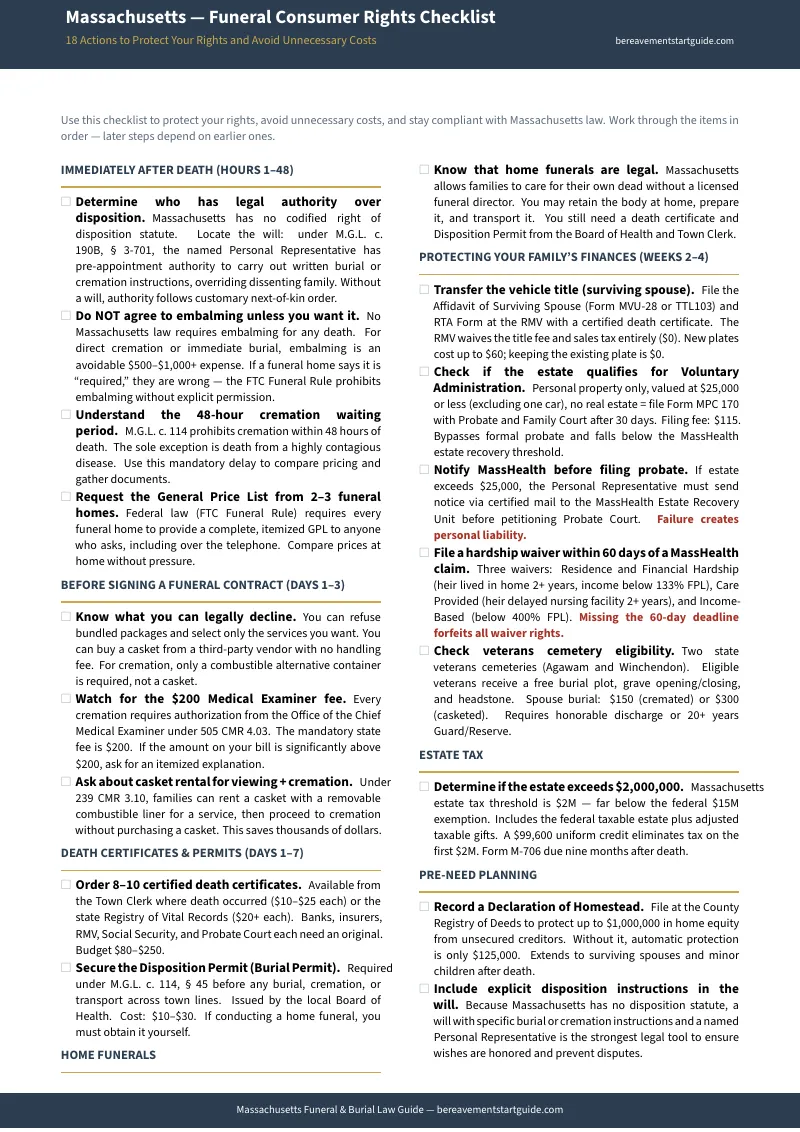
Not ready for the full guide? Download the free Massachusetts Funeral Consumer Rights Checklist — a printable 18-item action list covering your core legal rights when dealing with funeral homes, crematories, and cemeteries in Massachusetts. Enough to know what you can legally refuse before your next conversation with a funeral director.
You should not have to learn consumer protection law while you are grieving. But the rights are real, the savings are significant, and the guide puts them in your hands before anyone else can take advantage of the fact that you did not know.
Frequently Asked Questions
What if the rules change after I buy?
We update the guide when the rules change. Email us any time, even years later, and we'll send you the current edition free.