You Were Just Named Personal Representative in Massachusetts. The Probate Court Wants Five Different Forms Filed in a Specific Order. The Estate Might Qualify for a $115 Shortcut That Skips the Entire Probate Process. And the State Just Rewrote the Rules on Whether MassHealth Can Claim the Family Home.
You did not plan for this. Maybe you were named in the will. Maybe there was no will, and the family turned to you because you are the surviving spouse, the eldest child, or the one who lives closest. Either way, the funeral is barely over and the paperwork has started. The bank froze the accounts the moment they received a death certificate. The Probate and Family Court wants a petition, an inventory, and forms you have never seen. Your brother is asking about the house. And you just discovered that Massachusetts imposes its own estate tax on estates over $2,000,000 — with an automatic lien on every property the deceased owned, even if the estate owes nothing.
Welcome to probate under the Massachusetts Uniform Probate Code. Not one process, but four possible tracks — Voluntary Administration, Informal Probate, Formal Probate, and Late and Limited — each with its own forms, deadlines, and consequences for getting it wrong. The Probate and Family Court has the forms but is legally prohibited from telling you which ones to file, in what order, and what happens if you miss a deadline. Massachusetts probate attorneys will guide you, at hourly rates that run $3,000 to $10,000 in retainers for a straightforward estate.
The Massachusetts Probate Process Guide is a Four-Track Decision System for every procedural step between the death certificate and the final distribution. Not a law textbook. Not a generic probate overview that treats Massachusetts like every other state. A structured, Massachusetts-specific manual built around the MUPC, the Probate and Family Court procedures, and the state-specific rules — the $25,000 Voluntary Administration shortcut, the motor vehicle exemption, the Chapter 197 MassHealth reforms, the estate tax lien release — that make probate here different from any other state.
What's Inside the Four-Track Decision System
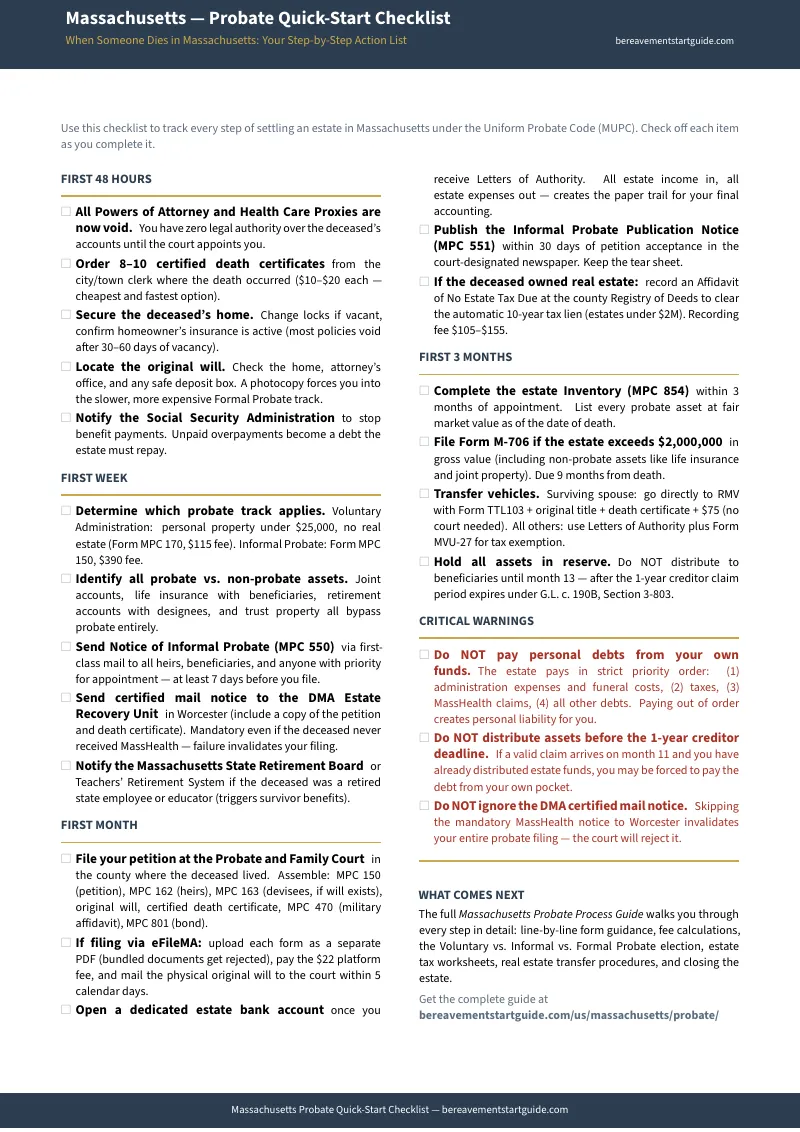
A comprehensive 12-chapter guide and a Quick-Start Probate Checklist — covering every stage from locating the original will through closing the estate, built specifically for the Massachusetts Uniform Probate Code, the Probate and Family Court procedures, and the state-specific rules that catch families off guard:
How Massachusetts Probate Actually Works: Four Tracks, One Decision Tree
Before you file a single form, you need to know which track applies to your estate. Massachusetts runs four distinct probate pathways — Voluntary Administration for small personal-property estates, Informal Probate for uncontested estates with a clear will, Formal Probate when disputes or problems surface, and Late and Limited for cases filed more than three years after death. The guide walks you through a decision tree that sorts your estate into the right track based on three questions: total asset value, presence of real estate, and whether all heirs agree. Get this wrong and you waste hundreds of dollars filing the wrong forms.
Immediate Actions: The First 30 Days After a Death
Every Power of Attorney and Health Care Proxy the deceased signed became void at the instant of death. You have zero legal authority over their accounts, property, or affairs until the court formally appoints you. The guide covers the exact sequence: ordering death certificates from the city or town clerk (the cheapest and fastest option at $10-$20 each), securing vacant property before insurance lapses, locating the original will — because a photocopy forces you into the slower Formal Probate track — and the critical things NOT to do, including paying the deceased's credit card bills from your own pocket.
Voluntary Administration: The $115 Shortcut Most Families Miss
If the estate consists entirely of personal property valued at $25,000 or less, with no real estate, you can skip full probate entirely. One form — MPC 170 — one filing fee of $115, and you can walk into the bank with the court-stamped statement to release the accounts. The guide explains the most beneficial quirk in Massachusetts probate law: a single motor vehicle, regardless of value, is completely excluded from the $25,000 calculation. A $40,000 car and $18,000 in bank accounts? Still qualifies. The guide walks you through the 30-day waiting period, the exact filing steps, and how to use the MPC 170 at the bank window and the RMV.
Informal Probate: The Main Track for Most Estates
For estates above $25,000 or containing real estate, Informal Probate is the standard path — handled by a magistrate, no courtroom hearing required. But the filing is not just one form. It is a package: MPC 150 (petition), MPC 162 (surviving spouse and heirs), MPC 163 (devisees), MPC 470 (military affidavit), MPC 801 (bond), plus the original will and certified death certificate. The guide walks through each form, explains the mandatory 7-day advance notice to all interested parties, covers the $390 filing fee, and details the eFileMA electronic filing process — including the rule that bundled PDF uploads get rejected.
Formal Probate: When Things Get Complicated
The moment a formal objection is filed, your informal proceedings freeze. The powers granted to the Personal Representative are suspended until a judge rules. The guide explains when Formal Probate is unavoidable — a lost or damaged will, a photocopy instead of the original, handwritten changes, unknown heirs, or actively disputing family members — and what it means for timelines and costs. This chapter is honest: when formal litigation begins, the guide tells you plainly that you need an attorney, and shows you how to use the checklists to reduce their billable hours.
The Estate Inventory: Three Months, No Extensions
Form MPC 854 is due within three months of your appointment as Personal Representative. The guide covers exactly what goes on the inventory — and equally important, what stays off. Joint bank accounts, life insurance with named beneficiaries, retirement accounts with designated beneficiaries, and property held in a living trust all bypass probate and should not appear on your MPC 854. Inflating the probate estate by listing non-probate assets is one of the most common mistakes pro se executors make, and it can trigger unnecessary tax exposure.
Real Estate: The Tax Lien Nobody Warned You About
Massachusetts places an automatic estate tax lien on every piece of real property the deceased owned — even if the estate is worth far less than the $2,000,000 estate tax threshold and owes nothing. If you try to sell the house without clearing this lien, the buyer's title insurance company will halt the closing. The guide covers the complete real estate process: determining whether a License to Sell is required under G.L. c. 202, filing the MPC 210 petition if needed, and clearing the automatic tax lien by filing Form M-792 or a notarized affidavit at the Registry of Deeds. Every step between Letters of Authority and a clear title.
Creditor Claims and the One-Year Rule
This is the chapter that protects you from personal liability. Massachusetts gives creditors one full year from the date of death to file claims against the estate. If you distribute assets to beneficiaries before that year expires and a valid claim arrives on month 11, you may be forced to pay the debt from your own pocket. The guide explains the statutory payment priority — funeral expenses first, then administration costs, then taxes, then MassHealth claims, then all other debts — and the protective strategy of holding reserves in an estate account until day 366.
MassHealth Estate Recovery: The 2024 Chapter 197 Reforms
If the deceased was 55 or older and received long-term care benefits, the Commonwealth can file a recovery claim against the probate estate. Families hear "the state will take the house" and panic. The reality changed dramatically in August 2024. Chapter 197 of the Acts of 2024 limits recovery to federally mandated minimums, exempts CommonHealth and Personal Care Attendant costs entirely, provides an automatic waiver for gross probate estates of $25,000 or less, and introduces income-based hardship waivers up to $50,000 per heir. Most online resources still cite the pre-2024 rules. The guide covers the current law.
Massachusetts Estate Tax: The $2,000,000 Threshold
While the federal estate tax exemption sits at $15,000,000, Massachusetts taxes estates above $2,000,000 at graduated rates up to 16%. The guide covers when Form M-706 is required (due 9 months from death), how to calculate gross estate value including non-probate assets, and the critical process for clearing the estate tax lien on real property — the step that halts house sales when executors do not know it exists.
Closing the Estate: Ending Your Legal Liability
Filing the closing statement is not just paperwork — it is your legal shield. The guide covers both Form MPC 850 (standard closing) and MPC 851 (small estate closing), explains the powerful statutory protection these forms provide, and details the final distribution process. Once the closing statement is filed and one year passes without a legal challenge, the Personal Representative is permanently shielded from future claims except in cases of proven fraud.
When You Need a Lawyer and When You Do Not
This chapter is honest. For Voluntary Administration estates and straightforward uncontested Informal Probate cases with solvent assets, the guide and checklist are designed to get you through the process without a retainer. For contested wills, insolvent estates, complex MassHealth recovery audits, or actively hostile family disputes, the guide says so plainly — and shows you how to use the checklists to organize everything before the first consultation, reducing the attorney's billable hours by doing the administrative legwork yourself.
Who This Guide Is For
- The executor who just got turned away at the bank trying to access the deceased's checking account — who needs Letters of Authority from the Probate and Family Court but does not know which of the four tracks applies to the estate, whether it qualifies for the $115 Voluntary Administration shortcut, or what forms to file first
- The surviving spouse trying to sell the family home whose buyer's title company just halted the closing because the Massachusetts estate tax lien has not been cleared — who needs the exact process for filing Form M-792 or a notarized affidavit at the Registry of Deeds, even though the estate is well below the $2,000,000 threshold
- The out-of-state adult child named Personal Representative for a parent who died in Massachusetts — who needs every MUPC form, deadline, and filing sequence in one document so they can manage the process without repeated trips to the Probate and Family Court
- The family terrified of MassHealth recovery who heard "the state will take everything" because the deceased received nursing home benefits — who needs the actual post-Chapter 197 rules, the $25,000 automatic waiver, the income-based hardship exemptions, and which assets are genuinely at risk
- The executor managing a small estate who does not realize the $40,000 car does not count toward the $25,000 Voluntary Administration threshold — who could skip the $390 Informal Probate filing entirely and resolve everything with a single $115 form
- The conflict-averse administrator trying to keep siblings from escalating a disagreement into Formal Probate — who needs a documented, authoritative playbook to show the family that every step is being handled by the book
Why Free Resources Will Not Get You Through This
The information exists. It is scattered across Mass.gov, the Probate and Family Court website, the Department of Revenue, the Registry of Deeds, MassHealth, and a dozen federal agency portals. Here is what you encounter when you try to navigate Massachusetts probate using free sources alone:
- Mass.gov hosts every MUPC form but is legally prohibited from telling you what to do with them. The Estate Administration Procedural Guide is a 14-chapter technical manual written for court staff and legal practitioners. It provides form numbers without filing sequences, deadlines without consequences, and statutory references without plain-English explanations. It hands you the pieces without the order.
- Massachusetts probate attorneys write content designed to sell retainers. Local firms produce accurate blog posts that carefully omit the procedural how-to. Every article highlights the extreme dangers, the personal liability risks, the complexity of the MUPC — then closes with a "Schedule a Consultation" button. For contested estates, they are right. For straightforward estates, a $5,000 retainer buys organization you can build yourself.
- National platforms miss the details that make Massachusetts different. Nolo and FindLaw offer polished overviews that consistently use incorrect terminology — calling them "Letters Testamentary" instead of the MUPC-correct "Letters of Authority." They miss the Voluntary Administration vehicle exemption, skip the Chapter 197 MassHealth reforms entirely, and treat Massachusetts probate like every other state. It is not.
- MassLegalHelp provides solid explanations in academic prose. Their content is accurate and well-sourced. But there are no printable checklists, no decision trees for choosing between probate tracks, and no way to track your progress through a 12-month timeline. It reads like a reference, not a crisis management tool.
Free resources give you fragments from a dozen sources that do not reference each other. The Four-Track Decision System puts every Massachusetts-specific statute, form, deadline, and procedure into one document, in the order you actually need them.
— Less Than Fifteen Minutes With a Massachusetts Probate Attorney
A single consultation with a Massachusetts probate attorney costs $250 to $400 per hour. Standard probate representation runs $3,000 to $10,000 as a flat retainer. National estate planning software charges $149 per year in recurring subscriptions. This guide costs less than fifteen minutes of professional legal time and gives you the complete Massachusetts-specific roadmap — every track, every form, every deadline, and the decision trees that tell you whether you even need an attorney at all.
Your download includes 7 PDFs: the complete 12-chapter guide, the standalone Quick-Start Probate Checklist, a one-page Four-Track Decision Tree flowchart, a printable Critical Deadlines fridge sheet with fill-in date fields, an Essential Forms Reference Card covering all 16 MUPC forms, a Complete Fee Schedule for every court and government filing, and a Real Estate Tax Lien Clearance Checklist for the Registry of Deeds process. Every tool you need to walk into the Probate and Family Court with confidence. Instant download, no account required.
Money-back guarantee, no time limit. If the guide does not give you clarity on which track your estate follows and confidence that you are filing the right forms in the right order, email us for a full refund. No questions asked.
Not ready for the full guide? Download the free Massachusetts Probate Quick-Start Checklist — a printable action list covering death certificates, securing the estate, determining your probate track, and the critical deadlines for the first 90 days. Enough to get started tonight.
You did not ask for this job. But the process is knowable, the forms are finite, and the deadlines are clear. The guide shows you the path through it, one step at a time.
Frequently Asked Questions
What if the rules change after I buy?
We update the guide when the rules change. Email us any time, even years later, and we'll send you the current edition free.