The State Just Placed an Automatic Tax Lien on Your Home. The Pension Office Says Survivor Benefits Depend on an "Option" Your Spouse Chose Years Ago. MassHealth Is Preparing to Recover the Cost of Nursing Care From the Estate. And You Have 60 Days to File a Waiver You Did Not Know Existed.
Someone has died in Massachusetts, and now you are the person responsible for figuring out what the surviving family is owed --- and what the Commonwealth is about to take. You called the Massachusetts Teachers' Retirement System and learned that your spouse chose "Option A" at retirement, which means there may be no survivor pension at all --- unless death occurred within 30 days of the retirement date, a narrow exception nobody mentioned. You called Social Security and spent forty minutes on hold before being told that the lump-sum death payment is $255, a figure that will not cover a single day of funeral expenses. You tried to refinance the house and discovered that Massachusetts automatically places an estate tax lien on every piece of real property the moment someone dies --- even if the estate is worth $200,000 and nowhere near the $2 million tax threshold.
Meanwhile, deadlines are running. MassHealth has initiated estate recovery proceedings, and you have exactly 60 days from their notice to file an Undue Hardship Waiver or lose your right to contest. The Group Insurance Commission requires you to actively apply for survivor health coverage --- it does not continue automatically, and it terminates if you remarry. Your local Veterans' Service Officer administers Chapter 115 benefits that can cover rent, medical care, and up to $4,000 in burial costs, but the VSO cannot help you with probate, pensions, or property tax exemptions. Every agency operates on its own timeline, with its own forms, and none of them will tell you about the other agencies you should also be contacting.
The Massachusetts Survivor Benefits Navigator is a Cross-Agency Benefits Tracker for every federal payment, state pension, county program, and statutory entitlement available to surviving families in Massachusetts --- from the first phone call on day one through estate tax lien release and MassHealth recovery defense months later. Not a grief resource. Not a blog post written by a funeral home or an elder law firm trying to sell you a consultation. A plain-English, Massachusetts-specific administrative reference that tells you which benefits exist, who qualifies, what forms to file, what documents to bring, and which deadlines will permanently disqualify you if you miss them.
What's Inside the Cross-Agency Benefits Tracker
A 16-chapter guide, a quick-start checklist, and 4 reference matrices --- covering every survivor benefit, application process, and statutory deadline that Massachusetts families face after a death:
Chapter 1: The First 72 Hours
The immediate triage sequence that prevents cascading problems. Who to contact first and in what order: financial institutions (notify the bank but do not close the account --- the SSA and pension systems issue payments in the month of death that must be legally reversed), public assistance agencies (SNAP and MassHealth reporting deadlines), employer HR (final paycheck, COBRA, and death-year 401(k) waivers), and the critical distinction between probate assets and non-probate assets. Why you should not pay the deceased's personal credit card bills from joint accounts until you determine whether the estate qualifies for the $25,000 Voluntary Administration threshold. Plus the immediate MassHealth estate recovery deferral that protects the home from forced sale as long as a surviving spouse continues to reside there.
Chapter 2: Securing Funds and Accounts
Every agency demands certified originals and every agency has different requirements. The master document checklist tells you exactly what to gather before you file anything: 10-12 certified death certificates, marriage certificate, divorce decree, DD-214, Social Security numbers, and the specific forms each Massachusetts agency requires. How to notify banks without triggering premature account freezes. How to collect the final paycheck under Massachusetts law. Having the full package ready when you walk into an office eliminates the most common cause of delay and rejection.
Chapter 3: Choosing Your Probate Pathway
The Massachusetts Uniform Probate Code offers three distinct tracks, and filing the wrong one wastes months. Voluntary Administration (Form MPC 170) for estates under $25,000 in personal property with no real estate --- a $115 filing fee and no court hearing. Informal Probate (Forms MPC 150, 162, 163) for larger estates that do not involve disputes. Formal Probate (Form MPC 160) for contested estates requiring judicial intervention. The guide walks through each pathway's eligibility requirements, required forms, filing fees, and the 30-day waiting period for Voluntary Administration.
Chapter 4: Intestate Succession
When there is no will, Massachusetts General Laws dictate exactly who inherits and in what proportion. The surviving spouse's share depends on whether there are children, whether the children are from the current marriage, and whether there are surviving parents. The guide covers every permutation, the $200,000 off-the-top allowance, and the specific forms needed to petition for administration when there is no named executor.
Chapter 5: The Real Estate Title Shield --- Estate Tax and Lien Release
Massachusetts automatically places an estate tax lien on every piece of real property owned by a decedent at the time of death. This lien clouds the title and prevents selling, refinancing, or transferring the home --- even if the estate is worth a fraction of the $2 million tax threshold. The guide provides step-by-step instructions for filing a notarized Affidavit of No Estate Tax at your local County Registry of Deeds to release the lien. Includes the 2023 tax reform changes: the new $2 million exemption (up from $1 million), the elimination of the cliff effect, the $99,600 tax credit, and the exclusion of out-of-state real estate.
Chapter 6: Homestead Exemption
Massachusetts General Laws Chapter 188 provides two tiers of homestead protection. The automatic exemption shields up to $125,000 in home equity from creditors. A declared homestead shields up to $1,000,000. The guide explains how homestead protection transfers automatically to a surviving spouse upon death, how it interacts with MassHealth estate recovery (it does not override it), and how to verify your current homestead status at the Registry of Deeds.
Chapter 7: Public Pension Survivor Benefits (MTRS and MSERS)
If the deceased was a public school teacher, state employee, or member of another public retirement system, the survivor pension depends entirely on the retirement option chosen at enrollment --- and the consequences are permanent. Option A provides no survivor benefit (except within a narrow 30-day post-retirement death window). Option B provides a lump-sum payout of the remaining annuity savings account. Option C provides a joint survivor allowance paying two-thirds of the member's benefit for life. The guide covers the "pop-up" rules under Option C, the process for contacting MTRS and MSERS, GIC health insurance continuation (which requires active application and terminates upon remarriage), and the forms required for each scenario.
Chapter 8: Workers' Compensation Death Benefits
When death results from a workplace injury, Massachusetts General Laws Chapter 152, Section 31 provides burial expenses up to eight times the state average weekly wage (currently exceeding $14,123) and weekly income replacement equal to two-thirds of the deceased worker's average weekly wage for 250 weeks --- or for life if the surviving spouse is not fully self-supporting. Plus $60 per week for each dependent child if the surviving spouse remarries. The guide covers exact benefit calculations, filing requirements, and the distinction between workers' compensation and employer-provided life insurance.
Chapter 9: Veterans Benefits and Chapter 115
Federal VA burial benefits, Dependency and Indemnity Compensation, and the Massachusetts Chapter 115 Benefits Program --- a state-mandated, locally funded initiative (75% state, 25% municipality) providing financial aid for shelter, medical care, and up to $4,000 for burial expenses. Chapter 115 is administered by local Veterans' Service Officers, not the VA, and many surviving families never learn it exists. The guide covers eligibility, application procedures, the role of the municipal VSO, and how Chapter 115 benefits interact with federal VA payments.
Chapter 10: Property Tax Relief
Massachusetts General Laws Chapter 59, Section 5 provides multiple property tax exemptions for surviving spouses. Clause 17 provides a standard exemption. Clause 17C provides enhanced relief for low-income survivors. Clause 17D provides additional exemptions with financial asset limits (the whole estate, excluding the primary residence, cannot exceed $40,000). The guide covers each clause, the application process through your local town assessor, income and asset thresholds, and how exemptions interact with other survivor benefits.
Chapter 11: MassHealth Estate Recovery Defense
If the deceased received long-term care or nursing facility services funded by MassHealth, the Commonwealth will attempt to recover those costs from the probate estate --- including the family home. The guide covers the statutory deferrals that protect the home while a surviving spouse or disabled child resides there, the three Undue Hardship Waivers (Care Provided, Income-Based with up to $50,000 waiver for incomes below 400% of the Federal Poverty Level, and Residence and Financial Hardship), the strict 60-day filing window after the state's notice of claim, and the critical distinction between probate and non-probate assets. MassHealth only pursues assets within the probate estate --- non-probate assets like life insurance with named beneficiaries and jointly held property with rights of survivorship are generally insulated.
Chapter 12: Estate Administration
The operational chapter for managing the estate after probate is opened. Covers creditor notification requirements, the inventory and accounting obligations of the personal representative, the newspaper publication requirement, and the process for distributing assets to heirs. Includes the health care proxy access window --- Massachusetts Chapter 201D allows appointed health care proxies to access confidential medical records for up to six months after death if no personal representative has been appointed.
Chapter 13: Funeral Assistance
The Department of Transitional Assistance provides up to $1,100 in funeral payment assistance, but only if total funeral and burial costs do not exceed $3,500. Payments go directly to the funeral home, not to the family. The guide covers DTA eligibility, the application process, the cost cap, and how DTA assistance interacts with Chapter 115 veteran burial benefits and Social Security's $255 lump-sum payment.
Chapters 14-16: Document Checklist, Forms Reference, and Timeline Summary
The operational backbone of the Navigator. A master document checklist with everything you need before filing any claim. A consolidated forms reference listing every form number (MPC 170, MPC 150, MPC 160, MPC 162, MPC 163, Form M-706, DD-214), issuing agency, and submission method. And a chronological timeline summary organizing every deadline from 72 hours through one year, so you never discover a filing window after it has closed.
4 Reference Matrices
Printable tools designed to be used independently: the Massachusetts Survivor Benefit Eligibility Map (every benefit matched to every persona type), the Form Index and Application Tracker (every form number, agency, and submission method in one table), the Deadline Calendar (every time-sensitive filing organized chronologically), and the Denial Management and Appeal Pathways (what to do when a claim is rejected, including Massachusetts Court Service Centers and the Volunteer Lawyers Project).
Who This Guide Is For
- The surviving spouse who just lost the household's primary income --- who needs to know whether the pension continues (it depends on which option the member chose at retirement), how to apply for GIC health insurance continuation before coverage lapses, how to release the automatic estate tax lien on the house, and what the MassHealth recovery timeline looks like. The guide maps the entire income replacement and asset protection sequence from the first phone call through benefit activation.
- The adult child who just became an accidental estate administrator --- who needs to figure out which probate pathway to use, whether the estate qualifies for the $25,000 Voluntary Administration bypass, which benefits to claim for the surviving parent, and how to handle MassHealth's recovery notice. The guide gives you the chronological action plan and the cross-agency filing sequence so you can process everything systematically instead of discovering benefits after their deadlines have passed.
- The surviving spouse of a public employee --- who is trying to understand the MTRS or MSERS retirement options, secure the "pop-up" benefit under Option C, continue GIC health coverage, and claim the Clause 17D property tax exemption. The guide covers every public-sector-specific benefit and the exact forms each retirement system requires.
- The family facing MassHealth estate recovery --- who received a notice that the Commonwealth intends to recover the cost of nursing care from the probate estate and does not know how to respond. The guide covers the three Undue Hardship Waivers, the 60-day filing window, the automatic deferrals, and the non-probate asset strategies that insulate certain property from recovery.
- The veteran family or low-income household --- who may not know that Massachusetts funds a separate Chapter 115 benefits program through local municipalities, or that DTA provides funeral payment assistance with strict cost caps, or that property tax exemptions exist for surviving spouses under multiple statutory clauses. The guide covers every state and local program alongside the federal benefits.
Why Free Resources Leave Money on the Table
Survivor benefit information exists. It is spread across the Social Security Administration in one set of forms, the VA in another, MTRS in a third, MSERS in a fourth, the Department of Transitional Assistance in a fifth, local town assessors in a sixth, and the Registry of Deeds in a seventh. Here is what happens when you try to navigate all of this yourself:
- Mass.gov covers individual agency programs. It does not connect them to each other. The MTRS website explains pension survivor options but does not mention the estate tax lien on your home. The DTA page covers funeral assistance but does not cross-reference Chapter 115 veteran burial benefits. The Registry of Deeds does not explain when you need to file the Affidavit of No Estate Tax. Every agency covers only its own silo.
- The forms are free. The sequence is not. You can download Form MPC 170 from the Probate Court website. But the court will not tell you that filing Voluntary Administration interacts with MassHealth estate recovery, or that you should release the property lien before listing the home, or that GIC coverage requires a separate active application within a specific window. The forms exist; what does not exist anywhere on Mass.gov is the chronological order in which to use them.
- Elder law attorneys charge $300 to $500 per hour. Even a "Voluntary Probate Coaching" session costs $550, and a full small-estate package runs $1,100. Many of the initial tasks --- ordering death certificates, filing the Affidavit of No Estate Tax, contacting MTRS, applying for Clause 17D property tax relief --- are purely administrative. They do not require legal counsel. They require knowing what to file, where to file it, and when.
- National checklists from funeral homes and financial advisors omit everything Massachusetts-specific. They will tell you to "contact Social Security" and "review your benefits." They will not tell you about the automatic estate tax lien, the $25,000 Voluntary Administration bypass, the GIC coverage that requires active application, the Chapter 115 municipal benefits, or the 60-day MassHealth waiver window. When you need Massachusetts statute numbers and Massachusetts forms, a national checklist leaves you exactly where you started.
Free resources give you one agency at a time, with no sequencing, no cross-referencing, and no way to know what you are missing. The Cross-Agency Benefits Tracker maps every benefit to every persona, organizes every form by deadline, and tells you exactly which agencies to contact in which order --- so you can claim everything your family is owed without spending weeks navigating portals that were never designed to talk to each other.
--- Less Than One Hour of an Elder Law Attorney's Time
Massachusetts families lose thousands of dollars in unclaimed survivor benefits every year --- not because they are ineligible, but because no one told them the benefit existed. A surviving spouse does not apply for GIC health coverage because nobody said it required an active application. A Clause 17D property tax exemption worth hundreds of dollars annually goes unclaimed because the VA does not mention state-level tax relief. An estate under $2 million stays encumbered by a lien because the family did not know they could file a one-page affidavit at the Registry of Deeds to release it. A MassHealth waiver goes unfiled because the 60-day window closed before the family understood it existed. This guide costs less than any single one of those lost benefits and tells you where to find every one of them.
Your download includes the complete 16-chapter guide, the Massachusetts Survivor Benefits Quick-Start Checklist, and 4 printable reference matrices --- the Survivor Benefit Eligibility Map (every benefit matched to every persona), the Form Index and Application Tracker (every form number and agency in one table), the Deadline Calendar (every time-sensitive filing organized chronologically), and the Denial Management and Appeal Pathways (what to do when a claim is rejected). Print the ones you need. Use them independently or alongside the full guide.
Money-back guarantee, no time limit. If the guide does not give you a clear map of every survivor benefit available to your family, every form you need to file, and every deadline you need to meet --- email us for a full refund. No questions asked.
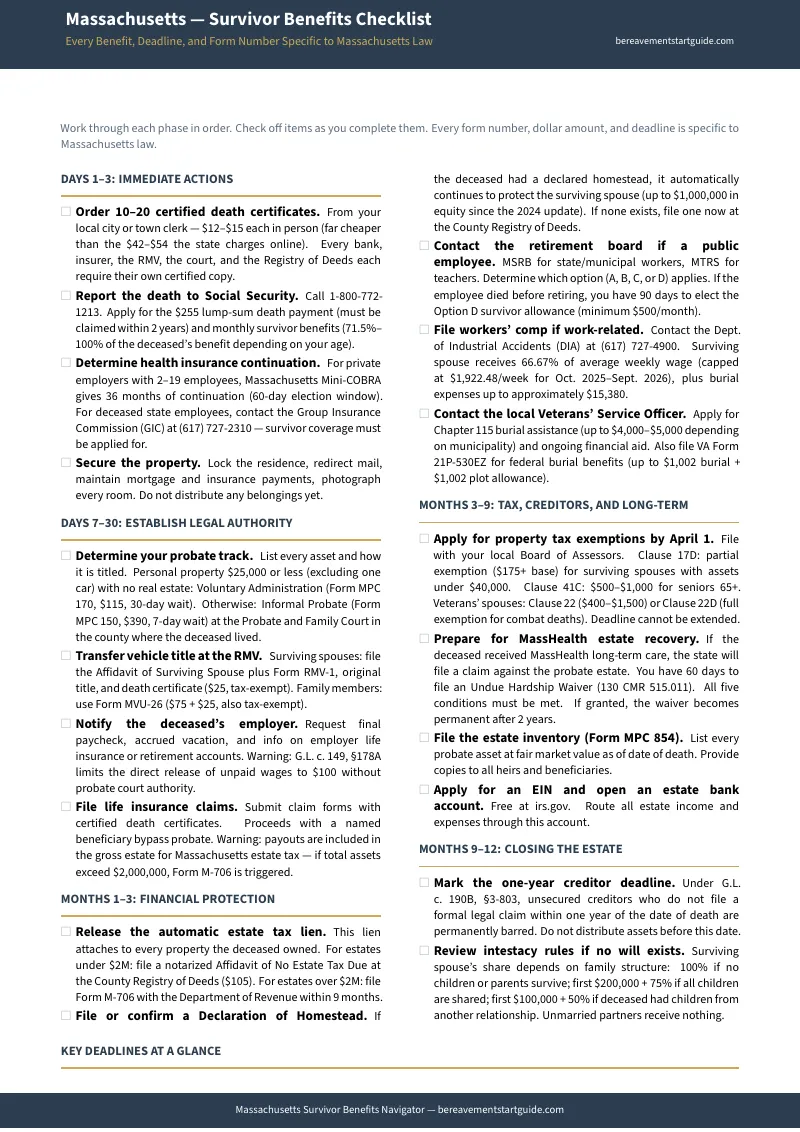
Not ready for the full guide? Download the free Massachusetts --- Survivor Benefits Checklist --- a summary of the most time-sensitive actions, deadlines, and forms that most families do not discover until it is too late. Enough to start contacting the right agencies in the right order.
You did not plan for this. But you can plan what happens next. The guide gives you the benefits, the forms, the deadlines, and the filing sequence --- so the next six months are spent claiming what your family is owed, not discovering what you missed.
Frequently Asked Questions
What if the rules change after I buy?
We update the guide when the rules change. Email us any time, even years later, and we'll send you the current edition free.