
Someone You Love Just Died in Michigan. The Bank Froze the Accounts. The Secretary of State Replaced the Vehicle Transfer Form You Found Online. And You Just Learned That Paying the Wrong Bill First Can Make You Personally Liable for the Entire Difference.
You are standing in something no one prepared you for. Maybe you were named personal representative in a will you barely remember reading. Maybe there was no will at all, and the family turned to you because you are the surviving spouse, the eldest child, or the person who picked up the phone. The funeral director is asking how many death certificates you need. The bank told you the checking account is frozen until you bring in something called "Letters of Authority." Your sister is asking about the house. And somewhere behind all of it, a question keeps circling: if I pay the wrong bill, miss a deadline I did not know existed, or sign the wrong affidavit — can they hold me personally responsible?
Yes. MCL 700.3805 establishes a strict priority for paying an estate's debts in Michigan. If you pay a credit card company before you reimburse the person who paid the funeral home, cover the family allowance, or satisfy the court administration costs — and the estate later runs short — you are personally liable for the difference. That is not a technicality. That is Michigan probate law. And it is just one of the traps waiting in a state that recently overhauled its vehicle transfer forms, adjusts its small estate thresholds every year for inflation, and offers up to $86,000 in statutory allowances that most families never claim because no one told them they existed.
The When Someone Dies in Michigan — Estate Settlement Guide is The EPIC Navigator — named for the Estates and Protected Individuals Code that governs every probate proceeding in this state — a structured, Michigan-specific manual for every legal, financial, and administrative step between the funeral home and final distribution. Not a law textbook. Not a generic national checklist that confuses Michigan with Maryland. A chronological roadmap built around EPIC's actual statutes, the 2026 inflation-adjusted thresholds, and the new Secretary of State forms that replaced the ones still showing up in outdated Google results — so you stop guessing and start working through this in the right order.
What's Inside The EPIC Navigator
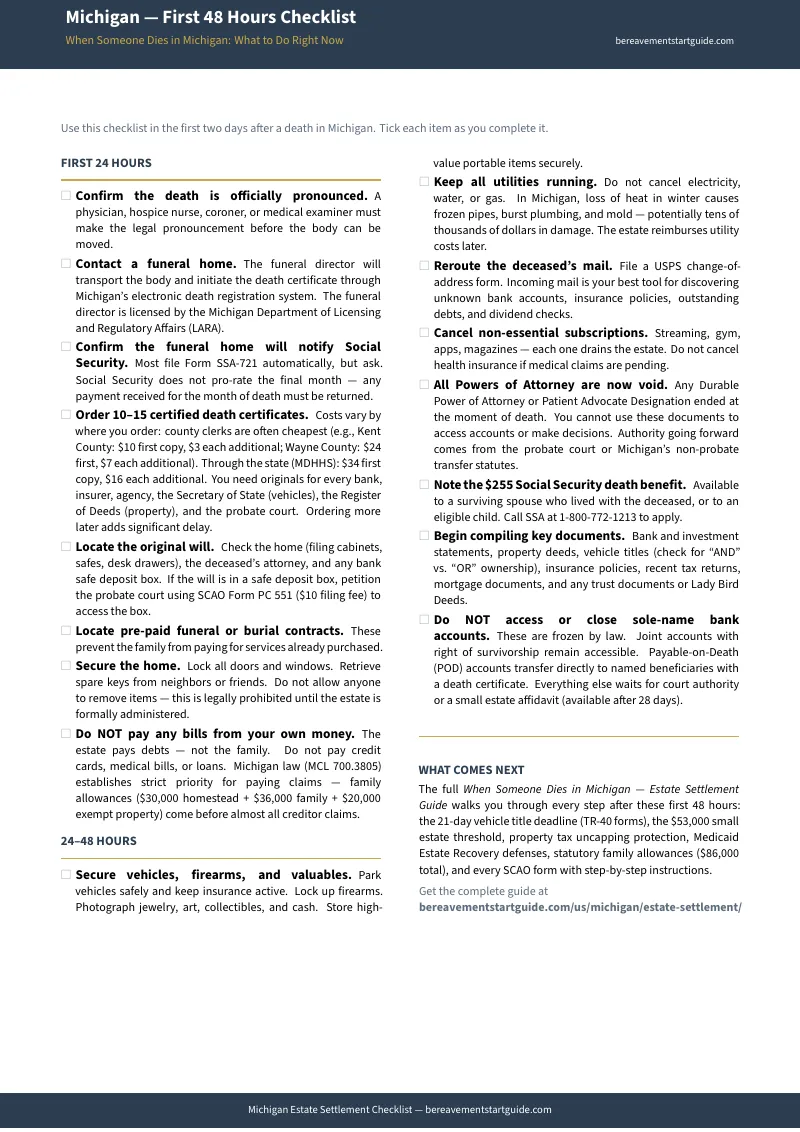
A comprehensive guide and the First 48 Hours Checklist — covering every stage from the moment of death through final asset distribution, built specifically for Michigan's Estates and Protected Individuals Code, the county probate court system, and the state-specific rules that make settling an estate here different from any other state:
The First 48 Hours: Death Certificates and Immediate Actions
The funeral director is going to ask how many certified death certificates to order, and most families guess wrong. Michigan practitioners advise 8 to 12 certified copies — not photocopies — because every bank, every insurance company, the county probate court, the Secretary of State, and the IRS will each demand an original certified copy from the county clerk or Michigan Department of Health and Human Services. The guide gives you the exact calculation based on the deceased's assets so you order the right number now instead of waiting weeks for additional copies later. This chapter also covers what to do today, what to do tomorrow, and the single most important rule in the entire guide: do not pay any of the deceased's bills with your own money.
The First Week: Securing the Estate and the Family Meeting
Before the probate court gives you legal authority over the estate, you have a duty to prevent assets from being lost, stolen, or damaged. This chapter covers locking the home, securing vehicles and valuables, rerouting mail — your best forensic tool for discovering unknown accounts, debts, and subscriptions — and the family meeting where you set one critical expectation: no one takes anything until the court says so. It also addresses Michigan's specific property concerns — winterizing vacant homes to prevent frozen pipes, securing lakefront cottages and seasonal properties in the Upper Peninsula, and managing a property tax situation that can change dramatically depending on how the home is transferred.
Banking and Financial Accounts: Unlocking Frozen Money
When a bank receives notice that an account holder has died, individual accounts are frozen immediately. Being the surviving spouse does not override the freeze. But not every account is locked. Pay-on-Death and Transfer-on-Death accounts transfer directly to named beneficiaries with a death certificate — no court involvement required. Joint accounts with right of survivorship stay open. And if the total estate falls under the right threshold, the small estate process can unlock accounts with a simple affidavit instead of full probate. The guide maps every account type, what unlocks it, and exactly what paperwork to bring to the bank — so you stop getting turned away at the counter.
Vehicle Title Transfers: The New TR-40 Process That Nobody Told You About
This is the chapter that saves you from driving to the Secretary of State branch office with the wrong forms. As of January 2026, Michigan replaced the old TR-29 vehicle transfer form with the entirely new TR-40 series — TR-40a (Certification from Heir), TR-40b (Certification of No Interest), and TR-40c (Certification of Ownership Transfer). Most websites, legal blogs, and even some funeral home packets still reference the TR-29. If you show up at the branch with the old form, you will be sent home. The guide walks you through every step of the new TR-40 process, the $100,000 aggregate vehicle value limit that operates independently from the $53,000 small estate threshold, and the 21-day deadline you need to know about. If you need to sell a vehicle to cover funeral costs, this chapter tells you exactly how.
The Big Decision: Small Estate Affidavit vs. Formal Probate
Not every estate needs the full probate process. Michigan's small estate threshold for 2026 is $53,000 — and here is the detail that changes everything for families with a mortgaged home: you can deduct up to $264,000 in real estate liens from the gross estate value when calculating whether you qualify. A family home worth $220,000 with a $190,000 mortgage? That home contributes $30,000 to the estate calculation, not $220,000. This single deduction moves thousands of Michigan estates from formal probate into the simplified affidavit process every year. The guide includes a step-by-step calculation worksheet and explains the mandatory 28-day waiting period before you can file the Transfer by Affidavit under MCL 700.3983 — and the personal liability you assume when you sign it.
The $86,000 in Statutory Allowances Most Families Never Claim
Michigan law provides three powerful financial protections for surviving spouses and dependent children, and they take priority over almost every creditor in the estate — including unsecured debt collectors who are calling the house. For 2026, these allowances total up to $86,000: a $30,000 Homestead Allowance, a $36,000 Family Allowance, and a $20,000 Exempt Property Allowance. They are not gifts from the estate. They are statutory rights under EPIC that sit above general creditors in the payment hierarchy. Most families never claim them because they do not know they exist. The guide explains exactly how each allowance works, who qualifies, how to calculate the amounts, and the filing procedures to claim them before creditors consume what the law says belongs to the family.
Creditor Management: The Priority of Claims That Protects You
The estate pays the debts, not the family. But when the estate does not have enough money to pay everyone, Michigan law under MCL 700.3805 dictates a strict priority order: administration costs first, then reasonable funeral and burial expenses, then the Homestead Allowance ($30,000), then the Family Allowance ($36,000), then the Exempt Property Allowance ($20,000), then federal debts, then state debts, and only then general unsecured creditors. If you pay a lower-priority credit card bill before satisfying higher-priority obligations and the estate later runs short, you can be held personally liable for the deficiency. The guide maps this hierarchy in plain language and gives you the framework for managing creditor demands during the four-month formal claim period — the window that begins when you publish the required notice in a local legal newspaper.
Real Estate Transfers: Lady Bird Deeds and the Property Tax Trap
Here is where Michigan diverges from what the national legal websites tell you. Michigan does not recognize standard Transfer-on-Death deeds for real estate. If you found a "TOD Deed" template on Nolo or LegalZoom, it does not work here. Michigan uses Enhanced Life Estate Deeds — commonly called Lady Bird Deeds — to transfer property outside of probate. The guide explains how Lady Bird Deeds function after death, the critical property tax uncapping rules under Public Act 497 of 2012, and which transfers to qualified relatives preserve the existing low tax assessment. Transfer the home the wrong way and the property taxes can double or triple overnight. Transfer it correctly and the family keeps the existing rate.
Medicaid Estate Recovery: What the State Can and Cannot Take
The fear that "the state will take the house" to recover nursing home costs is one of the most anxiety-producing concerns families face. Here is what Michigan law actually says: the Michigan Medicaid Estate Recovery Program (MERP) currently recovers only from assets that pass through the probate estate. If the family home bypassed probate entirely through a Lady Bird Deed, joint tenancy with rights of survivorship, or a trust, it is generally not subject to MERP recovery. The guide explains the actual recovery rules, the hardship waiver process for surviving spouses and disabled dependents, and the specific asset arrangements that may provide protection — replacing fear with facts.
Government Notifications: SSA, IRS, Michigan Treasury, and Form 2766
Each agency operates on its own timeline with its own forms and its own penalties for delay. Social Security benefits deposited for the month of death will be clawed back if you do not act. The IRS needs a final Form 1040 filed for the deceased. Michigan does not impose a state estate tax or inheritance tax — but the Michigan Department of Treasury requires Form 2766 (Michigan Inheritance Tax Return) filed within 45 days for certain estates involving property that predates the tax repeal. The guide covers every agency, every form, every deadline, and the specific Michigan procedures that differ from what the federal agencies tell you on their national websites.
The Complete Timeline: Every Statutory Deadline on One Calendar
From Day 1 through Month 24, every Michigan statutory deadline in one sequential reference. The 21-day vehicle notification window. The 28-day waiting period for the small estate affidavit. The 45-day Form 2766 deadline. The 91-day inventory filing requirement. The four-month creditor claim period. Every deadline that matters, in the order it appears, with clear language about what happens if you miss it.
Who This Guide Is For
- The surviving spouse whose partner just died and whose bank accounts were frozen this morning — who needs to know which accounts stay accessible, which ones require Letters of Authority, and how to claim the $86,000 in statutory allowances that Michigan law guarantees before any general creditor gets paid
- The adult child named as personal representative who lives out of state and is trying to manage a Michigan estate from Ohio or Illinois — who needs the complete sequence of fiduciary duties, court deadlines, and the Day 1 through Month 24 timeline in one document instead of scattered across a dozen county court websites
- The family with no will who just learned that Michigan's intestate succession laws under EPIC will decide everything — who needs to understand exactly who inherits what, whether the estate qualifies for the small estate process, and whether formal probate is truly required
- The person who just got rejected at the bank trying to access their deceased parent's checking account — who needs to know whether a POD designation, a joint account, or the $53,000 small estate threshold can bypass full probate, or whether Letters of Authority are the only path forward
- The family trying to sell a vehicle to cover funeral costs and getting nowhere because every website still references the old TR-29 form — who needs the exact TR-40 process, the $100,000 aggregate limit, and the documents to bring to the Secretary of State
- The family terrified about Medicaid who heard that "the state will take the house" because the deceased received long-term care benefits — who needs to understand that Michigan MERP currently only recovers from probate assets, and who needs to know which asset arrangements may provide protection
- The person determined to handle this without a $3,000 attorney retainer — who needs a guide that covers the administrative process in enough detail to do it right, while being honest about the situations where professional legal representation is worth the cost
Why Free Resources Will Not Get You Through This
The information exists. It is scattered across the Michigan State Court Administrative Office, 83 independent county probate courts, the Secretary of State's website, the Department of Health and Human Services, and a dozen federal agency portals that do not reference each other. Here is what you actually encounter when you try to settle a Michigan estate using free sources alone:
- The SCAO gives you blank forms and tells you the clerk cannot help you fill them out. The Michigan State Court Administrative Office publishes every probate form you will ever need — PC 556, PC 557, PC 558, PC 559, and dozens more. Every form is free. But court clerks are legally prohibited from telling you which form applies to your situation, which sequence to file them in, or whether your estate qualifies for the small estate process or requires formal administration. They hand you a stack of paperwork without telling you the order.
- Michigan probate law firms write blog posts designed to sell retainers. The Probate Pro, Thompson Law, and similar practices produce accurate, detailed content about Michigan estate settlement. Every article is designed to convince you the process is too dangerous to handle alone. They offer free consultations that are essentially intake interviews for $3,000 to $5,000 retainers. For contested estates, professional representation is essential. For the majority of straightforward estates, the answer costs a fraction of a retainer.
- Michigan Legal Help provides excellent tools buried in clinical prose. Their small estate calculator is genuinely useful. Their step-by-step articles are accurate. But the content is written for legal professionals, not grieving families. There are no printable checklists with a sequence you can follow, no decision trees for the small estate calculation, no worksheets for tracking assets, and no way to manage a 12-month timeline from a collection of web pages. The information is right but the format fails people in crisis.
- National platforms reference legal instruments Michigan does not recognize. Nolo, LegalZoom, and FindLaw offer polished overviews of probate. They consistently mention Transfer-on-Death deeds for real estate — which Michigan does not have. They reference generic small estate thresholds that lag behind Michigan's 2026 COLA-adjusted $53,000 figure. They miss the $264,000 real estate lien deduction entirely. And they have no idea that the TR-29 vehicle form was replaced by the TR-40 series. Generic tools do not just fall short. In Michigan, they actively mislead.
- Funeral homes hand you a surface-level checklist that ends where the hard questions begin. They remind you to notify Social Security and cancel credit cards. They do not mention the MCL 700.3805 priority of claims, the $86,000 in statutory allowances, the Lady Bird Deed vs. TOD deed distinction, the 91-day inventory deadline, or the personal liability you assume when you sign a small estate affidavit. Their advice covers the first 72 hours. The legal process runs for 6 to 24 months.
Free resources give you fragments from a dozen sources that do not reference each other. The EPIC Navigator puts every Michigan-specific statute, form, deadline, and procedure into one document, in the order you actually need them.
— Less Than Five Minutes With a Michigan Probate Attorney
A single consultation with a Michigan probate attorney costs $250 to $400 per hour. Standard probate representation starts at $3,000 as a retainer and climbs from there. The county probate court charges a $175 filing fee before the process even begins, plus sliding-scale inventory fees based on the estate's gross value. This guide costs less than five minutes of professional legal time and gives you the complete Michigan-specific roadmap — every statute, every deadline, every form, and the decision trees that tell you whether you even need an attorney at all.
Your download includes the complete guide, the First 48 Hours Checklist, the Asset Inventory Worksheet, the Small Estate vs. Formal Probate Decision Tree, the Statutory Allowance and Creditor Priority Reference, the Vehicle Title Transfer Reference, the Statutory Deadline Calendar, and the Real Estate and Medicaid Recovery Reference — eight PDFs organized around Michigan's 2026 EPIC statutes so you work through the process in the right order without missing deadlines or making the mistakes that trigger personal liability. Instant download, no account required.
Money-back guarantee, no time limit. If the guide does not give you clarity on what to do next and confidence that you are doing it in the right order, email us for a full refund. No questions asked.
Not ready for the full guide? Download the free Michigan First 48 Hours Checklist — covering everything that must happen in the first two days after a death in Michigan: death certificates, securing the home, notifying Social Security, what not to pay, and what to gather. It is enough to get through tonight and tomorrow.
You did not ask for this job. But you can do it. The EPIC Navigator shows you how, one step at a time.
Frequently Asked Questions
What if the rules change after I buy?
We update the guide when the rules change. Email us any time, even years later, and we'll send you the current edition free.