Michigan Is One of Eight States That Forces You to Hire a Funeral Director. This Guide Makes Sure That Director Works for You.
Someone has died in Michigan — or someone you love is planning ahead. Either way, you are about to enter a system designed around a single legal fact: Michigan Compiled Laws § 700.3206 requires a licensed funeral director to supervise the handling, disposition, and disinterment of every body in the state. You cannot legally opt out. You cannot do this alone. And the person you are required to hire has a financial incentive to sell you services you may not need.
Within hours, you will be told that embalming is "required." It is not — unless final disposition will not occur within 48 hours, and even then, refrigeration is the legal alternative. You will be shown a casket showroom starting at $2,000. Federal law says you can buy one online for $400 and the funeral home cannot charge you a handling fee. You will sign a cremation authorization without anyone explaining the 48-hour waiting period, the county medical examiner fee, or why all siblings in the same priority class must agree before the cremation can proceed.
Free resources exist. The Michigan LARA website publishes raw statutes. County probate courts post blank forms. National legal sites will tell you home burial is "legal in Michigan" without mentioning the one-acre limit, the zoning restriction to rural land outside city limits, or the fact that a licensed funeral director must still supervise the process. None of these sources give you a chronological sequence of what to do, when to do it, and what you can legally refuse.
The Regulatory Defense System
This guide consolidates every Michigan funeral statute, federal FTC consumer protection, and post-death administrative procedure into one plain-English manual — organized around the decisions you face, in the order you face them. It is built for the specific legal environment in Michigan: the funeral director mandate, the 2016 Funeral Representative Act, the EPIC probate code with its 2026 inflation-adjusted thresholds, and the Medicaid Estate Recovery program that uses a private contractor on a 13.9% commission to pursue your family home through probate.
The result: you stop paying for services you do not need, you stop signing forms you do not understand, and you stop deferring to professionals whose revenue depends on your confusion.
The 48-Hour Rule They Use Against You
Michigan funeral establishments routinely pressure families into purchasing embalming by citing the 48-hour transportation rule. The guide explains exactly what this rule says, what it does not say, and how refrigeration serves as the legal alternative. It gives you the specific language to decline chemical embalming while remaining fully compliant with state law.
The Funeral Representative Designation Most Families Skip
If you die without designating a Funeral Representative under Michigan's 2016 Act (MCL 700.3206), the law defaults to your next of kin — in priority order. When multiple people share the same priority level (three adult children, for example), the law requires majority consensus on every decision: burial versus cremation, open or closed casket, which funeral home to use. One dissenting sibling can paralyze the entire process. The guide includes the designation process, explains the priority hierarchy, and shows you how written directions made during life override everyone.
The $53,000 Calculation That Determines Whether You Need Probate Court
Michigan's 2026 small estate threshold is $53,000 in probate-countable assets. Above it, you face formal probate — months of court supervision and potential attorney retainers of $3,000 to $5,000. Below it, you can use a Transfer by Affidavit (no real property) or Petition for Assignment (with real property) and settle the estate in weeks. The critical detail: a 2026 cost-of-living adjustment allows you to deduct up to $264,000 in real estate liens from the property's value when calculating this threshold. A family with a home worth $290,000 and a $250,000 mortgage has only $40,000 in countable real estate — under the limit. The guide walks you through this calculation step by step.
The Lady Bird Deed That Blocks Medicaid Recovery
Michigan's Medicaid Estate Recovery program can only pursue assets that pass through probate. A Lady Bird Deed (Enhanced Life Estate Deed) transfers real estate automatically at death, bypassing probate entirely — and therefore shielding the family home from recovery. The guide explains how this works, when to file it, and why Michigan families with any Medicaid exposure should understand this instrument before it is too late.
What You Get
- The Complete Michigan Funeral Law Guide — 18 chapters covering the funeral director mandate, embalming rules, cremation authorization, home burial regulations, death certificate timelines, the FTC Funeral Rule, pre-need contracts, Medicaid planning, estate settlement paths, vehicle transfers, veteran burial, and complaint filing
- FTC Funeral Rule Defense Checklist — a printable checklist for the arrangement conference covering your right to a General Price List, itemized billing, third-party casket acceptance, the right to decline embalming, and the right to choose a direct cremation or immediate burial package
- Funeral Representative Designation Guide — the complete priority hierarchy under the 2016 Act, the majority-rule problem, and step-by-step instructions for appointing a single decision-maker who overrides all default rules
- Cremation Authorization Roadmap — the 48-hour waiting period, medical examiner review process, county fees, pacemaker disclosure requirements, and the sibling-consent rules that can freeze cremation mid-process
- Home Burial and Green Burial Guide — Michigan's one-acre limit, the rural-zoning restriction, soil depth requirements, the funeral director supervision mandate even on private land, and Green Burial Council resources
- Small Estate Calculator — the 2026 $53,000 threshold, the $264,000 lien deduction, Transfer by Affidavit versus Petition for Assignment, and the spousal allowances ($30,000 homestead, $36,000 family, $20,000 exempt property)
- Lady Bird Deed and Medicaid Defense Briefing — how Enhanced Life Estate Deeds bypass probate, the Medicaid Estate Recovery program's limitations, and the 13.9% contractor commission that drives aggressive pursuit of probate assets
- Vehicle Transfer Checklist — the TR-40 Certification from Heir process, Secretary of State requirements, and how to transfer a vehicle title without probate
Who This Is For
- Families arranging a funeral right now who need to know their rights before the first meeting with a funeral director — especially those facing pressure to purchase embalming, premium caskets, or services they suspect are unnecessary
- Surviving spouses or adult children navigating cremation authorization disputes, frozen bank accounts, or the question of whether the estate qualifies for simplified probate under the 2026 thresholds
- Pre-planners and their families who want to file a Funeral Representative Designation, execute a Lady Bird Deed, or evaluate a prepaid funeral contract before signing
- Families with Medicaid concerns who need to understand how Michigan's Estate Recovery program targets probate assets — and how to structure ownership to protect the family home
- Families considering home burial or green burial who want to confirm they are meeting Michigan's zoning, acreage, and supervision requirements before proceeding
Why Free Information Falls Short
Michigan LARA publishes statutes online. County probate courts post forms. But Chapter 328 of the Public Health Code, the Estates and Protected Individuals Code, the Prepaid Funeral and Cemetery Sales Act, the 2016 Funeral Representative Act, and the Federal Trade Commission's Funeral Rule are spread across five different regulatory frameworks. No state website connects them into a sequence. No county clerk will explain which form to use. No funeral home blog will tell you how to minimize what you pay them.
Law firms cover these topics well — in blog posts designed to demonstrate that you need a $3,000 retainer. This guide covers the same material in plain English, with every relevant statute cited, so you can handle the administrative steps yourself and hire an attorney only when the stakes genuinely require one.
What This Guide Does Not Do
This guide is an educational and administrative tool — not legal representation. It does not constitute legal, tax, financial, or medical advice, and purchasing it does not create an attorney-client relationship. When you need a probate attorney, an elder law specialist, or intervention from the Michigan Attorney General's Consumer Protection team, the guide tells you exactly which professional and why.
— Less Than One Hour of an Elder Law Attorney's Time
A Michigan elder law attorney charges $200 to $400 per hour for an initial consultation. A single unnecessary embalming adds $500 to $1,000 to a funeral contract. A probate filing you could have avoided costs months and thousands of dollars. If this guide prevents just one unnecessary line item or helps you qualify for simplified estate settlement, it has paid for itself many times over.
Every purchase includes a money-back guarantee, no time limit. If the guide does not give you the clarity and confidence you need to navigate Michigan's funeral and estate settlement system, email us for a full refund.
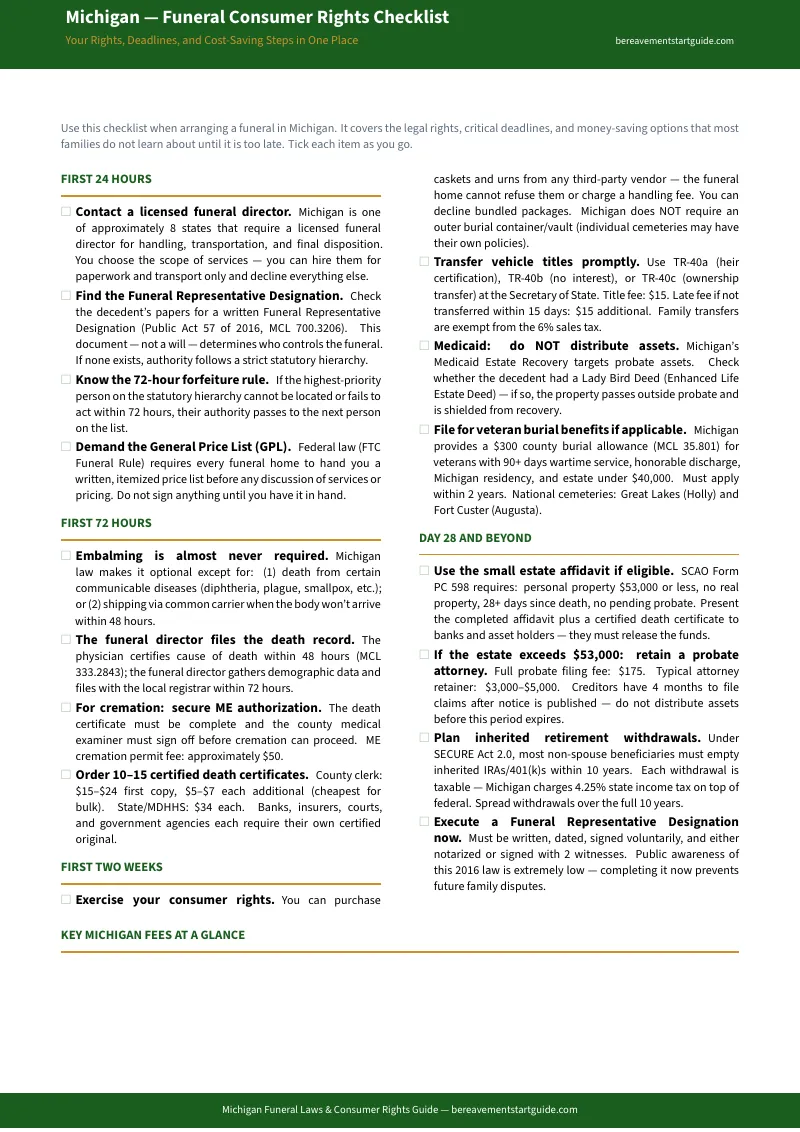
The free Consumer Rights Checklist covers the 16 most critical actions — the ones with hard deadlines and immediate financial consequences. The full guide covers every chapter in depth: the funeral director mandate, embalming rules, cremation authorization, home burial regulations, the Funeral Representative Act, pre-need contracts, Lady Bird Deeds, Medicaid defense, the three estate settlement paths, vehicle transfers, veteran burial benefits, and the 2026 threshold changes that affect every Michigan family.
Frequently Asked Questions
What if the rules change after I buy?
We update the guide when the rules change. Email us any time, even years later, and we'll send you the current edition free.