The Probate Court Says File PC 558. The Secretary of State Says Bring Form TR-40a. The Assessor Says You Have 45 Days Before Your Property Taxes Double. And Nobody Told You About the $86,000 in Priority Allowances That Michigan Law Guarantees You Before Any Creditor Gets Paid.
Someone has died, and now you are the person responsible for figuring out what the surviving family is owed. You called the county probate court and learned that Michigan charges a mandatory inventory fee calculated on the gross value of every asset that passes through probate --- and the court cannot waive it, even if paying it means liquidating the family home. You called the Secretary of State about the deceased's car and were told you need Form TR-40a, but only if the total value of all vehicles is under the COLA-adjusted threshold. You called the Office of Retirement Services and discovered that the deceased chose "Straight Life" at retirement, which means the pension stops entirely --- no survivor benefit, no continued health insurance.
Meanwhile, deadlines are running. The local municipal assessor requires Form 2766 within exactly 45 days of death, or the property tax cap is removed and your bill can double or triple overnight. The MDHHS State Emergency Relief funeral assistance application expires 20 business days after the burial. The COBRA health insurance election window closes in 60 days. Every agency has its own clock, its own forms, and its own rejection criteria --- and none of them will tell you about the other agencies you should also be contacting.
The Michigan Survivor Benefits Navigator is a Cross-Agency Deadline Tracker for every federal payment, state pension, county benefit, and statutory entitlement available to surviving families in Michigan --- from the Social Security call on day one through Medicaid estate recovery defense months later. Not a grief resource. Not a blog post written by a funeral home or an elder law firm trying to sell you a retainer. A plain-English, Michigan-specific administrative reference that tells you which benefits exist, who qualifies, what forms to file, what documents to bring, and which deadlines will permanently disqualify you if you miss them.
What's Inside the Cross-Agency Deadline Tracker
A 17-chapter guide, a quick-start checklist, and a forms quick-reference matrix --- covering every survivor benefit, application process, and statutory deadline that Michigan families face after a death:
Chapter 1: Immediate Administrative Triage
The first-call sequence that prevents cascading problems. Who to contact first and in what order: the Social Security Administration (report the death, apply for the $255 lump-sum payment, and flag any post-death deposits for reversal), the deceased's employer (collect unpaid wages and accrued vacation directly under MCL 408.480 --- no probate required), the Michigan Office of Retirement Services (if the deceased was a public employee, immediate notification prevents pension fraud liability and a lapse in dependent health coverage), and every bank and brokerage (freeze accounts, identify POD/TOD designations that bypass probate, and distinguish joint accounts from sole-ownership accounts that may require court involvement). Plus the critical rule most families violate on day one: do NOT pay the deceased's unsecured debts out of your own pocket --- Michigan's EPIC statute gives surviving spouses approximately $86,000 in priority allowances that must be paid before credit card companies receive anything.
Chapter 2: Death Certificates and Document Assembly
Why you need 8-12 certified copies, not the 3 the funeral director suggested. The exact cost breakdown: $34 base fee per request plus $16 for each additional copy ordered simultaneously. The VitalChek expedited option that reduces turnaround from 4-5 weeks to 1-5 business days. Form DCH-0569 for ordering from MDHHS Vital Records. Who can legally request copies under Michigan's restricted access rules. And the international apostille requirement for foreign-held assets.
Chapter 3: Vehicle and Watercraft Transfers Without Probate
Michigan provides one of the most generous vehicle transfer exemptions in the country. The guide covers the exact process for transferring titles at the Secretary of State using Form TR-40a --- no probate court required for vehicles up to the COLA-adjusted threshold ($100,000 cumulative value, indexed beginning 2026). The TR-40b form for clearing title when multiple heirs have equal standing. The parallel watercraft exemption under MCL 324.80312. And the critical strategic reason to use this process: vehicles transferred through the Secretary of State never enter the probate estate, which means they are protected from Michigan Medicaid Estate Recovery.
Chapter 4: The 45-Day Property Tax Deadline
The most expensive mistake Michigan families make after a death. When property ownership transfers, Michigan "uncaps" the taxable value and resets it to the current State Equalized Value --- which in an appreciating market can double or triple the tax bill overnight. The family transfer exemption exists, but only if you file Form 2766 with the local municipal assessor within exactly 45 days of death. The penalty for missing the deadline: $5 per day plus the risk of permanent uncapping. The guide covers Form 2766, Form 2368 (Principal Residence Exemption), Lady Bird deed compliance requirements, and the disabled veteran property tax exemption that continues indefinitely for unremarried surviving spouses --- including the co-ownership trap that permanently destroys the exemption if you add an adult child to the title.
Chapter 5: Michigan's Small Estate Rules
Before you assume the estate needs formal probate, the guide walks you through Michigan's COLA-adjusted thresholds to determine whether you can bypass the court entirely. For deaths in 2026, the small estate threshold is $53,000 --- and Michigan allows you to deduct active mortgages from real property value (up to $264,000) when calculating eligibility. The guide covers the Transfer by Affidavit process (SCAO Form PC 598, no court required, 28-day waiting period), the Petition and Order for Assignment (SCAO Form PC 556, simplified court process), and the exact calculation that determines whether a home with a $200,000 market value but a $170,000 mortgage qualifies as a small estate.
Chapter 6: The $86,000 Shield --- Priority Spousal Allowances
Michigan law guarantees surviving spouses three statutory allowances that must be paid before virtually all unsecured creditors: approximately $30,000 Homestead Allowance, $36,000 Family Allowance, and $20,000 Exempt Property (2026 COLA-adjusted figures). Combined, these allowances can lawfully consume the liquidity of an estate and render it insolvent to credit card companies and medical debt collectors. The guide covers how to claim these allowances using SCAO Form PC 582, why skipping this filing means losing your priority position, and how these allowances interact with the small estate threshold and Medicaid recovery.
Chapter 7: Probate Inventory Fees
If the estate enters formal probate, Michigan assesses a mandatory, progressive inventory fee on the gross value of all probated assets --- and the Michigan Court of Appeals ruled in In re Estate of DeCoste that the court cannot waive this fee even if paying it requires liquidating the surviving spouse's primary residence. The guide provides the complete fee schedule, explains what counts toward the gross value calculation, and lays out the strategic case for removing assets from the probate estate before filing.
Chapters 8-11: Workers' Compensation, Public Pensions, Health Insurance, and Unpaid Wages
Workers' compensation death benefits for workplace fatalities: 80% of after-tax average weekly wage for up to 500 weeks, plus $6,000 burial expense --- but you must prove factual financial dependency with tax returns and bank statements because Michigan eliminated automatic spousal presumptions. Office of Retirement Services pension survivor options for teachers, state employees, and state police --- including the Straight Life trap (no survivor benefit) and the Equated Plan reduction that permanently cuts the survivor pension when the deceased would have reached age 62. Federal COBRA vs. Michigan state health insurance continuation for small employer survivors. And the MCL 408.480 carve-out that lets employers release final paychecks directly to heirs without waiting for probate.
Chapter 12: Defending Against Medicaid Estate Recovery
Michigan is a probate-only recovery state --- MDHHS can only reach assets that pass through formal probate. The guide explains exactly which assets are vulnerable and which are protected, how to respond to the Estate Recovery Questionnaire without inadvertently surrendering protected wealth, the absolute statutory exemptions (surviving spouse, child under 21, blind or permanently disabled child), the undue hardship waiver (income below 200% FPL, resources under $10,000), and why every non-probate transfer strategy in the earlier chapters directly reduces your Medicaid exposure.
Chapters 13-17: SER Funeral Assistance, Homestead Tax Credit, Deadlines Calendar, When to Hire a Professional, and Forms Quick Reference
State Emergency Relief funeral assistance (up to $615 for burial, $480 for cremation, strict 20-business-day application deadline). The Michigan Homestead Property Tax Credit (up to $1,200 annually for eligible survivors). A consolidated deadlines calendar listing every time-sensitive filing from immediately upon death through annual compliance. Clear professional boundary guidance on when to retain a probate attorney ($2,500-$4,500 typical flat fee), a CPA, or a workers' compensation attorney. And a complete forms quick-reference table listing every SCAO form, Treasury form, and SOS form with download locations.
Who This Guide Is For
- The surviving spouse who just lost the household's primary income --- who needs to know how to file for Social Security survivor benefits, whether the ORS pension continues, how to collect the final paycheck without probate, and what happens to the health insurance. The guide maps the entire income replacement sequence from the first phone call through monthly benefit activation.
- The adult child who just became the de facto personal representative --- who needs to figure out which benefits to claim, which forms to file, and whether the estate can bypass probate entirely under the $53,000 small estate threshold. The guide gives you the chronological action plan, the document checklist, and the cross-agency filing sequence so you can process everything systematically instead of discovering benefits after their deadlines have passed.
- The veteran family dealing with VA claims --- who needs to secure DIC, burial allowances, and the Michigan county veteran burial benefit ($300 for eligible low-income veterans and unremarried surviving spouses), while simultaneously protecting the disabled veteran property tax exemption that continues for the unremarried surviving spouse.
- The family of a worker killed on the job or in a motor vehicle accident --- who needs to navigate Michigan workers' compensation death benefits (500 weeks of wage replacement) or No-Fault auto insurance survivor's loss benefits (up to $7,201/month for accidents in the 2025-2026 period). The guide covers the dependency proof requirements that catch most surviving spouses off guard.
- The family defending against Medicaid recovery --- who received an Estate Recovery Questionnaire from MDHHS and needs to know exactly which assets are vulnerable to state recovery and which are protected by Lady Bird deeds, POD/TOD designations, and the vehicle transfer process.
- The low-income family facing immediate insolvency --- who needs the SER funeral assistance application filed within 20 business days, the Homestead Property Tax Credit (up to $1,200), and the priority spousal allowances that shield $86,000 from creditors before anyone else gets paid.
Why Free Resources Leave Money on the Table
Survivor benefit information exists. It is spread across the Social Security Administration in one set of forms, the VA in another, the Michigan Office of Retirement Services in a third, the Secretary of State in a fourth, the Department of Health and Human Services in a fifth, the Department of Treasury in a sixth, and county assessor offices that each enforce their own 45-day filing deadline. Here is what happens when you try to navigate all of this yourself:
- The SSA website covers Social Security benefits. It does not mention the ORS pension, the SER funeral assistance, the Homestead Property Tax Credit, or the $86,000 in EPIC priority allowances. Every federal agency covers only its own programs. If you stop at Social Security, you miss everything Michigan provides at the state and county level.
- The SCAO website provides free probate forms. It does not tell you which forms to file or in what order. If you file for full formal probate before realizing the estate qualifies for the $53,000 small estate threshold, you trigger mandatory, non-refundable inventory fees on the gross estate value. The forms are free. The procedural mistakes cost thousands.
- Michigan Legal Help provides excellent plain-language guidance for low-income residents. It does not cover benefit-stacking strategies. It will not show you how to combine the vehicle transfer, Lady Bird deed, POD designations, and Transfer by Affidavit to remove assets from the probate estate before filing --- reducing both the inventory fee and the Medicaid recovery exposure simultaneously.
- Elder law firms publish detailed content about EPIC allowances and Medicaid defense. Every article ends with a consultation pitch. The content is a lead-generation tool. It rarely provides the exhaustive "do-it-yourself" sequences needed to handle straightforward benefit claims without hiring the firm at $2,500-$4,500 for basic estate administration.
- Funeral homes provide basic aftercare checklists. They are generic, non-legal, and rarely address EPIC inflation adjustments, inventory fee calculations, or Medicaid recovery exemptions. A checklist that says "Contact the DMV" is not the same as "Bring Form TR-40a, the original title, a certified death certificate, and your Michigan ID to the Secretary of State to transfer vehicles up to $100,000 without probate."
Free resources give you one agency at a time, with no sequencing, no cross-referencing, and no way to know what you are missing. The Cross-Agency Deadline Tracker maps every benefit to every persona, organizes every form by deadline, and tells you exactly which agencies to contact in which order --- so you can claim everything your family is owed without spending weeks navigating portals that were never designed to talk to each other.
--- Less Than One Hour of a Probate Attorney's Time
Michigan families leave thousands of dollars in unclaimed survivor benefits every year --- not because they are ineligible, but because no one told them the benefit existed or the deadline had already passed. A surviving spouse who does not file SCAO Form PC 582 loses priority access to $86,000 in statutory allowances. A family that misses the 45-day Form 2766 deadline faces permanent property tax uncapping that costs thousands over the life of the home. A Medicaid recipient's heir who unnecessarily opens probate for an asset that could have transferred by affidavit exposes that asset to state recovery. This guide costs less than any of those lost benefits and tells you how to avoid every one of them.
Your download includes 7 printable PDFs: the complete 17-chapter guide, a quick-start checklist, and five standalone reference sheets you can print separately and keep on your desk while you work through each agency:
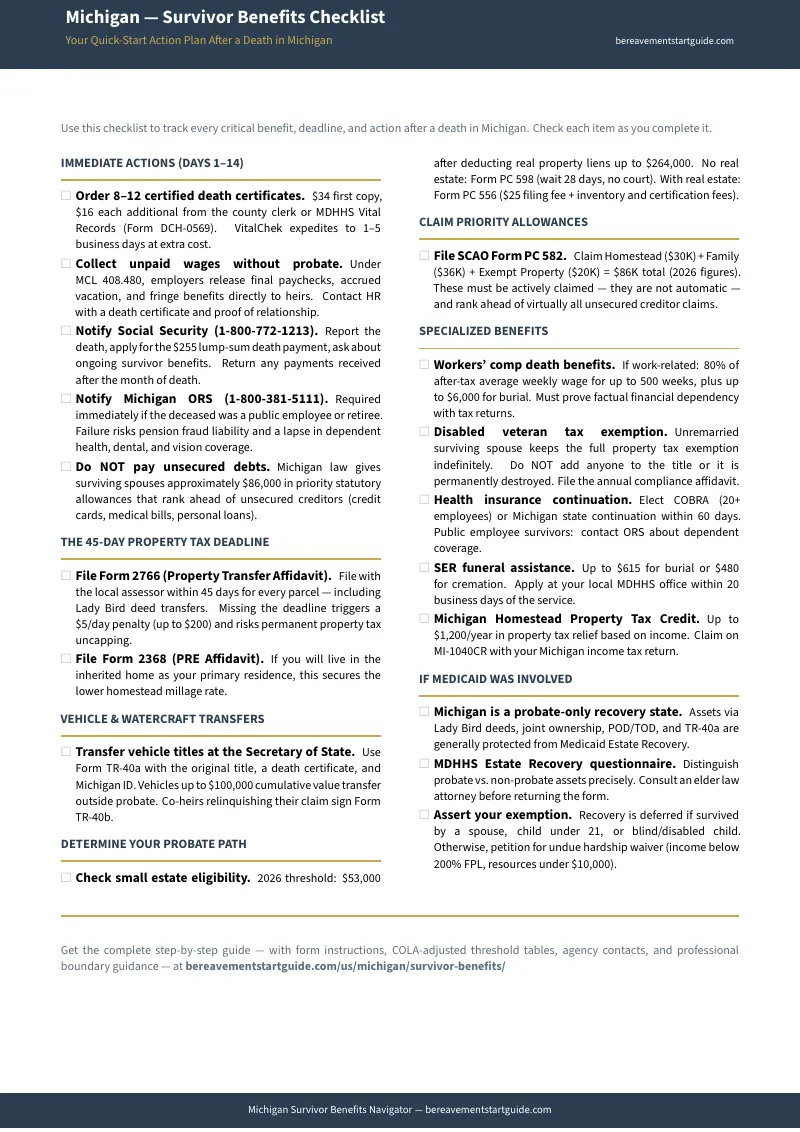
- Michigan Survivor Benefits Quick-Start Checklist --- the time-sensitive actions organized by urgency
- Forms Quick-Reference Table --- every SCAO, Treasury, and SOS form with download locations
- Deadlines Calendar --- every statutory deadline from day one through annual compliance, with penalty consequences
- EPIC Priority Allowances Breakdown --- the exact 2026 dollar amounts, statutory references, and claiming instructions for your $86,000 shield
- Small Estate Threshold Calculator --- decision tree and worked examples showing whether your estate can bypass probate entirely
- Medicaid Estate Recovery Defense Guide --- which assets are protected, which are vulnerable, and how to respond to the MDHHS questionnaire
Print the checklist. Use the forms reference. Work through the guide chapter by chapter or jump directly to the section that matches your most urgent problem.
Money-back guarantee, no time limit. If the guide does not give you a clear map of every survivor benefit available to your family, every form you need to file, and every deadline you need to meet --- email us for a full refund. No questions asked.
Not ready for the full guide? Download the free Michigan Survivor Benefits Checklist --- a summary of the most time-sensitive actions, deadlines, and forms that most families do not discover until it is too late. Enough to start contacting the right agencies in the right order.
You did not plan for this. But you can plan what happens next. The guide gives you the benefits, the forms, the deadlines, and the filing sequence --- so the next six months are spent claiming what your family is owed, not discovering what you missed.
Frequently Asked Questions
What if the rules change after I buy?
We update the guide when the rules change. Email us any time, even years later, and we'll send you the current edition free.