The Funeral Director Knows Minnesota Statute 149A Better Than You Do. That Is About to Change.
Someone you love has died in Minnesota. Within hours, you will be sitting across from a funeral director presenting a contract for services running $8,000 to $15,000. That person knows every line of Chapter 149A. You are still trying to figure out whether embalming is actually required by law. (It is not — unless burial or cremation cannot occur within 72 hours, and even then refrigeration and dry ice are both legal alternatives.) The funeral director will not volunteer that distinction. It is not in their financial interest.
Meanwhile, your family is splitting apart. Your brother wants cremation. Your mother insists on a traditional burial. Your father's health care directive named an agent nobody remembers agreeing to — and Minnesota Statute 149A.80 says that agent holds top priority over the surviving spouse and all adult children. If no agent was designated, your siblings must operate on majority rule, and one holdout can freeze the entire process while daily refrigeration charges accumulate. The funeral home does not resolve these disputes. They wait, and they bill.
Free resources exist. The Minnesota Revisor of Statutes publishes Chapter 149A. The Department of Health provides PDF forms. The FTC has a one-page fact sheet about the Funeral Rule. But these resources share a fatal problem: the statutes are dense legalese scattered across Chapter 149A (Mortuary Science Practice), Chapter 307 (Cemeteries), and Chapter 524 (Probate Code). The Department of Health will give you a Certificate of Removal form but will not explain when you need it versus a Disposition Permit, or how a noncompensated family member can legally transport a body without hiring a funeral director. A national legal site will tell you home burial is "legal in Minnesota" without mentioning the professional survey requirement, the county plat recording, or the municipal zoning restrictions that can shut down a private cemetery before the first burial.
The Minnesota Consumer Rights Shield
This guide consolidates every Minnesota funeral regulation, federal consumer protection, and multi-agency administrative procedure into one plain-English manual — organized around the decisions you actually face, in the order you face them. It functions as a consumer rights shield: you read it before the arrangement conference, and you walk in knowing exactly what the funeral home is required to provide, what you can legally decline, and which agency to call if they push back.
The result: you stop paying for services you do not need, you stop signing authorizations you do not understand, and you stop deferring to an industry that profits from your confusion during the worst week of your life.
The 72-Hour Clock, Refrigeration, and Dry Ice
Minnesota Statute 149A.91 establishes three options when final disposition cannot occur immediately: embalming, refrigeration (up to six days), or dry ice packing (up to four days). Funeral homes routinely present embalming as the only path — adding $700 to $1,200 to your bill for a service you have every legal right to decline. The guide maps the exact statutory language, explains which scenarios actually trigger the embalming requirement (public viewing, public transit shipment, communicable disease), and gives you the precise words to use when a funeral director implies you have no choice.
The 149A.80 Disposition Hierarchy and Family Disputes
Minnesota law establishes a strict priority list for who controls funeral decisions. A designated agent in a health care directive holds top priority — above the surviving spouse, above the adult children, above everyone. When no agent exists, the surviving spouse decides. When there is no spouse, a majority of adult children must agree. Here is what most families do not know until it is too late: if siblings are evenly split and cannot reach majority agreement, the funeral home freezes all services. The body sits in commercial storage. Daily charges accumulate. The guide breaks down the entire priority hierarchy, explains the 36-hour forfeiture window when public authorities must step in, and shows how a single health care directive designation could have prevented the standoff entirely.
Cremation: No Mandatory State Waiting Period
Minnesota does not impose a mandatory waiting period between death and cremation — unlike many states that require 24 to 48 hours. What the law does require is a fact of death record and a formal Disposition Permit before any cremation can proceed. The guide clarifies this critical distinction, explains the cremation authorization requirements, walks through the process for pacemaker and medical device removal, and details what happens when the medical examiner's investigation delays the timeline.
Home Funerals, Human Composting, and Aquamation
Minnesota is one of the more permissive states for families who want to handle final arrangements without a funeral director. Noncompensated family members with the right to control disposition can legally transport and care for the body — provided they secure a Certificate of Removal and a Disposition Permit, wrap the body in a non-porous sheet within a rigid container, and use an enclosed vehicle. The guide covers the complete home funeral process, the requirements for establishing a private family cemetery under Chapter 307 (professional survey, county plat recording, local zoning compliance), and the legal status of emerging alternatives: alkaline hydrolysis (aquamation), which is already legal and regulated, and natural organic reduction (human composting), which became explicitly legal in Minnesota on July 1, 2025.
Prepaid Funeral Contracts and Medicaid Asset Sheltering
For families engaged in pre-planning — whether triggered by a terminal diagnosis, estate planning, or approaching a Medical Assistance application — the guide covers a critical intersection of funeral law and elder law. Minnesota allows up to $2,000 for an individual (or $3,000 for a couple) to be placed in an irrevocable funeral trust, sheltering those assets from Supplemental Security Income and Medical Assistance eligibility calculations. The guide explains the difference between revocable and irrevocable trusts, the implications for the aggressive DHS estate recovery program, and the specific trust mechanisms that protect prepaid funeral funds from state claims.
What You Get
- The Complete Minnesota Funeral Law Guide — plain-English coverage of every relevant statute, from the 72-hour preservation rules through filing a complaint, with every Minnesota Statute section and administrative rule cited
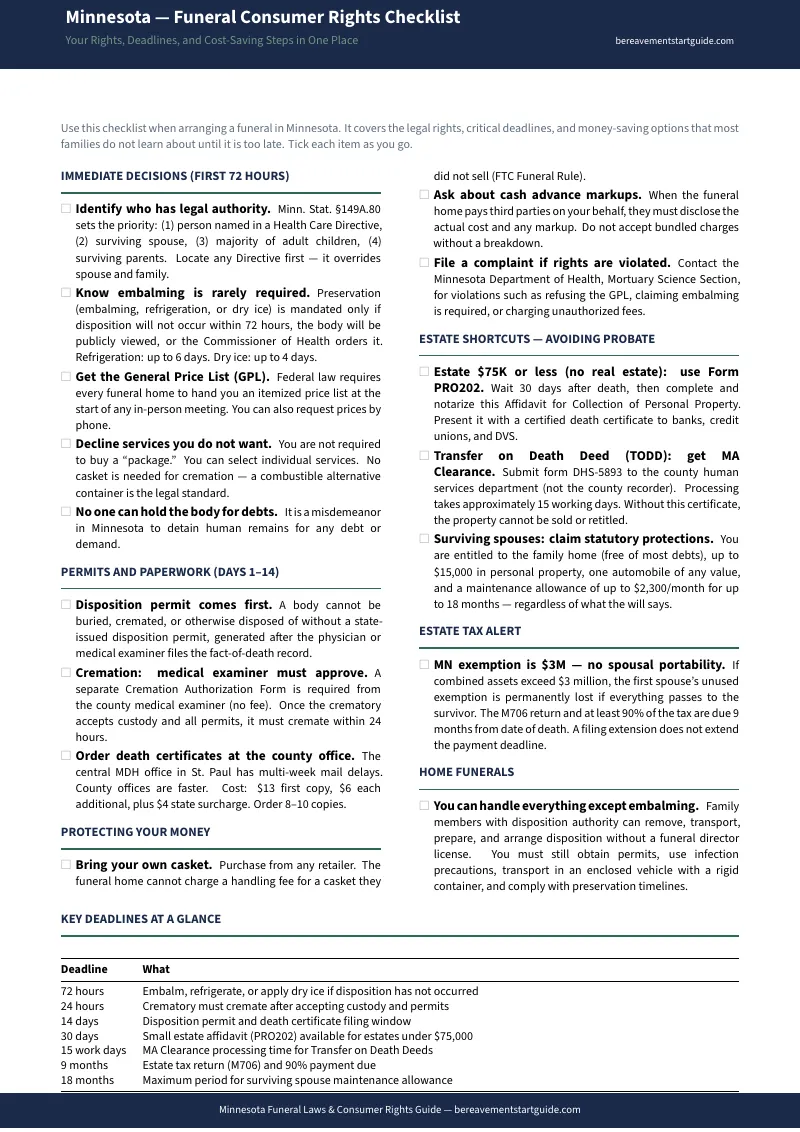
- Consumer Rights Checklist — a printable checklist of every federal and Minnesota-specific right you have when arranging a funeral, including the right to decline embalming, receive an itemized General Price List, and use a third-party casket or cremation container without penalty
- Disposition Authority Toolkit — the complete 149A.80 priority hierarchy for who controls funeral decisions, with guidance on health care directive designation, the majority rule for same-class disputes, the 36-hour forfeiture window, and resolving family conflicts before they escalate
- Cremation Authorization Guide — fact of death record requirements, Disposition Permit procedures, medical device removal rules, and the authorization forms that delay families who are not prepared
- Home Funeral and Green Burial Guide — legal requirements for family-directed funerals in Minnesota, including Certificate of Removal procedures, body transport rules for noncompensated persons, private cemetery establishment under Chapter 307, and the current status of aquamation and human composting
- Ash Scattering Guide — Minnesota rules on private land scattering, National Park Service permit requirements, EPA Clean Water Act compliance for water scattering, and FAA regulations for aerial scattering
- Agency Navigation Map — the exact handoffs between the Department of Health Mortuary Science Section, the Board of Mortuary Science Examiners, the county medical examiner, the State Registrar, and the EPA, with contact information, form numbers, fee amounts, and deadline windows for each
- Complaint Filing Guide — how to file a complaint with the Minnesota Department of Health Mortuary Science Section for statutory violations, including what constitutes a valid complaint versus a customer service dispute, and the federal FTC process for Funeral Rule violations
- Prepaid Contract and Medicaid Sheltering Guide — revocable versus irrevocable trust structures, the $2,000/$3,000 asset shelter for Medical Assistance eligibility, cancellation rights, and safer alternatives to prepaid funeral insurance
- Body Transport Guide — Certificate of Removal and Disposition Permit procedures for moving remains within Minnesota and across state lines, the noncompensated person exemption, wrapping and container requirements, common carrier embalming rules, and TSA screening for cremated remains
Who This Is For
- Families arranging a funeral right now who need to know their rights before the first meeting with a funeral director — especially those facing an $8,000+ price quote and wondering what they can legally decline
- Surviving spouses or adult children navigating the 149A.80 disposition hierarchy, family disagreements over burial versus cremation, or pressure to purchase services they suspect are unnecessary
- Families considering a home funeral, green burial, aquamation, or human composting who want to confirm they are meeting every Minnesota and federal requirement before proceeding
- Pre-planners structuring prepaid funeral trusts to shelter assets from Medical Assistance eligibility calculations and the DHS estate recovery program — especially those facing a long-term care transition
- Families in blended or estranged situations where a dispute over who controls disposition is likely — and where understanding the 149A.80 priority hierarchy is the difference between a resolved decision and a frozen funeral with mounting daily charges
- Anyone exploring Minnesota's emerging green options — aquamation, natural organic reduction, or establishing a private family cemetery — who needs the exact legal framework rather than a funeral home's marketing version of it
Why Free Information Falls Short
The Minnesota Revisor of Statutes publishes Chapter 149A in its entirety. But that chapter alone cross-references the Minnesota Administrative Rules, intersects with federal FTC regulations and EPA environmental rules, and requires coordination with multiple state agencies. Here is what you actually encounter when you try to navigate funeral arrangements using free sources alone:
- The Minnesota Department of Health provides forms without context. You can download the Certificate of Removal and Disposition Permit PDFs. But the site does not explain when you need one versus the other, how the electronic death registration system generates them, or how a family acting as their own funeral director can obtain them without a mortician intermediary.
- The Funeral Consumers Alliance of Minnesota is outdated and fragmented. FCA-MN publishes consumer rights information and price surveys, but the website architecture is aging, the content is scattered across disconnected PDFs, and there is no integration with Minnesota probate law, estate tax implications, or Medical Assistance recovery — which are inseparable from funeral planning for most families.
- National legal sites miss Minnesota-specific details. Nolo and FindLaw cover funeral laws in broad terms, but they do not address the 149A.80 disposition priority hierarchy, the specific embalming alternatives under 149A.91, the Transfer Care Specialist licensing requirements, or the July 2025 legalization of human composting. Minnesota is not a footnote — it is a state with its own rules.
- Funeral home websites educate you toward their services. Bradshaw, Morris Nilsen, and Interra Green Burial all publish helpful content about burial types and green alternatives. But their content is designed to sell their specific services. They will not explain your right to refuse embalming, to bring a third-party casket, or to handle the entire process yourself as a noncompensated family member. Their advice ends where your consumer rights begin.
- Elder law firm blogs make everything sound dangerously complex. Attorney posts about prepaid trusts, Medical Assistance recovery, and funeral pre-planning are accurate — and they are explicitly designed to convince you that the process requires a $300-per-hour retainer. For families who need help structuring a complex irrevocable trust, that is the right advice. For the majority of families who need to understand their basic rights at the arrangement conference, the answer costs a fraction of one billable hour.
Free resources give you fragments from a dozen different sources that do not reference each other. The Consumer Rights Shield puts every Minnesota-specific statute, form, deadline, and procedure into one document, in the order you actually need them.
— Less Than One Hour With a Minnesota Attorney
A consultation with a Minnesota elder law or probate attorney runs $300 or more per hour. If this guide prevents just one unnecessary embalming charge, one pressure-sold package upgrade, or one family dispute that freezes services while daily refrigeration fees accumulate, it has paid for itself many times over. If it gives you the confidence to demand an itemized General Price List before signing anything, the savings compound from there.
Your download includes the complete guide and nine standalone printable references: the Consumer Rights Checklist, Disposition Authority Toolkit, Cremation Authorization Guide, Home Funeral and Green Burial Guide, Ash Scattering Guide, Agency Navigation Map, Complaint Filing Guide, Prepaid Contract and Medicaid Sheltering Guide, and Body Transport Guide. Ten PDFs total — instant download, no account required.
30-day money-back guarantee. If the guide does not give you the clarity and confidence you need to navigate Minnesota's funeral system, email us for a full refund. No questions asked.
Not ready for the full guide? Download the free Minnesota Funeral Consumer Rights Checklist — the most critical actions with hard deadlines and immediate financial consequences. It is enough to walk into the arrangement conference knowing your rights.
The funeral industry is built on the assumption that grieving families will not ask questions. This guide makes sure you know exactly which questions to ask — and what the law says the answers should be.