The Bank Froze the Joint Account. PERA Sent a Letter You Cannot Decipher. The $2,300 Monthly Spousal Allowance Exists but Nobody Mentioned It. And the State Can Recover Medicaid Costs From the House Unless You Know the Exemption That Stops Them.
Someone has died, and now you are the person responsible for figuring out what the surviving family is owed in Minnesota. You called Social Security and spent forty minutes on hold before learning the lump-sum death payment is $255. You called PERA about the pension and were told the survivor benefit depends on which Joint-and-Survivor option the member elected at retirement --- 50%, 75%, or 100% --- and that election is irrevocable. You do not know which option was chosen or what it means for your income next month. You pulled up the Minnesota Judicial Branch website to search for probate forms and found a labyrinth of PDFs with no instructions on which ones apply to you. You called the county assessor about the property tax homestead credit and reached voicemail.
Meanwhile, deadlines are running. The Affidavit for Collection of Personal Property cannot be filed until 30 days after the death, but nobody explained why or what happens if you wait too long. The Minnesota estate tax exemption is $3 million --- and unlike the federal system, Minnesota does not allow spousal portability, which means the first spouse's exemption is permanently lost if it was not placed in trust. Medical Assistance Estate Recovery can reach non-probate assets like the family home. Every agency has its own clock, its own forms, and its own rejection criteria --- and none of them will mention the other agencies you should also be contacting.
The Minnesota Survivor Benefits Navigator is a Cross-Agency Benefits Sequencer for every federal payment, state pension, county program, and statutory entitlement available to surviving families in Minnesota --- from the Social Security notification on day one through Medicaid estate recovery and property tax relief months later. Not a grief resource. Not a blog post written by a funeral home. A plain-English, Minnesota-specific administrative reference that tells you which benefits exist, who qualifies, what forms to file, what documents to bring, and which deadlines will permanently disqualify you if you miss them.
What's Inside the Cross-Agency Benefits Sequencer
A comprehensive guide and a quick-start checklist --- covering every survivor benefit, application process, and statutory deadline that Minnesota families face after a death:
Chapter 1: The First 72 Hours
The triage sequence that prevents cascading financial losses. Stop pension direct deposits before the next payment cycle --- if a PERA, MSRS, or TRA payment posts after the date of death, the system will recover it. Order 10-15 certified death certificates from the Minnesota Department of Health or county vital records ($13 first copy, $6 each additional). Report the death to Social Security and claim the $255 lump-sum payment. Secure key documents: marriage certificate, DD-214, will, pension benefit statements, life insurance policies, and property deeds. Do not pay any debts out of your personal funds --- debt priority is determined by the probate court, not the creditor calling you.
Chapter 2: Social Security and Federal Benefits
Survivor annuity calculations at every age threshold: 71.5% at age 60, scaling to 100% at full retirement age. The child-in-care exception that lets a surviving spouse of any age collect benefits while caring for the deceased's child under 16. The divorced spouse rule requiring 10+ years of marriage. The repeal of the Government Pension Offset, which used to cut Social Security for PERA and TRS retirees and no longer does --- plus how to confirm SSA recalculated your benefit and paid what it owes back to January 2024. Dependency and Indemnity Compensation for veteran families. Every form number: SSA-8, SSA-10, 21P-534EZ.
Chapter 3: Minnesota Public Pension Systems
Minnesota has three major public retirement systems --- PERA, MSRS, and TRA --- and the survivor benefit depends entirely on which Joint-and-Survivor option the member elected. A 50% option means exactly that: half the monthly pension for the rest of your life. A 100% option means the full amount continues. If the member died before retirement and was vested, you may elect a survivor annuity. If the member was not vested, you may receive only a lump-sum refund of accumulated contributions. The guide covers every tier, every election, the TRA 1% supplemental contribution provision that provides survivor allowances to dependent children, and the Form RET-600 Death Notification that must be filed immediately.
Chapter 4: Surviving Spouse Statutory Protections
Minnesota law guarantees the surviving spouse powerful rights that most families never learn about. Under Minnesota Statute 524.2-403, you can claim up to $15,000 in exempt personal property --- household furniture, appliances, and personal effects --- plus one automobile, regardless of its value, completely outside the directives of the will. Under 524.2-404, the personal representative can disburse up to $2,300 per month for 12 to 18 months to maintain your standard of living during probate. These statutory allowances apply even if the will attempts to disinherit the surviving spouse. The guide shows you exactly how to claim each one.
Chapter 5: Probate Shortcuts and Small Estate Options
Minnesota probate can take 12 to 18 months and consume 2-3% of the estate in administrative costs. But not every estate requires formal probate. If the deceased's probate assets (excluding real property) are valued at $75,000 or less, you can use the Affidavit for Collection of Personal Property under Minnesota Statute 524.3-1201 --- but you must wait a mandatory 30 days after the death before presenting it. If the estate is heavily encumbered but the property itself is exempt, the summary assignment procedure lets the court close administration and assign exempt property directly to entitled persons without appointing a personal representative. Transfer on Death Deeds (TODDs) bypass probate entirely for real estate. The guide covers every threshold, every procedure, and every form.
Chapter 6: Health Insurance Continuation
If you were covered under the deceased's employer health plan, federal COBRA provides up to 36 months of continuation coverage. But COBRA premiums are the full unsubsidized rate. A change in household income after a death triggers a special enrollment period on MNsure, Minnesota's health insurance exchange, where you may qualify for subsidized coverage or Medical Assistance. The guide covers every coverage scenario, the enrollment deadlines, and how to avoid a gap in coverage while transitioning between plans.
Chapter 7: Workers' Compensation Death Benefits
When death results from a workplace injury in Minnesota, the workers' compensation system provides weekly wage replacement. A surviving spouse with no dependent children receives 50% of the weekly wage for 10 years. A spouse with one dependent child receives 60% of the daily wage. A spouse with two or more dependent children receives 66-2/3%. Benefits continue until the youngest child turns 18 (or 25 if in school), and the spouse's share continues for life or until remarriage. Filing deadline: three years from the date of death. The guide provides the exact formulas, the forms, and the filing sequence.
Chapter 8: Property Tax Relief
Two Minnesota programs reduce your property tax burden. The Homestead Credit Refund is available to homeowners with household income under $142,490 --- file Form M1PR with the Minnesota Department of Revenue. The Market Value Exclusion provides up to $300,000 in property tax valuation reduction for surviving spouses of 100% permanently and totally disabled veterans or those receiving Dependency and Indemnity Compensation. This exclusion is transferable once if you move. The guide covers both programs, the application deadlines, and the documentation each one requires.
Chapter 9: Medical Assistance Estate Recovery
If the deceased received Medical Assistance (Medicaid) for long-term care at age 55 or older, the county will file a claim against the estate to recover costs. Since 2003, the recovery can reach non-probate assets --- joint tenancies, life estates, and property transferred via Transfer on Death Deeds. But surviving spouses, children under 21, and permanently disabled children are completely exempt. The state cannot recover against the home while you are alive. If you are not exempt, the undue hardship waiver must be filed within 30 days of the recovery notice. The guide covers every exemption, the waiver process, and what the county agencies are legally prohibited from telling you.
Chapter 10: Minnesota Estate Tax
The Minnesota estate tax exemption is $3 million --- far lower than the federal exemption. Estates exceeding $3 million face a state tax rate of 13% to 16%. Minnesota does not allow spousal portability: if the first spouse dies without using their $3 million exemption through proper trust planning, that exemption is permanently lost. Minnesota also imposes a three-year clawback rule --- any taxable gifts made within three years of death are pulled back into the estate valuation. The guide maps the thresholds, the rates, and the planning traps that catch families who assumed the federal rules applied at the state level.
Chapter 11: VA and Veteran-Specific Benefits
Minnesota County Veterans Service Officers (CVSOs) provide free advocacy for VA benefit claims, including Dependency and Indemnity Compensation, burial allowances, and headstone applications. The 1-888-LinkVet line connects you to your local CVSO. The $300,000 property tax Market Value Exclusion is one of the most lucrative veteran survivor benefits in any state, and the guide walks you through every step of the application.
Chapter 12: Critical Deadlines and Risk Mitigation
The master deadline table: every time-sensitive filing organized chronologically, from the immediate pension notification through the 30-day affidavit waiting period, the M1PR property tax filing, the three-year workers' compensation window, and the estate tax return deadlines. Plus identity theft protections --- obituary-driven fraud, credit freezes, IRS identity protection PINs --- and a complete document security sequence.
Who This Guide Is For
- The surviving spouse who just lost the household's primary income --- who needs to know whether the PERA or TRA pension continues, how much the monthly payment will be, whether the $2,300 family allowance applies, and how to claim the Homestead Credit Refund. The guide maps the entire income replacement sequence from the pension notification through monthly benefit activation.
- The adult child managing a parent's estate --- who is trying to determine whether the estate falls under the $75,000 small estate threshold, whether the Transfer on Death Deed is valid, and whether Medical Assistance Estate Recovery can reach the family home. The guide gives you the chronological action plan, the document checklist, and the cross-agency filing sequence so you can process everything methodically instead of discovering benefits after their deadlines have passed.
- The family of a state employee or teacher --- who needs to understand the irrevocable PERA or TRA pension election, the difference between a vested and non-vested member's survivor options, and what the repeal of the Government Pension Offset means for their Social Security. The pension board brochures explain the actuarial math. The guide explains what those numbers mean for your actual monthly income.
- The family dealing with an estate near the $3 million threshold --- who needs to understand that Minnesota's estate tax has no spousal portability and that the three-year clawback rule can pull recent gifts back into the estate. The guide covers the planning traps and the scenarios where professional tax counsel is worth every dollar.
- The family terrified that the state will seize the home --- who has heard that Medical Assistance recovers costs from the estate but does not know about the surviving spouse exemption, the disabled child exemption, or the undue hardship waiver process. The guide translates the statutes that the county agencies are legally prohibited from explaining to you.
Why Free Resources Leave Money on the Table
Survivor benefit information exists. It is spread across the Social Security Administration in one portal, PERA and MSRS and TRA in three more, the Minnesota Judicial Branch for probate forms, the Department of Human Services for Medical Assistance, the Department of Revenue for property tax credits, and 87 county offices that each administer programs slightly differently. Here is what happens when you try to navigate all of this yourself:
- The SSA website covers Social Security benefits. It does not mention PERA pensions, property tax relief, or the $2,300 monthly spousal allowance. Every federal agency covers only its own programs. If you stop at Social Security, you miss everything Minnesota provides at the state and county level.
- PERA, MSRS, and TRA cover their own pension systems. They do not cross-reference Social Security offsets, property tax credits, or spousal statutory protections. A surviving spouse can miss thousands of dollars in exempt property and family allowance entitlements while focused entirely on the pension paperwork. The pension board will never mention Minnesota Statute 524.2-403.
- The Minnesota Judicial Branch provides probate forms. It explicitly states that court staff cannot provide legal advice or tell you which form to file first. You get a download page with dozens of PDFs and no sequencing. Filing the wrong form or missing the 30-day affidavit waiting period creates delays that cost weeks.
- The Department of Human Services publishes Medical Assistance estate recovery rules. It does not explain the surviving spouse exemption in plain English. County agencies are legally prohibited from answering hypothetical questions about your situation, leaving families in anxious limbo about whether they will lose the home --- when the statute explicitly protects them.
- Hiring a probate attorney for straightforward benefit claims is the most expensive possible solution. A Minnesota probate attorney charges $200-$500 per hour, with flat fees around $4,500 for standard proceedings. For a surviving spouse who needs to know which forms to file with which agencies in which order, a legal retainer is a disproportionate expense for what is fundamentally an organizational problem.
Free resources give you one agency at a time, with no sequencing, no cross-referencing, and no way to know what you are missing. The Cross-Agency Benefits Sequencer maps every benefit to every situation, organizes every form by deadline, and tells you exactly which agencies to contact in which order --- so you can claim everything your family is owed without spending weeks navigating portals that were never designed to talk to each other.
--- Less Than One Hour of a Probate Attorney's Time
Minnesota families leave thousands of dollars in unclaimed survivor benefits every year --- not because they are ineligible, but because no one told them the benefit existed. A $2,300 monthly family allowance goes unclaimed because no one mentioned Minnesota Statute 524.2-404. A $15,000 exempt property right goes unexercised because the funeral home checklist did not include it. A Homestead Credit Refund goes unfiled because the surviving spouse did not know about Form M1PR. The $300,000 veteran property tax exclusion goes unclaimed because the county assessor did not send a reminder. This guide costs less than any of those lost benefits and tells you where to find every one of them.
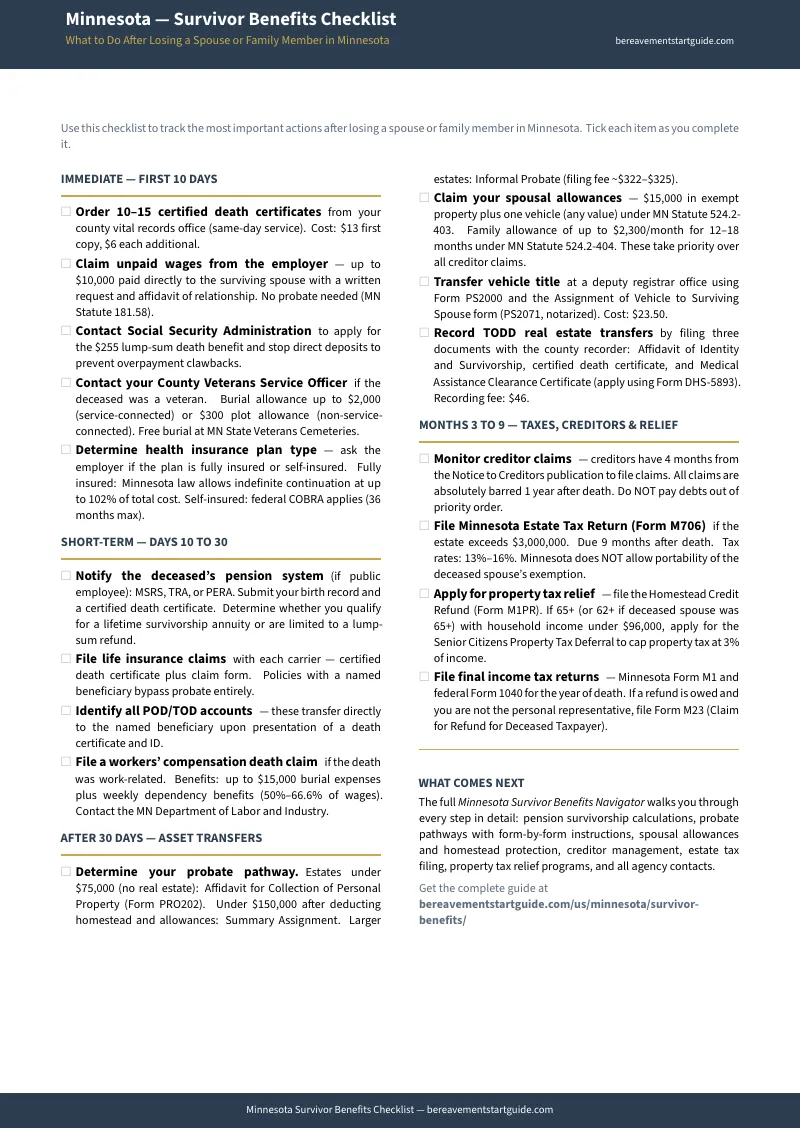
Your download includes the complete guide, the Minnesota Survivor Benefits Quick-Start Checklist, and printable reference tools: a Deadline Calendar with every time-sensitive filing organized chronologically, an Eligibility Map matching each benefit program to its qualifying criteria and dollar amounts, a Form Index listing every government form with its requirements, and an Agency Contact Directory with phone numbers and websites for every relevant state and federal agency. Print the reference tools and keep them where you handle estate paperwork.
Money-back guarantee, no time limit. If the guide does not give you a clear map of every survivor benefit available to your family, every form you need to file, and every deadline you need to meet --- email us for a full refund. No questions asked.
Not ready for the full guide? Download the free Minnesota Survivor Benefits Checklist --- a summary of the most time-sensitive actions, deadlines, and forms that most families do not discover until it is too late. Enough to start contacting the right agencies in the right order.
You did not plan for this. But you can plan what happens next. The guide gives you the benefits, the forms, the deadlines, and the filing sequence --- so the next six months are spent claiming what your family is owed, not discovering what you missed.
Frequently Asked Questions
What if the rules change after I buy?
We update the guide when the rules change. Email us any time, even years later, and we'll send you the current edition free.