The Funeral Home Has Memorized Mississippi Law. You Are Running on Grief.
Someone you love has died in Mississippi. Within hours, you will be sitting across from a funeral director who has arranged thousands of services and knows every line of the Mississippi Code. You are trying to remember whether your mother wanted cremation or burial. The funeral director is presenting a package running $7,000 to $12,000 and speaking as if every line item is required by state law.
Most of it is not. But you will not know that unless you know what Mississippi actually requires — and what the federal Funeral Rule prohibits funeral homes from doing. Embalming is not required by Mississippi law. You can buy a casket from any source and the funeral home cannot charge a handling fee. You have the right to an itemized General Price List before you sign anything. You can legally bury someone on private property in Mississippi without involving a funeral home at all.
Free resources exist. The Mississippi State Board of Funeral Service has a website. The FTC publishes a fact sheet. Various consumer advocacy groups offer generic national advice. But the state board site is regulatory — built for licensees, not families. The FTC fact sheet covers federal rules but misses everything Mississippi-specific: the 48-hour embalming rule, the Self-Directed Disposition Authorization, the Preneed Loss Recovery Fund, the $75,000 Small Estate Affidavit threshold, the fact that the yellow copy of Form 511 doubles as your burial-transit permit. National guides tell you home burial is "legal in most states" without mentioning that Mississippi requires you to file a property map with the Board of Supervisors.
The Mississippi Consumer Protection Framework
This guide consolidates every Mississippi funeral regulation, federal consumer protection, estate settlement shortcut, and administrative deadline into one plain-English manual — organized around the decisions you face, in the order you face them. It is designed to function as a protective framework: you read it before the arrangement conference, and you walk in knowing exactly what the funeral home must provide, what you can legally decline, and which agency to contact if they push back.
The result: you stop paying for services you do not need, you stop signing authorizations you do not understand, and you stop deferring to an industry that profits from your confusion during the worst week of your life.
The 48-Hour Rule
Mississippi law requires that within 48 hours of death, the body must be embalmed or placed in refrigerated storage. This clock creates pressure — funeral directors use it to push embalming as the default, because refrigeration means the family has not yet committed to an expensive package. What they will not tell you: embalming is never legally required for immediate burial or direct cremation. Refrigeration satisfies the 48-hour rule and costs a fraction of embalming. The guide explains exactly how this clock works, what triggers it, and what to say when a funeral home presents embalming as mandatory.
Who Controls the Funeral — And What Happens When Family Disagrees
Mississippi has a statutory priority list that determines who has the legal right to make disposition decisions. A surviving spouse holds first priority. But Mississippi also has the Self-Directed Disposition Authorization — a 2021 law that lets any adult name a designated agent who overrides the entire family hierarchy, including the spouse. When same-class relatives disagree about cremation versus burial, Mississippi uses a majority rule. The guide maps the complete priority list, explains the Self-Directed Disposition Authorization, and walks through the majority rule so families know exactly who holds legal authority before the funeral home freezes services while daily storage fees accumulate.
The Small Estate Shortcut
If the estate is worth $75,000 or less in personal property, Mississippi allows you to skip formal probate entirely using a Small Estate Affidavit. Most families do not know this exists, and many hire probate attorneys for estates that could have been settled with a notarized document. The guide covers the exact requirements, the 30-day waiting period, and the limitations — so you know whether your situation qualifies before spending money on legal fees you may not need.
What You Get
- The Complete Mississippi Funeral Law Guide — 15 chapters covering everything from the 48-hour rule through advance planning, written in plain English with every relevant statute cited
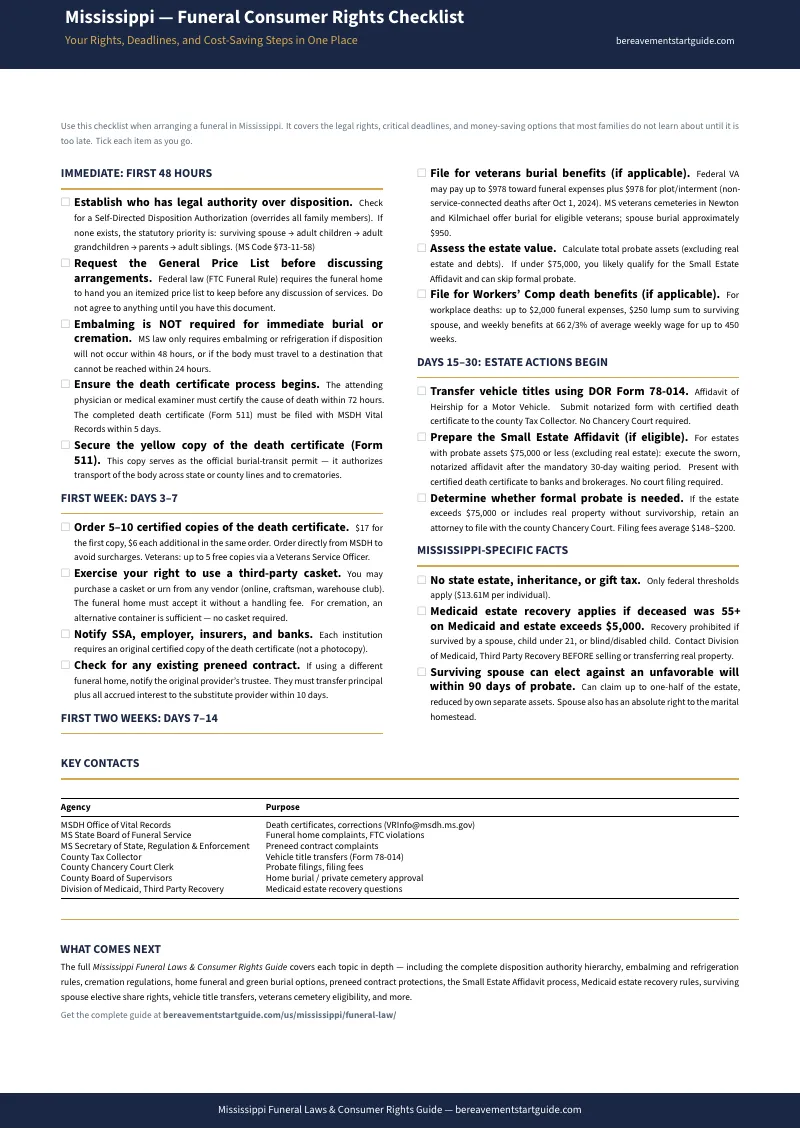
- Consumer Rights Checklist — a printable 18-item checklist organized by timeline: First 48 Hours, First Week, Days 7-14, and Days 15-30
- Disposition Authority Guide — the complete statutory priority list for who controls funeral decisions, the Self-Directed Disposition Authorization that overrides all family, and the majority rule for same-class disputes
- Forms Quick Reference — every form, agency, and contact number you need in one printable sheet: Form 511, DOR Form 78-014, MSDH, Chancery Court, DOM Office of Third Party Recovery, and more
- FTC Funeral Rule Rights — every federal protection explained in context: the General Price List requirement, the ban on casket handling fees, the embalming disclosure rule, and the right to select only the services you want
- Cremation Authorization Guide — the authorization hierarchy, the coroner sign-off requirement, ash scattering rules, and the procedures that delay families who are not prepared
- Home Burial and Green Burial Guide — the legal requirements for private property burial in Mississippi, including the Board of Supervisors map filing, setback distances, and the fact that no funeral director is required
- Prepaid Funeral Contract Protection — Mississippi's regulatory oversight framework, the Preneed Loss Recovery Fund that protects your money if a funeral home goes under, and the critical cancellation warning every family needs before signing
- Small Estate Affidavit Walkthrough — the $75,000 threshold, the 30-day waiting period, eligible property types, and when you still need formal probate through Chancery Court
- Veterans Benefits and Financial Assistance — free burial at Newton and Kilmichael state veterans cemeteries, spouse burial costs, VA headstone applications, and every available financial assistance program
- Medicaid Recovery Defense — the Darby v. Stinson homestead exemption that protects the family home from Medicaid estate recovery, plus the rules for non-homestead assets
- Step-by-Step Administrative Timeline — every action item, deadline, and agency filing from the first 48 hours through the final estate settlement, organized chronologically
Who This Is For
- Families arranging a funeral right now who need to know their rights before the first meeting with a funeral home — especially those facing a multi-thousand-dollar price quote and wondering what they can legally decline
- Surviving spouses or adult children navigating cremation disputes, family disagreements over disposition, or pressure to purchase services they suspect are unnecessary
- DIY estate administrators who want to settle the estate without hiring a probate attorney — particularly those who may qualify for the $75,000 Small Estate Affidavit
- Families worried about Medicaid recovery who need to know whether the family home is protected under Darby v. Stinson and what assets are actually at risk
- Families considering home burial, green burial, or cremation who want to confirm they are meeting every Mississippi and federal requirement before proceeding
- Pre-planners evaluating prepaid funeral contracts and wanting to understand the Preneed Loss Recovery Fund, cancellation rules, and how to prevent family disputes with a Self-Directed Disposition Authorization
Why Free Information Falls Short
The Mississippi State Board of Funeral Service website is built for funeral directors, not consumers. It will tell you which funeral homes are licensed — it will not tell you which services are optional or how to challenge an inflated price list. The FTC Funeral Rule fact sheet explains federal rights but misses everything Mississippi-specific: the 48-hour embalming rule, the Self-Directed Disposition Authorization, the Preneed Loss Recovery Fund, the Board of Supervisors map filing for home burial. National consumer advocacy sites will tell you to "comparison shop funeral homes" without mentioning that Mississippi's Form 511 yellow copy is your burial-transit permit, or that the state has no estate or inheritance tax, or that Darby v. Stinson established homestead protection from Medicaid recovery.
Law firm blogs in Mississippi will walk you through probate procedure and end with "contact us for a consultation." They will not mention the $75,000 Small Estate Affidavit that could save you the consultation fee entirely.
This guide bridges that gap — not by replacing legal counsel, but by connecting the dots between every relevant agency, statute, and deadline so you can make decisions from a position of knowledge rather than grief-driven urgency.
— Less Than One Hour of a Probate Attorney
Mississippi probate attorneys typically charge $200 to $350 per hour. If this guide helps you determine that a $75,000 Small Estate Affidavit applies to your situation, you may avoid thousands of dollars in legal fees. If it prevents one unnecessary embalming ($700+), one pressure-sold casket upgrade ($2,000+), or one missed veterans benefit deadline, it has paid for itself many times over. If it gives you the confidence to demand an itemized General Price List before signing anything, the savings compound from there.
Every purchase includes a money-back guarantee, no time limit. If the guide does not give you the clarity and confidence you need to navigate Mississippi's funeral and estate system, email us for a full refund.
The free Consumer Rights Checklist covers the 18 most urgent actions — the ones with hard deadlines and immediate financial consequences. The full guide covers every chapter in depth: who controls disposition, the 48-hour rule, cremation procedures, home burial requirements, prepaid contract protections, the Small Estate Affidavit, Medicaid recovery defense, veterans benefits, motor vehicle transfers, advance planning, and the complete administrative timeline.
Frequently Asked Questions
What if the rules change after I buy?
We update the guide when the rules change. Email us any time, even years later, and we'll send you the current edition free.