You Were Just Named Executor in Mississippi. The Bank Froze the Accounts. The Chancery Court Requires You to Hire a Lawyer Before You Can File a Single Form. And You Just Found Out That Mississippi Probate Attorneys Charge $200 to $600 an Hour.
The funeral is over and the paperwork has already started. You called the bank to get access to the checking account — they told you they need "Letters Testamentary" before they will release a dollar. You searched online for the forms. There are no forms. Mississippi Chancery Courts do not provide fill-in-the-blank probate packets for the public because Mississippi law — Uniform Chancery Court Rule 6.01 — bans you from representing yourself in probate proceedings. Every executor and administrator must be represented by a licensed Mississippi attorney, no exceptions. You cannot file a petition, attend a hearing, or sign a court document without one.
So you start calling attorneys. The first one quotes $3,500 for a simple estate. The second one bills hourly at $350. The third one says it depends on how organized you are. And that is the key nobody tells you: the biggest variable in your legal bill is not the size of the estate or the complexity of the law. It is how much administrative work the attorney has to do. Every hour your lawyer spends tracking down bank statements, cataloging assets, identifying creditors, and organizing paperwork is an hour billed to the estate at $200 to $600.
The Mississippi Probate Process Guide is a Chancery Court Preparation System for every organizational step between the death certificate and the final distribution order. Not a replacement for the attorney Mississippi law requires. A preparation tool that ensures your attorney spends time on legal judgment — not on sorting your paperwork. Built around the Mississippi Code, the Uniform Chancery Court Rules, and the specific procedures of all 82 county Chancery Courts — covering the exact statutes, the exact deadlines, the exact thresholds, and the exact decision points that determine whether this costs $2,500 or $10,000.
What's Inside the Chancery Court Preparation System
A comprehensive guide, printable worksheets, and a Quick-Start Probate Checklist — covering every stage from locating the will through closing the estate, built specifically for Mississippi's mandatory-attorney Chancery Court system and the state-specific rules that make probate here different from any other state:
Do You Actually Need Chancery Court? The Probate Bypass Assessment
Before you sign a retainer agreement and write a $2,500 check to an attorney, you need to know whether formal probate is even required. Mississippi offers two powerful shortcuts that bypass Chancery Court entirely — and neither one requires an attorney. The Small Estate Affidavit under Mississippi Code 91-7-322 lets you collect personal property (bank accounts, stocks, insurance proceeds) without court involvement if the total value is $75,000 or less and at least 30 days have passed since the death. The Department of Revenue Motor Vehicle Transfer Affidavit (Form 78-014) lets you transfer car titles through a sworn statement without opening an estate. The guide walks through the exact eligibility criteria for each shortcut, tells you what documents to bring to the bank window, and identifies the one detail that disqualifies you: a single piece of real estate, even a $20,000 vacant lot, forces you into formal probate regardless of total estate value.
Muniment of Title: The Real Estate Fast Track
When the only significant asset is Mississippi real property and the decedent died with a valid will, Mississippi Code 91-5-35 offers the fastest path to clearing the title: Muniment of Title. The will is admitted to probate solely as evidence of ownership — no executor is appointed, no creditor publication is required, no formal administration is opened. The petition must track the statutory language precisely and swear that all debts and taxes are paid. The guide explains who qualifies, what the petition must contain, and why this matters: without it, a title company or real estate attorney will flag a break in the chain of title and the property cannot be sold, refinanced, or transferred until the defect is cured through full probate.
The Mandatory Attorney Requirement: What It Means and What It Does Not
UCCR 6.01 requires every fiduciary in Mississippi Chancery Court to be represented by a licensed attorney. This is not optional, not waivable, and not subject to a pro se exception. But the rule covers legal representation in court proceedings — it does not cover organization, preparation, or administrative work. Mississippi law does not require you to pay an attorney $350 an hour to gather bank statements, catalog assets, track down medical bills, or compile the creditor list. The guide positions you to do the administrative preparation yourself and hand your attorney a fully organized, audit-ready file. This is how executors negotiate lower flat fees instead of open-ended hourly billing.
Filing Through Chancery Court: The Complete Sequence
Filing for probate in Mississippi is a sequence of interlocking steps, each with its own statutory requirements. Locate and file the original will with the Chancery Clerk within a reasonable time after death. Petition the Chancellor for Letters Testamentary (with a will) or Letters of Administration (without one). Post a bond unless the will specifically waives it. Attend the opening hearing. Receive your Letters — the document that gives you legal authority over the estate. The guide covers each step in order, explains the bond calculation, and details the filing fees and publication costs that vary by county.
The 90-Day Creditor Notice Window
This is where executors create personal liability without realizing it. Mississippi requires a dual-notice system: you must mail written notice to every known creditor and simultaneously publish a notice to unknown creditors in a local newspaper for three consecutive weeks. The first publication date triggers a strict 90-day window. Any creditor who fails to file a formal claim with the Chancery Clerk within those 90 days is permanently barred. Distribute assets to heirs before the window closes and you are personally liable if a valid claim surfaces later. The guide provides the creditor notification tracker, the publication timeline, and the statutory rules for accepting, rejecting, or negotiating claims.
The 90-Day Inventory Deadline
Within 90 days of your appointment, Mississippi law requires a comprehensive, oath-verified inventory of all estate assets — every bank account, every piece of real estate, every vehicle, every investment — with market values and encumbrances. Most executors do not know that this requirement can be waived: the testator can include a waiver in the will, or the Chancellor can waive it upon petition. The guide covers both the inventory requirements and the waiver process, plus a printable inventory worksheet that organizes every asset in the format the court expects.
Spousal Rights: The Protections Mississippi Law Guarantees
Mississippi law provides the surviving spouse with powerful protections that override the terms of the will. A widow's allowance for one year of support, typically $12,000 or more as determined by court-appointed appraisers. A homestead exemption protecting up to 160 acres or $75,000 in equity from general creditors. The absolute right to renounce the will within 90 days and claim an intestate share of up to one-half of the estate. The guide explains each protection, how they interact, and when the surviving spouse should consider electing against the will — a decision that should be made with full information, not discovered after the deadline passes.
Intestate Succession: When There Is No Will
When the decedent died without a will, Mississippi's intestate succession laws determine who inherits — and the Chancery Court must issue a formal Determination of Heirship before assets can be transferred. The process requires a court hearing, the presentation of evidence, and sometimes publication of a summons to unknown heirs. In blended families, estates with estranged relatives, or situations involving children from multiple relationships, this is where conflicts surface. The guide maps the intestate distribution hierarchy — surviving spouse, children, parents, siblings — and the procedural steps for the heirship determination.
Medicaid Estate Recovery: When the State Files a Claim
If the deceased was 55 or older and received nursing facility care or Home and Community-Based Services through Medicaid, the Mississippi Division of Medicaid can file a recovery claim against the estate. Families hear "the state will take the house" and panic. The reality is more nuanced: recovery is barred if there is a surviving spouse, a dependent child under 21, or a disabled child of any age. Recovery only applies to estates exceeding $5,000. The guide explains the actual recovery rules, the exemptions that protect most families, and the hardship waiver process available when recovery would cause undue financial hardship.
Taxes: What Mississippi Does and Does Not Require
Mississippi imposes no state-level estate or inheritance tax — a fact that surprises many families who spend weeks worrying about a tax bill that does not exist. The actual tax obligations are the decedent's final federal and state income tax returns and the estate's fiduciary income tax returns (federal Form 1041 and Mississippi Form 81-110) if the estate generates income during administration. The guide covers the filing deadlines, when an EIN is required, and the common mistake of filing unnecessary returns.
Transferring Vehicles Without Probate
The Department of Revenue's Motor Vehicle Transfer Affidavit (Form 78-014) allows heirs to transfer car titles through a sworn statement listing the next of kin and the vehicle information — without opening an estate, without Letters Testamentary, and without an attorney. The guide covers the exact requirements: the affidavit form, the original title, a certified death certificate, and the VIN information. This is often the first tangible relief families experience — getting the car transferred while the rest of the estate is still being organized.
Final Accounting and Closing the Estate
Before the Chancellor will discharge you from fiduciary liability, you must file a detailed final accounting of every dollar received and every dollar disbursed. Every beneficiary reviews it. Obtaining waivers and joinders from all beneficiaries avoids a formal hearing — saving the estate both time and attorney fees. The guide walks through the final accounting format, the beneficiary receipt process, the closing petition, and the order of discharge that releases you from personal liability permanently.
Who This Guide Is For
- The executor who just discovered Mississippi requires a lawyer for probate — who needs to understand exactly which steps require an attorney and which administrative preparation can be done independently to reduce the legal bill from $5,000 to $2,500
- The family handling a small estate under $75,000 — who needs to know whether the Small Estate Affidavit bypasses Chancery Court entirely, what documents to bring to the bank, and exactly how to present the affidavit so it is not rejected by an out-of-state corporate legal department unfamiliar with Mississippi law
- The heir trying to clear title on Mississippi real estate — who needs to understand whether Muniment of Title applies, what the petition must contain, and how to avoid being upsold into a full formal probate administration by an attorney when a faster, cheaper option exists
- The surviving spouse who needs to protect the homestead — who needs to understand the widow's allowance, the homestead exemption, the right to renounce the will, and whether Medicaid estate recovery can reach assets the family assumed were protected
- The out-of-state family member named executor — who needs the complete sequence of Mississippi fiduciary duties, deadlines, and requirements in one document so they can manage the process without repeated calls to an attorney billing $350 an hour for phone consultations
- The family terrified of Medicaid recovery — who heard the state will seize the family home because the deceased received nursing home benefits, and who needs to understand the actual rules, the exemptions that protect most families, and the hardship waiver process
Why Free Resources Will Not Get You Through This
The information exists. It is scattered across local law firm marketing blogs, national legal directories, form vendor subscription sites, and isolated statute pages. Here is what you encounter when you try to navigate Mississippi probate using free sources alone:
- Mississippi Chancery Courts do not provide probate form packets for the public. Unlike states that adopted the Uniform Probate Code, Mississippi does not offer fill-in-the-blank probate petitions because individuals cannot represent themselves in Chancery Court proceedings. County clerk websites provide civil cover sheets and general filing information — but the specific petitions, inventories, and accountings must be drafted by your attorney. You cannot download what does not exist.
- Local Mississippi law firms write content designed to sell $2,500-to-$5,000 retainers. Morton Elder Law, Palmer and Slay, and MS Probate publish accurate blog posts that carefully describe the complexity of probate without ever providing step-by-step procedural guidance. Every article ends with a consultation form. For contested estates, they are right — you need litigation counsel. For straightforward, uncontested estates, the organizational work that drives the legal bill is work you can do yourself.
- National platforms get Mississippi law dangerously wrong. Atticus — a venture-backed estate settlement platform — explicitly states that Mississippi executors "can absolutely prepare all of the probate forms yourself" and that Mississippi does not require a lawyer. This is false. UCCR 6.01 mandates attorney representation for every fiduciary in Chancery Court. Following this advice could result in rejected filings, wasted time, and procedural setbacks that cost the estate thousands.
- Form vendors charge subscriptions for a single affidavit with zero context. eForms and eSign provide the raw Small Estate Affidavit PDF behind a monthly paywall — without explaining the $75,000 threshold, the 30-day waiting period, the personal-property-only restriction, or how to actually present the form at a bank window without being turned away.
Free resources give you fragments from a dozen sources that contradict each other — some of them dangerously wrong about Mississippi's mandatory attorney requirement. The Chancery Court Preparation System puts every Mississippi-specific statute, deadline, threshold, and procedure into one document, in the order you actually need them.
— Less Than Ten Minutes With a Mississippi Probate Attorney
A single consultation with a Mississippi probate attorney costs $200 to $600 per hour. Full representation runs $2,500 to $5,000 for simple, uncontested estates — and significantly more when real estate, intestate heirship determinations, or Medicaid recovery is involved. National estate software charges $100 to $200 per year in recurring subscriptions. This guide costs less than ten minutes of professional legal time and gives you the complete Mississippi-specific roadmap — every statute, every deadline, every threshold, and the decision tools that tell you whether you even need to go through Chancery Court at all.
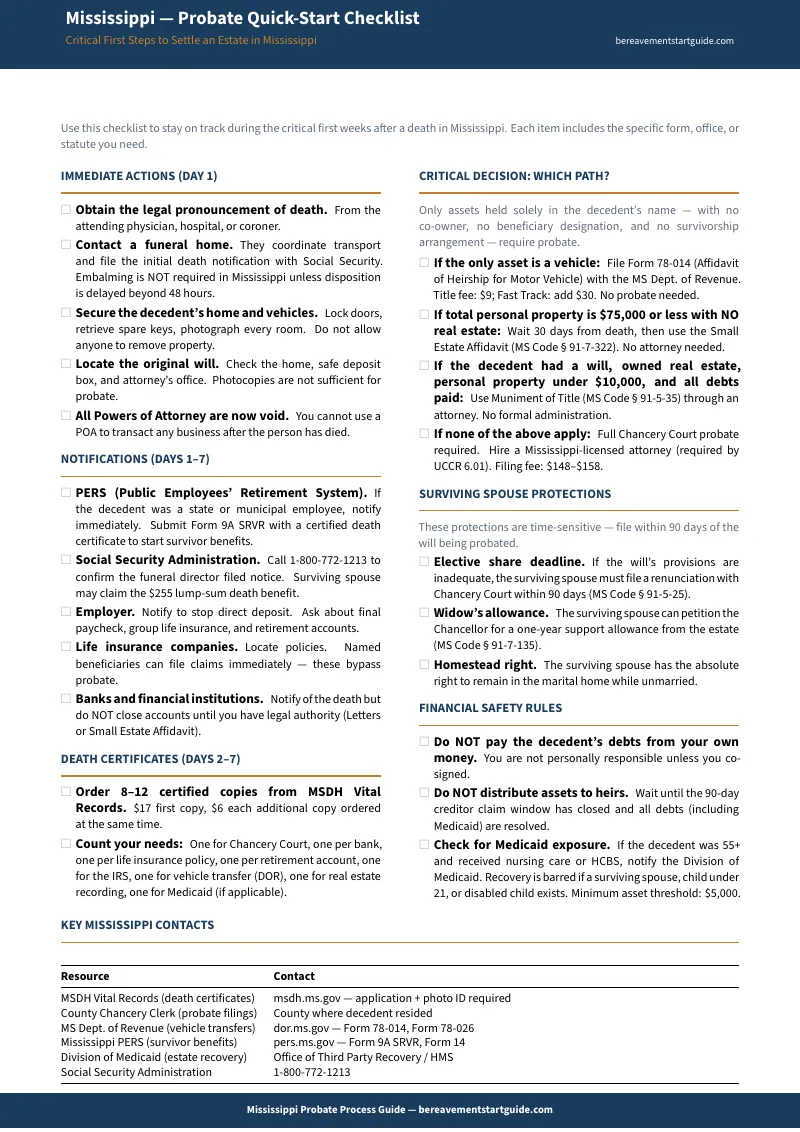
Your download includes the complete guide, the standalone Mississippi Probate Quick-Start Checklist, and printable reference tools — the Probate Bypass Assessment, Asset Inventory Worksheet, Creditor Notification Tracker, Spousal Rights Reference, Medicaid Recovery Exemption Guide, Small Estate Affidavit Eligibility Checklist, Vehicle Transfer Instructions, and Final Accounting Template. Every tool you need to walk into your attorney's office organized and prepared. Instant download, no account required.
Money-back guarantee, no time limit. If the guide does not give you clarity on whether your estate requires Chancery Court, confidence in managing the administrative preparation, and a clear path to reducing your legal costs, email us for a full refund. No questions asked.
Not ready for the full guide? Download the free Mississippi Probate Quick-Start Checklist — a printable action list covering death certificates, securing the estate, determining whether you qualify for a probate bypass, and the critical deadlines for the first 90 days. Enough to get started tonight.
You did not choose this responsibility. But the process is knowable, the deadlines are clear, and the preparation is something you can do yourself. The guide shows you exactly what to organize so your attorney can focus on what only a lawyer can do.
Frequently Asked Questions
What if the rules change after I buy?
We update the guide when the rules change. Email us any time, even years later, and we'll send you the current edition free.