The Bank Froze Everything. The Probate Clerk Handed You Blank Forms. And You Just Found Out That Paying the Wrong Bill First Could Make You Personally Liable.
Someone you love just died in Missouri. The bank locked the checking account the moment they heard. You need that money for the funeral, but the teller says you need "Letters Testamentary" -- and the probate clerk at the circuit court handed you a stack of forms without explaining which ones apply to your situation. There's a car that needs to be registered and a house that might have a beneficiary deed -- or maybe it doesn't. The funeral bill is due in ten days. And somewhere in the back of your mind, you remember hearing that the deceased was on Medicaid, which means the state might come after the house.
You start searching online. The Missouri Revised Statutes are available on revisor.mo.gov, but RSMo 473.397 -- the ten-class creditor priority system -- reads like it was written to confuse you on purpose. County court websites have downloadable Small Estate Affidavit forms, but nobody explains the critical difference between the $40,000 threshold and the $15,000 rule that silently triggers mandatory attorney representation. The Department of Revenue has vehicle title transfer forms, but they don't explain that a surviving spouse can use Form 2305 to transfer one vehicle of any value without probate -- or that waiting too long triggers a $25-per-month late penalty. Every probate attorney you call quotes $200 to $500 per hour, and you're not even sure you need one.
Meanwhile, your sibling just paid the credit card bill from estate funds. You have a sick feeling that was wrong -- and under Missouri law, it was. If the estate runs short and higher-priority claims go unpaid because unsecured debt was settled first, the person who authorized that payment faces personal financial liability.
The Missouri Estate Settlement Roadmap
This guide does what no single Missouri government website, court clerk, or attorney consultation does: it puts the entire estate settlement process into one chronological sequence, from the hour of death through final distributions and estate closure -- with every form number, statutory threshold, agency contact, and deadline in one place.
It's built specifically for Missouri. Not a generic national probate overview with "check your state laws" footnotes. Every chapter addresses the exact thresholds, timelines, and traps that make Missouri different -- the $40,000 Small Estate Affidavit and the hidden $15,000 rule that forces attorney representation, the Spousal Refusal and Creditor's Refusal of Letters that let qualifying families bypass formal probate entirely, the ten-class creditor priority system under RSMo 473.397 that dictates exactly which bills get paid first, and the aggressive MO HealthNet estate recovery program that can reach non-probate assets under RSMo 461.300.
What You Get
The Complete Guide
- First 48 Hours protocol -- understanding that all Powers of Attorney are immediately and irrevocably void at the moment of death, securing the residence and vehicles, maintaining insurance coverage, and the one rule that prevents the most common financial mistake: do not pay the deceased's debts from your own money
- Death certificate strategy -- ordering through the Bureau of Vital Records using Form VS-151BD at $14 for the first certified copy and $11 for each additional copy ordered simultaneously, Missouri's restricted access rules limiting who can request copies, how many to order (10 to 15 for most families), and which institutions demand originals versus photocopies
- Missouri pension notifications -- contacting MOSERS, LAGERS, or PSRS/PEERS if the deceased received state or local government retirement benefits, survivor benefit options, and why you must stop pension payments immediately to avoid overpayment clawbacks
- The $255 Social Security death benefit -- confirming the funeral director filed Form SSA-721, the documentation required for a surviving spouse or dependent child to claim the lump-sum benefit, and halting automatic deposits to prevent complex overpayment recovery
- Vehicle title transfer without probate -- Form 2305 (Affidavit to Establish Title to Exempt Property) plus Form 108 for surviving spouses to transfer one vehicle of any value, Form 4160 for vehicles with Transfer-on-Death beneficiary designations, the $8.50 title fee plus processing fees, and the $25-per-month late penalty for delayed transfers
- Bank account classification -- which accounts bypass probate entirely (POD designations, JWROS joint accounts under RSMo 362.470) and which ones stay frozen until you obtain Letters Testamentary, Letters of Administration, or a court-stamped Small Estate Affidavit
- Small Estate Affidavit (RSMo 473.097) -- the $40,000 net estate threshold, the mandatory 30-day waiting period, the critical $15,000 rule that triggers mandatory attorney representation and creditor publication for larger small estates or estates containing real property, and the step-by-step filing procedure at the circuit court
- Refusal of Letters (RSMo 473.090) -- three separate fast-track paths: the Spousal Refusal for surviving spouses to claim assets without formal probate, the Minor Refusal for surviving minor children, and the Creditor's Refusal that reimburses up to $15,000 in funeral expenses. How each one works, which county courts interpret the Spousal Refusal more broadly, and when these shortcuts qualify as genuine alternatives to opening a full estate
- Full probate administration -- Independent versus Supervised Administration, filing the petition at the Probate Division of the Circuit Court in the county where the deceased lived, the fiduciary bond requirement and when the will waives it, the mandatory attorney rule for estates with real property or values above $15,000, and the timeline from appointment through final settlement
- The ten-class creditor priority system -- RSMo 473.397 explained in plain English: costs of administration first, then exempt property allowances, then funeral expenses, then debts to the United States, then MO HealthNet claims, then wages, then state and local taxes, then judgments, then all other claims. Why paying a credit card before settling a Medicaid claim creates personal liability for the executor
- Surviving spouse protections -- the $15,000 homestead allowance (RSMo 474.290), exempt personal property (RSMo 474.250), the reasonable one-year family support allowance (RSMo 474.260), the right to elect against the will under RSMo 474.160, and how these allowances interact with creditor claims and with each other
- MO HealthNet estate recovery -- the state's aggressive pursuit of long-term care costs, statutory exemptions for surviving spouses and blind or disabled children living in the home, the expanded definition of "estate" under RSMo 461.300 that reaches non-probate transfers including beneficiary deeds, the Estate Notice Form for the DSS Cost Recovery Unit in Jefferson City, and when case law (In re Estate of Shuh) may limit recovery from a surviving spouse's non-probate assets
- Real estate transfers -- beneficiary deeds under RSMo 461.025 (recorded before death to bypass probate), executor's deed through formal probate, and the Small Estate Affidavit path. Why real estate in the estate almost always requires attorney involvement, and how MO HealthNet recovery can still attach to properties transferred by beneficiary deed
- No state estate or inheritance tax -- Missouri imposes neither, but federal estate tax obligations still apply to estates exceeding the federal exemption, and the guide explains when a federal return is required
- Complete statutory deadline calendar -- the 30-day waiting period for Small Estate Affidavits, the one-year deadline to open probate or admit a will, the six-month creditor claim window, and every other mandatory timeline in one consolidated reference
- When to hire a professional -- the exact triggers where Missouri law effectively requires an attorney (real property, estates over $15,000 in probate, contested wills, MO HealthNet recovery disputes), so you don't pay thousands for tasks you can handle yourself but don't accidentally mishandle tasks that require professional help
6 Standalone Printable Tools
In addition to the 71-page guide, you get six standalone reference cards and worksheets — print them individually and use them exactly where you need them:
- Creditor Priority Reference -- RSMo 473.397's ten-class system on one page, so you know exactly which bills to pay first and protect yourself from personal liability
- Probate Decision Tree -- a one-page flowchart that determines whether the estate qualifies for a Small Estate Affidavit, a Refusal of Letters, or needs full probate
- Statutory Deadline Calendar -- every Missouri estate deadline on one page: the 30-day waiting period, 6-month creditor window, 1-year probate filing deadline, and pension notification timelines
- Vehicle Title Transfer Guide -- three paths for transferring a vehicle after death, with the exact DOR forms for each path and the $25-per-month late penalty warning
- Account Closing Checklist -- what documents to bring and what to do for each type of financial account, plus a checklist of what to bring to every bank meeting
- Key Contacts & Forms Reference -- every Missouri agency, court, and pension system you may need to contact, plus a quick reference for all probate forms
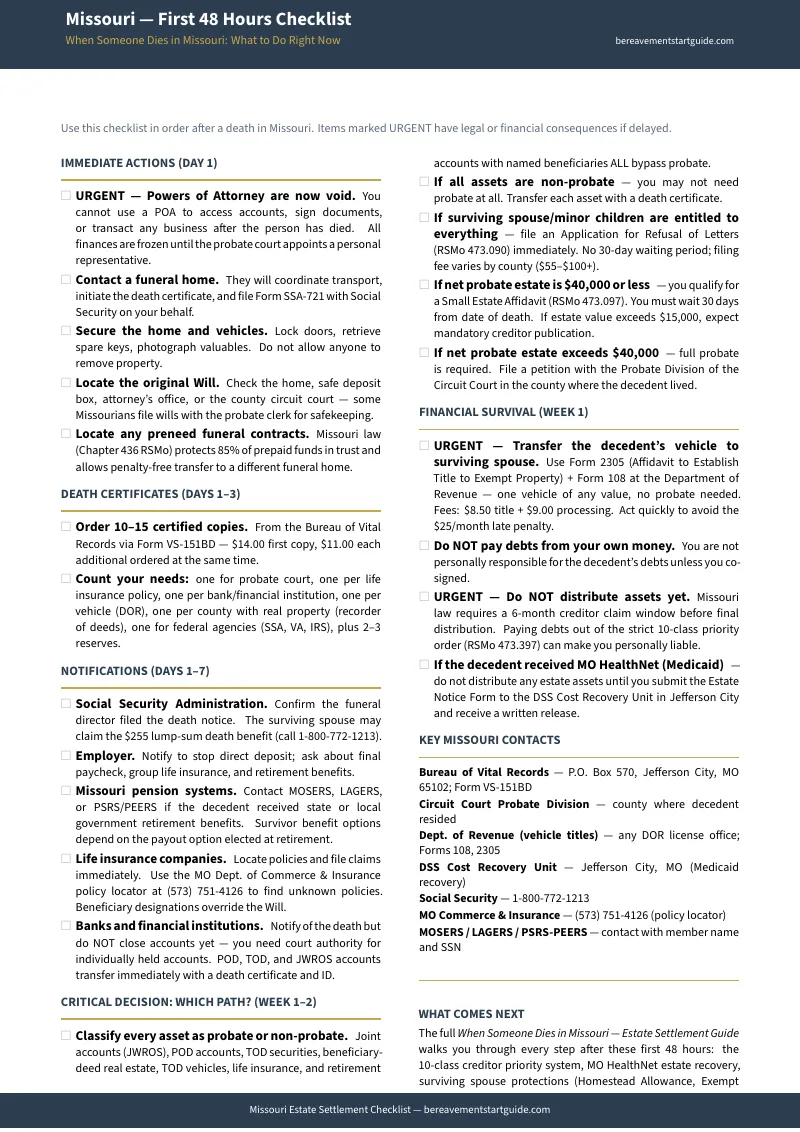
The Free Missouri First 48 Hours Checklist
A printable emergency checklist covering the most urgent tasks -- from understanding that all Powers of Attorney are now void and securing the residence through ordering death certificates, notifying pension systems, and determining whether the estate might qualify for Missouri's $40,000 Small Estate Affidavit or a Refusal of Letters. Available as a free download so you can start immediately while deciding whether the full guide is right for your situation.
Who This Is For
- Surviving spouses who need to access frozen bank accounts, understand POD and JWROS designations, transfer the vehicle using Form 2305 without probate, calculate homestead and exempt property allowances, and determine whether a Spousal Refusal of Letters can bypass formal probate entirely
- Adult children settling a parent's estate for the first time -- especially those living out of state who need to understand Missouri's circuit court system, the difference between the Small Estate Affidavit and full administration, whether out-of-state executors need a Missouri resident agent, and how to organize the estate before handing it to a local attorney
- Executors and personal representatives who want to fulfill their fiduciary duties correctly, protect themselves from personal liability by following the ten-class creditor priority system exactly, meet every statutory deadline, and close the estate using the right settlement procedure
- Families dealing with MO HealthNet recovery who need to know whether the surviving spouse or disabled child exemptions apply, whether beneficiary deeds actually protect the house from state recovery, and when Missouri's expanded estate definition under RSMo 461.300 means they should consult an elder law attorney before distributing any assets
- Cost-conscious administrators of modest estates who want to determine whether the $40,000 Small Estate Affidavit or a Refusal of Letters can settle the estate without the expense of formal probate -- saving thousands in attorney fees that would otherwise consume a significant portion of the inheritance
Why Not Just Use the Free Government Forms?
Every form referenced in this guide is available for free from a Missouri government office. The Small Estate Affidavit form is on the county circuit court website. The vehicle title transfer forms are at the Department of Revenue. The death certificate application is available from the Bureau of Vital Records in Jefferson City.
What's not free -- and what no government website provides -- is the sequence. The probate clerk can hand you a Small Estate Affidavit form but is legally prohibited from telling you whether your estate actually qualifies, or that the $15,000 threshold silently changes the rules by requiring an attorney and newspaper publication. The Department of Revenue has Forms 108 and 2305 but doesn't explain that only surviving spouses and unmarried minor children qualify for the exemption, or that the late-transfer penalty starts accumulating at $25 per month. No state website connects the 30-day Small Estate waiting period to the six-month creditor claim window to the one-year probate filing deadline into a single timeline you can actually follow. And no county court page warns you that paying the deceased's credit card before settling MO HealthNet claims can make you personally liable for the shortfall.
Each agency handles its piece. None of them tell you what the next agency in line requires, or warn you about the traps hiding between the steps. This guide connects the dots -- putting every form, every deadline, every calculation, and every agency into the order you actually need them.
-- Less Than One Hour of Attorney Time
A single consultation with a Missouri probate attorney runs $200 to $500 per hour. A flat-fee retainer for a straightforward estate starts at $2,000 to $5,000. And for a moderately complex estate, attorney fees consume thousands before executor compensation, bond premiums, and court costs. This guide covers the administrative fundamentals that would otherwise consume your first several billable hours -- ordering certificates, classifying probate versus non-probate assets, qualifying for the Small Estate Affidavit or Refusal of Letters, organizing your documents, sequencing creditor payments correctly, and meeting every statutory deadline. Even if you ultimately hire an attorney, completing these steps first saves the estate hundreds of dollars in billable intake time.
If the guide doesn't save you at least ten hours of frustrating research across scattered government websites, email us at any time for a full refund. No questions asked.
Frequently Asked Questions
What if the rules change after I buy?
We update the guide when the rules change. Email us any time, even years later, and we'll send you the current edition free.