
Missouri Has No Estate Tax. The State Still Expects Five Separate Filings.
Your loved one died in Missouri. Someone told you there is no state estate tax, which is true. You assumed that meant the tax side was simple. Then you discovered the decedent's final individual income tax return is due on Form MO-1040 -- and if you enter a negative Federal Adjusted Gross Income, Missouri requires you to change it to zero. Nobody told you that. You found it buried in a regulation (12 CSR 10-2.710) that most CPAs have to look up.
Then the estate's bank account earned $600 in interest while you were sorting paperwork, which triggered a mandatory fiduciary income tax return on Form MO-1041. That form requires you to calculate the "Missouri Fiduciary Adjustment" -- a state-specific recalculation based on federal distributable net income. The instructions assume you already know what that means. You called the Missouri Department of Revenue. They cannot give you tax advice. You called the probate court. They told you your six-month creditor window is running, the inventory is due in 30 days, and have you determined whether the estate qualifies for a Small Estate Affidavit under the $40,000 threshold? You had not.
So you searched online. SmartAsset confirmed there is no Missouri estate tax in a single paragraph. Reddit threads argued about Beneficiary Deeds and whether they shield property from MO HealthNet estate recovery (they do not always). Attorney blogs explained just enough to justify a $400/hour consultation. No single source connected the Department of Revenue's tax filings to the probate court's timeline to the Medicaid Cost Recovery Unit's claims. Three systems, zero coordination, and every deadline is yours to miss.
The Missouri Estate Tax Compliance System -- One Guide Across Three Agencies
The Missouri Final Tax & Estate Tax Guide takes the scattered demands of the Department of Revenue, the circuit court probate division, and the MO HealthNet Cost Recovery Unit and organizes them into one chronological action plan. It translates Missouri Revised Statutes and administrative regulations into plain English and tells you which forms to file, to which office, in what order, by when, and what happens if you miss.
What You Get
The Complete Tax & Estate Tax Guide
A comprehensive guide covering every tax obligation after a death in Missouri -- organized by timeline, not by agency. Written for executors and families, not CPAs.
- Final MO-1040 Walkthrough -- How to file the decedent's final Missouri individual income tax return, including the zero-FAGI rule that trips up even experienced filers: if the federal return shows a net operating loss (negative FAGI), Missouri law forces you to enter $0. The guide walks you through income reporting from January 1 through date of death, surviving spouse joint filing, and the Form MO-1310D refund procedure.
- MO-1041 Fiduciary Return Decoder -- The estate earns $600 in interest while sitting in probate, and suddenly you owe a Missouri Fiduciary Income Tax Return. The guide explains the Missouri Fiduciary Adjustment calculation -- the state-specific modification of federal distributable net income -- in plain English, with examples. It also covers the 5% penalty for late payment, even when a federal extension is filed, because Missouri does not extend the payment deadline.
- $40,000 Small Estate Threshold Diagnostic -- A worksheet that walks you through every asset category to determine whether the estate qualifies for the Small Estate Affidavit under RSMo 473.097. The calculation excludes joint accounts, TOD/POD designations, Beneficiary Deeds, life insurance, and trust assets. Get it wrong and you file the wrong paperwork. Get it right and you skip formal probate entirely.
- MO HealthNet Estate Recovery Defense -- If the decedent received Medicaid-funded nursing care after age 55, the state will attempt to recover costs from the estate -- and sometimes from assets transferred via Beneficiary Deed. The guide maps the exact statutory exemptions (surviving spouse, child under 21, blind or disabled child of any age) and walks you through the Cost Recovery Unit notification process and release timeline.
- Step-Up in Basis and Property Sale Procedure -- How the federal step-up resets inherited property to its date-of-death fair market value, potentially eliminating massive capital gains. The guide connects this to Missouri's 4.95% income tax rate on gains, the Beneficiary Deed recording process, and the property tax proration you owe when selling.
- Portability Election Strategy -- Even if the estate is nowhere near the $15 million federal exemption, surviving spouses should understand Form 706 portability. Filing preserves the deceased spouse's unused exclusion -- a combined $30 million shield -- for the surviving spouse's future estate. The nine-month deadline is absolute.
- County-Specific Probate Variations -- Bond waiver policies, attorney requirements, and Refusal of Letters thresholds vary sharply across Missouri's 114 counties plus St. Louis City. St. Louis County typically requires attorneys even for small estate filings. Rural counties often waive bonds for estates under $15,000. The guide flags these differences so you do not assume your county works like the one described on a blog.
- CPA and Attorney Handoff Organizer -- If your case is complex and you need a professional, this section lists exactly which documents, schedules, and basis calculations to organize before your first meeting. Walk in prepared instead of paying $400/hour for them to sort your paperwork.
The Tax After Death Checklist
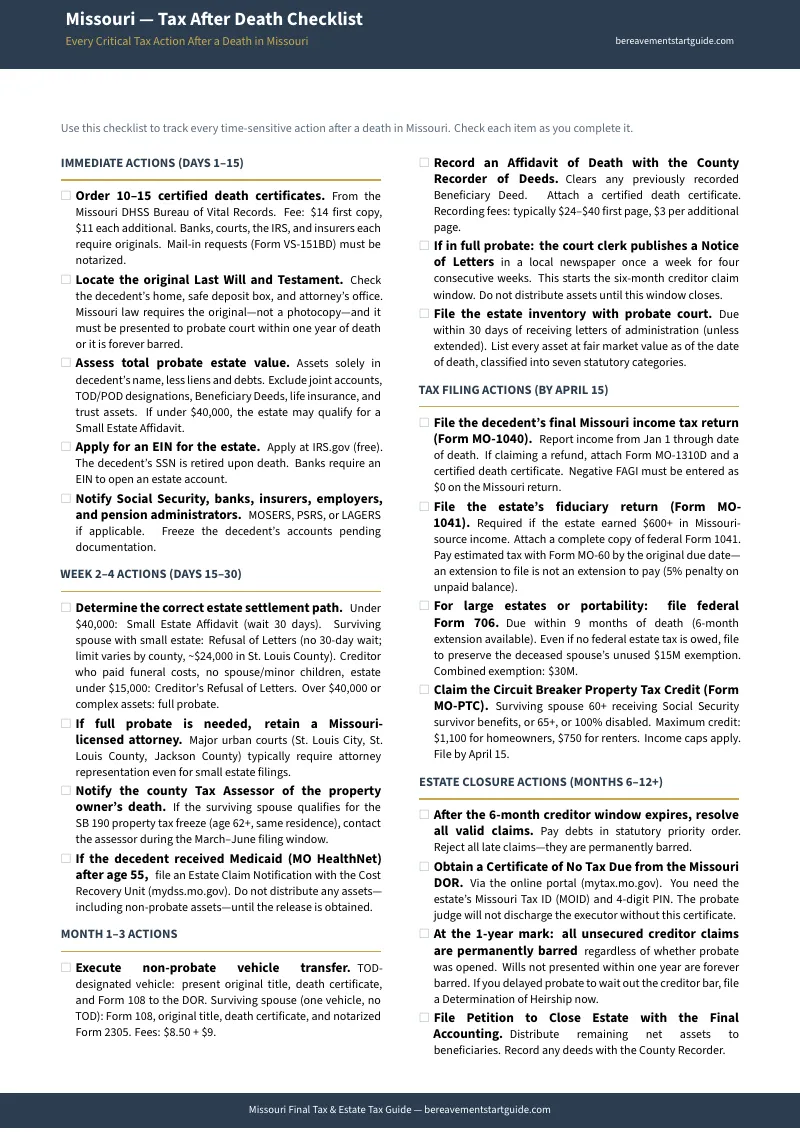
A printable chronological checklist covering every tax-related action from the first week through estate closing. Organized by deadline -- the 30-day Small Estate Affidavit eligibility date, the 30-day inventory filing deadline, the six-month creditor window, the nine-month Form 706 deadline, and the April 15 income tax returns -- so nothing falls through the cracks.
Who This Is For
- Executors and administrators who need to file the final MO-1040 and the estate's MO-1041 but cannot get straight answers from the Department of Revenue about how the Missouri Fiduciary Adjustment works or when the zero-FAGI rule applies
- Families trying to determine whether their estate qualifies for the $40,000 Small Estate Affidavit or whether they are locked into full probate administration -- and what that choice means for attorney fees and timeline
- Surviving spouses who need to understand the portability election, the property tax freeze (SB 190), the spousal elective share, and whether filing a joint final return is advantageous
- Beneficiaries who inherited a house through a Beneficiary Deed and need to establish the stepped-up basis, clear the title with the County Recorder, and understand whether MO HealthNet can still recover costs from the property
- Anyone preparing documents for a CPA who wants to minimize billable hours by walking in with organized schedules instead of a stack of unsorted paperwork
Why Not Free Resources?
The Missouri Department of Revenue and the circuit court probate division provide every form you need. They do not provide the one thing you actually need -- a coherent explanation of how to use them together:
- The Department of Revenue publishes Form MO-1040 and Form MO-1041 instructions written for tax professionals who already know the Missouri code -- they assume you understand the Missouri Fiduciary Adjustment and the zero-FAGI regulation
- The probate court clerk provides applications and affidavit forms but is legally prohibited from advising you on which path to file, how to calculate the $40,000 threshold, or whether your county requires an attorney for small estate filings
- SmartAsset and Nolo rank for "Missouri estate tax" by confirming the tax was repealed in a single paragraph -- they say nothing about the MO-1041 fiduciary return, the zero-FAGI rule, or the MO HealthNet estate recovery claim that can block closing
- Attorney blogs explain just enough to demonstrate complexity -- they intentionally withhold the procedural details to funnel you into a $400/hour consultation
- No single free source connects all three systems -- Department of Revenue tax filings, circuit court probate requirements, and MO HealthNet cost recovery -- into one sequential workflow
-- Less Than One Hour With a Missouri Probate Attorney
Missouri probate attorneys charge $200 to $400 per hour, or take a statutory percentage of the estate -- 5% on the first $5,000, 4% on the next $20,000, 3% on the next $75,000. Even for a modest $150,000 estate, combined attorney and executor statutory fees easily exceed $9,000. This guide costs less than fifteen minutes of professional time -- and it can replace dozens of hours of confused research across scattered government websites.
For straightforward estates, this guide can eliminate the need for a tax professional entirely. For complex estates, organizing your paperwork with this guide before your first CPA meeting can save hundreds in billable hours -- because you walk in with completed worksheets instead of questions.
60-day, no-questions-asked refund guarantee. If this guide does not save you at least 10 hours of frustrating tax research, email us for a full refund. You keep the guide.
Frequently Asked Questions
What if the rules change after I buy?
We update the guide when the rules change. Email us any time, even years later, and we'll send you the current edition free.