
Someone You Love Just Died in Missouri. The Funeral Director Handed You a Contract. You Have No Idea What You Are Legally Required to Pay For and What You Can Refuse.
You are sitting in an arrangement room at a funeral home, and everything is moving too fast. The director is walking you through casket options, vault selections, embalming fees, and package prices. You are exhausted, you are grieving, and every item on the list sounds like something you are supposed to buy. The total is climbing toward $8,000, $10,000, $12,000 -- and a voice in the back of your head is asking whether all of this is actually required or whether you are simply too overwhelmed to push back.
You are not imagining it. The funeral transaction is the only major purchase in American life where the buyer is in active grief, operating under a hard deadline, and negotiating against a seller who controls access to the body. Missouri funeral homes are required by federal law to provide you an itemized General Price List before you agree to anything. Most families never ask for it. Of the families who receive one, most do not understand what they are looking at -- which line items are legally mandated, which are optional, which are cemetery requirements disguised as state law, and which are pure margin.
Here is what Missouri law actually says: embalming is not required. An outer burial container -- the vault the cemetery insists on -- is never mandated by state law. The 40-hour waiting period before cremation is a strict statutory requirement, not a funeral home policy. Families have the legal right to transport their own dead. And the person who controls every decision about burial, cremation, or other disposition is determined by a specific statutory hierarchy under RSMo 194.119 -- not by whoever shows up at the funeral home first or whoever is most insistent at the family meeting.
The Missouri Funeral Laws & Consumer Rights Guide is a Consumer Shield System for every legal right, procedural requirement, and cost-avoidance strategy available to Missouri families arranging a funeral, cremation, home burial, or green burial. Not a generic national overview. Not funeral home marketing dressed up as consumer advice. A structured, Missouri-specific manual that translates RSMo 194.119, the FTC Funeral Rule, Missouri State Board of Embalmers and Funeral Directors regulations, and 20 CSR 2120 administrative rules into plain English -- so you know exactly what you must pay for, what you can legally refuse, and who holds the authority to make every decision.
What's Inside the Consumer Shield System
A comprehensive guide and the Missouri Funeral Consumer Rights Checklist -- covering every stage from the moment of death through final disposition, built specifically for Missouri statutes and the regulatory rules that make arranging a funeral here different from any other state:
Your Rights at the Funeral Home: The FTC Funeral Rule in Missouri
Federal law requires every Missouri funeral establishment to provide you a General Price List the moment you walk in or the moment you ask over the phone. You have the right to an itemized breakdown of every charge. You cannot be forced into a package deal. You cannot be charged a handling fee for bringing in a casket you purchased elsewhere. You have the absolute right to select only the services and merchandise you want -- and the funeral home must accommodate your choices without penalty. The guide walks you through every line item on a typical Missouri GPL, explains what each charge covers, identifies the items that carry the highest margins, and gives you the language to decline services you do not want without feeling like you are disrespecting the deceased.
Embalming: What Missouri Law Actually Requires
Missouri does not require embalming. That sentence alone is worth the price of this guide for most families, because the overwhelming majority of people walking into a Missouri funeral home believe the opposite. What the law does say: if final disposition does not occur within 24 hours, the body must be embalmed, refrigerated, or placed in a hermetically sealed casket. For deaths involving communicable diseases subject to isolation, the body must be embalmed or placed in a sealed casket before any public viewing. The guide explains every scenario -- standard deaths, communicable disease cases, deaths requiring medical examiner involvement -- so you know when refrigeration is a perfectly legal and significantly cheaper alternative to embalming, and when embalming is genuinely required.
The Right of Sepulcher: Who Controls the Decisions
When family members disagree about burial versus cremation, which funeral home to use, or what kind of service to hold, Missouri law does not leave the answer to whoever argues loudest. RSMo 194.119 establishes a strict legal hierarchy. An attorney-in-fact designated in a Durable Power of Attorney that explicitly grants the Right of Sepulcher holds the highest priority -- above the surviving spouse, above adult children, above everyone. After that comes a designee on a military DoD Form 93, then the surviving spouse, then adult children. If two or more people in the same class disagree, the funeral director is legally permitted to follow the instructions of any one of them, provided they have no knowledge of objections from the others. The guide maps the complete hierarchy, explains how to establish authority before a dispute escalates, and covers what happens when no one in the hierarchy can be located.
Cremation: The 40-Hour Wait and Authorization Rules
Missouri imposes a mandatory 40-hour waiting period between death and cremation. This is state law, not funeral home policy, and it cannot be waived by the family. During that window, a physician or medical examiner must certify the cause of death. The authorization hierarchy for cremation follows the same Right of Sepulcher order, but with an additional layer: if the deceased signed a written cremation authorization before death -- such as in a preneed contract -- that document supersedes any objection from the next of kin. The guide covers the full authorization process, the specific forms required by Missouri cremation establishments, what happens when the medical examiner flags the death for investigation, and how the 40-hour clock interacts with weekend and holiday schedules.
Home Burial: What Missouri Actually Allows
Missouri law permits private burial on land of less than one acre, provided the land is deeded in trust to the county commission and the deed is recorded with the county clerk within 60 days. Families are legally permitted to prepare the body themselves, conduct their own funeral service, and bury their loved one on private property -- all without hiring a funeral director. But local zoning ordinances can override state law, and most families do not discover this until after they have made plans. The guide covers every step of the home burial process, the county-level restrictions you need to check before committing, the notification requirements, and the practical logistics of transport and grave preparation that no government website explains.
Transporting a Body: Your Right to Do It Yourself
You are not required to hire a funeral director to transport a body in Missouri. Families have the legal right to transport their own dead, provided they secure a completed notification of death filed with the local registrar and, if acting without a funeral director, obtain physician or medical examiner authorization before moving the body. For deaths involving communicable diseases subject to isolation, strict protocols apply -- the body must be placed in a closed ambulance pouch during transit. The guide covers both standard transport and infectious disease exceptions, the electronic death registration system, the burial transit permit process, and how to handle out-of-state transport when the death occurs in Missouri but the burial is elsewhere.
The Outer Burial Container Myth
Missouri state law does not require an outer burial container, vault, or grave liner. Individual cemeteries may require them as a maintenance policy -- but that is a private business decision, not a legal mandate. Funeral homes are required under the FTC Funeral Rule to disclose this distinction on the General Price List. Many do not make it clear. The guide explains the difference between state law and cemetery policy, helps you understand when a vault is genuinely necessary versus when it is an upsell, and covers how to find cemeteries in Missouri that do not impose this requirement -- which matters enormously for families pursuing green burial.
Green Burial and Alternative Disposition
Because Missouri does not mandate embalming, does not require vaults, and permits home burial, the state is legally hospitable to green burial. The guide covers the specific requirements for biodegradable caskets and shroud burials, lists certified and hybrid green burial sites including Bellefontaine Cemetery in St. Louis and Green Acres in Rocheport, and explains the operational rules at each site. It also covers ash scattering -- Missouri has no state agency monitoring where ashes are scattered, but scattering on private land requires the landowner's explicit permission, and the 90-day notice rule for unclaimed cremated remains under RSMo 194.350 matters if you are dealing with an estranged family member's remains.
Prepaid Funeral Contracts: Consumer Protections
If the deceased purchased a prepaid funeral contract, or if you are considering purchasing one for yourself, Missouri's Preneed Funeral Contract Act (RSMo 436.400) provides specific consumer protections that most families never learn about. Eighty-five percent of the purchase funds must be placed in a designated trust account. The contract is legally portable -- you can switch funeral homes without forfeiting funds. The guide explains how to verify that a preneed trust is properly funded, what to do if you suspect the funeral home has not deposited the required percentage, and how to file a complaint with the Missouri State Board if the contract terms are not being honored.
Filing a Complaint: When Your Rights Are Violated
If a funeral home refused to provide a General Price List, pressured you into purchasing services you did not want, misrepresented state law to sell embalming or a vault, or failed to honor a preneed contract, you have the right to file a formal complaint. The guide provides the direct contact information for the Missouri State Board of Embalmers and Funeral Directors, explains the board's investigative authority, walks you through the complaint process step by step, and covers the parallel federal FTC complaint path for violations of the Funeral Rule.
Veterans Burial Benefits in Missouri
Missouri operates state veterans cemeteries that provide free interment -- including burial space, an upright granite headstone, and a grave liner -- for eligible veterans, their spouses, and dependent children. The guide covers the pre-certification application process, the DD-214 documentation requirement, and how state veterans cemetery benefits layer on top of federal VA burial allowances. For families who do not know where the DD-214 is, it includes the process for requesting a replacement from the National Personnel Records Center.
Death Certificates: Getting the Right Number
Every institution that processes the estate -- banks, insurance companies, the probate court, the Department of Revenue for vehicle transfers -- requires an original certified death certificate, not a photocopy. The guide explains the 72-hour window for medical certifiers to complete their portion, the recent legislative changes allowing physicians to designate others to enter data electronically, and gives you the calculation for how many certified copies to order based on the deceased's financial accounts and property holdings. Getting this number wrong means coming back weeks later for additional copies, paying higher fees, and delaying every claim in the process.
The Medicaid Shield: Protecting Assets from MO HealthNet Recovery
If the deceased received Medicaid benefits after age 55, MO HealthNet will pursue estate recovery. But Missouri operates a strict probate-only recovery system -- the state generally only pursues assets that pass through probate court. A properly recorded Transfer-on-Death deed passes the family home directly to heirs without going through probate, legally shielding it from state recovery. The guide explains how TOD deeds work, why they must be recorded before death, and how this single legal mechanism can protect a $200,000 family home from recovery efforts -- a return on investment that dwarfs the cost of any guide.
The Funeral Reimbursement Path: Creditor's Refusal of Letters
If you paid for the funeral out of your own pocket and the deceased had assets in solely-owned accounts, Missouri law provides a mechanism to reimburse yourself up to $15,000 without opening a full probate estate. The Creditor's Refusal of Letters allows you to claim funeral expenses directly from the deceased's frozen bank accounts, provided there is no surviving spouse or unmarried minor children. The guide walks you through the filing process, the documentation requirements, and the limits of this mechanism -- because getting it wrong means waiting months for reimbursement through formal probate instead.
Who This Guide Is For
- The family sitting in the arrangement room right now who needs to know -- before signing anything -- which charges on the funeral home contract are legally required, which are optional, and which are cemetery policies being presented as state law
- The surviving spouse or adult child who was just told embalming is required and needs to know that Missouri law says otherwise -- and that refrigeration is a legal, significantly cheaper alternative for the first 24 hours
- The family fighting over burial versus cremation who needs to know exactly who holds legal authority under RSMo 194.119, and whether the deceased's Durable Power of Attorney supersedes everyone else's opinion
- The person who wants a simple, affordable funeral and does not know that Missouri law permits families to transport their own dead, prepare the body at home, and bury on private property without hiring a funeral director
- The adult child dealing with a parent's prepaid funeral contract who is not sure whether the funeral home is honoring the original terms, whether the trust funds are properly deposited, or whether the contract can be transferred to a different provider
- The family of a veteran who does not know that Missouri state veterans cemeteries provide free interment, a granite headstone, and a grave liner -- and that these benefits can be combined with federal VA burial allowances
- The executor who paid for the funeral personally and needs to know how the Creditor's Refusal of Letters can reimburse up to $15,000 from the deceased's frozen accounts without opening a full probate case
- The proactive planner who watched a family member get overcharged at a funeral and is determined to document their own wishes, establish legal authority through a Durable Power of Attorney, and record a Transfer-on-Death deed before it is too late
Why Free Resources Will Not Get You Through This
The information exists. It is scattered across Missouri state board websites, county registrar offices, federal FTC guidance pages, and funeral home bereavement content that was written to sell services. Here is what you actually encounter when you try to navigate Missouri funeral law using free sources alone:
- Missouri state websites give you the statutes and nothing else. The Missouri Revised Statutes and the Code of State Regulations are public domain. They are also written in dense legalese, spread across multiple disjointed platforms. Cross-referencing RSMo 194.119 governing the Right of Sepulcher with 20 CSR 2120-2.071 governing cremation rules to understand why a funeral director is refusing to proceed requires legal training most families do not have -- and time that grief does not provide.
- Funeral homes explain the process in a way that sells their services. Missouri funeral home websites offer helpful-sounding content about cremation timelines, embalming, and casket selection. They rarely mention that embalming is not legally required, that vault requirements come from the cemetery and not from state law, or that families have the legal right to transport the body themselves. The advice consistently steers families toward purchasing the maximum number of commercial services.
- Consumer advocacy groups cover the basics but miss Missouri-specific details. The Funeral Consumers Alliance provides excellent general guidance on FTC Funeral Rule rights. The Greater Kansas City chapter is active, but rural Missouri coverage is sparse. None of these organizations provide step-by-step guidance on the 40-hour cremation wait, the specific TOD deed mechanism that shields homes from MO HealthNet recovery, or the Creditor's Refusal of Letters filing process.
- Elder law attorneys use complexity to justify retainer fees. Missouri probate and elder law firm blogs are accurate on the legal details -- and they are explicitly designed to convince you that the regulatory landscape is so dangerous you need to spend hundreds per hour on representation. For contested estates and complex planning, that is true. For the family that simply needs to understand their rights before walking into a funeral home, the answer costs a fraction of what an attorney charges.
- National publishers miss the details that matter in Missouri. Nolo.com and us-funerals.com cover funeral law in general terms. They do not explain Missouri's unique 40-hour cremation wait, the probate-only Medicaid recovery rule, the specific conditions under which home burial is legal, or the Creditor's Refusal of Letters mechanism. Missouri is not a footnote -- it is a state with its own rules, and generic content misses them.
Free resources give you fragments from a dozen sources that do not reference each other. The Consumer Shield System puts every Missouri-specific statute, regulation, consumer right, and procedural step into one document, in the order you actually need them.
-- Less Than Twenty Minutes With a Missouri Attorney
A single consultation with a Missouri elder law or probate attorney costs $200 to $350 per hour. Funeral home upsells on services you are not legally required to purchase can add thousands to the final bill. This guide costs less than twenty minutes of professional legal time and gives you the complete Missouri-specific consumer protection toolkit -- every statute, every regulation, every right, every deadline, and the negotiation framework that tells you exactly what you can refuse.
Your download includes 8 PDFs -- instant download, no account required:
- The complete guide covering Missouri funeral law, consumer rights, and asset protection strategies
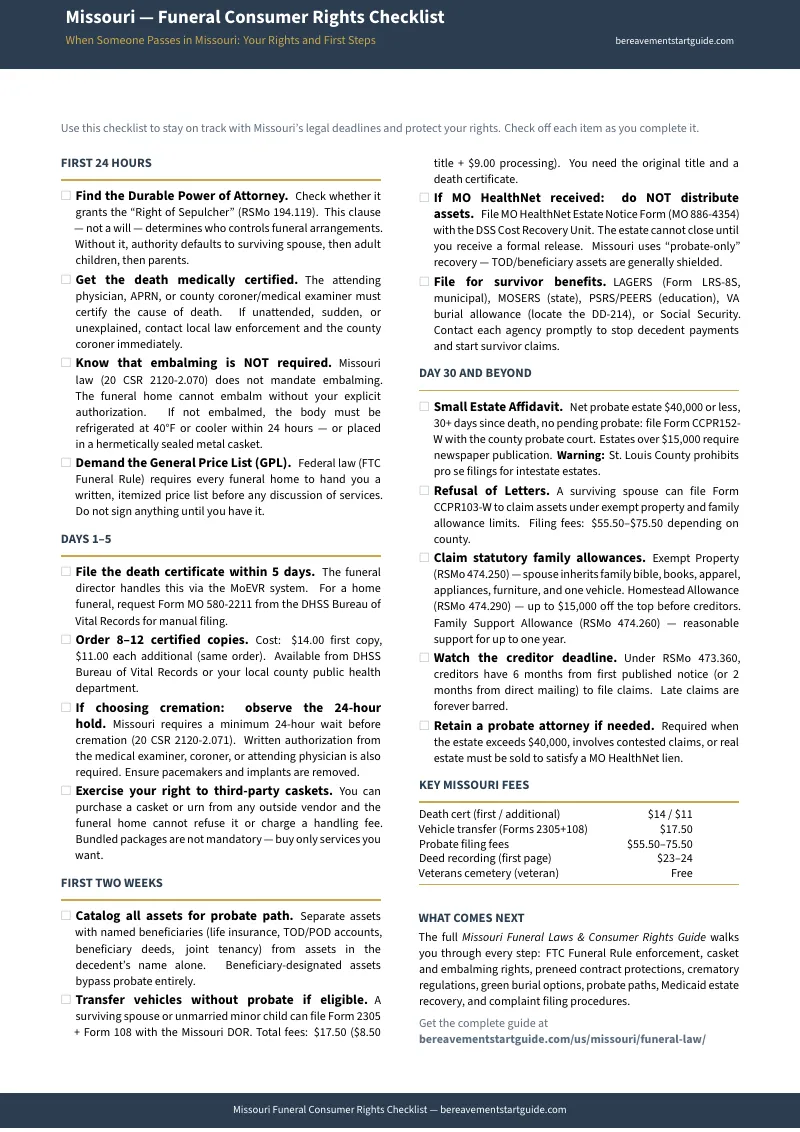
- Missouri Funeral Consumer Rights Checklist -- the critical actions, deadlines, and rights on one printable page
- FTC Compliance Checklist -- every itemized-pricing right and the language to exercise them at the funeral home
- Right of Sepulcher Reference Card -- the full RSMo 194.119 authority hierarchy and the 48-hour waiver rule
- Embalming Decision Table -- when embalming is legally required versus when refrigeration is the cheaper alternative
- Cremation Authorization Checklist -- the 40-hour wait, authorization hierarchy, and required forms
- Post-Death Administration Timeline -- every deadline from hours 1-24 through months 2-6 on one printable page
- Forms and Agencies Reference Card -- every form number, agency contact, and filing fee in one place
Money-back guarantee, no time limit. If the guide does not give you clarity on your rights and confidence that you are making informed decisions, email us for a full refund. No questions asked.
Not ready for the full guide? Download the free Missouri Funeral Consumer Rights Checklist -- the critical actions, deadlines, and rights you need to know before signing any funeral home contract. It covers your FTC rights, the embalming truth, the cremation waiting period, the Right of Sepulcher hierarchy, and the items you can legally decline. Enough to walk into the arrangement room tonight with confidence.
Nobody should have to negotiate their rights while they are grieving. The guide makes sure you do not have to.
Frequently Asked Questions
What if the rules change after I buy?
We update the guide when the rules change. Email us any time, even years later, and we'll send you the current edition free.