You Were Just Named Executor in Missouri. The Bank Wants "Letters Testamentary" Before Releasing a Dollar. The Attorney Wants a $3,000 Retainer. And You Just Discovered That Missouri Charges Statutory Fees Based on Estate Value -- Whether the Work Takes Ten Hours or a Hundred.
The funeral is over. You called the bank to access the checking account and they told you to come back with court-issued Letters. You called an attorney. They quoted the Missouri statutory fee schedule: 5% on the first $5,000, 4% on the next $20,000, 3% on the next $75,000, and it keeps climbing. A $300,000 estate generates roughly $8,625 in minimum statutory attorney fees -- before the court filing fees, the newspaper publication costs, and the surety bond premium. You have not filed a single form and the process has already become expensive.
Then comes the second discovery: Missouri probate is not one process. It is at least four. The Refusal of Letters pathway lets a surviving spouse bypass court entirely for estates under about $24,000. The Small Estate Affidavit handles estates under $40,000 -- but if the net value exceeds $15,000 or includes any real estate, Missouri law requires you to hire an attorney anyway. Independent Administration lets the executor manage the estate with minimal court oversight, but only if the will authorizes it or every single heir consents in writing. Supervised Administration puts the judge in control of every significant decision. Choose the wrong pathway and you waste months backtracking through court proceedings you could have avoided.
The Missouri Probate Process Guide is a Court Preparation System for every organizational step between the death certificate and the final distribution. Not a replacement for the attorney Missouri law requires for most estates. A preparation tool that ensures your attorney spends time on legal judgment -- not on sorting your paperwork. Built around the Missouri Revised Statutes, the Supreme Court Rules, and the county-by-county procedural variations that make probate in Jackson County different from probate in Greene County or St. Louis County -- covering the exact statutes, the exact deadlines, the exact dollar thresholds, and the exact decision points that determine whether this costs $2,500 or $12,000.
What's Inside the Court Preparation System
A comprehensive guide, printable worksheets, and a Quick-Start Probate Checklist -- covering every stage from locating the will through closing the estate, built specifically for Missouri's four-pathway system and the state-specific rules that make probate here different from any other state:
Which Pathway Applies? The Probate Pathway Assessment
Before you write a retainer check, you need to know whether formal probate is even required. Missouri offers multiple shortcuts that bypass full court administration. The Refusal of Letters procedure under RSMo 473.090 lets a surviving spouse or minor's guardian bypass probate entirely for very small estates. The Small Estate Affidavit under RSMo 473.097 covers estates with a net value of $40,000 or less -- but hides a critical trap: if the estate exceeds $15,000 or contains any real estate, an attorney is legally mandated. The guide walks through the exact eligibility criteria for each pathway, the net value calculation (gross assets minus liens, debts, and encumbrances), and the decision sequence that tells you precisely which path applies to your estate before you spend a dollar on legal representation.
The Attorney Mandate: What It Requires and What It Does Not
Missouri law requires attorney representation for all formal probate proceedings and for small estates exceeding $15,000 or involving real estate. Some counties -- including St. Louis County -- require attorney representation for all probate filings regardless of estate value. But the mandate covers legal representation in court. It does not cover organization, preparation, or administrative work. Missouri law does not require you to pay an attorney $300 an hour to gather bank statements, catalog assets, compile a creditor list, or organize the 30-day court inventory. The guide positions you to do the administrative preparation yourself and hand your attorney a fully organized, audit-ready file -- the single most effective way to negotiate a lower flat fee instead of open-ended hourly billing.
Filing Through Probate Court: The Complete Sequence
Filing for probate in Missouri is a sequence of interlocking steps, each with its own statutory requirements. Present the will to the Circuit Court Probate Division within one year of death -- miss this deadline and the will is permanently invalidated under RSMo 474.510, forcing the estate into intestacy regardless of what the decedent wanted. File the Application for Letters Testamentary or Letters of Administration. Post a surety bond unless the will specifically waives it. Receive your Letters -- the document that gives you legal authority over the estate. The guide covers each step in order, explains the bond waiver provisions, and details the filing fees that vary from county to county ($148 to $260 or more depending on the court).
The Mandatory 30-Day Inventory
Within 30 days of receiving your Letters, Missouri law requires a comprehensive inventory of every probate asset -- every bank account, every piece of real estate, every vehicle, every investment -- with fair market values and encumbrances. Real property requires the full legal description and a recent valuation: a letter from a licensed realtor or a drive-by appraisal dated within the last six months. The guide includes a printable Asset Inventory Worksheet that organizes every asset category in the format the court expects, so the inventory is accepted on the first filing.
The Six-Month Creditor Claims Period
This is where executors create personal liability without realizing it. Missouri requires you to publish a notice to creditors in a local newspaper, which triggers a strict six-month window for claims. But publication alone is not enough: you must also mail direct written notice to every creditor you actually know about. Each known creditor gets two months from mailing (or six months from publication, whichever is later) to file a claim. Distribute assets to heirs before these windows close and you are personally liable if a valid claim surfaces. The guide provides the Creditor Notification Tracker -- publication timeline, mailing log, and the statutory rules for accepting, rejecting, or negotiating claims.
Statutory Fees: The Math Nobody Shows You
Missouri uses a rigid fee schedule (RSMo 473.153) that dictates compensation for both the attorney and the personal representative: 5% of the first $5,000, 4% of the next $20,000, 3% of the next $75,000, 2.75% of the next $300,000, 2.5% of the next $600,000, and 2% on everything above $1,000,000. These percentages apply to each -- the attorney and the executor each collect the same schedule. Add court filing fees ($148 to $260+), newspaper publication costs ($50 to $600+), surety bond premiums, and certified copy charges, and the total cost of probate becomes significant. The guide lays out the complete fee math so there are no surprises.
Spousal Rights: What Missouri Law Guarantees
Missouri provides powerful protections for surviving spouses that override the terms of the will. The right to "take against the will" under RSMo 474.160 -- electing to receive one-third of the estate if there are lineal descendants, one-half if there are not. Exempt property rights: the family bible, one automobile, household appliances, and furnishings. A one-year family allowance for support during estate administration. A homestead allowance protecting the family home. These protections interact with each other and with the distribution plan in ways that require careful calculation. The guide explains each right, the election deadlines, and how the offsets work.
MO HealthNet Estate Recovery: When the State Files a Claim
If the deceased was 55 or older and received Medicaid-funded nursing care or home-based services, the MO HealthNet Division can file a recovery claim against the estate. Families hear "the state will take the house" and freeze. The reality is governed by specific statutory exemptions: recovery is prohibited if there is a surviving spouse, a child under 21, or a blind or disabled child of any age. But families who assumed a Beneficiary Deed (RSMo 461.025) would protect the home often discover that Missouri permits recovery from non-probate transfers as well. The guide walks through the mandatory Estate Claim Notification form (MO 886-4354), the exemption rules, and the process for securing the Release Letter the estate cannot close without.
Independent vs. Supervised Administration
This is the single most consequential decision in Missouri probate. Independent Administration (RSMo 473.780) lets the executor manage the estate without petitioning the court for permission to sell property, pay claims, or distribute assets. It requires the will to authorize it or unanimous written consent from all distributees. Supervised Administration requires judicial approval for virtually every significant action, mandates audited annual settlements, and can extend the process by years. If a single heir refuses to consent to independent administration, the estate defaults to supervised. The guide explains the consent process, the advantages and risks of each path, and how to handle the situation when family disagreement makes independent administration impossible.
Out-of-State Executors: The Resident Agent Requirement
If you live outside Missouri, RSMo 473.117 requires you to designate a Resident Agent -- a Missouri resident authorized to accept legal service of process on your behalf. This must be filed before your Letters will be issued. Some counties scrutinize corporate or law firm addresses and reject them. The guide covers the designation form, what qualifies as an acceptable agent, and the additional logistics of managing a Missouri estate from another state -- including remote bond procurement and coordinating with local attorneys.
Transferring Vehicles Without Full Probate
A surviving spouse can often transfer a vehicle title outside of probate entirely using Missouri Department of Revenue Form 2305 (Affidavit to Establish Title to Exempt Property). The process requires a notarized affidavit, a certified death certificate, and modest fees ($8.50 title fee + processing). For vehicles that must go through probate, the standard transfer uses Form 108 (Application for Missouri Title and License). The guide covers both pathways step by step -- often the first tangible relief families experience while the rest of the estate is still being organized.
Closing the Estate
Before you are discharged from fiduciary liability, every administrative thread must be resolved. Independent administration: file a Statement of Account, mail to all interested parties, wait 20 days for objections, then distribute. Supervised administration: prepare a Final Settlement, publish notice for four weeks, submit for court audit, obtain judicial approval, distribute assets, collect signed receipts, and file for final discharge. In both cases, the estate absolutely cannot close until the MO HealthNet Cost Recovery Unit has issued a formal Release Letter confirming no claim or that all claims have been satisfied. The guide includes the Final Accounting Template and the closing checklist that gets you to discharge.
Who This Guide Is For
- The executor facing Missouri's statutory fee schedule -- who needs to understand exactly which steps require an attorney and which administrative preparation can be done independently to reduce the legal bill from $8,000 to $3,000
- The family handling a small estate under $40,000 -- who needs to know whether the Small Estate Affidavit or Refusal of Letters bypasses formal probate entirely, what forms are required, and the $15,000 threshold that triggers the mandatory attorney requirement
- The surviving spouse who needs immediate access to frozen accounts -- who needs to understand the Refusal of Letters procedure, exempt property rights, the elective share option, and whether MO HealthNet estate recovery can reach assets the family assumed were protected
- The out-of-state executor who was named in the will -- who needs to know about the Resident Agent designation, remote bond procurement, and the complete sequence of fiduciary duties in one document so they can manage the process without repeated calls to an attorney billing $300+ an hour
- The family terrified of MO HealthNet recovery -- who heard the state will seize the family home because the deceased received nursing home benefits, and who needs the actual exemption rules, the notification process, and the Release Letter procedure
- The executor choosing between Independent and Supervised Administration -- who needs to understand what unanimous consent means, what happens when a single heir refuses, and how to avoid the supervised pathway that doubles the timeline and legal costs
Why Free Resources Will Not Get You Through This
The information exists. It is scattered across local law firm blogs, county court websites, national legal directories, and isolated statute pages. Here is what you encounter when you try to navigate Missouri probate using free sources alone:
- County court forms are not interchangeable. Missouri's decentralized court system means a Petition for Letters printed from the Jackson County website will be rejected in Greene County. St. Louis County Local Rule 3.2 prohibits forms printed double-sided. Each county has its own forms, its own filing fees, and its own procedural requirements. Free courthouse forms give you a blank document with zero context on how to complete it or where it fits in the timeline.
- Local Missouri law firms write content designed to secure $3,000+ retainers. Firms like Schnurbusch Law maintain extensive blog libraries that accurately describe the complexity of probate -- then end every article with a consultation booking form. For contested or complex estates, they are right -- you need litigation counsel. For straightforward, uncontested estates, the administrative work that drives the legal bill is work you can prepare yourself.
- National platforms get Missouri law wrong. Estate settlement SaaS platforms advertise generalized state landing pages suggesting you can handle Missouri probate with their templates. They fail to mention the $15,000 attorney mandate for small estates, the county-by-county form differences, or the MO HealthNet notification requirement. Following generic national advice in Missouri can result in rejected filings and procedural setbacks that cost the estate thousands.
- The Missouri Bar's free Probate Resource Guide provides definitions, not directions. It explains what a "Personal Representative" is. It does not provide a 60-day task timeline, a creditor tracking worksheet, or the decision sequence for choosing between independent and supervised administration.
Free resources give you fragments from a dozen sources that contradict each other on critical details like the attorney mandate threshold or the creditor claims window. The Court Preparation System puts every Missouri-specific statute, deadline, threshold, and procedure into one document, in the order you actually need them.
-- Less Than Ten Minutes With a Missouri Probate Attorney
A single consultation with a Missouri probate attorney costs $200 to $400 per hour. Full representation runs $3,000 to $10,000+ for moderate estates using the statutory fee schedule. National estate software charges $100 to $200 per year in recurring subscriptions. This guide costs less than ten minutes of professional legal time and gives you the complete Missouri-specific roadmap -- every statute, every deadline, every threshold, and the decision tools that tell you which probate pathway applies to your estate before you write a retainer check.
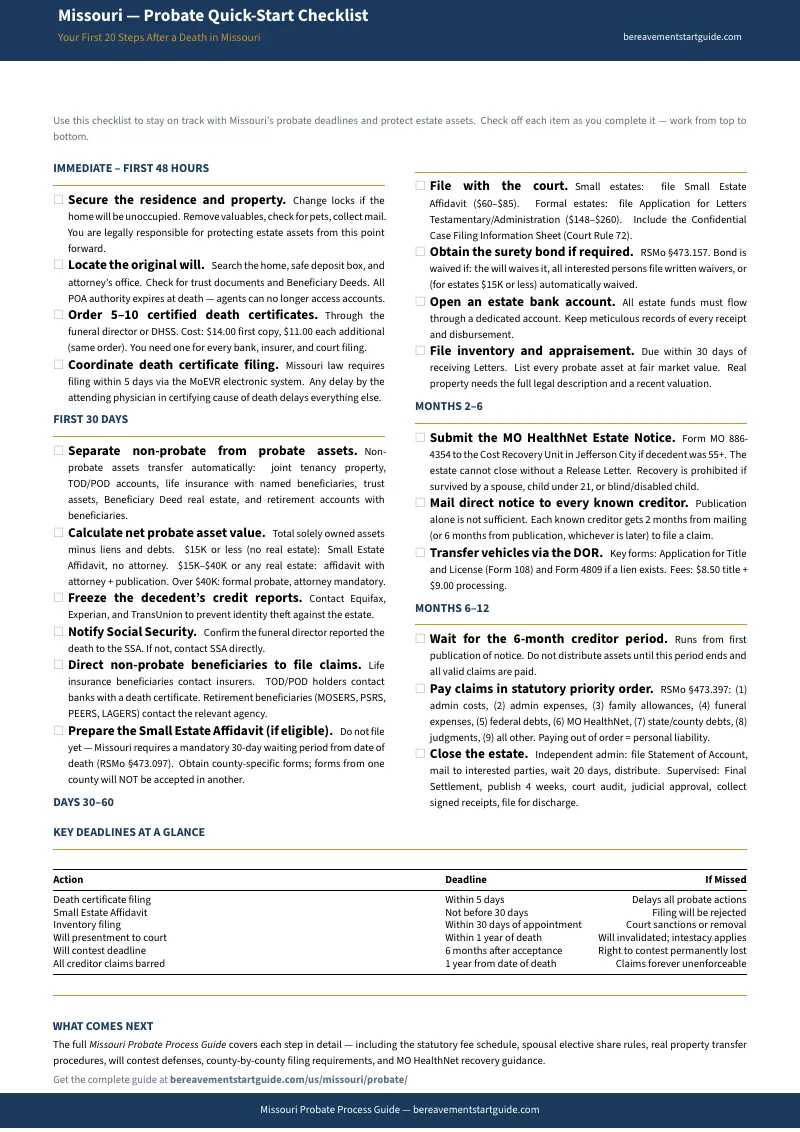
Your download includes the complete guide, the standalone Missouri Probate Quick-Start Checklist, and printable reference tools -- the Probate Pathway Decision Flowchart, Asset Inventory Worksheet, Creditor Notification Tracker, Spousal Rights Reference, MO HealthNet Recovery Guide, Statutory Fee Calculator, Vehicle Transfer Instructions, and Final Accounting Template. Every tool you need to walk into your attorney's office organized and prepared. Instant download, no account required.
Money-back guarantee, no time limit. If the guide does not give you clarity on which probate pathway applies to your estate, confidence in managing the administrative preparation, and a clear path to reducing your legal costs, email us for a full refund. No questions asked.
Not ready for the full guide? Download the free Missouri Probate Quick-Start Checklist -- a printable action list covering death certificates, securing the estate, determining your probate pathway, and the critical deadlines for the first six months. Enough to get started tonight.
You did not choose this responsibility. But the process is knowable, the deadlines are clear, and the preparation is something you can do yourself. The guide shows you exactly what to organize so your attorney can focus on what only a lawyer can do.
Frequently Asked Questions
What if the rules change after I buy?
We update the guide when the rules change. Email us any time, even years later, and we'll send you the current edition free.