
The District Court Clerk Cannot Tell You How to File. The MVD Wants Form MV12 but Only for Estates Under $100,000. DPHHS Charges $16 Per Death Certificate but Nobody Says How Many You Actually Need. The TOD Deed on the House Does Not Protect It From Title Insurance Rejection. And Senate Bill 279 Doubled the Small Estate Threshold --- but Every Website Still Says $50,000.
Your mother died in Missoula on a Tuesday. By Thursday morning you had a stack of incoming mail --- a hospital bill, two credit card statements, a property tax notice --- and a funeral director asking how many certified death certificates you want at $16 each. You guessed six. You will need twelve. Every bank, every insurance company, every government agency requires an original certified copy, and the DPHHS Office of Vital Records takes weeks to process reorders.
You went to the Clerk of the District Court on Friday to ask about probate. The clerk handed you a stack of forms and told you they are legally prohibited from explaining how to fill them out or in what order to file them. You called a probate attorney in Billings --- $300 per hour. You searched for the Small Estate Affidavit online and found ten different websites saying the threshold is $50,000. It is not. Montana doubled it to $100,000 through Senate Bill 279 in 2023. But nobody updated the free guides, and nobody told you that non-probate assets --- joint accounts, life insurance, POD accounts, retirement funds --- do not count toward that $100,000 limit. The actual probate estate might qualify for the shortcut even if the total estate is worth far more.
The Montana Estate Settlement Navigator is a Probate Bypass Roadmap built entirely around the Montana Uniform Probate Code --- mapping every form, deadline, statutory threshold, and agency requirement into one chronological sequence. It diagnoses whether your estate qualifies for the $100,000 Small Estate Affidavit, whether informal probate through the District Court is sufficient, or whether formal supervised administration is unavoidable. It tells you which agencies to contact in which order so no deadline expires because nobody told you it existed.
What's Inside the Probate Bypass Roadmap
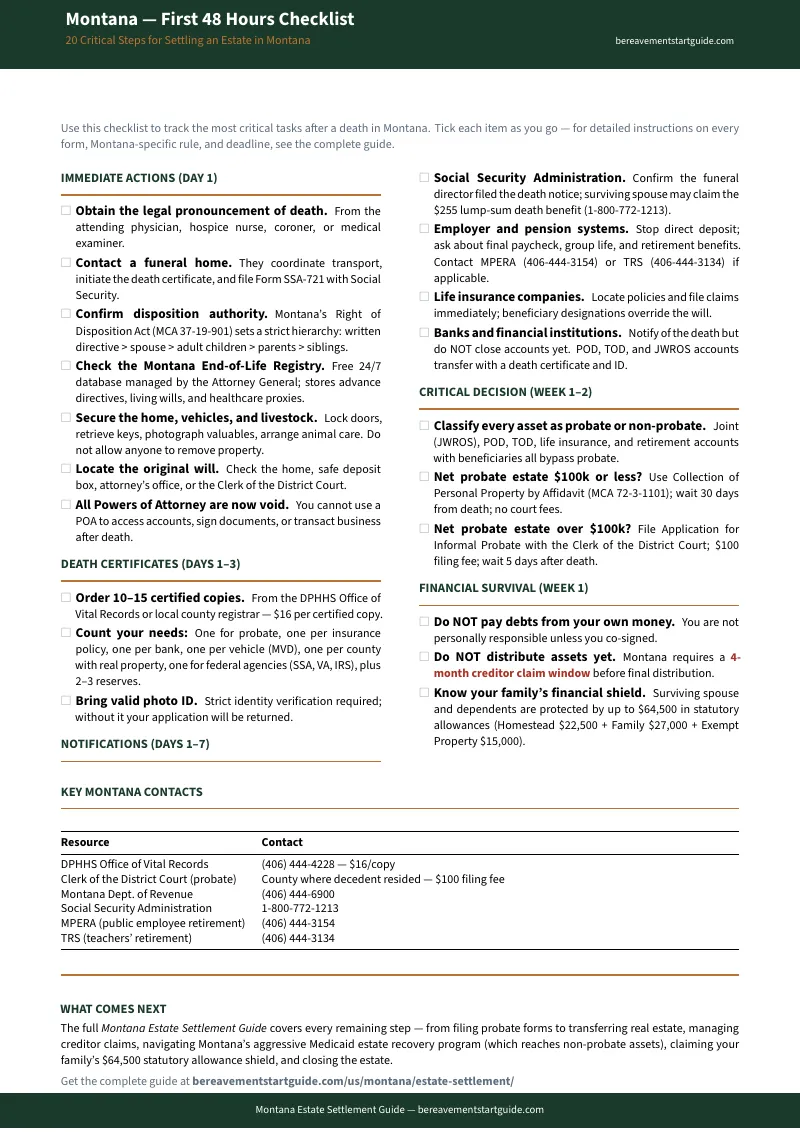
A 15-chapter guide, a printable 20-item action checklist, and two appendices --- covering every probate shortcut, asset transfer, survivor allowance, and agency procedure available under Montana law:
Chapters 1-2: The First 48 Hours and Securing the Estate
Where to order certified death certificates from the Montana DPHHS Office of Vital Records ($16 per certified copy, uniform rate statewide), how many you actually need (10-15 minimum), and the day-by-day triage sequence for the first two days. The Montana End-of-Life Registry --- a free 24/7 database maintained by the Attorney General's office that stores advance directives, living wills, and healthcare proxy designations. The Right of Disposition Act (MCA 37-19-901) and its strict legal hierarchy for who controls funeral decisions. Securing the home, vehicles, and livestock. Locating the original will. Understanding that all Powers of Attorney are immediately void. The family meeting framework and what to cover before anyone contacts a lawyer.
Chapter 3: Banking and Financial Accounts
How Montana banks handle death notification and why you should notify but NOT attempt to close accounts in the first week. Which accounts transfer automatically without probate --- joint accounts with right of survivorship (JWROS), payable-on-death (POD), and transfer-on-death (TOD) --- and which require court authority. Using the Small Estate Affidavit (MCA 72-3-1101) to unlock individually held accounts for estates under $100,000 in net probate value. When you need Letters of Authority from the District Court. How to open an estate bank account. The account-closing checklist that prevents the most common bank rejections.
Chapter 4: Vehicle Title Transfers
Three paths for transferring a vehicle title after death in Montana: TOD beneficiary designation (direct transfer at the MVD), right of survivorship using Form MV12 (Application for Title by Non-Probate Transfer) for estates under $100,000, and transfer through probate with a Decree of Distribution. Title transfer fees ($12.36 for light vehicles). The vehicle transfer decision tree that tells you which path fits before you drive to the county treasurer's office. Special situations: vehicles titled in another state, vehicles with liens, and multiple vehicles.
Chapter 5: The Probate Decision --- Simplified Alternatives vs. Court
The diagnostic flowchart that tells you which path fits your estate before you spend a dollar on a legal retainer. The Small Estate Affidavit for estates with net probate assets under $100,000 (with the mandatory 30-day waiting period under MCA 72-3-1101 and the critical requirement that no probate petition can be pending). The non-probate transfer checklist that walks through every asset type to confirm which ones bypass court entirely. And the decision tree for when informal probate through the District Court is required because the estate includes real property not covered by a TOD deed or joint tenancy.
Chapter 6: Opening Informal Probate
The 120-hour rule --- Montana law requires a mandatory five-day waiting period after death before anyone can file for informal probate. Who qualifies to serve as Personal Representative under the Montana UPC, and the priority of appointment when there is no will. Filing the Application for Informal Appointment with the Clerk of the District Court ($100 filing fee). The Fiduciary Statement. Letters of Authority and what they actually authorize you to do. Your ongoing duties as Personal Representative: the asset inventory, creditor notification, and the distinction between informal administration (no court hearings required) and formal proceedings.
Chapter 7: Real Estate Transfers
Four pathways for transferring real property after death in Montana: TOD deeds under the Uniform Real Property Transfer on Death Act (recording the death certificate plus filing the Realty Transfer Certificate with the Department of Revenue), joint tenancy with right of survivorship, transfer through probate via a Deed of Distribution, and the role of living trusts. The Transfer on Death Deed trap --- why title insurance underwriters in certain Montana counties refuse to insure property transferred via a TODD for up to one year after the date of death, because the property remains subject to the decedent's creditor claims. County recording fees. When an affidavit of heirship works versus when you need a court order.
Chapter 8: Creditors, Debts, and the Priority of Claims
The biggest fear for surviving families, answered directly: Montana heirs are not personally responsible for the decedent's debts. The MCA 72-3-807 priority of claims --- the exact statutory order in which estate assets must pay debts: 1) costs of administration, 2) reasonable funeral and burial expenses, 3) federal debts and taxes, 4) state debts and taxes, and 5) all other claims. The four-month creditor claim window after publication of notice. Which debts die with the person. How to respond to aggressive collection calls from credit card companies. Medicaid estate recovery --- DPHHS can pursue reimbursement for long-term care costs, but not while a surviving spouse, child under 21, or blind/disabled child of any age is living.
Chapter 9: Medicaid Estate Recovery
Montana's DPHHS estate recovery program and the specific exemptions that protect the family home. The surviving spouse exemption, the dependent child exemption, the disabled child exemption, and the hardship waiver. How to respond to a recovery notice. The critical difference between Medicaid liens and estate recovery claims. Why TOD deeds do not protect property from recovery --- and what does. The documentation you need to assert an exemption before the state files a claim against the estate.
Chapter 10: The Three Allowances
Montana's powerful survivor protections that most families never learn about: the Homestead Allowance ($22,500), the Exempt Property Allowance ($15,000 in household goods, furnishings, and personal effects), and the Family Allowance (up to $27,000 for maintenance during administration). These allowances have absolute priority over all general creditor claims against the estate. The combined $64,500 protection that shields the surviving spouse and dependent children from aggressive creditors --- and why the Homestead Allowance is a cash payment, not a requirement that you own a home.
Chapters 11-12: Professional Help and Tax Administration
The specific scenarios where hiring a Montana probate attorney is worth the retainer versus the situations where the Probate Bypass Roadmap lets you handle everything yourself. How to evaluate attorney fee structures. When a CPA is more useful than a lawyer. The decedent's final income tax return. Montana Form FID-3 for estate income tax. The critical fact that Montana has no state estate or inheritance tax --- but the federal estate tax still applies to estates above the exemption threshold. Property tax considerations for the surviving spouse.
Chapters 13-15: Pensions, Timeline, and Closing the Estate
Montana Public Employee Retirement Administration (MPERA) and Teachers' Retirement System (TRS) survivor benefits --- each with different eligibility rules, payment options, and offset calculations. Workers' compensation death benefits for on-the-job fatalities. The complete Montana estate settlement timeline mapped to statutory deadlines: Day 0-5 (the 120-hour filing restriction), Day 30 (Small Estate Affidavit becomes available), Month 4 (creditor claim window closes after publication of notice), and the path to closing the estate with a Closing Statement filed with the District Court.
Appendices A-B: Forms Reference and Key Contacts
A complete reference table of every state and federal form mentioned in the guide, organized by agency. A contact directory for every Montana agency involved in estate settlement --- DPHHS Vital Records, District Court Clerk offices, the MVD/County Treasurers, MPERA, TRS, the Attorney General's End-of-Life Registry, and the Department of Revenue.
Who This Guide Is For
- The surviving spouse or adult child managing an estate in Montana who needs to know whether the estate qualifies for the $100,000 Small Estate Affidavit or whether informal probate through the District Court is required --- and wants to answer that question before paying $300 per hour for a probate attorney to sort through it.
- The nominated Personal Representative who accepted the role because the will named them, but has never filed a probate application, never published a creditor notice, and does not know the difference between informal and formal administration under the Montana UPC.
- Families inheriting real property through a Transfer on Death Deed who assumed probate was avoided, but discovered that title insurance underwriters refuse to insure the property for up to a year after death due to creditor claim exposure --- and need to understand the workarounds.
- Families terrified of Medicaid estate recovery who received a DPHHS notice and do not know which statutory exemptions protect the family home --- or that those exemptions must be affirmatively asserted.
- Out-of-state family members settling a Montana estate remotely who cannot drive to the District Court, the MVD, or the county recorder's office without knowing exactly which forms, fees, and documents to bring --- and what sequence to follow so each trip counts.
Why Free Government Forms Do Not Replace a Sequenced Roadmap
Every form referenced in this guide is available for free from a Montana government office or website. The probate application is at the District Court. Form MV12 is at the MVD. The Small Estate Affidavit is a standard notarized document. Here is why the forms alone are not enough:
- The District Court clerk cannot tell you how to file. Montana court staff are legally prohibited from providing legal advice or explaining how to administer an estate. They hand you the forms and point you to the door. You get the raw paperwork without a single word of instruction about sequencing, deadlines, or which forms apply to your situation.
- National legal websites still publish the wrong Small Estate threshold. Montana doubled the threshold from $50,000 to $100,000 through Senate Bill 279 in 2023. Most free guides, national form vendors, and even some Montana attorney websites have not updated. Families read the old threshold and assume they must open probate when they do not.
- MSU Extension publishes twenty separate MontGuides --- none of them linked. The Montana State University Extension produces authoritative, individual fact sheets covering beneficiary deeds, cremation, annuities, and estate planning. They are academically dense, written for different audiences, and completely unsequenced. You must download, read, and cross-reference them yourself to piece together a complete picture of the process.
- Law firm websites explain the problem. They withhold the solution. Montana probate attorneys publish detailed articles about the complexity of estate settlement. The content is accurate. It is also deliberately incomplete --- designed to trigger a consultation call, not to empower you to handle it yourself. The diagnostic question is not "how complicated is this?" but "does my estate actually require an attorney?" The answer, for many Montana estates under $100,000 in net probate value, is no.
- Filing out of sequence triggers delays that compound. Attempting the Small Estate Affidavit before the 30-day waiting period expires results in rejection. Filing for informal probate before 120 hours have elapsed gets refused. Presenting Form MV12 at the county treasurer without the correct supporting documents means another trip. Recording a TOD deed transfer without the Realty Transfer Certificate means the Department of Revenue flags the transaction. The forms exist. The sequence is what turns them into assets in your name.
Free resources give you one agency at a time, with no sequencing, no cross-referencing, and no way to know what you are missing. The Probate Bypass Roadmap maps every asset, every form, and every deadline into one chronological sequence --- so you claim everything, avoid every common rejection, and determine whether you actually need an attorney before spending a dollar on one.
--- Less Than Twenty Minutes of a Probate Attorney's Time
Montana families lose weeks and thousands of dollars every year --- not because the estate was complicated, but because nobody told them about the shortcuts the Uniform Probate Code provides. An estate that qualifies for the $100,000 Small Estate Affidavit opens formal probate instead because outdated websites still say $50,000. A surviving spouse never claims the $22,500 Homestead Allowance because nobody mentioned it. A family challenges a Medicaid estate recovery notice without knowing the surviving spouse exemption exists. A TOD deed beneficiary waits a year to sell the inherited property because nobody explained the title insurance workaround. This guide costs less than any of those mistakes.
Your download includes the complete 15-chapter guide with two appendices, the Montana --- First 48 Hours Checklist, and eight standalone printable reference sheets --- an account-closing checklist, vehicle transfer guide, probate decision tree, creditor priority reference, Medicaid recovery reference, survivor allowances reference, estate settlement timeline, and forms-and-contacts directory. Ten PDFs total, covering every time-sensitive step from securing the estate on day one through the critical 30-day and 120-hour milestones that determine which probate path your family takes.
Money-back guarantee, no time limit. If the guide does not give you a clear map of every probate shortcut available for your Montana estate, every form you need to file, and every deadline you need to meet --- email us for a full refund. No questions asked.
Not ready for the full guide? Download the free Montana --- First 48 Hours Checklist --- a summary of the most time-sensitive actions, forms, and thresholds that most families do not discover until it is too late. Enough to start the right sequence on day one.
You did not plan for this. But you can plan what happens next. The guide gives you the forms, the deadlines, the statutory shortcuts, and the filing sequence --- so the next six months are spent settling the estate correctly, not discovering what you missed.
Frequently Asked Questions
What if the rules change after I buy?
We update the guide when the rules change. Email us any time, even years later, and we'll send you the current edition free.