
Montana Repealed Its Estate Tax in 2005 and Its Inheritance Tax in 2001. But the Executor Who Files the Wrong Form, Misses the Four-Month Creditor Window, or Distributes Assets Before the FID-3 Is Filed Faces Personal Liability --- and No Government Website Puts Those Obligations in Order.
Your father died on a Thursday. By Monday the bank froze his checking account and told you to come back with an EIN, Letters Testamentary, and a certified death certificate. The funeral director mentioned something about a small estate affidavit. Your uncle said Montana has no death tax. Your brother-in-law heard you need Form 706. The accountant's office said they would call you back about something called a FID-3. Nobody explained which of these actually apply, which ones are obsolete, or what happens if you file the wrong form in the wrong order.
Here is what actually happens after a death in Montana: the state charges zero estate tax and zero inheritance tax. That part is true. But the estate must still file the decedent's final income tax return (Form 2) by April 15. If the estate earns a single dollar of income after the date of death --- bank interest, a rental payment, a dividend --- the executor must file Montana's fiduciary income tax return (Form FID-3) with its newly overhauled 2024 calculations that most tax software still gets wrong. And if the estate exceeds $15 million, federal Form 706 is due within nine months. Miss the deadlines, and the IRS and Montana Department of Revenue come after the executor personally --- not the estate.
The Montana Final Tax & Estate Tax Guide is a Tax Compliance Sequencer that maps every tax obligation, probate pathway, and asset transfer step required after a death in Montana into one chronological system. It tells you which forms to file, in what order, by which deadline, and what happens if you get it wrong. It covers what Montana actually taxes (fiduciary income), what it does not tax (estates and inheritances), and the federal obligations that apply regardless of state law --- so you stop researching non-existent taxes and start executing the real ones.
What's Inside the Tax Compliance Sequencer
A 16-chapter guide and a printable quick-start checklist --- covering every tax form, probate track, creditor process, and asset transfer available under Montana law:
Chapters 1-2: What Montana Taxes (and What It Does Not) and the First 30 Days
The immediate clarity that Montana imposes no estate tax (repealed 2005) and no inheritance tax (repealed 2001) --- so you stop wasting time researching taxes that do not exist. The taxes that do apply: the final income tax return (Form 2), fiduciary income tax (Form FID-3) at 4.7% to 5.9% on ordinary income and 3.0% to 4.1% on capital gains, and federal estate tax for estates over $15 million (2026). The critical distinction between principal (not taxed) and income earned during administration (taxed). Day-by-day triage: ordering 8-12 certified death certificates ($16 each from DPHHS), checking the End-of-Life Registry, securing property, applying for an EIN, and assessing whether the probate estate falls under the $100,000 small estate affidavit threshold.
Chapters 3-4: Probate Pathways and the Creditor Process
The three probate tracks: Small Estate Affidavit (estates under $100,000 --- threshold doubled from $50,000 by the Legislature, though most websites still cite the old number), informal probate through the District Court Clerk ($70 filing fee), and formal probate before a judge. The mandatory four-month creditor claim window triggered by newspaper publication. Why distributing assets before this window closes creates personal liability for the executor. The statutory priority of claims: homestead allowance ($22,500) and family allowance (up to $27,000) take absolute priority over unsecured creditors.
Chapters 5-6: The Final Income Tax Return and Fiduciary Income Tax
Filing the decedent's final Montana Form 2: the "Deceased" checkbox, the part-year income calculation, the Elderly Homeowner/Renter Credit (Form 2EC) for surviving spouses 62+ with income under $45,000 (up to $1,150). The fiduciary income tax return (Form FID-3) --- the 2024 overhaul that eliminated the deduction for federal taxes paid, the completely redesigned Schedule I and Worksheet I, the new tax brackets, and why you must manually verify the calculations because commercial tax software is still catching up with these Montana-specific changes.
Chapters 7-8: Federal Estate Tax, Portability, and Step-Up in Basis
The $13.99 million federal exemption (2025) and $15 million (2026). The portability election that preserves the deceased spouse's unused exemption for the surviving spouse's future estate --- and why filing Form 706 purely for portability is critical even when no estate tax is owed. Revenue Procedure 2022-32 for late portability elections within five years. Step-up in basis explained: how the reset to fair market value at death eliminates most capital gains, with Montana-specific capital gains rates of 3.0% to 4.1%. The inherited retirement account trap: 401(k) and IRA distributions are taxed as ordinary income with no step-up.
Chapter 9: Medicaid Estate Recovery
DPHHS is legally required to recover costs from estates of individuals who received Medicaid after age 55. The exemptions that stop recovery: surviving spouse, child under 21, blind or disabled child. The Undue Hardship Waiver under ARM 37.82.431 for family farms and sole-income properties. The 30-day remittance rules for excess burial funds over $5,000 and nursing facility personal needs accounts. Why understanding these rules before the creditor window opens is the difference between keeping the family home and losing it.
Chapters 10-11: Transferring Vehicles and Real Estate
Vehicle title transfers via Form MV12 (estates under $100,000) or Letters Testamentary with Form MV1. The Transfer on Death Deed trap: title insurance underwriters frequently refuse to insure TOD-transferred property for a full year after death because creditors can still reach it under the Uniform Real Property Transfer on Death Act. The Realty Transfer Certificate (RTC) process at the County Clerk and Recorder. Recording fees ($20 first page, $10 each additional after October 2025). How the step-up in basis applies to real estate and what it means for selling immediately versus holding.
Chapters 12-16: Retirement Benefits, Deadlines, Forms, Professional Help, and Verification
MPERA and TRS survivor benefit options for estates of state employees and teachers. The complete tax deadline master calendar from Day 1 through Month 12+. Every form, fee, agency phone number, and website --- DPHHS, SSA, IRS, MVD, District Court, County Clerk and Recorder, Department of Revenue, and the Attorney General's End-of-Life Registry. When to hire an attorney (contested wills, complex real estate, Medicaid disputes) and when the guide handles everything you need. The verification checklist to confirm every required action is complete before final distribution.
Who This Guide Is For
- The executor who was just handed a stack of unfamiliar forms and needs to know which ones Montana actually requires, which are obsolete relics of repealed taxes, and what order to file them in --- because filing Form FID-3 with the wrong Schedule I calculation or distributing assets before the creditor window closes creates personal financial liability.
- The out-of-state adult child appointed personal representative who returned home after the funeral and realized they must navigate Montana probate law, Montana-specific tax forms, and Montana county offices remotely --- with no idea whether the estate qualifies for the $100,000 small estate affidavit or requires a full District Court proceeding.
- The surviving spouse afraid of surprise tax bills who heard Montana has no death tax but does not understand why the bank is asking about Form FID-3, why the brokerage sent a 1099 after the date of death, or why inherited IRA distributions are fully taxable even though the inheritance itself is not.
- The DIY executor trying to avoid $300-per-hour legal fees who discovered that Montana removed statutory percentage caps on attorney fees in 2019, replacing them with a subjective "reasonable fee" standard --- and wants to handle every step they legally can before paying a professional for only the genuinely complex parts.
- The family facing Medicaid estate recovery who received a DPHHS notice and needs to understand the surviving spouse exemption, the dependent child exemptions, the Undue Hardship Waiver, and the 30-day remittance deadlines before the state files a claim against the family home.
Why Free Government Forms Do Not Replace a Sequenced Tax Compliance System
Every form referenced in this guide is available for free from a government website. The Montana Department of Revenue publishes Form FID-3. The IRS hosts Form 706 and Form 1041. The District Court has probate application forms. Here is why the raw forms are not enough:
- Forms tell you what to fill in. They do not tell you when to file, in what order, or what happens if you file them out of sequence. Distributing estate assets before the four-month creditor window closes triggers personal liability for the executor. Filing Form FID-3 without the updated 2024 Schedule I produces incorrect tax calculations. The forms themselves contain no warning about either of these.
- The Department of Revenue, the IRS, and the District Court each know only their own requirements. Nobody connects the dots between the federal Form 1041, the Montana FID-3, the creditor notice publication, the small estate affidavit, and the Medicaid recovery timeline. Each agency hands you their form and assumes you already know how it fits into the larger sequence.
- Montana's 2024 fiduciary tax overhaul broke the autopilot. The elimination of the federal tax deduction, the redesigned Schedule I, and the new Worksheet I mean that prior-year returns are no longer a reliable template. Commercial tax software is still catching up with these Montana-specific changes, and the Department of Revenue's own instructions assume you already understand the old system well enough to recognize what changed.
- Law firm blogs explain the complexity. They withhold the solution. Montana estate attorneys publish detailed articles about creditor claims, TOD deed title insurance problems, and FID-3 filing requirements. The articles are accurate. They are also designed to demonstrate that you need a $300-per-hour attorney rather than a $24 guide. The complexity is real. The requirement for professional help at every step is not.
- National legal websites cite outdated Montana thresholds. Most still list the small estate affidavit limit as $50,000 (the pre-2023 figure). Some still reference the old fee structure that allowed percentage-based attorney fees. Generic templates cannot track state-level legislative changes.
Free forms give you raw paperwork with no sequence, no deadlines, and no warnings. The Tax Compliance Sequencer puts every form, every deadline, and every filing dependency into one chronological system --- so you execute them in the right order and avoid the errors that create personal liability.
--- Less Than Ten Minutes of a Probate Attorney's Time
Montana executors make expensive mistakes not because the information does not exist, but because it is scattered across six different agencies, none of which explain how their requirements connect to the others. An executor files the final income tax return but misses the fiduciary return. A beneficiary sells inherited property without understanding the step-up in basis and overpays capital gains tax by thousands. A surviving spouse distributes assets before the creditor window closes and becomes personally liable for unpaid debts. A family loses the home to Medicaid estate recovery because nobody told them about the Undue Hardship Waiver until after DPHHS filed its claim. This guide costs less than any one of those mistakes.
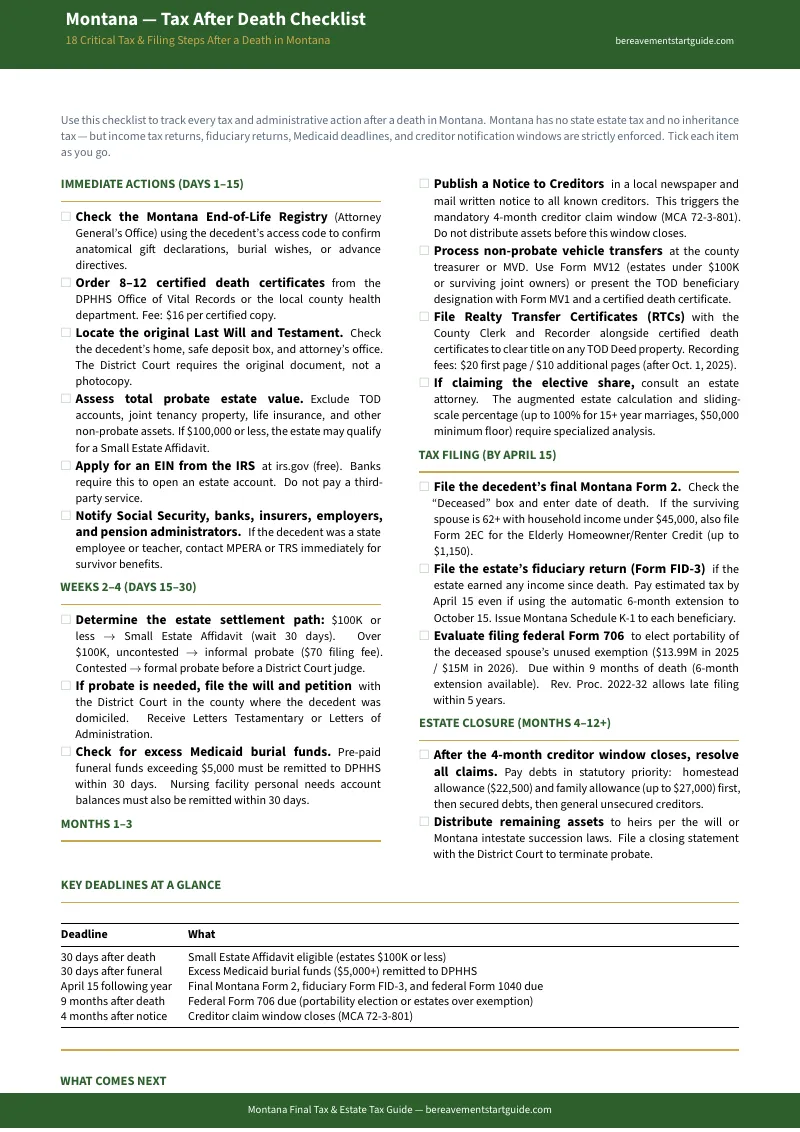
Your download includes 9 PDFs --- the complete 16-chapter guide, the Montana --- Tax After Death Checklist (a printable action plan organized by timeline), and 7 standalone reference sheets designed to be printed individually and brought to meetings, kept by the phone, or taped to the fridge:
- Tax Deadline Master Calendar --- every federal and Montana deadline from Day 1 through Month 12+, with statutory deadlines flagged in red
- Forms & Agency Directory --- every form number, filing fee, phone number, and website on one reference page
- FID-3 Filing Reference --- the 2024 overhaul changes, tax rate table, filing mechanics, and a pre-filing checklist to sit next to your tax software
- Medicaid Estate Recovery Defense --- exemptions, the Undue Hardship Waiver process, and 30-day remittance deadlines to bring to a DPHHS meeting
- Step-Up in Basis Quick Reference --- the gift-vs-inheritance comparison, what gets a step-up and what does not, and the community property double step-up exception
- Probate Pathway Decision Guide --- the four tracks compared side by side with thresholds, fees, and when to use each one
- Statutory Allowances Reference --- the homestead, exempt property, and family allowances plus the full elective share sliding scale for surviving spouses
30-day money-back guarantee. If the guide does not give you a clear, sequenced map of every tax obligation, probate pathway, and asset transfer step required after a death in Montana --- email us for a full refund. No questions asked.
Not ready for the full guide? Download the free Montana --- Tax After Death Checklist --- a summary of the most critical deadlines, tax forms, and filing sequences that most executors do not discover until a penalty notice arrives. Enough to start executing on day one.
Montana eliminated the estate tax and the inheritance tax. It did not eliminate the executor's obligation to file the right forms, in the right order, by the right deadlines. This guide makes sure you do exactly that --- before the penalties and personal liability find you first.