
The Funeral Director Knows Montana Law. You Don't. That's About to Change.
Someone in your family has died in Montana. Within 24 hours, you need an ART form signed or the body cannot legally leave the place of death. Within 48 hours, the remains must be embalmed or refrigerated. Within 10 days, the death certificate must be filed with the local registrar. And somewhere in the middle of all this, a funeral home has just handed you a contract that runs close to $7,742 — the Montana state average for a traditional funeral.
The person across the table has memorized every line of MCA Title 37. You are still trying to figure out whether Montana actually requires embalming, who in your family has the legal right to authorize cremation, and whether anyone can be buried on private land outside of town.
Free resources exist. The Montana Code Annotated is online. The Board of Funeral Service publishes administrative rules. The FTC has a consumer fact sheet. But these resources share a critical weakness: the statutes are scattered across Title 37 (funeral services), Title 50 (vital records), and Title 72 (estates). Government websites assume you already know which form you need. National legal directories like Nolo still quote an outdated $50,000 small estate threshold that the Montana legislature increased to $100,000. And local law firm blogs introduce topics only to pivot into pushing expensive consultations.
The Montana Funeral Consumer Shield
This guide consolidates every Montana funeral regulation, consumer protection, and administrative procedure into a single plain-English manual — organized around the decisions you face, in the order you face them. Read it before the arrangement conference, and you walk in knowing exactly what you can legally decline, what the funeral home is required to disclose, and which agency to call if they push back.
The result: you stop paying for services you do not need. You stop signing authorizations you do not understand. You stop making permanent decisions from a position of confusion during the worst week of your life.
The Embalming Pressure Play
Montana funeral providers must include a specific disclosure on their General Price List: embalming is not required by law. Yet families routinely pay for it because a funeral director describes it as "standard procedure." The guide provides the exact legal framework — embalming is never required for a standard local burial or cremation. The only exceptions involve specific transportation timelines: common carrier transit exceeding 8 hours, or private carrier transit exceeding 48 hours. For everything else, refrigeration is a legally mandated alternative that every equipped funeral provider must offer. Knowing this before you sit down saves hundreds of dollars and eliminates the single most common pressure point in the arrangement conference.
The Family Dispute Trap
When a family cannot agree on burial versus cremation, MCA 37-19-904 determines who holds the legal right to decide — and the answer surprises most families. The statutory hierarchy runs from surviving spouse to a majority of surviving children to surviving parents to a majority of surviving siblings. A minority of a priority class can act if they have made documented efforts to notify other members. When consensus fails entirely, any party — including the mortician holding the remains — can petition the District Court. Meanwhile, the body sits in refrigeration at daily rates. The guide maps this entire hierarchy, explains the majority-rule provision, and shows how written disposition directions could have prevented the dispute before it started.
The $100,000 Threshold Almost No One Knows About
Montana's Small Estate Affidavit allows families to bypass probate entirely for estates valued at $100,000 or less after subtracting liens. The legislature raised this threshold from $50,000, but a remarkable number of legal websites, county resources, and even attorney blogs still cite the old limit. Families assume they need a probate lawyer when a notarized affidavit and a 30-day waiting period would have transferred every bank account and vehicle title without ever seeing a courtroom. The guide covers the exact process, the required language, and the Form MV12 vehicle transfer procedure.
What You Get
- The Complete Montana Funeral Laws Guide — 19 chapters covering everything from the first 24 hours through Medicaid estate recovery, written in plain English with every relevant Montana statute cited
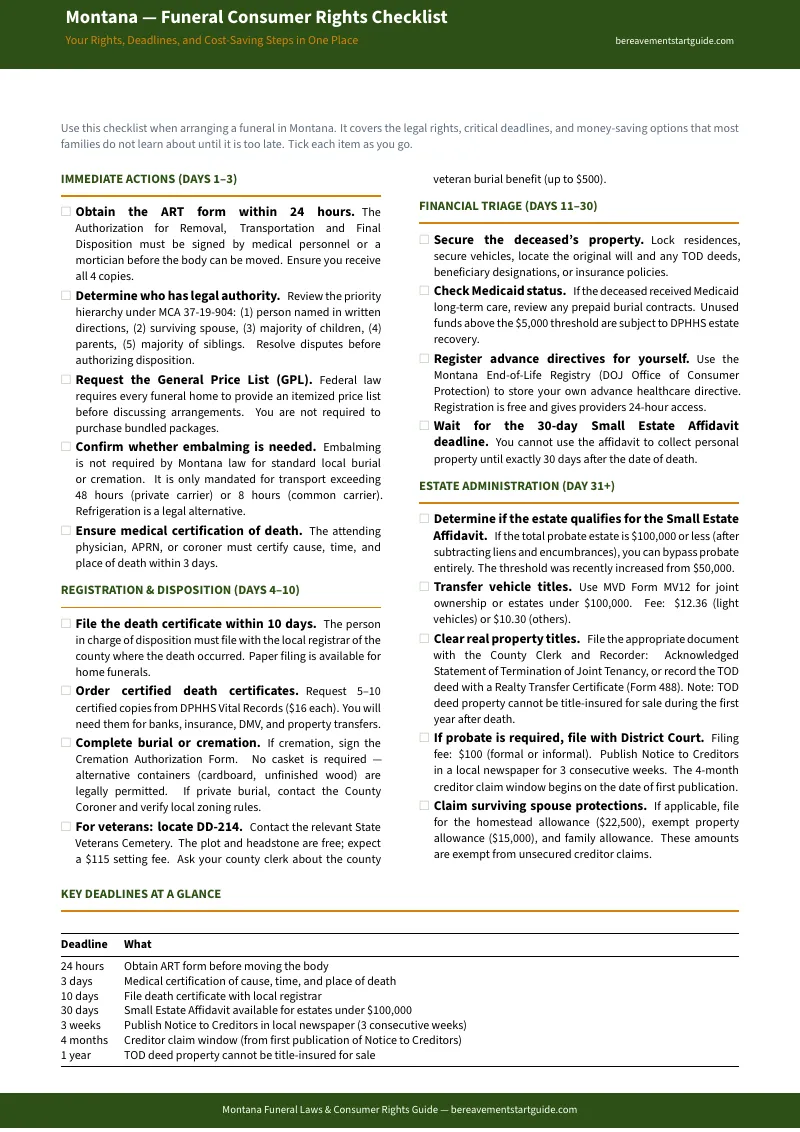
- Consumer Rights Checklist — a printable 18-item checklist covering the most urgent actions organized by Montana's specific deadlines: 24 hours (ART form), 3 days (medical certification), 10 days (death certificate), 30 days (Small Estate Affidavit eligibility)
- Disposition of Remains Hierarchy Chart — the complete priority list under MCA 37-19-904, including the minority-action provision, the District Court petition process, and the mortician's right to rely
- Home Funeral and Green Burial Guide — step-by-step instructions for families handling the funeral without a funeral director, including ART form procedures, paper death certificate filing, refrigeration alternatives, and county-specific private burial zoning rules
- Private Land Burial Compliance Guide — state minimum depth requirements, county-level zoning examples (Madison County's one-acre minimum, well setbacks, 5-body cap), and the Private Family Burial Grounds Notice recording process
- Veterans Benefits Navigator — Montana's four state veterans cemeteries, the $115 headstone setting fee, county-level burial stipends (up to $500), Corey Shea Act eligibility, and DD-214 documentation requirements
- End-of-Life Registry Walkthrough — how to register advance directives with the DOJ Office of Consumer Protection, Standard versus Higher Privacy options, and why emergency access to your directives requires registration
- Medicaid Estate Recovery Defense Guide — how DPHHS recovers from both probate and non-probate assets, the $5,000 funeral fund threshold, surviving spouse protections, and the undue hardship waiver process
- Small Estate Affidavit Instructions — the updated $100,000 threshold, the 30-day waiting period, Form MV12 for vehicle transfers, and the critical limitation that real property cannot be transferred by affidavit
- Official Forms Reference — every form you need with issuing agency, purpose, and where to obtain it: ART form, death certificate application, MV12, MV37A, Realty Transfer Certificate (Form 488), Small Estate Affidavit, and Advance Directive registration
Who This Is For
- Families arranging a funeral right now who need to know their legal rights before the arrangement conference — especially those facing embalming pressure, cremation authorization questions, or a price quote significantly above Montana's $7,742 average
- Surviving spouses and adult children trying to determine who controls the disposition of remains under Montana's statutory hierarchy, or navigating a family disagreement about burial versus cremation
- Families considering a home funeral, private land burial, or green burial who need Montana's specific legal requirements, county zoning rules, and filing procedures before proceeding
- Informal executors handling a small estate who want to use the $100,000 affidavit process instead of paying for a probate attorney
- Pre-planners setting up advance directives, registering with the End-of-Life Registry, evaluating prepaid funeral contracts, or structuring TOD deeds to avoid the one-year title insurance trap
Why Free Information Falls Short
Montana's funeral regulations are scattered across three titles of the Montana Code Annotated, dozens of Administrative Rules, and at least five different state agencies. The DPHHS handles vital records and Medicaid recovery. The DOJ runs the End-of-Life Registry. The Board of Funeral Service sets cremation authorization rules. The MVD handles vehicle transfers. The County Clerk and Recorder manages property deed recordings and private burial notices. No single government website connects these systems into a coherent sequence of actions.
National legal directories provide generic answers calibrated for the average state. They miss Montana's specific ART form process, the 48-hour private carrier rule, the county-level private burial zoning framework, and the $100,000 small estate threshold that half the internet still gets wrong. Local law firm blogs are designed to convert readers into billable clients — they introduce the complexity of probate and Medicaid recovery, then stop just short of telling you what to actually do.
This guide bridges that gap. Not by replacing legal counsel, but by connecting every agency, form, deadline, and decision point so you make choices from a position of knowledge — not from grief-driven urgency.
What This Guide Does Not Do
This guide is an educational and administrative tool — not legal representation. It does not constitute legal, tax, financial, or medical advice, and purchasing it does not create an attorney-client relationship. When you need a probate attorney, an elder law specialist, or a CPA, the guide tells you exactly which professional to call and why — so you use their expensive time as efficiently as possible.
— Less Than One Unnecessary Embalming
If this guide prevents one pressure-sold embalming service, one day of unnecessary refrigeration charges, or one probate attorney consultation that the $100,000 Small Estate Affidavit would have made unnecessary, it has paid for itself many times over. If it gives you the confidence to request an itemized General Price List before signing anything, the savings compound from there.
Every purchase includes a 30-day money-back guarantee. If the guide does not give you the clarity and confidence you need to navigate Montana's funeral system, email us for a full refund.
The free Consumer Rights Checklist covers the 18 most critical actions — the ones with hard deadlines and immediate financial consequences. The full guide covers every chapter in depth: consumer rights, the disposition hierarchy, embalming and transport rules, cremation authorization, home funerals, private land burial, veterans benefits, advance directives, prepaid contracts, the complaint process, the Small Estate Affidavit, probate, vehicle and property transfers, and Medicaid estate recovery.