The Court Clerk Hands You a Stack of Blank Forms. Then Says She Cannot Tell You What to Do With Them.
Your loved one died in Montana. You were named executor in the will -- or there was no will, and now you are the one everyone is looking at. You drove to the county courthouse expecting guidance. The clerk handed you an Application for Informal Probate, a Fiduciary Statement, and an inventory form. When you asked what order to file them, what deadlines apply, and what happens if you get something wrong, she said: "I'm not allowed to give legal advice." You left with blank paper and a knot in your stomach.
So you searched online. MontanaLawHelp.org told you the Uniform Probate Code "generally simplifies proceedings" but did not provide a checklist. Nolo gave you a national overview that mentioned Montana in passing. A Billings law firm blog explained just enough to make you realize the process is complex, then ended with a consultation booking link at $250/hour. You tried to figure out whether the estate qualifies for a Small Estate Affidavit and found half the internet still citing the old $50,000 threshold -- but the legislature raised it to $100,000 under MCA 72-3-1101. You do not know which number to trust. You do not know whether the house counts. You do not know what the Fiduciary Statement actually commits you to, legally, when you sign it.
Meanwhile, the bank froze the checking account and said they need "Letters Testamentary" before releasing anything. The surviving spouse cannot pay the electric bill. The funeral home has been paid, but nobody told you that Medicaid can file a lien against the estate for nursing home costs the decedent incurred years ago. Three systems -- the court, the financial institutions, and the state recovery program -- all demand paperwork from you, none of them coordinate with each other, and every deadline is yours to miss.
The Montana Probate Action Plan -- Every Step the Court Clerk Cannot Give You
The Montana Probate Process Guide takes the scattered demands of the District Court, the banks, the Motor Vehicle Division, and the Medicaid Estate Recovery Program and organizes them into one chronological action plan. It translates the Montana Uniform Probate Code and Montana Code Annotated into plain English and tells you which forms to file, to which office, in what order, by when, and what happens if you miss.
What You Get
The Complete Probate Process Guide
A comprehensive guide covering every step of probate administration in Montana -- organized by timeline, not by agency. Written for executors and families, not attorneys.
- Probate-or-Skip Decision Tree -- A diagnostic flowchart that walks you through every asset to determine whether the estate qualifies for the updated $100,000 Small Estate Affidavit under MCA 72-3-1101, whether informal probate is appropriate, or whether your situation requires formal supervised administration. Assets with designated beneficiaries, joint tenancy, and Transfer-on-Death deeds are excluded from the calculation -- the guide shows you exactly which ones count and which do not.
- Informal Probate Sequence -- Step-by-step instructions for the process most Montana estates actually use: filing the Application for Informal Probate, signing the Fiduciary Statement under MCA 72-3-109, obtaining Letters Testamentary from the clerk, publishing the Notice to Creditors, and managing the entire process without continuous court supervision. Each step includes the exact form name, the filing fee, and the statutory deadline.
- Creditor Priority and Debt Hierarchy -- Montana law dictates a strict order for paying debts from an insolvent estate. The guide maps the full priority sequence: costs of administration, family allowances, funeral expenses, federal and state taxes, and Medicaid recovery claims. Paying creditors out of order can make you personally liable. This section prevents that.
- Spousal Allowances and Family Protections -- The surviving spouse can claim the Homestead Allowance ($22,500), the Exempt Property Allowance (up to $20,000 for household furnishings and vehicles), and the Family Allowance (up to $27,000 for living expenses during administration) -- all before creditors are paid. These are statutory rights, not discretionary gifts. The guide explains how to claim each one and in what order.
- Medicaid Estate Recovery Defense -- If the decedent received Medicaid-funded nursing home care after age 55, the Montana Department of Public Health and Human Services will attempt to recover costs from the estate, including the family home. The guide maps the statutory exemptions -- surviving spouse, disabled child, undue hardship -- and explains the notification process and timeline for obtaining a release before estate closing.
- Transfer-on-Death Deed Traps -- Montana allows TOD deeds under MCA 72-6-415, but they come with pitfalls most families do not discover until after the death. The guide explains when a TOD deed successfully bypasses probate, when it fails, and what happens when the named beneficiary predeceases the owner. It also covers the intersection with Medicaid recovery -- a TOD deed does not always shield property from state claims.
- Vehicle and Real Estate Transfers -- Separate procedures for transferring a car through the Motor Vehicle Division (with or without probate) and clearing title on a house through the county clerk and recorder. Includes the dual pathway for vehicles: Small Estate Affidavit route versus Letters Testamentary route, with specific forms for each.
- Tax Obligations and Final Returns -- Montana has no state estate or inheritance tax, but that does not mean the tax obligations end. The guide covers the decedent's final federal income tax return, the estate's EIN application, and the federal estate tax return (Form 706) threshold and portability election for surviving spouses.
- Lawyer Decision Matrix -- A clear, honest assessment of when you can handle probate yourself and when you must hire a Montana probate attorney. Simple informal estates with a valid will and cooperating heirs are strong candidates for DIY. Contested wills, insolvent estates, aggressive Medicaid liens, and multi-state property holdings require professional counsel. The guide tells you which category you fall into before you spend money finding out.
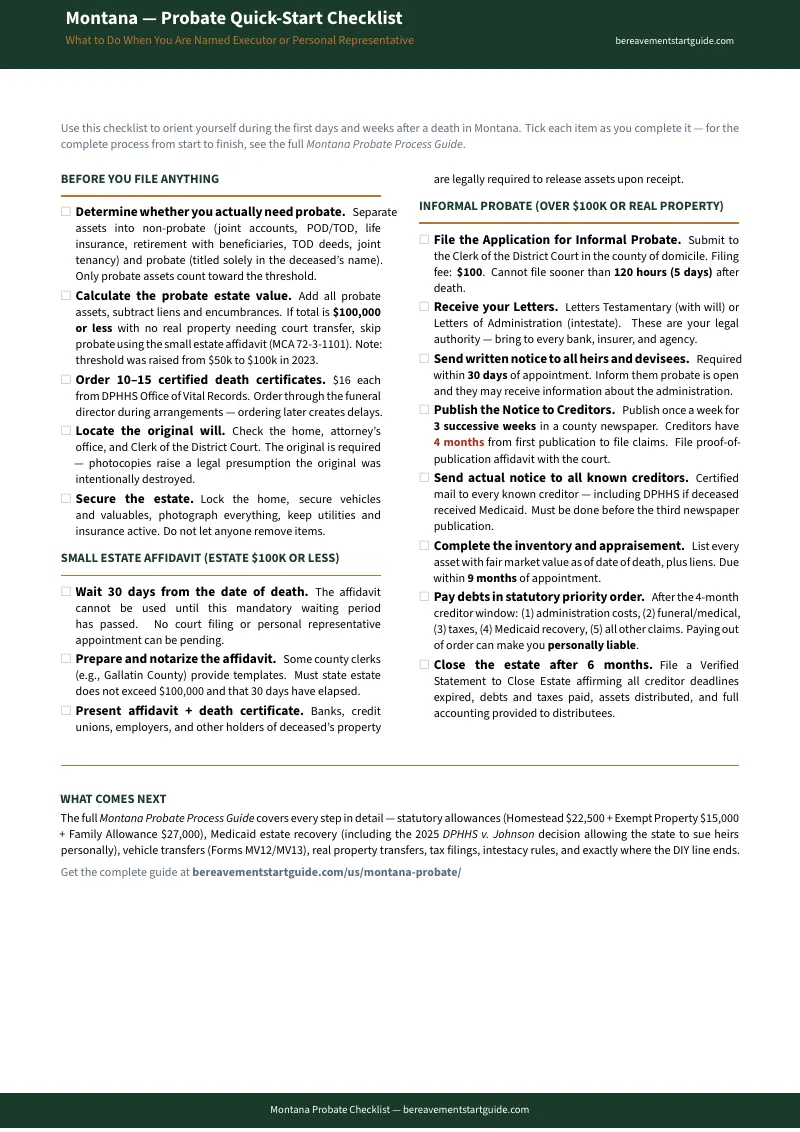
The Probate Quick-Start Checklist
A printable chronological checklist covering every probate action from the first week through estate closing. Organized by phase -- the 30-day Small Estate Affidavit waiting period, the inventory filing, the creditor notice publication, the claim period expiration, and the final accounting -- so nothing falls through the cracks.
7 Standalone Worksheets and Reference Cards
Print-ready tools you can bring to the courthouse, the bank, or the Motor Vehicle Division -- without carrying the full guide:
- Probate-or-Skip Decision Tree -- The diagnostic flowchart as a standalone printable, with the $100,000 threshold calculation and all three pathway options
- Estate Asset Inventory Worksheet -- Fillable worksheet to categorize every asset as probate or non-probate and calculate your total probate estate value
- Creditor Priority Reference Card -- The MCA 72-3-807 payment hierarchy on one page, with the personal liability warning and statutory allowance amounts
- Spousal Allowances Reference Card -- Homestead, Exempt Property, Family Allowance, and Elective Share amounts with MCA citations and eligibility rules
- Vehicle and Property Transfer Worksheet -- Step-by-step instructions for transferring vehicles (Forms MV12/MV13) and real property, with current fees and the TOD deed title insurance warning
- Montana Probate Timeline -- Wall-ready timeline covering every phase from death through estate closing, designed to pin up and reference daily
- Forms and Agency Directory -- Every form name, issuing agency, purpose, and website in one printable reference
Who This Is For
- Executors who just left the courthouse with a stack of blank forms and no instructions -- you signed the will years ago and now the court expects you to act like an attorney without any training
- Families trying to determine whether their loved one's estate qualifies for the $100,000 Small Estate Affidavit or whether full probate is required -- and confused by outdated resources still citing the old $50,000 threshold
- Surviving spouses who need to access frozen bank accounts, claim statutory allowances, and stabilize household finances while the estate is being administered
- Out-of-state heirs managing Montana probate remotely who need a consolidated action plan instead of piecing together requirements from scattered county court websites
- Anyone preparing documents for a probate attorney who wants to minimize billable hours by walking in with organized paperwork instead of questions
Why Not Free Resources?
The Montana District Courts and state websites provide every form you need to file. They do not provide the one thing you actually need -- a coherent sequence of actions that connects the forms to the deadlines to the agencies:
- MontanaLawHelp.org provides excellent definitions but explicitly states it "is not intended to serve as a complete guide" -- it warns you about requirements without telling you the order to address them
- The District Court clerk provides blank applications and affidavit forms but is legally prohibited from advising you on which path to file, how to calculate the $100,000 threshold, or what happens after you submit the paperwork
- Nolo and FindLaw rank for "Montana probate" with generic national overviews that mention Montana statutes in passing but lack the county-level procedural details you need to actually file
- The State Bar of Montana publishes a comprehensive probate manual -- written for practicing attorneys, priced at $150, and completely impenetrable for a grieving family member trying to figure out which form comes first
- Attorney blogs explain just enough to demonstrate complexity, then deliberately withhold the procedural steps to funnel you into a $250/hour consultation
-- Less Than One Hour With a Montana Probate Attorney
Montana probate attorneys charge $200 to $350 per hour, and even a simple informal estate can require 10 to 20 hours of professional time. The State Bar's own probate forms manual costs $150 and assumes you already know the law. This guide costs less than fifteen minutes of professional time and covers more procedural ground than most initial consultations -- because it gives you the chronological action plan that the attorney would otherwise build for you at their hourly rate.
For straightforward estates, this guide can eliminate the need for an attorney entirely. For complex estates, organizing your documents with this guide before your first meeting can save hundreds in billable hours -- because you walk in with a completed inventory and timeline instead of a list of questions.
60-day, no-questions-asked refund guarantee. If this guide does not save you at least 10 hours of frustrated research across scattered government websites, email us for a full refund. You keep the guide.
Frequently Asked Questions
What if the rules change after I buy?
We update the guide when the rules change. Email us any time, even years later, and we'll send you the current edition free.