The County Court Clerk Cannot Tell You How to File. The County Treasurer Wants a Death Certificate for the Vehicle Title but Nobody Says Whether to Use the TOD Tag or the 30-Day Affidavit. DHHS Sent an Estate Recovery Form but Funeral Expenses Are Supposed to Come First. The County Attorney Must Approve the Inheritance Tax Worksheet Before a Judge Can Rule on It. And the Real Property Small Estate Threshold Doubled to $100,000 in 2024 --- but Most Websites Still Say $50,000.
Your father died in Lancaster County on a Wednesday. By Friday you had a hospital bill, two credit card statements addressed to him, and a funeral director asking how many certified death certificates you want at $16 each. You said five. You will need ten. Every bank, every insurance company, every government office requires an original certified copy, and the DHHS Office of Vital Records takes weeks to process reorders.
You went to the county court on Monday to ask about probate. The clerk handed you a stack of forms and explained they are legally prohibited from telling you how to fill them out or in what order to file them. You called a probate attorney --- $300 per hour. You found the Small Estate Affidavit online and every website said the threshold for real property is $50,000. It is not. Nebraska doubled it to $100,000 effective July 19, 2024, through an amendment to Section 30-24,129. But nobody updated the free guides, and nobody told you that non-probate assets --- joint accounts, TOD bank accounts, POD designations, life insurance, and retirement funds with named beneficiaries --- do not count toward that $100,000 limit. The actual probate estate might qualify for the shortcut even if the total estate is worth far more.
The Nebraska Estate Settlement Navigator is a County-by-County Filing Sequence built entirely around the Nebraska Revised Statutes and the Uniform Probate Code as adopted in Nebraska --- mapping every form, deadline, statutory threshold, county office, and agency requirement into one chronological sequence. It diagnoses whether your estate qualifies for the $100,000 Small Estate Affidavit (personal property under Form CC 15:40 or real property under Form CC 15:41), whether informal probate through the county court is sufficient, or whether formal administration is unavoidable. It tells you which offices to contact in which order so no deadline expires because nobody told you it existed.
What's Inside the County-by-County Filing Sequence
A 13-chapter guide with 3 appendices, a printable 17-item action checklist, and standalone reference sheets --- covering every probate shortcut, asset transfer, creditor defense, and agency procedure available under Nebraska law:
Chapters 1-2: Understanding Nebraska and the First 48 Hours
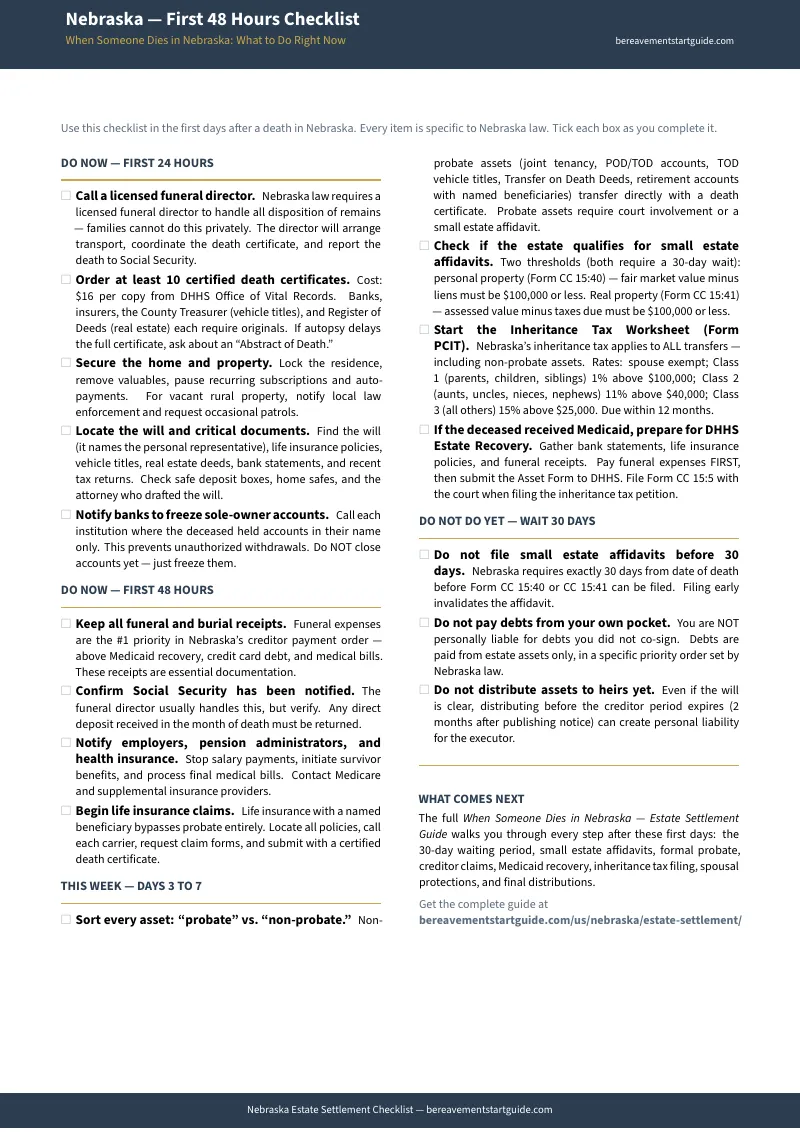
What makes Nebraska different from every other state: the county-level inheritance tax that applies to both probate and non-probate assets, the mandatory licensed funeral director requirement, the newly doubled $100,000 real property threshold, and DHHS Medicaid estate recovery as a statutory creditor. Day-by-day triage for the first 48 hours: ordering at least 10 certified death certificates from DHHS ($16 per copy), securing the residence and assets, locating the will, freezing sole-owner bank accounts against unauthorized withdrawals, and confirming Social Security notification. What NOT to do --- do not pay any of the deceased's debts from your personal funds, do not distribute assets, and do not close accounts or file affidavits before the 30-day waiting period expires.
Chapter 3: The 30-Day Waiting Period
Nebraska requires exactly 30 days to pass after the date of death before you can file small estate affidavits. This chapter maps every productive action you can take during that mandatory wait: sorting every asset into probate vs. non-probate categories, beginning the Inheritance Tax Worksheet (Form PCIT), gathering bank statements and funeral receipts for DHHS estate recovery, contacting life insurance companies, and filing survivor benefit claims --- all of which have no waiting period. The asset classification table that determines your entire path forward.
Chapter 4: Small Estate Pathways
The diagnostic that tells you whether you can bypass formal probate entirely. Two separate thresholds, both updated for 2024-2025: Form CC 15:40 for personal property valued at $100,000 or less, and Form CC 15:41 for real property with a county assessment roll value of $100,000 or less (doubled from $50,000 effective July 19, 2024). How to calculate net value by subtracting liens and encumbrances. The strict eligibility requirements: the 30-day waiting period, no application for a personal representative can be pending, and you must have the right to claim the asset by law. Where to file each form. What to bring to the county court and the register of deeds.
Chapter 5: Formal Probate
When the small estate path does not work --- real property over $100,000, contested wills, or complex creditor situations --- the county court process from start to finish. Informal vs. formal probate under the Nebraska UPC. Filing the application for appointment as personal representative. Letters Testamentary and Letters of Administration. The $42 filing fee. The personal representative's duties: asset inventory, creditor notification, publishing the notice in a local newspaper, and the specific authority granted by the court. The critical distinction between testate (with a will) and intestate (without a will) proceedings.
Chapter 6: Non-Probate Transfers
Step-by-step instructions for every asset type that bypasses court entirely: joint tenancy with right of survivorship (WROS), payable-on-death (POD) bank accounts, transfer-on-death (TOD) bank and brokerage accounts, TOD vehicle titles ($10 fee at the County Treasurer), Transfer on Death Deeds for real estate (with the 120-hour survival rule), life insurance policies with named beneficiaries, and retirement accounts (IRAs, 401(k)s, pensions) with designated beneficiaries. The vehicle transfer decision tree: TOD tag on the title vs. no TOD tag (30-day waiting period + affidavit). Real estate: recording the death certificate plus Form 521 (Nebraska Real Estate Transfer Statement) with the register of deeds.
Chapter 7: Creditors and the Nonclaim Period
The biggest fear for personal representatives, answered directly: Nebraska heirs are not personally responsible for the deceased's debts unless they co-signed. The two-month creditor claim window under Neb. Rev. Stat. Section 30-2485 --- once you publish notice, creditors have exactly two months to present claims. The statutory priority of payments: funeral and burial expenses first, then costs of administration, then federal debts and taxes, then all other claims. How to publish the required notice. How to respond to aggressive collection calls. Which debts die with the person.
Chapter 8: Medicaid Estate Recovery
How the Nebraska DHHS Estate Recovery Unit operates --- as a statutory creditor, not a lienholder. The $4,000 resource disregard used during life is revoked after death; all remaining assets become subject to recovery. The required documentation: the DHHS Asset Form, bank statements, and life insurance policies. Why you must pay funeral and burial expenses FIRST, then submit the Asset Form. Form CC 15:5 for filing with the court. The exemptions that protect the family home: surviving spouse, blind or disabled child under 21, and hardship waivers. Step-by-step response protocol for DHHS recovery notices.
Chapter 9: Nebraska Inheritance Tax
Nebraska's county-level inheritance tax --- one of only five states that imposes it. The tax applies to ALL property transfers, including non-probate assets. The complete rate schedule: surviving spouse is fully exempt; Class 1 (parents, children, siblings) pays 1% above $100,000; Class 2 (aunts, uncles, nieces, nephews) pays 11% above $40,000; Class 3 (all others) pays 15% above $25,000. How to complete the Inheritance Tax Worksheet (Form PCIT). The county attorney review process. The county judge's determination order. The 12-month filing deadline and the brutal penalty structure: 14% annual interest plus 5% per month (maximum 25% penalty). Common mistakes that trigger county attorney rejections.
Chapter 10: Spousal Protections and Statutory Allowances
Nebraska's survivor protections that most families never learn about: the Homestead Allowance ($20,000 to the surviving spouse or $20,000 divided among minor children), the Exempt Property Allowance (up to $5,000 in household goods and personal effects), and the Family Allowance (reasonable maintenance during administration). These allowances have absolute priority over general creditor claims. The surviving spouse's elective share right --- one-third to one-half of the augmented estate depending on the length of the marriage. Why these protections matter when the estate has significant debts.
Chapter 11: Rural and Agricultural Estate Considerations
Nebraska-specific guidance for farm and ranch estates: managing verbal agricultural leases when the landlord dies (the personal representative steps into the lease until probate concludes), Transfer on Death Deeds for agricultural land and the crop disposition requirement, the USDA Farm Service Agency (FSA) notifications, the Nebraska Beginning Farmer Tax Credit, center-pivot irrigation equipment considerations, and operating loan obligations. Why agricultural land complicates small estate affidavits and when an estate appraisal vs. the county assessment roll value matters.
Chapters 12-13: Closing the Estate and When to Call a Professional
Filing the closing statement with the county court after all creditors are paid, the inheritance tax is settled, and assets are distributed. The sworn statement of closing. When to hire a Nebraska probate attorney vs. when the guide handles everything: contested wills, estates with complex business interests, multi-state property, Medicaid recovery disputes, and litigation scenarios. How to evaluate attorney fee structures and when a CPA is more useful than a lawyer for filing the final income tax return and the Form PCIT.
Appendices A-C: Forms Reference, Key Deadlines, and Key Costs
A complete reference table of every Nebraska form mentioned in the guide organized by agency: county court forms (CC 15:40, CC 15:41, CC 15:5, CC 15:5.1, Form PCIT), Register of Deeds forms (Form 521), and County Treasurer forms. Every statutory deadline: 30-day waiting period for affidavits, 2-month creditor claim window, 12-month inheritance tax filing deadline, and the 120-hour survival rule for TOD deeds. Every fee: $16/death certificate, $42 filing fee, $10 vehicle TOD transfer, real estate recording fees.
Who This Guide Is For
- The surviving spouse or adult child managing an estate in Nebraska who needs to know whether the estate qualifies for the $100,000 Small Estate Affidavit or whether formal probate through the county court is required --- and wants to answer that question before paying $300 per hour for a probate attorney to sort through it.
- The nominated personal representative who accepted the role because the will named them, but has never filed a probate application, never published a creditor notice, and does not know the difference between informal and formal administration under the Nebraska Uniform Probate Code.
- Families terrified of the Nebraska inheritance tax who know the state charges a county-level inheritance tax but do not understand the exemption thresholds, the Class I/II/III rate structure, or the 12-month filing deadline and its brutal penalty schedule --- and need to complete the Form PCIT without triggering a county attorney rejection.
- Families facing DHHS Medicaid estate recovery who received a recovery notice and do not know which statutory exemptions protect the family home --- or that funeral expenses must be paid before submitting the DHHS Asset Form.
- Farm and ranch families managing verbal agricultural leases, Transfer on Death Deeds with crop disposition requirements, FSA notifications, and irrigation equipment --- who need the agricultural-specific chapters that generic estate guides never cover.
Why Free Government Forms Do Not Replace a Sequenced Filing Guide
Every form referenced in this guide is available for free from a Nebraska government office or website. The probate application is at the county court. Form CC 15:40 and Form CC 15:41 are standard notarized affidavits. The inheritance tax worksheet is available from the county attorney. Here is why the forms alone are not enough:
- The county court clerk cannot tell you how to file. Nebraska court staff are legally prohibited from providing legal advice or explaining how to administer an estate. They hand you the forms and direct you to the door. You get the raw paperwork without a single word of instruction about sequencing, deadlines, or which forms apply to your situation.
- National legal websites still publish the wrong Small Estate threshold. Nebraska doubled the real property threshold from $50,000 to $100,000 effective July 19, 2024, through an amendment to Section 30-24,129. Most free guides, national form vendors, and even some Nebraska attorney websites have not updated. Families read the old threshold and assume they must open probate when they do not.
- The inheritance tax creates a second layer of complexity that other states do not have. Even if you successfully transfer every asset through TOD designations, joint tenancy, and small estate affidavits --- completely bypassing probate --- the county-level inheritance tax still applies to every transfer. Completing the Form PCIT, getting the county attorney's agreement, and obtaining the county judge's determination order is a mandatory process that no free checklist explains step by step.
- Law firm websites explain the problem. They withhold the solution. Nebraska probate attorneys publish detailed articles about estate settlement complexity. The content is accurate. It is also deliberately incomplete --- designed to trigger a consultation call, not to empower you to handle it yourself. The question is not "how complicated is this?" but "does my estate actually require an attorney?" The answer, for many Nebraska estates under $100,000 in net probate value, is no.
- Filing out of sequence triggers delays that compound. Attempting the Small Estate Affidavit before the 30-day waiting period expires results in rejection. Presenting a vehicle title transfer without the correct supporting documents means another trip to the County Treasurer. Distributing assets before the creditor claim period closes creates personal liability. Submitting the DHHS Asset Form before paying funeral expenses puts you in the wrong position. The forms exist. The sequence is what turns them into assets in your name.
Free resources give you one agency at a time, with no sequencing, no cross-referencing, and no way to know what you are missing. The County-by-County Filing Sequence maps every asset, every form, and every deadline into one chronological sequence --- so you claim everything, avoid every common rejection, and determine whether you actually need an attorney before spending a dollar on one.
--- Less Than Twenty Minutes of a Probate Attorney's Time
Nebraska families lose weeks and thousands of dollars every year --- not because the estate was complicated, but because nobody told them about the shortcuts the Uniform Probate Code provides. An estate that qualifies for the $100,000 Small Estate Affidavit opens formal probate instead because outdated websites still say $50,000. A surviving spouse never claims the $20,000 Homestead Allowance because nobody mentioned it. A family submits the DHHS Medicaid Asset Form before paying funeral expenses, losing their priority position. An heir pays the inheritance tax late and triggers 14% annual interest plus a 25% penalty because nobody explained the 12-month deadline. This guide costs less than any of those mistakes.
Your download includes 8 PDFs: the complete 13-chapter guide with three appendices, the Nebraska --- First 48 Hours Checklist, and 6 standalone printable reference sheets --- the Asset Classification Worksheet, Small Estate Diagnostic, Inheritance Tax Rate Card, Statutory Deadline Calendar, Forms Directory, and Vehicle Transfer Decision Tree --- covering every time-sensitive step from securing the estate on day one through the critical 30-day affidavit milestone, the 2-month creditor claim window, and the 12-month inheritance tax filing deadline.
Money-back guarantee, no time limit. If the guide does not give you a clear map of every probate shortcut available for your Nebraska estate, every form you need to file, and every deadline you need to meet --- email us for a full refund. No questions asked.
Not ready for the full guide? Download the free Nebraska --- First 48 Hours Checklist --- a summary of the most time-sensitive actions, forms, and thresholds that most families do not discover until it is too late. Enough to start the right sequence on day one.
You did not plan for this. But you can plan what happens next. The guide gives you the forms, the deadlines, the statutory shortcuts, and the filing sequence --- so the next six months are spent settling the estate correctly, not discovering what you missed.
Frequently Asked Questions
What if the rules change after I buy?
We update the guide when the rules change. Email us any time, even years later, and we'll send you the current edition free.