The County Inheritance Tax System Nobody Warned You About
You just lost someone in Nebraska. And now you're discovering that Nebraska is one of only six states that charges an inheritance tax — collected not by the state, but by the county. The rate depends on who you are: a child pays 1%, a nephew pays 11%, a friend pays 15%. Miss the 12-month deadline and interest starts at 14% per year, with penalties climbing to 25%.
The county court clerk can hand you a blank form. What they legally cannot do is tell you how to fill it out, which deductions you qualify for, or how to avoid overpaying. That gap between getting the form and knowing what to do with it is where families lose thousands of dollars — or months of time.
The Nebraska Estate Tax Navigation System
This guide maps the complete tax landscape after a death in Nebraska — from the day you order death certificates through the day you close the estate with the county court. It covers the county inheritance tax, the final income tax, the fiduciary return, the federal estate tax, step-up in basis for farmland, Medicaid recovery, and every form in between.
It is not a generic national template. Every form number, every deadline, every fee schedule, and every agency reference is specific to Nebraska law — including the LB 310 inheritance tax changes (2023) and the LB 1195 small estate threshold increase (2024).
What's Inside
The Four Taxes, Untangled
Nebraska has no state estate tax — but it has three other tax obligations that executors routinely confuse. The guide separates each one: county inheritance tax (the big one), federal estate tax (irrelevant for most families), final individual income tax (Form 1040N), and fiduciary income tax (Form 1041N). You'll know exactly which apply to your situation and which you can ignore.
Inheritance Tax Rates, Worked Examples, and Legal Deductions
The guide walks through Class 1, 2, and 3 rates with real-dollar examples showing the actual tax bill at each level. More importantly, it covers every legal deduction under Neb. Rev. Stat. 77-2018.04 — funeral costs, last-illness expenses, administration fees, and valid debts — that reduce the taxable amount before you calculate what's owed.
Small Estate Shortcuts — When You Can Skip Probate Entirely
If the estate qualifies, you can transfer personal property (up to $100,000) with Form CC 15:40 and real property (up to $100,000 on county assessment rolls) with Form CC 15:41 — no probate, no attorney, no courtroom. The guide covers both affidavits step by step, including the mandatory 30-day waiting period, notarization requirements, and multi-county filing rules.
Step-Up in Basis for Agricultural Assets
For families inheriting Nebraska farmland or depreciated farm equipment, the step-up in basis can eliminate hundreds of thousands in potential capital gains taxes. The guide explains how it works, how property title type changes the outcome (fee simple vs. joint tenancy vs. tenants in common), and why getting the date-of-death appraisal right is the most valuable thing you'll do during estate settlement.
Medicaid Estate Recovery Defense
If the person who died was 55 or older and received Medicaid, DHHS will file a recovery claim. The guide covers when they can and cannot recover, what to submit on the DHHS Asset Form, how to ensure funeral expenses take their statutory priority, and the specific situations where recovery is prohibited by law.
Vehicle Transfers, Real Property Filings, and Form 521
Transfer on Death designations, joint "OR" titles, sole-title vehicles requiring affidavit transfers, and the Register of Deeds filing for real property (including Form 521 and recording fees) — each scenario has its own procedure, and the guide covers them all.
Month-by-Month Timeline With Every Form Mapped
From day one through estate closing: CC 15:40, CC 15:41, Form PCIT, Form CC 15:5, Form 521, Form 1310N, Form 1041N, Schedule K-1N. Each form is tied to a specific deadline and a specific step in the process, so nothing falls through the cracks.
8 Standalone Printable Worksheets and Reference Cards
Beyond the 64-page guide, you get 8 standalone PDFs designed to print and use at your desk: an inheritance tax worksheet, beneficiary rate card, deadline timeline, small estate decision tree, step-up in basis worksheet, forms quick reference, Medicaid recovery checklist, and a document collection checklist.
Who This Guide Is For
- Executors and personal representatives navigating Nebraska probate for the first time — whether the estate is $50,000 or $5 million
- Surviving spouses who need to understand their full inheritance tax exemption and how to file the final joint return
- Adult children and siblings inheriting property, bank accounts, or vehicles
- Agricultural heirs dealing with farmland basis calculations and multi-county inheritance tax apportionment
- Anyone named in a Nebraska will who wants to understand their tax exposure before the estate is distributed
Why Free Online Resources Fall Short
The Nebraska Judicial Branch website will give you Form CC 15:40 and Form PCIT for free. The Department of Revenue will hand you a blank Form 521. What none of these agencies will give you is the sequence — which form to file first, which deductions to claim before submitting, how to handle multi-county property, or how to protect yourself from Medicaid recovery before distributing assets.
National legal portals like Nolo and FindLaw cover Nebraska in a paragraph or two, lumping it with 49 other states. They miss the county-level mechanics entirely — the county attorney waiver process, the Form PCIT filing with the county treasurer, the apportionment rules for multi-county real estate. One major national site even claims Nebraska doesn't make its probate forms available to the public and advises hiring a lawyer for everything.
Local attorneys write about the inheritance tax to generate consultation leads. Their content is accurate but deliberately incomplete — dense enough to establish expertise, thin enough that you need to call for a $300/hour appointment to get the actual steps.
This guide fills the gap between "here's a blank form" and "here's what to do with it."
The Free Checklist
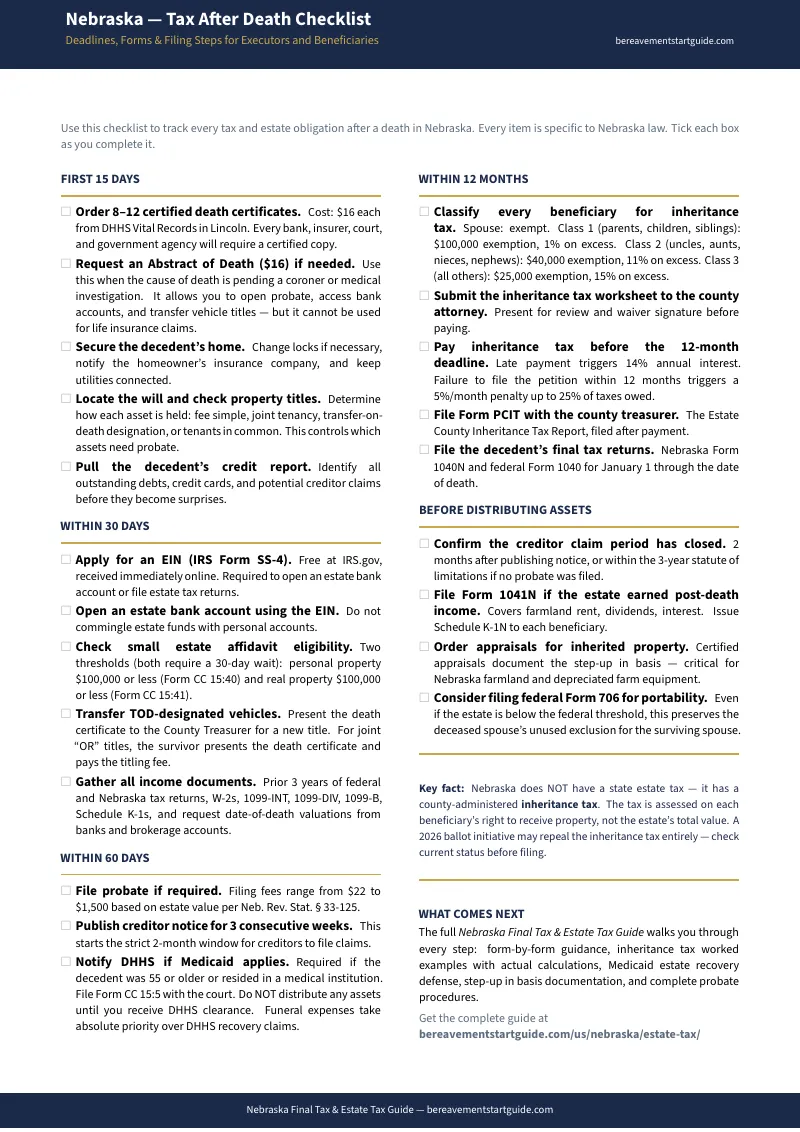
Not sure you need the full guide? Start with the Nebraska Tax After Death Checklist — a free download covering the 20 most critical actions, organized by deadline. It tells you what to do and when. The full guide tells you how, with worked examples, form-by-form instructions, and the legal context behind each step.
— Less Than One Hour With a Probate Attorney
A single consultation with a Nebraska probate attorney runs $200 to $400. This guide helps you walk into that meeting — if you need one at all — with your asset inventory organized, your beneficiary classifications determined, your deductions identified, and your inheritance tax worksheet drafted. For straightforward estates, it may be the only resource you need.