
Nebraska Requires a Funeral Director for Every Burial. The Director Is Not Required to Tell You What You Can Decline.
Someone in your family has died in Nebraska — or will soon. Within 24 hours, the body must be embalmed, refrigerated, or buried. Within a day or two of that, you will sit across a desk from a licensed funeral director and be presented with a contract for services averaging $8,500. That director has memorized every line of 172 Nebraska Administrative Code Chapter 68. You are still trying to figure out whether your siblings need to vote on the cremation authorization.
Nebraska is one of only eight states that legally mandate the involvement of a licensed funeral director for all dispositions — including burials on your own rural property. You cannot opt out of the commercial funeral system. What you can do is walk in knowing exactly which services are legally required and which ones exist to inflate the invoice. The director will not volunteer that embalming is almost never mandatory. They will not mention that you can supply your own casket and they cannot charge a handling fee. They will certainly not explain that Nebraska's inheritance tax can reach 15% for distant relatives, or that Legislative Bill 268 means your family's farmland may now be vulnerable to Medicaid estate recovery even if it never enters probate.
Free information exists. The Nebraska Revised Statutes are online. The DHHS publishes vital records forms. The FTC has a fact sheet about funeral pricing. But none of these sources tell you what to do, in what order, or how the statutes interact with each other. The Legislature's website does not explain that a Transfer on Death deed must be recorded within 30 days or it is void. The DHHS site does not warn you that LB 268 expanded Medicaid recovery to joint tenancy, living trusts, and POD accounts. The FTC page does not address Nebraska's 24-hour refrigeration rule or the three-day forfeiture clock on disposition authority.
The Nebraska Consumer Defense System
This guide consolidates every Nebraska funeral regulation, federal consumer protection, inheritance tax rule, and Medicaid recovery statute into one plain-English manual — organized around the decisions you actually face, in the order you face them. It functions as a consumer defense system: you read it before the arrangement conference, and you walk in knowing what the funeral home must provide, what you can legally refuse, and which agency to contact if they push back.
The result: you stop paying for services you do not need, you stop signing authorizations you do not understand, and you stop leaving asset protection decisions to chance during the worst week of your life.
The 24-Hour Clock
Nebraska law requires that a body be embalmed, refrigerated, or buried within 24 hours of death. Funeral homes routinely use this tight window to pressure families into embalming — a $500 to $1,000 service — by presenting it as a standard first step rather than one option among several. The guide explains exactly when refrigeration is the legal alternative, how an un-embalmed body can be held in cold storage for up to eight days, and the narrow exceptions where embalming is actually required (communicable disease or air transport without a sealed 20-gauge container).
The Family Dispute Trap
Nebraska law establishes a strict hierarchy for who controls funeral decisions under § 30-2223. If no one executed a written disposition affidavit, the surviving spouse holds priority. If there is no spouse, a majority of surviving adult children must agree. In blended families, estranged-sibling situations, or pending-divorce scenarios, achieving that majority is often impossible — and while the family argues, the body sits in commercial refrigeration at daily rates. The guide breaks down the entire priority list, explains the three-day forfeiture clock, and shows how a simple notarized affidavit eliminates the majority-vote problem entirely.
The LB 268 Asset Recovery Trap
Before 2017, Nebraska could only recover Medicaid long-term care costs from assets that passed through formal probate. Legislative Bill 268 changed that. The state can now recover from virtually any asset the deceased held an interest in — including jointly held property, Transfer on Death deeds, living trusts, and Payable-on-Death bank accounts. For families with agricultural land, this means the farm you assumed was protected by a TOD deed may be subject to a state recovery claim. The guide translates LB 268 into plain English, explains the exemptions (surviving spouse, children under 21, caregiver child), and walks through the irrevocable funeral trust strategy — including the current $6,696 trust cap for Medicaid spend-down eligibility.
What You Get
- The Complete Nebraska Funeral Law Guide — 17 chapters covering everything from the first 24 hours through estate settlement and professional escalation points, written in plain English with every relevant statute cited
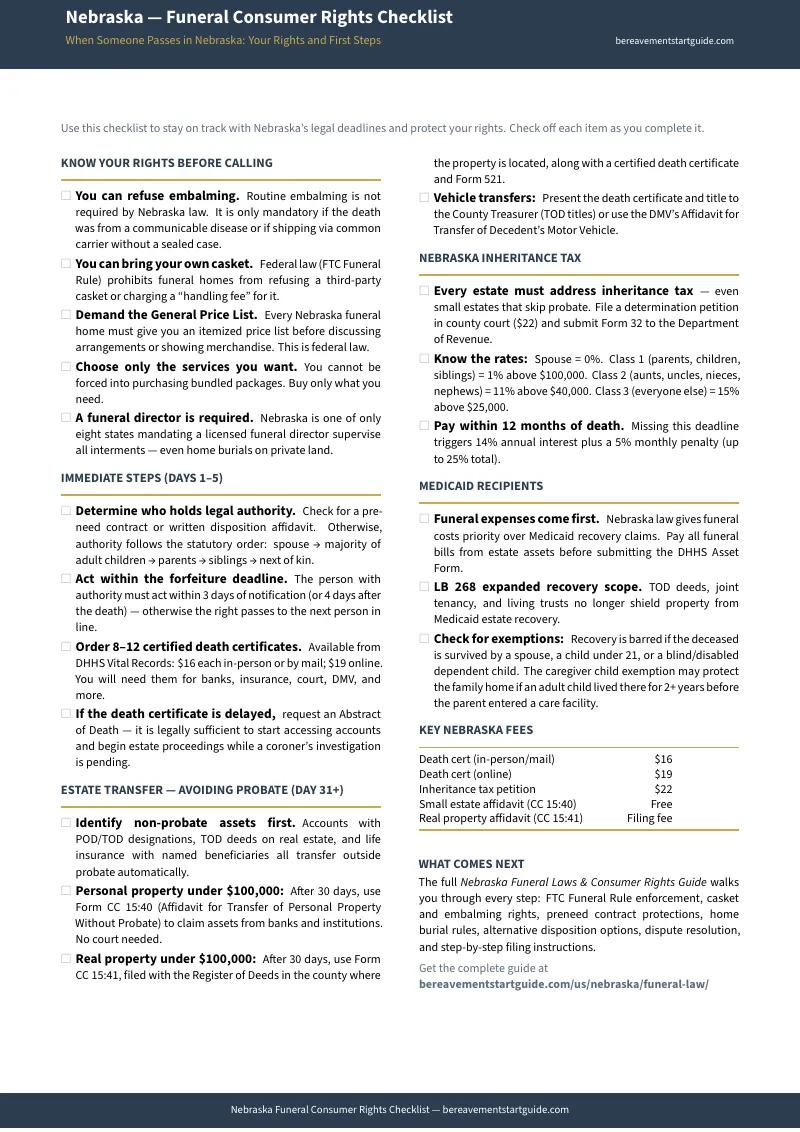
- Consumer Rights Checklist — a printable 20-item checklist covering the most urgent actions, from the 24-hour refrigeration rule through inheritance tax deadlines and Medicaid recovery exemptions
- Right of Disposition Hierarchy Chart — the complete priority list under § 30-2223 for who controls funeral decisions, with the disposition affidavit process, three-day forfeiture clock, and majority-vote rules
- Cremation Authorization Guide — the authorization hierarchy, medical examiner requirements, and the documentation procedures that delay families who are not prepared
- Home Burial and Green Burial Guide — the legal requirements for burial on private property in Nebraska, including the mandatory funeral director supervision, county registration, zoning rules, and the 24-hour preservation standard
- Small Estate Transfer Forms Guide — step-by-step instructions for Forms CC 15:40 (personal property under $100,000) and CC 15:41 (real property under $100,000), including the 30-day waiting period and county filing requirements
- Nebraska Inheritance Tax Breakdown — the three-class rate structure (1% / 11% / 15%), exemption thresholds, the 12-month payment deadline, penalty calculations, and the county court determination process
- Medicaid Estate Recovery Defense Guide — how LB 268 expanded recovery to non-probate assets, the surviving-spouse and caregiver-child exemptions, the irrevocable funeral trust strategy, and the DHHS Asset Form process
- Agency Navigation Map — the exact handoffs between DHHS Vital Records, the county court, the Register of Deeds, the Department of Revenue, and DHHS Medicaid, with contact information, form numbers, fee amounts, and deadline windows
- Complaint Filing Guide — how to file a regulatory complaint with the DHHS Licensure Unit when a funeral home violates your rights, plus the parallel federal FTC complaint path
Who This Is For
- Families arranging a funeral right now who need to know their rights before the first meeting with a funeral home — especially those facing an $8,500+ price quote and wondering what they can legally decline
- Surviving spouses or adult children navigating cremation authorization disputes, the disposition hierarchy, or pressure to purchase services they suspect are unnecessary
- Rural and agricultural families concerned about protecting farmland from Medicaid estate recovery under LB 268, or navigating the inheritance tax on transferred agricultural assets
- Families considering a home burial, green burial, or out-of-state alkaline hydrolysis who need to confirm they are meeting Nebraska's funeral director supervision requirement and transit permit rules
- Pre-planners evaluating preneed funeral contracts and wanting to understand trust account protections, cancellation rights, and the irrevocable trust cap for Medicaid eligibility
Why Free Information Falls Short
The Nebraska Revised Statutes are free to read online. But the funeral regulations alone span the Uniform Probate Code, DHHS administrative rules, county court procedures, the FTC Funeral Rule, and IRS guidelines — scattered across dozens of separate chapters and regulatory bodies. The DHHS website will give you a vital records order form but will not explain the 30-day waiting period for small estate affidavits or the 12-month inheritance tax deadline. A national consumer advocacy site will tell you that home burial is "legal in Nebraska" without mentioning the mandatory funeral director supervision. An elder law blog will discuss Medicaid planning without telling you the exact irrevocable trust cap or the TOD deed recording deadline.
The guide bridges this gap — not by replacing legal counsel, but by connecting the dots between every relevant agency, statute, and deadline so you can make decisions from a position of knowledge rather than grief-driven urgency.
— Less Than One Hour of Attorney Time
Nebraska estate attorneys typically charge $250 to $400 per hour. If this guide prevents just one unnecessary embalming, one missed inheritance tax deadline, or one improperly recorded TOD deed, it has paid for itself many times over. If it gives you the confidence to demand an itemized General Price List before signing anything, the savings compound from there.
Every purchase includes a 30-day money-back guarantee. If the guide does not give you the clarity and confidence you need to navigate Nebraska's funeral system, email us for a full refund.
The free Consumer Rights Checklist covers the 20 most critical actions — the ones with hard deadlines and immediate financial consequences. The full guide covers every chapter in depth: the right of disposition hierarchy, cremation rules, home burial regulations, small estate transfers, the Nebraska inheritance tax, Medicaid recovery defense, preneed contract protections, religious and cultural considerations, and the DHHS complaint process.