The Bank Froze the Account. The DMV Wants a Form You Have Never Heard Of. The Casino Sent a Collection Notice Citing Criminal Fraud Statutes. Medicaid Recovery Filed Against the Family Home. And Nevada Just Raised the Small Estate Threshold to $150,000 --- but Most Websites Still Say $25,000.
Your mother died in Clark County on a Tuesday. By Thursday the funeral director asked how many certified death certificates you want at $38 for the first copy and $25 for each additional. You said four. You will need ten. Every bank, every insurance company, every government office requires an original certified copy with a raised seal, and the Southern Nevada Health District takes weeks to process reorders.
You went to the district court to ask about probate. The self-help center handed you a stack of forms and explained they are legally prohibited from telling you how to fill them out or in what order to file them. You called a probate attorney --- statutory fees start at 4% of the first $100,000. For a $300,000 estate, that is $9,000 before filing fees. You found the Affidavit of Entitlement online and every website said the threshold was $25,000 for a surviving spouse. It is not. Senate Bill 404, effective October 2025, raised it to $150,000 --- and raised the Set Aside limit to $150,000, and the Summary Administration threshold to $500,000. But nobody updated the free guides.
The Nevada Estate Settlement Navigator is a Community Property Filing Sequence built entirely around the Nevada Revised Statutes and the sweeping SB 404 threshold increases --- mapping every form, deadline, statutory pathway, county office, and agency requirement into one chronological sequence. It diagnoses whether your estate qualifies for the $150,000 Affidavit of Entitlement (no court required), whether a Set Aside petition gets you through with one hearing, whether Summary Administration applies up to $500,000, or whether full General Administration is unavoidable. It tells you which offices to contact in which order so no deadline expires because nobody told you it existed.
What's Inside the Community Property Filing Sequence
A 16-chapter guide with an appendix, a printable 18-item action checklist, and standalone reference sheets --- covering every probate shortcut, asset transfer, creditor defense, and agency procedure available under Nevada law:
Chapters 1-2: The First 48 Hours and Death Certificates
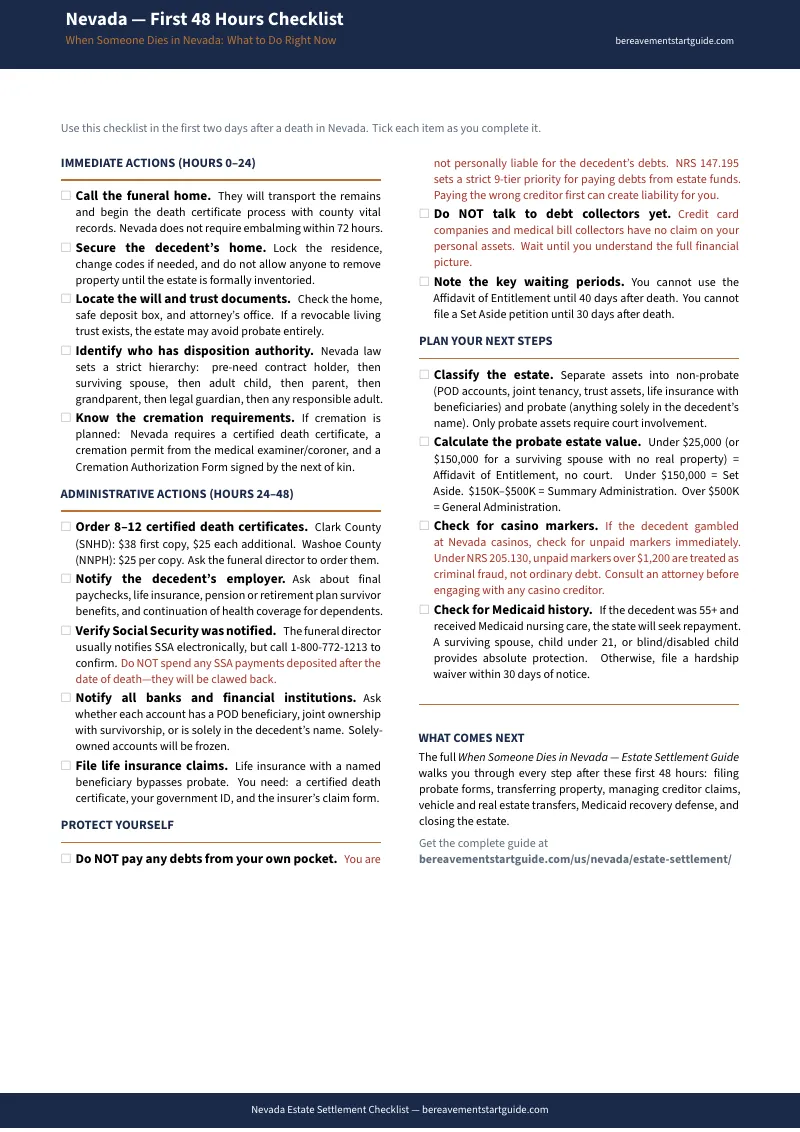
What makes Nevada different from every other state: community property laws that determine asset ownership at the moment of death, the strict statutory hierarchy for disposition authority, and the cremation permit requirement. Day-by-day triage for the first 48 hours: securing the residence, locating the will and trust documents, ordering 8-12 certified death certificates (Clark County SNHD: $38 first copy, $25 additional; Washoe County NNPH: $25 per copy), notifying the employer, confirming Social Security notification, and freezing sole-owner bank accounts. What NOT to do --- do not pay any debts from your personal funds, do not talk to debt collectors, and do not file any court documents before the mandatory waiting periods expire.
Chapter 3: Administrative Notifications
The complete notification sequence from Days 3 through 30: which agencies to contact, which require original certified death certificates, which accept photocopies, and the exact order that prevents wasted trips. Social Security clawback warnings, life insurance claims (bypasses probate with a named beneficiary), veterans benefits, and employer benefits. How to handle mail forwarding and prevent identity theft on the deceased's accounts.
Chapter 4: Classifying the Estate
The asset classification table that determines your entire legal pathway. Every asset sorted into probate vs. non-probate categories: community property with right of survivorship (full step-up in tax basis), joint tenancy with right of survivorship (half step-up only), POD/TOD bank accounts, transfer-on-death vehicle titles, revocable living trusts, life insurance, and retirement accounts with designated beneficiaries. Only probate assets count toward the SB 404 thresholds --- the actual probate estate might qualify for a shortcut even if the total estate is worth far more.
Chapter 5: Four Administration Pathways
The diagnostic that tells you whether you can bypass formal probate entirely, updated for the sweeping SB 404 threshold increases effective October 2025. Four distinct pathways: the Affidavit of Entitlement (up to $25,000, or $150,000 for a surviving spouse with no real property, 40-day waiting period), the Set Aside Without Administration ($150,000 limit including real property, requires one court hearing), Summary Administration ($500,000, requires creditor publication), and General Administration (above $500,000 or contested estates). The qualifying criteria, filing requirements, and typical timeline for each pathway.
Chapter 6: Vehicle Title Transfers Through the Nevada DMV
Step-by-step instructions for every vehicle transfer scenario: checking for a Transfer on Death (TOD) beneficiary via Form VP 239, using Form VP 241 for TOD transfers ($20 fee), using the Affidavit for Transfer Without Probate (Form VP 024) for estates under $25,000 (or $100,000 for a surviving spouse), the 14-day written notice requirement to other successors, in-person notarization requirements, and the inspection and emission testing rules. The decision tree that tells you exactly which path applies to your situation.
Chapter 7: Real Property Transfers
How to transfer the family home based on how the deed is titled. The critical difference between Joint Tenancy with Right of Survivorship and Community Property with Right of Survivorship --- and why the latter provides a full step-up in tax basis that can save tens of thousands in capital gains taxes. Recording the Affidavit of Death of Joint Tenant. When real property forces you into a court proceeding (Set Aside or General Administration). Transfer Tax Declaration requirements. The Assessor's Office notifications.
Chapters 8-9: Debts, Creditor Claims, and Casino Markers
The 9-tier creditor priority system under NRS 147.195 --- funeral and burial expenses paid first, then administrative costs, then secured debts, then medical bills, then credit cards last. How to publish the Notice to Creditors (60-day claim window). Confirmation that heirs are NOT personally responsible for debts they did not co-sign. The uniquely Nevada chapter on casino markers: under NRS 205.130, unpaid markers exceeding $1,200 are treated as criminal fraud, not ordinary debt. How to investigate, negotiate, and resolve marker obligations before they escalate.
Chapter 10: Medicaid Estate Recovery
How the Nevada Division of Health Care Financing and Policy (DHCFP) recovers Medicaid costs from estates of recipients age 55 and older. Nevada's aggressive "undivided estate" definition that reaches joint tenancies, living trusts, and annuities --- not just probate assets. The absolute statutory protections: surviving spouse, child under 21, or blind/disabled child. The 30-day hardship waiver deadline. The DHCFP response protocol and the Carson City contact information. Why funeral expenses must be paid before engaging with recovery.
Chapter 11: Nevada's Tax Environment
Nevada imposes no state income tax, no state estate tax, and no state inheritance tax. The federal estate tax exemption ($15 million for 2026). The community property step-up in basis advantage that makes Nevada one of the most favorable states for inherited real estate. Final federal income tax return filing requirements. The EIN application for the estate.
Chapter 12: The Nevada Timeshare Problem
Nevada's thriving vacation and retirement destination market means a massive volume of nonresident decedents own timeshares in Las Vegas and Reno. Timeshare interests are real property under Nevada law, which means they require ancillary probate --- a separate court proceeding in Nevada even if the primary probate is happening in another state. The special assessment obligations, the HOA lien risks, and the practical options for surrendering or transferring timeshare interests without opening full probate.
Chapters 13-16: Intestate Succession, Filing Fees, Timeline, and When to Hire a Professional
Nevada's intestate succession order when there is no will: community property goes entirely to the surviving spouse, separate property is divided between spouse and children. District court filing fees ($185-$540 depending on estate value and county). The complete estate settlement timeline from Day 1 through final distribution. The decision framework for when the guide handles everything vs. when you need a Nevada probate attorney: contested wills, complex business assets, multi-state property, Medicaid disputes, and litigation scenarios.
Appendix: Official Forms and Agency Contacts
Every Nevada form organized by agency: district court probate forms, DMV vehicle transfer forms (VP 024, VP 239, VP 241), county recorder real property forms, and vital records applications. Complete contact information for Clark County, Washoe County, and rural county offices.
Who This Guide Is For
- The surviving spouse navigating community property who needs to know which assets pass automatically and which require court involvement --- and wants to understand the difference between Joint Tenancy and Community Property with Right of Survivorship before making a tax mistake that costs tens of thousands of dollars.
- The out-of-state executor dealing with Nevada ancillary probate whose parent owned a timeshare, vacation home, or bank account in Nevada and just learned that Nevada real property requires a separate probate proceeding regardless of where the primary probate is happening.
- The price-sensitive administrator of a small estate who consulted with a probate attorney, received a retainer quote of $3,000-$10,000, and wants to know whether the estate qualifies for the Affidavit of Entitlement, Set Aside, or Summary Administration under the new SB 404 thresholds before paying statutory legal fees.
- Families dealing with casino markers who discovered the decedent had unpaid markers and learned that Nevada treats markers over $1,200 as criminal fraud under NRS 205.130 --- not ordinary consumer debt --- and need to know how to resolve them before they escalate.
- Families facing Medicaid estate recovery who received a DHCFP recovery notice and need to understand which statutory exemptions protect the family home, whether they qualify for a hardship waiver, and the 30-day response deadline.
Why Free Government Forms Do Not Replace a Sequenced Filing Guide
Every form referenced in this guide is available for free from a Nevada government office or website. The probate petition is at the district court. The DMV forms are on the Nevada DMV website. The Affidavit of Entitlement is a standard notarized form. Here is why the forms alone are not enough:
- The court self-help center cannot tell you how to file. Nevada court staff are legally prohibited from providing legal advice. The Clark County Civil Law Self-Help Center hands you forms and directs you to the door. You get the raw paperwork without a single word of instruction about sequencing, deadlines, or which forms apply to your situation.
- Most websites still publish the old SB 404 thresholds. Senate Bill 404 raised the Affidavit of Entitlement limit from $25,000 to $150,000 for surviving spouses, the Set Aside limit to $150,000, and the Summary Administration threshold to $500,000 --- effective October 2025. Most free guides, national form vendors, and even some Nevada attorney websites have not updated. Families read the old thresholds and open formal probate when they qualify for a fast-track pathway that avoids court entirely.
- Community property creates a second layer of complexity that common-law states do not have. How the deed is titled determines not just who inherits, but how much capital gains tax the survivor pays when they sell. The difference between Joint Tenancy and Community Property with Right of Survivorship can mean tens of thousands of dollars in taxes --- and most free checklists treat them as interchangeable.
- Law firm websites explain the problem. They withhold the solution. Nevada probate attorneys publish detailed articles about estate settlement complexity. The content is accurate. It is also deliberately incomplete --- designed to trigger a consultation call, not to empower you to handle it yourself. The question is not "how complicated is this?" but "does my estate actually require an attorney?" The answer, for many Nevada estates under $500,000 in net probate value, is no.
- Nevada has state-specific hazards that no generic guide covers. Casino markers treated as criminal fraud. Timeshare interests requiring ancillary probate. Medicaid recovery that reaches beyond probate assets into joint tenancies and living trusts. The DMV's labyrinth of VP forms. These are not footnotes --- they are the issues that derail Nevada estate settlements when families use national templates.
Free resources give you one agency at a time, with no sequencing, no cross-referencing, and no way to know what you are missing. The Community Property Filing Sequence maps every asset, every form, and every deadline into one chronological sequence --- so you claim everything, avoid every common rejection, and determine whether you actually need an attorney before spending a dollar on one.
--- Less Than Twenty Minutes of a Probate Attorney's Time
Nevada families lose weeks and thousands of dollars every year --- not because the estate was complicated, but because nobody told them about the shortcuts the Nevada Revised Statutes provide. An estate that qualifies for the $150,000 Affidavit of Entitlement opens formal probate instead because outdated websites still say $25,000. A surviving spouse never learns about the community property step-up in tax basis and pays capital gains taxes they did not owe. A family responds to a casino marker collection notice without understanding the criminal fraud statute. A Medicaid recovery notice arrives and nobody tells them about the 30-day hardship waiver deadline. This guide costs less than any of those mistakes.
Your download includes the complete 16-chapter guide with appendix, the Nevada --- First 48 Hours Checklist, and standalone printable reference sheets --- covering every time-sensitive step from securing the estate on day one through the critical 40-day Affidavit of Entitlement milestone, the 60-day creditor claim window, and final estate distribution.
30-day money-back guarantee. If the guide does not give you a clear map of every probate shortcut available for your Nevada estate, every form you need to file, and every deadline you need to meet --- email us for a full refund. No questions asked.
Not ready for the full guide? Download the free Nevada --- First 48 Hours Checklist --- a summary of the most time-sensitive actions, forms, and thresholds that most families do not discover until it is too late. Enough to start the right sequence on day one.
You did not plan for this. But you can plan what happens next. The guide gives you the forms, the deadlines, the statutory shortcuts, and the filing sequence --- so the next six months are spent settling the estate correctly, not discovering what you missed.