Your Spouse Died in Nevada. The Bank Froze the Joint Account Until You Produce an EIN. The County Recorder Wants a Real Property Transfer Tax Payment Before Recording the Deed. And Medicaid Just Sent a Letter Claiming the State Is Entitled to Reimbursement From the Estate.
The funeral is behind you. You called the bank and they told you the joint checking account is locked until the estate has its own Employer Identification Number from the IRS -- even though the money was yours too. You asked the title company about transferring the house and learned that Clark County charges $2.55 per $500 of assessed value as a Real Property Transfer Tax, but there might be an exemption if the transfer is between first-degree relatives or results from a death. Nobody at the recorder's office could tell you which exemption applies to your situation. Then a letter arrived from the Nevada Division of Health Care Financing and Policy informing you that Medicaid may seek reimbursement from the estate for care your spouse received after age 55. You have 30 days to respond.
Here is what makes Nevada estates uniquely confusing: the state has no estate tax, no inheritance tax, no income tax, and no capital gains tax. Everyone told you this would be simple. But the IRS does not care what Nevada charges. Federal estate tax applies to estates over $15 million. Federal income tax applies to the decedent's final year of earnings. Federal fiduciary income tax applies to any income the estate generates during probate -- rental income, stock dividends, the last paycheck. County transfer taxes apply to every deed recording. And Medicaid estate recovery reaches into living trusts, joint tenancy assets, and the family home. The absence of state taxes created a false sense of security, and now every federal form, county fee, and state recovery claim is landing on your desk at once.
The Nevada Final Tax & Estate Tax Guide is a Tax Sequence Roadmap that maps every federal form, every county filing, and every statutory deadline into a single chronological pathway. Not legal advice. Not a stack of blank government forms. A preparation system that shows you which taxes actually apply to a Nevada estate, which ones do not, and -- critically -- which exemptions can legally eliminate tens of thousands of dollars in taxes that most executors pay because they did not know the exemption existed. Built around the Internal Revenue Code, the Nevada Revised Statutes, the post-SB 404 probate thresholds effective October 2025, and county-specific procedures for Clark County, Washoe County, and rural Nevada.
What's Inside the Tax Sequence Roadmap
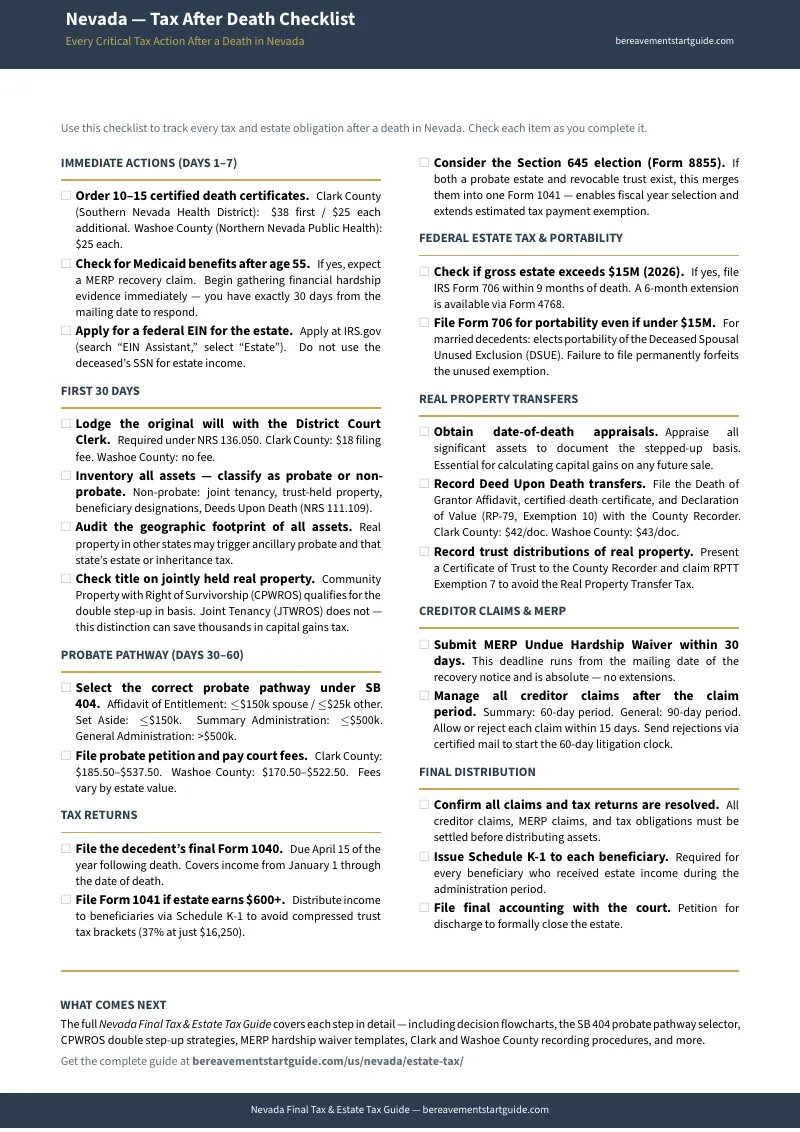
A comprehensive guide and printable Tax After Death Checklist -- covering every federal tax obligation, county transfer tax, Medicaid recovery defense, and asset protection strategy specific to Nevada estates, organized by deadline so you file the right forms in the right order:
Nevada's Tax Landscape: What Applies and What Does Not
Nevada repealed its estate tax in 2005. There is no state inheritance tax, no state income tax, and no state capital gains tax. But federal obligations remain in full force: the final Form 1040 for income earned before death, Form 1041 for estate income after death, Form 706 for estates near the federal threshold, and county-level Real Property Transfer Tax on every deed recording. The guide maps exactly which forms apply to your estate's size and asset mix -- so you do not waste time on forms you do not need, and you do not miss the ones you do.
The Double Step-Up in Basis: Nevada's Most Valuable Tax Advantage
Nevada is a community property state. When one spouse dies, both halves of community property receive a stepped-up basis to fair market value at the date of death. A home purchased for $200,000 that is worth $600,000 when your spouse dies gets a new tax basis of $600,000 for the entire property -- not just the deceased's half. Sell it for $600,000 and your federal capital gains tax is zero. This is the double step-up, and it is worth more than most families realize. But it only works if the property is titled as community property, not joint tenancy. The guide explains the critical titling distinction, how to document the valuation, and what happens with commingled separate property.
The Final Form 1040: Filing for a Deceased Person
Every Nevada decedent who earned income in their final year needs a federal income tax return. The IRS requires it even though Nevada charges no state income tax. The guide walks through how to sign the return as executor, how to handle joint filing with a surviving spouse, the rules for income received after death versus income accrued before death, and the April 15 deadline that does not shift because someone died.
Form 1041: The Fiduciary Income Tax Return Most Executors Miss
If the estate generates more than $600 in gross income during probate -- rental payments on a property you have not sold yet, stock dividends, interest on accounts -- the IRS requires Form 1041. Nevada does not impose a state fiduciary income tax, which is a genuine advantage. But the federal obligation is absolute. The guide explains when 1041 is required, how to obtain the Estate EIN that triggers it, and how to elect a fiscal year that can defer taxes by up to 11 months.
Form 706 and Portability: Planning Beyond the Federal Exemption
The federal estate tax exemption rises to $15 million per individual in 2026 under the One Big Beautiful Bill Act. Most Nevada estates fall well below this threshold and owe nothing. But filing Form 706 is still strategically important for married couples: it is the only way to elect portability, which transfers the deceased spouse's unused exemption to the survivor. That means a married couple can shelter up to $30 million from estate tax -- but only if someone files the 706 within nine months of death. The guide covers the filing requirements, the portability election, alternate valuation dates, and when hiring a CPA for the 706 is worth the cost.
Real Property Transfer Tax: The County Fee With Hidden Exemptions
Every time a deed is recorded in Nevada, the county charges a Real Property Transfer Tax: $1.95 per $500 of value in most counties, $2.55 per $500 in Clark County. On a $500,000 home, that is $1,950 to $2,550. But NRS 375.090 provides exemptions that can eliminate this tax entirely -- transfers between first-degree relatives, transfers that take effect upon the grantor's death, and transfers to a surviving joint tenant. The guide provides the complete exemption matrix and the Declaration of Value form instructions so you do not pay a transfer tax you legally do not owe.
Probate Pathways Under SB 404: The Thresholds That Changed in October 2025
Senate Bill 404 raised Nevada's probate thresholds dramatically. The Affidavit of Entitlement (NRS 146.080) now covers personal property estates up to $150,000 for surviving spouses -- up from the previous limits. Set Aside Without Administration covers estates with real property up to $150,000. Summary Administration now reaches $500,000, which means thousands of Nevada estates that previously required expensive General Administration now qualify for the faster, cheaper process. Most law firm websites and legal aggregators still cite the old limits. The guide uses the current ones.
Medicaid Estate Recovery: The 30-Day Window That Protects the House
If the decedent received Medicaid-funded care after age 55, the Nevada Medicaid Estate Recovery Program can file a claim against the estate. This reaches beyond probate assets -- it covers property in living trusts, joint tenancy, and the family homestead. But the law provides clear protections: Medicaid cannot recover during the lifetime of a surviving spouse, while there is a surviving child under 21, or while there is a blind or disabled child of any age. Nevada also offers a hardship waiver if recovery would deprive heirs of basic necessities -- but you must submit it within 30 days of receiving the recovery notice. The guide walks through every exemption, the waiver application process, and the timeline.
Special Assets: Timeshares, Casino Annuities, and Out-of-State Property
Nevada classifies timeshares as real property, which means a Las Vegas timeshare requires a separate ancillary probate proceeding even if the primary estate is settled elsewhere. Inherited casino annuities -- progressive slot jackpots paid over 20 years -- create ongoing federal income tax liability for the estate. Out-of-state real estate owned by a Nevada decedent triggers filing obligations in those states, even though Nevada itself imposes nothing. The guide covers the tax treatment, the probate requirements, and the cross-border complications for each asset type.
Final Distribution: Closing the Estate Tax-Free
The goal is to distribute assets to beneficiaries in a way that generates no surprise tax bills down the road. The guide covers which assets pass completely tax-free (life insurance, Roth IRAs, assets below the federal exemption), which ones carry hidden income tax liability (traditional IRAs, 401(k)s, deferred compensation), and the proper sequence for closing the estate -- final tax clearances, creditor claim periods, and the court filing that officially ends your fiduciary responsibility.
Who This Guide Is For
- The surviving spouse who just lost the double step-up without knowing it -- because the house was titled as joint tenancy instead of community property, and nobody explained the difference until after the deed was recorded
- The executor staring at frozen bank accounts -- who needs the EIN before the bank releases funds, needs to know whether the estate triggers Form 1041, and cannot figure out whether the estate qualifies for the Affidavit of Entitlement or requires full probate
- The out-of-state adult child managing a parent's Nevada estate remotely -- who discovered a Las Vegas timeshare requires its own ancillary probate, the Clark County recorder wants a Declaration of Value form, and every Nevada agency needs a certified death certificate they do not have enough copies of
- The family terrified of the Medicaid recovery letter -- who needs to know whether the surviving spouse exemption applies, what the hardship waiver requires, and whether the 30-day response deadline has already started running
- The executor of a larger estate weighing Form 706 -- who needs to understand portability elections, the nine-month filing deadline, alternate valuation dates, and whether strategic filing is worth the CPA cost even when the estate falls below the $15 million threshold
Why Free Resources Will Not Get You Through This
The IRS publishes forms. The Clark County Civil Law Self-Help Center provides fillable PDFs and automated interview bots. County recorder offices post fee schedules. Here is what you actually encounter when you try to navigate Nevada estate taxes using these free sources:
- Government sites provide forms without strategy. The Clark County Self-Help Center gives you a blank Affidavit of Entitlement but does not tell you whether filing it forfeits the double step-up. The IRS website has Form 1041 instructions but does not explain when a Nevada estate can skip it entirely. Free sources tell you what to file but never which filing sequence saves the most money.
- Law firm blogs end at the consultation booking form. Nevada probate attorneys like Jeffrey Burr and Drizin Law publish detailed articles about community property and timeshare probate -- then charge $250 to $450 per hour to answer the questions their articles deliberately leave open. Their content is designed to generate billable hours, not to help you handle this yourself.
- National legal aggregators cite outdated Nevada thresholds. Nolo, FindLaw, and RocketLawyer still reference pre-October 2025 probate limits. If you follow their guidance, you may file for General Administration when your estate qualifies for Summary Administration under the new $500,000 SB 404 threshold -- costing thousands in unnecessary attorney fees and months of additional court time.
- Tax software ignores Nevada-specific advantages. TurboTax and H&R Block handle the federal forms but know nothing about the RPTT exemptions under NRS 375.090, the community property double step-up documentation requirements, or the Medicaid hardship waiver timeline. The Nevada-specific strategies that save the most money are invisible to national tax platforms.
Free resources give you blank forms from agencies that do not coordinate with each other. The Tax Sequence Roadmap puts every federal obligation, every county filing, every exemption, and every deadline into one document, in the order you actually need them -- with the post-SB 404 thresholds, the double step-up documentation steps, the RPTT exemption matrix, and the Medicaid defense timeline that tells you exactly what to file and when.
-- Less Than Five Minutes With a Nevada Probate Attorney
A single consultation with a Nevada estate attorney costs $250 to $450 per hour. A CPA session to review the step-up in basis documentation runs $200 to $350. Filing for General Administration when your estate qualifies for Summary Administration under SB 404 can cost thousands in unnecessary legal fees. Missing the NRS 375.090 transfer tax exemption on a $500,000 home costs $2,550 in Clark County. Failing to document the community property double step-up before selling the house creates a federal capital gains liability on $400,000 of phantom gains. This guide costs less than five minutes of professional time and gives you the complete Nevada tax roadmap -- every form, every exemption, every deadline, and the filing sequence that minimizes what you pay to the IRS and the county.
Your download includes 8 PDFs: the complete guide, the printable Nevada Tax After Death Checklist, plus 6 standalone worksheets and reference sheets -- the Double Step-Up Worksheet for documenting community property basis, the Probate Pathway Reference with post-SB 404 thresholds, the RPTT Exemption Matrix for every NRS 375.090 exemption, the MERP Defense Timeline for the 30-day hardship waiver process, the Portability Planner for the Form 706 election, and the Forms & Fees Reference with county-specific filing information. Instant download, no account required.
30-day money-back guarantee. If the guide does not give you clarity on which taxes apply to your Nevada estate, confidence in claiming every exemption you qualify for, and a clear filing sequence from day one through final distribution, email us for a full refund. No questions asked.
Not ready for the full guide? Download the free Nevada Tax After Death Checklist -- a printable action list covering the most critical deadlines, tax forms, and exemptions for the first nine months. Enough to make sure you do not miss the filings that matter most.
You did not choose this. But the taxes are real, the exemptions exist, and the process for filing correctly is something you can navigate. The guide puts every form, every exemption, and every deadline in one place so you can focus on your family instead of chasing paperwork across federal agencies and county offices.