The Funeral Director Quoted You $10,495. You Have No Idea Which of Those Charges You Can Legally Refuse.
Someone in your family died in Nevada. You called the nearest funeral home and within the hour they quoted a traditional burial package — casket, embalming, viewing, chapel service, hearse, cemetery coordination — as though each piece were mandatory. They mentioned embalming like it was a health requirement. They presented the casket showroom but never told you that buying a casket online for half the price and having it shipped to their door is your federally protected right. They quoted cremation as a simpler alternative at $2,310 but glossed over the 48-hour state waiting period and what happens when your siblings cannot agree on who has the legal authority to sign the authorization form.
Meanwhile, the body is in a refrigeration unit. The 72-hour deadline for filing the death certificate is running. You still need to figure out who legally controls the arrangements under Nevada's strict priority hierarchy — because if the wrong person signs the authorization, the crematory will refuse to proceed and you will be back at the beginning. And nobody at the funeral home is going to volunteer that information, because every answer they do not give you is a service they can sell you instead.
The Nevada Funeral Laws & Consumer Rights Guide is a Consumer Defense Manual — a plain-English walkthrough of every Nevada funeral law, consumer protection, and mandatory deadline, organized in the exact order you need to act. Not a blog post designed to drive you toward a retainer. Not the 200 pages of NRS Title 38 that the legislature drafted for regulators. A single document that tells you which charges are legally declinable, which deadlines are real, and exactly where the funeral home's financial interests diverge from your legal rights.
What's Inside the Consumer Defense Manual
A 13-chapter guide plus a 20-item action checklist — covering every legal question families face from the hour of death through final disposition and complaint filing, built on the Nevada Revised Statutes, Nevada Administrative Code, the FTC Funeral Rule, and the specific regulatory framework that makes Nevada different from every other state:
Who Controls the Funeral Arrangements — and Who Does Not
NRS 451.024 establishes a strict priority hierarchy: designated agent first (via notarized affidavit), then surviving spouse, adult children, parents, siblings, grandparents, guardian, and finally the co-owner of the primary residence in joint tenancy. That last category matters — Nevada recognizes the practical reality of unmarried cohabitation. When multiple people share the same priority level, the funeral home requires majority agreement from that class before proceeding. If one sibling is blocking a cremation, the guide explains how to petition the district court for a disposition order. If nobody can be located within 30 days, authority passes automatically to the next person in the hierarchy. Knowing this prevents the single most common delay in Nevada funeral arrangements.
The First 72 Hours: Every Mandatory Deadline in Sequence
Death triggers a cascade of time-sensitive obligations that most families discover one at a time, usually by hitting a wall. The body must be placed in mechanical refrigeration at 48 degrees or below within 24 hours if not embalmed — that is NAC 451.015, not a suggestion. The death certificate must be filed with the local health registrar within 72 hours. The burial-transit permit must be issued before any transport, burial, or cremation can legally proceed. The religious and cultural exception allows up to 8 hours of contact with an unembalmed body for washing, dressing, or prayer — but only if the local health officer does not determine it poses a public health threat. The guide maps these obligations in chronological order so nothing falls through while you are making phone calls and fielding condolences.
The FTC Funeral Rule: Your Financial Shield
Federal law gives you the right to call any funeral home and request prices over the phone — without giving your name, without submitting to a sales pitch. When you walk in, the funeral home must hand you an itemized General Price List and a separate Casket Price List before discussing any arrangements. You have the absolute right to purchase services individually from that price list rather than accept a bundled package. You have the right to buy a casket from a third-party retailer — Costco, Titan Caskets, Amazon — and the funeral home is strictly prohibited from charging a handling fee, inspection fee, or refusing service because you did not buy from their showroom. The only non-declinable charge is the basic services fee. Every other line item is negotiable. The guide explains each right with the specific federal citation so you can point to the law if challenged.
Embalming: Not Required, Possibly Illegal to Demand
NRS 451.065 makes it a misdemeanor for any funeral establishment to require embalming before cremation, burial, or removal. That is not an ambiguity — it is a criminal statute. The actual legal requirement is refrigeration at 48 degrees within 24 hours. The only two circumstances where embalming can legally be compelled: a direct order from the State Board of Health during a communicable disease outbreak, or when the facility has held the body for 72 hours, cannot reach the family, and has no reason to believe they would object. Declining embalming saves approximately $800 or more — money that stays in the estate instead of funding a service you never needed.
Cremation Rules and the Authorization Trap
Nevada mandates a 48-hour waiting period between death and cremation. No legitimate fee can expedite this — any funeral home or crematory that offers to bypass the waiting period for an additional charge is violating state law. The legal next of kin under NRS 451.024 must sign the cremation authorization. If family members disagree, the crematory will refuse to proceed — they are protected from liability under NRS 451.710 when they act on a good-faith belief that a dispute exists. The only way to break a cremation deadlock is to petition the district court for a signed order. The guide walks through the exact steps: gather the death certificate, the will, and relative consent forms, then file the petition.
Green Alternatives, Human Composting, and Water Cremation
Assembly Bill 289, effective January 1, 2024, legalized Natural Organic Reduction — commonly called human composting — making Nevada the seventh state to permit the practice. The body is placed in a biodegradable container with wood chips and organic materials, undergoing microbial decomposition over 30 to 45 days. Alkaline hydrolysis (water cremation) is also legal under NRS 451.637, but facilities must provide 90 days' written notice to the Division of Environmental Protection and the local sanitary sewer operator before installing the equipment. Traditional green burial without a concrete vault is permitted — state law does not require vaults, though individual cemeteries retain the right to enforce their own internal rules.
Home Burial, Transporting Remains, and Preneed Contracts
Home burial on private property is technically legal but requires notifying the Health Division, establishing a formal cemetery deed, and complying with local zoning — and permanently impacts future property value and transferability. Transporting an intact body across state lines almost always requires a funeral home because airlines enforce TSA "known shipper" rules that individuals cannot satisfy. Preneed funeral contracts are regulated under NRS 689: sellers must hold a valid certificate from the Commissioner of Insurance, funds must be held in trust, and buyers can cancel and receive a net refund. The $15,000 Irrevocable Funeral Trust is exempt from Medicaid asset limits — but only if a detailed Goods and Services Statement proves the funds are strictly for disposition.
Probate Intersections, Medicaid Recovery, and Filing Complaints
Funeral expenses receive statutory priority in creditor claims during estate settlement. The guide covers where funeral costs intersect with probate — the $150,000 small estate affidavit threshold, Set Aside provisions for surviving spouses, and how SB 404 changed the landscape. If the deceased received Medicaid benefits after age 55, the state will pursue reimbursement from the estate — including assets held in trusts, joint tenancy, and POD accounts. The 30-day hardship waiver window is the single most important deadline in estate recovery, and missing it forfeits your right to challenge the claim. The guide also explains how to file complaints with the Nevada State Board of Funeral and Cemetery Services for licensing violations and with the FTC for pricing deception.
Who This Guide Is For
- The executor or next of kin who just received a funeral home quote and does not know what is required versus what is optional — who needs to understand that embalming is not mandatory, casket showrooms are not the only option, and that bundled package prices are negotiable under federal law
- The out-of-state family member managing arrangements in Nevada remotely — who needs every NRS citation, every deadline, and the specific procedures for death certificates, burial-transit permits, and interstate transport in one document instead of calling the funeral home repeatedly for answers they are not required to give
- The surviving spouse facing a Medicaid Estate Recovery notice — who needs to know about the 30-day hardship waiver, the spousal protection exemption, and how community property laws affect liability for the deceased's debts, including casino markers
- The family exploring alternatives to traditional burial — who wants to legally pursue home burial, Natural Organic Reduction, or water cremation and needs the exact statutory requirements, zoning procedures, and environmental notification timelines to do it without legal exposure
- The person planning ahead — who wants to evaluate preneed contracts, document disposition wishes via a Designated Agent Affidavit, or set up an Irrevocable Funeral Trust that protects assets during Medicaid eligibility determinations
Why Free Resources Will Not Protect You at the Funeral Home
Nevada funeral information exists on state websites, funeral home blogs, and national legal platforms. Here is what you actually encounter when you try to navigate funeral arrangements using free sources:
- The Nevada Revised Statutes are public record — and written for regulators, not grieving families. NRS Title 38 runs hundreds of pages of cross-referenced legal text. Finding the specific embalming law (NRS 451.065), the disposition hierarchy (NRS 451.024), or the cremation waiting period requires searching through statutes written for licensed funeral professionals and state board examiners. The law is available. The operational sequence is not.
- The Nevada State Board of Funeral and Cemetery Services handles licensing and enforcement — not consumer education. They can tell you whether a funeral home is licensed. They cannot tell you which charges on your invoice are legally declinable, how to resolve a family dispute over disposition authority, or whether your preneed contract meets the trust fund requirements of NRS 689.
- Funeral home websites publish planning guides designed to sell their services. Pre-planning checklists from Palm Mortuary, Neptune Society, and other Nevada providers bias heavily toward their own preneed contracts. They omit your right to use outside vendors, decline embalming, or purchase individual services from the General Price List. Their content is accurate where it covers their offerings and strategically silent about your rights.
- National platforms miss Nevada-specific rules. Articles about funeral rights on Nolo, Everplans, and similar sites cover the FTC Funeral Rule but not NRS 451.065 (the misdemeanor penalty for requiring embalming), not the designated agent affidavit, not the 48-degree refrigeration threshold, not the AB 289 human composting law, and not the 30-day Medicaid hardship waiver deadline. Nevada is not a generic state.
- Elder law and probate attorneys in Nevada charge $250 to $400 per hour. Paying a retainer to learn whether embalming is required, what a burial-transit permit is, or how the disposition hierarchy works is an unnecessary drain on the estate. Attorneys are essential for contested wills and complex Medicaid recovery — not for understanding which line items on a funeral invoice you can cross out.
Free resources give you raw statutes from the legislature, sales pitches from funeral homes, and generic overviews from national sites. The Consumer Defense Manual puts every Nevada-specific law, consumer right, and mandatory deadline into one document, in the order you actually need them — from the hour of death through final disposition.
— Less Than Thirty Minutes With a Nevada Attorney
A consultation with a Nevada probate or elder law attorney runs $250 to $400 per hour. A single hour of legal advice about funeral rights, disposition authority, and Medicaid recovery costs more than this entire guide. Meanwhile, declining embalming alone saves approximately $800 or more. Knowing your right to purchase a casket from a third-party retailer can save $1,000 to $3,000. Understanding which charges on the General Price List are declinable — rather than accepting a bundled package — can reduce your total funeral costs by 20 to 40 percent.
Your download includes 7 PDFs: the complete 13-chapter guide covering disposition hierarchy, FTC Funeral Rule rights, embalming laws, cremation authorization, green alternatives (including human composting and water cremation), home burial procedures, preneed contract protections, probate intersections, Medicaid Estate Recovery defense, and complaint filing — plus 6 standalone printables: the 20-Item Consumer Rights Checklist, a Disposition Authority Reference Card (NRS 451.024 hierarchy), a First 72 Hours Timeline, an FTC Funeral Rule Rights Card to bring to the funeral home, a Cremation Authorization Checklist, and an Agency Contact Reference with all 10 Nevada agencies. Instant download, no account required.
30-day money-back guarantee. If the guide does not give you clarity on your legal rights, the deadlines you face, and the charges you can decline — email us for a full refund. No questions asked.
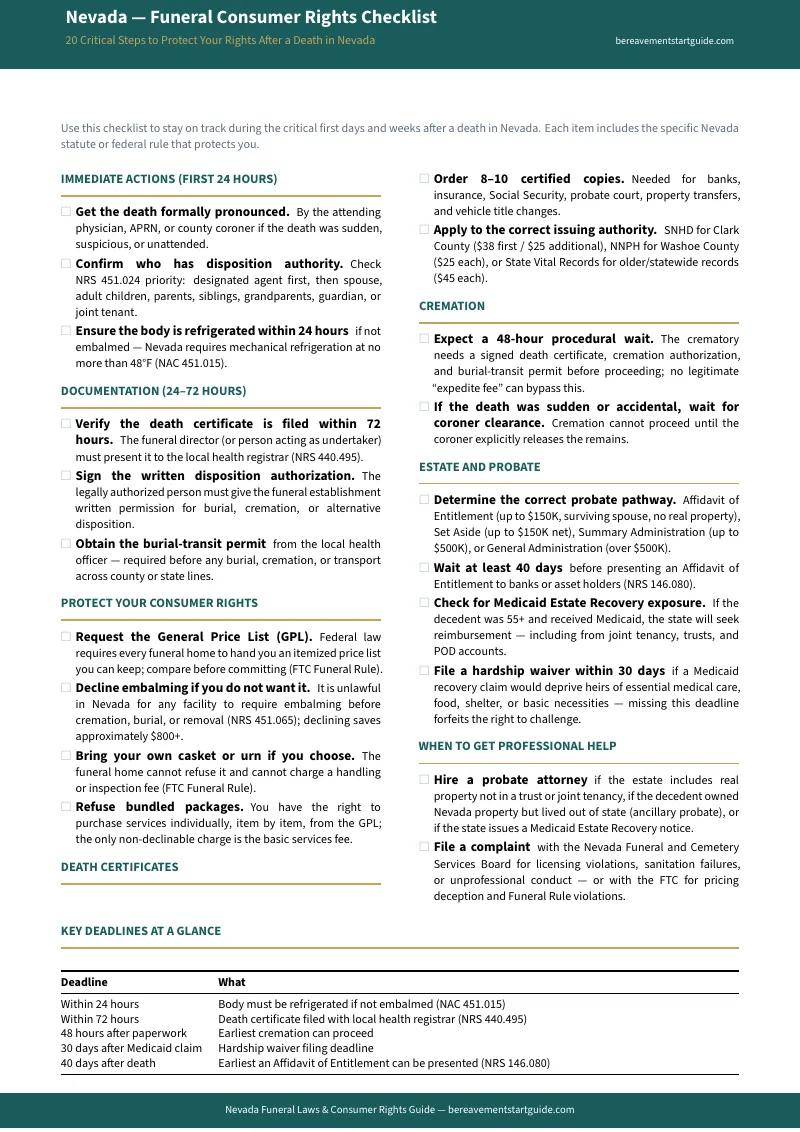
Not ready for the full guide? Download the free Nevada — Funeral Consumer Rights Checklist — an overview of your core legal protections, the critical deadlines, and the 20 essential actions to take after a death in Nevada. Enough to walk into a funeral home knowing your rights.
You did not train for this. But Nevada law gives you more power over funeral arrangements than the funeral home will ever volunteer. The guide puts those rights in your hands — one statute at a time.