The Bank Froze the Account. The Court Clerk Handed You a Stack of Forms and Said She Cannot Tell You What to Do with Them. You Have 40 Days to Figure Out Whether You Even Need to File.
You went to the bank with the death certificate and they told you the account is locked. The surviving spouse cannot withdraw grocery money. The mortgage is due in twelve days. You drove to the District Court and the clerk handed you a packet of forms and said — politely, firmly — that the court cannot provide legal advice. She cannot tell you which form to file, how to fill in the blanks, or whether you actually need to be in this courthouse at all. She told you to consult an attorney.
So now you are home with blank court forms, a frozen bank account, a will that means nothing until a judge validates it, and a set of questions nobody will answer for free. Maybe you will file a full probate petition for an estate that qualifies for a simple Affidavit of Entitlement — wasting $284.50 and months of your life in court. Maybe you will attempt the Affidavit of Entitlement because someone online said the limit is $25,000, not realizing that a surviving spouse qualifies up to $150,000 under the SB 404 changes that took effect in October 2025. Maybe you will skip creditor notification entirely and distribute the estate to the family, then discover — when Medicaid files for recovery of $47,000 in nursing home costs — that you are personally liable for the shortfall because you failed to notify the Nevada DHHS within the statutory window. Maybe you will pay a Las Vegas probate attorney $4,000 to $8,000 to handle a straightforward Set Aside that Nevada law specifically designed to let you handle yourself.
The Nevada Probate Process Guide is a Tier-by-Tier Filing Roadmap for every pathway, deadline, form, and decision in a Nevada probate case — from the initial determination of whether court is even necessary through final discharge and estate closing. Not a generic overview written for all 50 states. Not a blog post designed to convince you that probate is too complex to attempt without a retainer. A plain-English, Nevada-specific manual that tells you exactly what the court clerk cannot: which forms to file, in what order, which threshold applies to your estate, and which mistakes will cost you money or expose you to personal liability.
What's Inside the Tier-by-Tier Filing Roadmap
A 17-chapter guide, a filing-readiness checklist, and five standalone reference tools — 7 PDFs total — covering every phase of estate administration in Nevada from the first day through final discharge, built on the Nevada Revised Statutes (NRS), the SB 404 threshold changes effective October 2025, and the county-specific procedures that make Clark County and Washoe County different from each other and from every other state:
Before You File: Does the Estate Actually Need Probate?
This is the question that determines whether you spend six months in court or bypass the system entirely. Nevada provides multiple ways to avoid full probate. Assets titled in a living trust, joint tenancy, or with beneficiary designations transfer outside of probate completely. For personal property estates, the Affidavit of Entitlement (NRS 146.080) allows assets under $25,000 — or up to $150,000 for a surviving spouse — to transfer with a notarized affidavit after a 40-day waiting period. No court filing, no hearing, no appointment. But there is a hard disqualifier: if the decedent owned any real property in Nevada, the affidavit cannot be used, regardless of value. A $30,000 timeshare disqualifies the estate just as surely as a $500,000 house. The guide includes a decision flowchart that walks you through the exact criteria — so you do not file a full probate petition for an estate that qualifies for the shortcut, and you do not attempt the affidavit on an estate that does not qualify.
The Four-Tier System: Affidavit, Set Aside, Summary, and General
Nevada does not use "informal" or "formal" probate the way states that adopted the Uniform Probate Code do. Instead, it uses a tiered system based on estate value and asset type. The Affidavit of Entitlement handles personal property under $25,000 ($150,000 for spouses) without court involvement. The Set Aside Without Administration (NRS 146.070) handles estates under $150,000 — including real property — with a single court hearing and no formal creditor window. Summary Administration covers estates between $150,001 and $500,000 with a 60-day creditor claim period. General Administration handles estates over $500,000 with a 90-day creditor window. The guide covers all four tracks end to end, because the forms are different, the timelines are different, the notification requirements are different, and filing in the wrong tier wastes money and time.
Filing the Petition: What the Court Needs and What Triggers a Rejection
The filing packet varies by county and by probate tier. In Clark County, the Civil Law Self-Help Center provides downloadable form packets, but no instructions for connecting them — you get raw forms with no narrative explaining which documents to attach, what the court expects at the hearing, or what mistakes cause the petition to be denied or continued. In Washoe County, the forms and procedures differ. The guide maps the filing requirements for both major counties: which forms to download, what to attach (death certificate, will, proof of liens, property valuations), the filing fees ($284.50 for estates over $20,000, $185.50 for estates between $2,500 and $20,000, no fee for estates under $2,500), and the specific procedures that cause first-time filers to have their petitions rejected.
The Creditor Notification System: The Most Dangerous Phase for Executors
This is the chapter that protects you from personal liability. You must publish a Notice to Creditors three times in a local newspaper, with at least 10 days between the first and last publication. You must also mail notice directly to every known creditor. And you must notify the Nevada Department of Health and Human Services (DHHS) if the decedent received Medicaid benefits at age 55 or older or while in a nursing facility — because Nevada's Medicaid Estate Recovery Program can recover from the "undivided estate," including assets in trusts and joint tenancies. The creditor claim window is 60 days for Summary Administration and 90 days for General Administration. If you distribute assets before this window closes and a valid claim surfaces afterward, you are personally liable. The guide walks you through every notification requirement, every deadline, and the statutory priority order for paying claims.
Medicaid Estate Recovery: Protecting the Family Home
Nevada's Medicaid Estate Recovery Program is among the broadest in the country. It can pursue recovery from the decedent's entire "undivided estate" — not just assets that pass through probate, but also trust assets and jointly held property. Families are terrified that Medicaid will force the sale of the family home. The guide explains the absolute exemptions: recovery is prohibited while a surviving spouse is alive, while a minor child under 21 lives in the home, or while a blind or permanently disabled child of any age lives in the home. It covers the 30-day hardship waiver window and the specific documentation DHHS requires. And it explains the "dormant lien" that Medicaid places on real property — sitting quietly on the title until the exemption conditions no longer apply.
Community Property, Ancillary Probate, and the Nevada-Specific Complications
Nevada is a community property state. When one spouse dies, one-half of the community property vests automatically in the surviving spouse — but the other half is subject to the will and potential probate. Families frequently assume everything passes automatically, only to discover that a bank account titled solely in the decedent's name, or a property not held as community property with right of survivorship, requires a court order to transfer. The guide covers community property rules, joint tenancy, transfer-on-death deeds (NRS 111.109), and the specific requirements for ancillary probate — the separate Nevada court proceeding required when an out-of-state decedent owns real property in Nevada, such as a Las Vegas condo, a timeshare, or a rental property.
Costs, Compensation, Closing, and Tax Obligations
The guide includes complete fee schedules for Clark County (Eighth Judicial District) and Washoe County (Second Judicial District), executor compensation rules (statutory percentage: 4% on the first $15,000, 3% on the next $85,000, 2% on amounts above $100,000), attorney fee standards, and the Real Property Transfer Tax (RPTT) exemptions that prevent executors from paying unnecessary transfer taxes. It covers the closing process — filing the Final Accounting, obtaining court approval for distributions and compensation, collecting signed receipts from every beneficiary, and filing for the Final Discharge Order that releases you from fiduciary liability. Nevada has no state income tax and no state estate tax, but the guide walks you through the federal obligations: the decedent's final Form 1040, the estate's Form 1041 (if income exceeds $600), and the federal estate tax threshold.
Who This Guide Is For
- The executor who just received the will and does not know what to do with it — who needs to understand that a will is legally inert until validated by a district court judge, and that Nevada law requires you to deliver the original will to the court clerk within 30 days of learning of the death, even if you have not decided whether to open probate
- The surviving spouse whose bank account was frozen this morning — who may qualify for the Affidavit of Entitlement on estates up to $150,000 under the SB 404 amendments, or for a Set Aside petition that transfers the family home with a single court hearing, and who cannot afford to wait weeks because the filing was prepared incorrectly
- The out-of-state executor managing a Nevada timeshare or rental property — who just learned that their parent's California probate cannot transfer the Las Vegas condo, that Nevada requires a separate ancillary proceeding, and that the value of the Nevada property alone determines which probate tier applies
- The family with no will navigating intestate succession — who needs to understand that Nevada's intestate statute dictates exactly who inherits what, that a surviving spouse with children from a prior marriage receives only half the community property and a third of the separate property, and that an administrator must be appointed by the court
- The adult child trying to decide whether to hire an attorney or handle it themselves — who needs an honest framework: self-representation is realistic for Affidavit of Entitlement and Set Aside cases under $150,000, achievable for organized individuals handling Summary Administration, and strongly inadvisable for General Administration estates over $500,000 or any contested matter
- The family discovering that Medicaid is pursuing estate recovery — who needs to understand the absolute exemptions that prohibit recovery during the surviving spouse's lifetime, the 30-day hardship waiver window, and the dormant lien mechanism that attaches to the family home
Why Free Resources Will Not Get You Through This
Nevada probate information exists. The courts publish forms, county self-help centers maintain filing instructions for small estates, and dozens of law firms blog about the probate timeline. Here is what you actually encounter when you try to navigate probate using free sources:
- The Clark County Civil Law Self-Help Center provides form packets for small estates — and nothing for estates over $150,000. If you qualify for a Set Aside, the self-help center's 13-step guide walks you through the filing. If the estate exceeds $150,000 and requires Summary or General Administration, you are on your own. The self-help center does not provide guidance, form packets, or filing instructions for formal probate.
- District Court clerks cannot give you legal advice. They can confirm filing fees, verify that your packet is complete, and tell you the correct window. They cannot tell you which probate tier applies, how to answer specific questions on the petition, or whether the Affidavit of Entitlement works for your situation. If you ask, they will tell you to consult an attorney.
- The Nevada Supreme Court's self-help website provides individual forms — with no procedural sequence. The forms exist as isolated PDFs on selfhelp.nvcourts.gov. Understanding which form to file first, what to attach, what happens after the hearing, and how the forms connect chronologically is not provided anywhere on the state website.
- Attorney blog posts are accurate, detailed, and designed to sell you representation. Every probate firm in Las Vegas and Reno publishes content explaining how complex and dangerous the process is. For contested estates and General Administration, that is accurate. For the Set Aside case where the estate is under $150,000 and the heirs agree, those posts never quite tell you that the procedure was designed for exactly your situation. The post always ends with "schedule a consultation."
- National platforms miss Nevada-specific rules. They do not cover the SB 404 threshold changes, the four-tier system (which does not use UPC terminology), the 40-day Affidavit waiting period, the Clark County vs. Washoe County filing differences, the RPTT exemption for estate transfers, or the Medicaid Estate Recovery Program's power to pursue assets beyond probate. Nevada has its own probate code — "general probate advice" does not apply here.
Free resources give you isolated forms from the courts, refusals from the clerks, and fear from attorneys. The Tier-by-Tier Filing Roadmap puts every Nevada form, statute, deadline, and county procedure into one document, in the order you actually need them.
— Less Than Ten Minutes With a Nevada Probate Attorney
A consultation with a Nevada probate attorney runs $250 to $500 per hour. Full representation for a straightforward Set Aside or Summary Administration costs $3,000 to $8,000. Contested or General Administration cases run $8,000 to $20,000 or more. This guide costs less than ten minutes of professional legal time and gives you the complete Nevada-specific probate roadmap — every form in sequence, every statutory deadline, every county filing procedure, and the decision flowchart that tells you whether you need full probate at all.
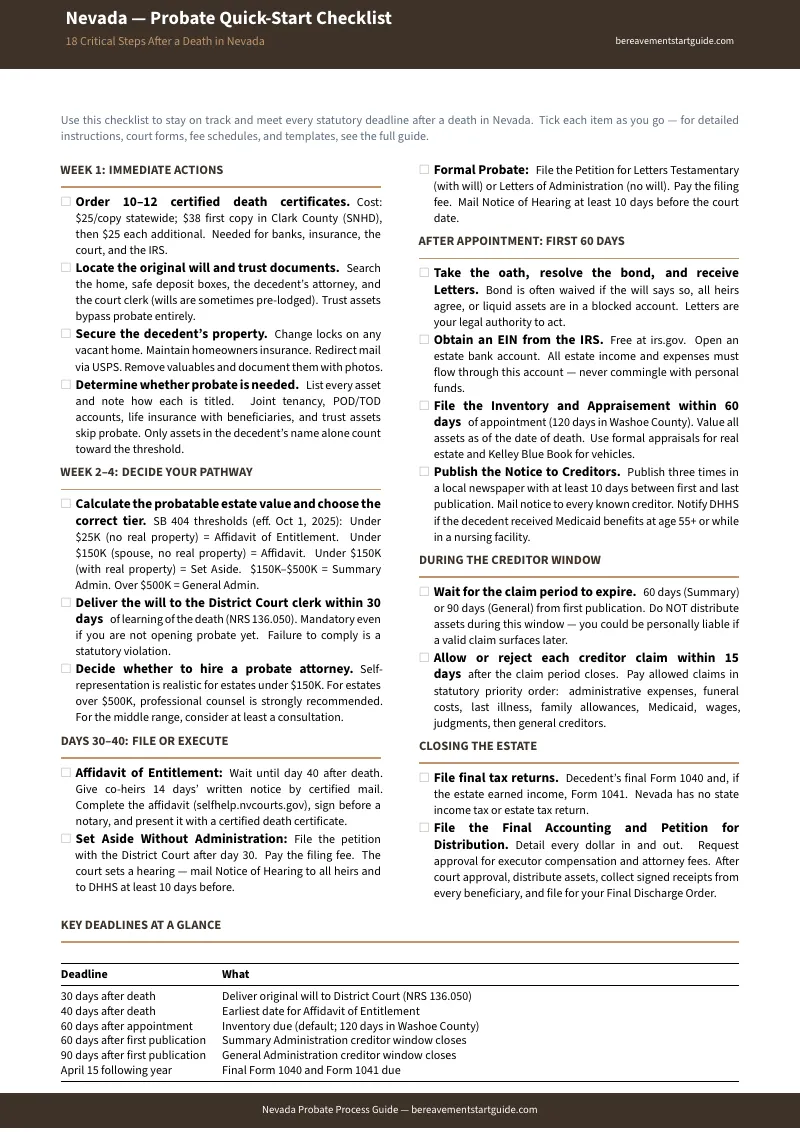
Your download includes 7 PDFs: the complete 17-chapter step-by-step guide covering all four probate tiers (Affidavit of Entitlement, Set Aside, Summary, and General Administration), testate and intestate succession, community property rules, and ancillary probate for out-of-state executors. Plus the standalone Nevada Probate Quick-Start Checklist with 18 essential steps, the Probate Tier Decision Flowchart, the Creditor Notification Reference, the Medicaid Estate Recovery Reference, the Fee Schedule and Cost Worksheet with Clark and Washoe County filing fees and executor compensation rates, and the Probate Timeline Reference with every statutory deadline on a pin-to-wall calendar. Instant download, no account required.
30-day money-back guarantee. If the guide does not give you clarity on what to file, when to file it, and what happens next — email us for a full refund. No questions asked.
Not ready for the full guide? Download the free Nevada — Probate Quick-Start Checklist — an overview of the probate process, the key deadlines, the SB 404 thresholds, and the 18 essential steps you need to complete. Enough to understand what you are facing and whether you need the full guide.
Probate is not something you were trained for. But Nevada's tiered system was designed to let capable people handle routine estates without a lawyer — particularly estates under $150,000. The guide gives you the instructions the court cannot — one form, one deadline, one filing at a time.