Your Spouse Died in Nevada. PERS Wants a Death Certificate Before Releasing Pension Options. The County Assessor Needs a Separate Application for the Property Tax Exemption. And You Just Learned That Missing the 60-Day PEBP Deadline Means Losing Your Health Insurance Permanently.
The funeral is over. You called PERS and they said the survivor benefit depends on which payout option your spouse selected years ago -- and you have no idea which one. You called the county assessor about keeping the property tax exemption and learned it does not transfer automatically: you have to apply with a certified death certificate and a Nevada ID, and each county handles it differently. You logged into the PEBP portal and discovered your health coverage terminates at the end of this month. You have 60 days to re-enroll or you lose state employee health insurance permanently. Nobody told you any of this.
Then comes the second discovery: Nevada survivor benefits are not one system. They are a dozen separate programs administered by agencies that do not communicate with each other. Social Security survivor benefits are federal, and the Government Pension Offset and Windfall Elimination Provision that used to strip hundreds of dollars a month from PERS families were repealed in January 2025 -- meaning you can now claim the full PERS pension and full Social Security, and if you were offset before, the SSA owes you a retroactive adjustment back to January 2024 that nobody will chase on your behalf. Workers' compensation death benefits pay 66.67% of the deceased's average monthly wage, but if there are minor children from a prior relationship, the benefit splits 50/50 between you and the children. The Victims of Crime Program covers up to $35,000 for families of homicide victims, but it is a payer of last resort and requires a separate application. Community property rules give you a double step-up in basis that could save you hundreds of thousands in capital gains taxes -- but only if the property is titled correctly. Every program has its own eligibility rules, its own deadlines, and its own forms. Miss one and the money disappears.
The Nevada Survivor Benefits Navigator is a Deadline Defense System that sequences every benefit, every form, and every filing window into a single chronological roadmap. Not legal advice. Not financial planning. A preparation tool that ensures you claim every dollar Nevada makes available to surviving families -- and that you do not accidentally forfeit benefits by missing the 30-day Medicaid hardship waiver, the 40-day affidavit waiting period, the 60-day PEBP window, or the one-year workers' compensation deadline. Built around the Nevada Revised Statutes, the post-SB 404 probate thresholds effective October 2025, and the county-by-county procedural variations that make filing in Clark County different from filing in Washoe County or rural Nevada.
What's Inside the Deadline Defense System
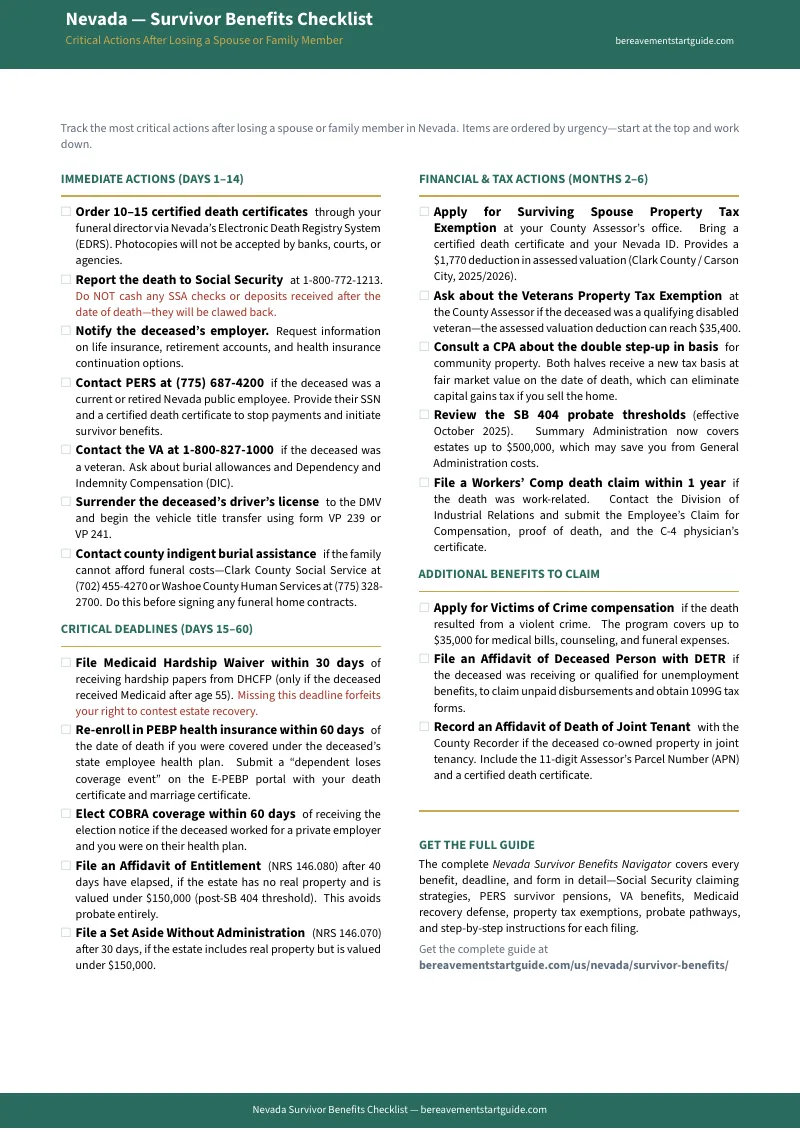
A comprehensive guide, printable checklist, and a Quick-Start Survivor Benefits Checklist -- covering every benefit, deadline, and filing procedure available to surviving families in Nevada, organized by urgency tier so you never miss a statutory window:
The First 48 Hours: Death Certificates, Notifications, and Triage
Everything starts with death certificates -- and Nevada makes ordering them more complicated than most states. Clark County (SNHD) charges $38 for the first copy and $25 for each additional. Washoe County charges a flat $25. Rural counties go through the Division of Public and Behavioral Health in Carson City. Order 10 to 15 certified copies through your funeral director immediately -- it is the fastest route and you will need them for every agency, bank, and government office. The guide covers exactly which agencies to notify first, what information each one requires, and the emergency burial assistance programs in Clark County and Washoe County for families who cannot afford funeral costs.
Community Property: The Money You Already Own
Nevada is a community property state. Everything acquired during the marriage is presumed to be owned 50/50. When one spouse dies, the surviving spouse already owns the entire community estate -- no probate required for the survivor's half. But the financial advantage goes further: if the property is titled as community property, both halves receive a double step-up in basis at the date of death. A home purchased for $200,000 that is now worth $500,000 gets a new tax basis of $500,000 for the entire property. Sell it for $500,000 and your capital gains tax is zero. The guide explains the critical difference between community property and joint tenancy titling, the separate property rules for assets acquired before marriage, and how commingled assets complicate the picture.
Probate Shortcuts: The SB 404 Thresholds That Changed Everything
Senate Bill 404, effective October 2025, dramatically raised the financial thresholds for avoiding formal probate. The Affidavit of Entitlement (NRS 146.080) now covers estates up to $150,000 in personal property. The Set Aside Without Administration covers estates with real property up to $150,000. Summary Administration now applies to estates up to $500,000 -- and since Nevada's median home price hovers between $400,000 and $500,000, thousands of estates that would have required expensive General Administration now qualify for the faster, cheaper pathway. The guide walks through each threshold, the waiting periods, and the exact forms for Clark County and Washoe County. Most law firm blogs still cite the pre-October 2025 limits. This guide does not.
Health Insurance: The 60-Day Window That Cannot Be Extended
If your spouse was a Nevada state employee and you were covered under PEBP, your health insurance terminates at the end of the month of death. You have exactly 60 days from the date of death to submit a qualifying life event re-enrollment through the E-PEBP portal. This deadline is absolute -- PEBP does not grant extensions. For spouses covered through private employers, the COBRA election window is also 60 days from receiving the election notice. The guide covers both pathways, the documentation required, and how to bridge coverage if you are transitioning to Medicare.
PERS Survivor Benefits: What Your Spouse's Election Means for Your Income
If the deceased was a current or retired Nevada public employee, the Public Employees' Retirement System provides ongoing monthly survivor benefits -- but the amount depends entirely on which payout option the member selected at retirement. The Unmodified Allowance, Option 2, and Option 3 each provide different survivor percentages. Qualification requires two years of service in the final two-and-a-half years, or ten years of total accredited service. The guide explains each option, the application process, and the 60-day PEBP re-enrollment that must happen in parallel.
Workers' Compensation Death Benefits: The Math and the Deadlines
If the death was work-related -- in Nevada's construction, mining, casino, or hospitality industries -- surviving dependents are entitled to workers' compensation death benefits. A surviving spouse receives 66.67% of the deceased's average monthly wage. If the worker had minor children from a prior relationship, the benefit splits: 50% to the spouse, 50% divided among the children. Benefits include a $10,000 burial expense payment, annual 2.3% cost-of-living adjustments, and continued payments until the spouse remarries or until dependent children reach age 18 (or 22 if enrolled full-time in school). The absolute filing deadline is one year from the date of death. The guide provides the form sequence, the C-4 physician's certificate requirement, and the calculation method.
Defending Against Medicaid Estate Recovery
If the deceased received Medicaid-funded care after age 55, the Nevada Medicaid Estate Recovery Program can seek reimbursement from the estate. Families hear "the state will take the house" and panic. The reality: Medicaid cannot recover during the lifetime of a surviving spouse, or while there is a surviving child under 21 or a blind or disabled child of any age. Nevada also provides a hardship waiver if recovery would deprive heirs of food, shelter, or basic necessities -- but you have exactly 30 days from the date the hardship papers are mailed to submit the waiver. The guide walks through the protections, the waiver process, and the timeline.
Property Tax Exemptions and Financial Relief
The surviving spouse assessed valuation deduction provides up to $1,770 in assessed value relief, but it does not apply automatically. You must physically apply at your county assessor's office with a certified death certificate and a valid Nevada ID. If the deceased was a qualifying disabled veteran, the Veterans Property Tax Exemption provides up to $35,400 in assessed valuation deduction -- substantial annual savings. The guide covers both exemptions, the county-specific application procedures, and the documentation requirements for Clark County, Washoe County, and rural counties.
Additional Benefits Most Families Never Claim
The Nevada Victims of Crime Program (VOCP) covers up to $35,000 for medical bills, crime scene cleanup, counseling, and funeral expenses for families of violent crime victims. The Department of Employment, Training and Rehabilitation (DETR) allows survivors to claim unpaid unemployment disbursements through an affidavit process. The real property transfer tax exemption eliminates the $1.30 per $500 transfer tax when property passes due to death. Life insurance payouts bypass probate entirely and do not count toward the small estate thresholds. The guide covers every ancillary benefit Nevada provides and the process for claiming each one.
Who This Guide Is For
- The surviving spouse trying to keep health insurance -- who needs to know about the 60-day PEBP re-enrollment deadline, the COBRA election window, and how to bridge coverage without a gap that could leave medical bills uncovered
- The widow or widower navigating PERS survivor pensions -- who needs to understand how the deceased's retirement option selection affects their monthly income, what service credit requirements must be met, and why the repeal of the Government Pension Offset now lets them stack a full PERS pension on top of full Social Security
- The out-of-state adult child managing a parent's Nevada estate -- who needs every Nevada-specific form, deadline, and agency contact in one document instead of spending hours calling Clark County offices from California or Arizona
- The family of a worker killed on the job -- who needs to file the workers' compensation death claim within one year, understand the benefit calculation, and navigate the complex split when there are minor children from a prior relationship
- The surviving spouse terrified of Medicaid estate recovery -- who needs the actual statutory protections, the 30-day hardship waiver deadline, and the exemptions that prevent the state from forcing a home sale
- The family who just learned about the SB 404 changes -- who read conflicting information about Nevada probate thresholds online and needs the current, post-October 2025 limits to determine whether formal probate is even required
Why Free Resources Will Not Get You Through This
The information exists. It is scattered across PERS bulletins, PEBP enrollment portals, county assessor websites, the DMV, the Division of Industrial Relations, and dozens of NRS statute pages. Here is what you encounter when you try to navigate Nevada survivor benefits using free sources alone:
- State agencies are completely siloed. PERS will tell you about pension options but not about PEBP re-enrollment. The county assessor handles property tax exemptions but knows nothing about workers' compensation. DHCFP administers Medicaid recovery but will not explain how the hardship waiver interacts with the probate timeline. You are the only person connecting these programs, and nobody hands you a timeline that sequences them all.
- Nevada law firm blogs are designed to generate retainers. Firms like Jeffrey Burr and Vander Laan Law publish checklists that accurately describe the complexity of survivor benefits -- then end every page with a consultation booking form. Their content highlights confusion to drive phone calls, not to resolve it.
- Funeral home checklists are generic national templates. They remind you to "call Social Security" and "cancel credit cards." They say nothing about SB 404 probate limits, the PEBP 60-day window, the Medicaid hardship waiver, or the double step-up in community property basis. These are the benefits worth the most money, and generic checklists miss all of them.
- National legal sites cite outdated Nevada thresholds. Most still reference the pre-October 2025 probate limits. Following those numbers could lead you to file for expensive General Administration when your estate qualifies for Summary Administration under the new $500,000 threshold.
Free resources give you fragments from a dozen agencies that do not talk to each other. The Deadline Defense System puts every Nevada-specific benefit, deadline, form, and procedure into one document, in the order you actually need them -- with the post-SB 404 thresholds, the county-specific filing procedures, and the cascading deadline calendar that tells you exactly what to file and when.
-- Less Than Fifteen Minutes With a Nevada Estate Attorney
A single consultation with a Nevada probate or estate attorney costs $250 to $450 per hour. A CPA session to discuss the community property step-up runs $200 to $350. National estate software charges $100 to $200 per year in recurring subscriptions -- and none of it covers PEBP re-enrollment, PERS survivor options, or county-specific property tax exemptions. This guide costs less than fifteen minutes of professional time and gives you the complete Nevada-specific roadmap -- every benefit, every deadline, every threshold, and the chronological system that tells you which claims to file first and which can wait.
Your download includes the complete guide plus five standalone printable tools: the Quick-Start Survivor Benefits Checklist (every critical step ordered by urgency tier), the Statutory Deadline Calendar (pin-to-the-wall timeline with every filing window), the Agency and Forms Directory (every phone number, form, and website on one page), the Survivor Benefits Tracker (fillable worksheet for logging applications and documents), and the Probate Decision Flowchart (answer three questions, know your probate pathway). Instant download, no account required.
30-day money-back guarantee. If the guide does not give you clarity on which benefits you qualify for, confidence in meeting every statutory deadline, and a clear path to claiming every dollar Nevada makes available to surviving families, email us for a full refund. No questions asked.
Not ready for the full guide? Download the free Nevada Survivor Benefits Quick-Start Checklist -- a printable action list covering the most critical deadlines, notifications, and benefit claims for the first six months. Enough to make sure you do not miss the windows that matter most.
You did not choose this. But the benefits exist, the deadlines are real, and the process for claiming them is something you can navigate. The guide puts every program, every form, and every deadline in one place so you can focus on your family instead of chasing paperwork across a dozen state agencies.