
The Probate Court Requires Electronic Filing Through TurboCourt but Nobody Explains How to Register. The Bank Froze the Account Because Your Name Is Not on the Letters of Appointment. DHHS Sent a Medicaid Estate Recovery Notice but the Homestead Exemption Should Protect the House. The Will Must Be Filed Within 30 Days but the Circuit Court Probate Division Is in a Different County Than the Town Clerk Who Issues Death Certificates. And the "Small Estate Affidavit" Every Website Mentions Was Repealed in 2005.
Your mother died in Hillsborough County on a Tuesday. By Thursday you had a hospital bill, a credit card statement addressed to her, and a funeral director asking how many certified death certificates you want at $15 for the first copy and $10 for each additional. You said four. You will need eight. Every bank, every insurance company, every government office requires an original certified copy, and the NH Division of Vital Records takes weeks to process reorders through the mail.
You went to the town clerk for the death certificates. Then you called the Circuit Court Probate Division to ask about settling the estate. They explained that all self-represented filers must use the Electronic Filing System through TurboCourt --- but the website does not explain how to navigate it if you have never used a court filing system. You searched for "small estate affidavit New Hampshire" and found dozens of websites describing the process. There is no such process. New Hampshire repealed its Small Estate Administration law (RSA 553:33) in 2005. What exists instead is a Waiver of Administration under RSA 553:32 --- a different procedure with different eligibility requirements that most national legal guides do not mention at all.
The NH Probate Navigator is an Estate Settlement Sequence built entirely around the New Hampshire Revised Statutes and the procedures of the Circuit Court Probate Division --- mapping every form, deadline, statutory threshold, court filing, and agency requirement into one chronological sequence. It diagnoses whether your estate qualifies for a Waiver of Administration (bypassing the grueling inventory and accounting phases), whether informal administration through the Probate Division is sufficient, or whether full formal administration is unavoidable. It walks you through the mandatory TurboCourt e-filing system step by step so no deadline expires because nobody told you it existed.
What's Inside the Estate Settlement Sequence
A comprehensive guide with appendices, a printable action checklist, and standalone reference sheets --- covering every probate shortcut, asset transfer, creditor defense, and agency procedure available under New Hampshire law:
Chapters 1-2: Understanding New Hampshire and the First 48 Hours
What makes New Hampshire different from every other state: the mandatory Electronic Filing System (TurboCourt) for all self-represented filers, the jurisdictional fragmentation between town clerks (death certificates), county probate courts (estate administration), and county registries of deeds (real property), the aggressive DHHS Estate Recovery Unit, the 2005 repeal of the small estate affidavit, and the brand-new Transfer on Death Deed law (RSA 563-D, effective July 1, 2024). Day-by-day triage for the first 48 hours: ordering certified death certificates from the town clerk where the death occurred ($15 first copy, $10 each additional), securing the residence and assets, locating the will, confirming Social Security notification, and understanding the strict 30-day deadline to file the will with the Probate Division. What NOT to do --- do not pay any of the deceased's debts from your personal funds, do not distribute assets, and do not close accounts before the estate is properly opened.
Chapter 3: The 30-Day Will Filing Deadline
New Hampshire law requires that the original will, any codicils, and the death certificate be filed with the Estate E-Filing Center within 30 days of the date of death --- even if there are no assets and even if you intend to seek a Waiver of Administration. This chapter walks you through registering for the TurboCourt Electronic Filing System, preparing the Petition for Estate Administration (Form NHJB-2145-Pe), and filing your documents before the clock runs out. Every productive action you can take during those first 30 days while the estate administration is pending: sorting assets into probate vs. non-probate categories, contacting life insurance companies, filing Social Security survivor benefits, and beginning the process of identifying creditors.
Chapter 4: The Waiver of Administration
The diagnostic that tells you whether you can bypass the most expensive and time-consuming parts of probate. Since New Hampshire repealed its Small Estate Administration law in 2005, the Waiver of Administration under RSA 553:32 is the only shortcut available. If the estate can pay all its debts and the administrator is the sole heir --- or all heirs assent in writing --- you can waive the formal inventory and accounting phases entirely. How to determine eligibility. How to prepare and file the waiver. The six-month minimum waiting period before the waiver statement can be filed. The court filing fees: $150 for estates under $10,000, scaling up to $305 for estates over $25,000. When the waiver works and when it does not.
Chapter 5: Formal Probate Administration
When the Waiver of Administration does not apply --- multiple heirs who disagree, insolvent estates, contested wills, or complex creditor situations --- the full Circuit Court Probate Division process from start to finish. Filing the Petition for Estate Administration through TurboCourt. Letters of Appointment (the court document that gives you legal authority to act). Surety bonds under RSA 553:13 and when the court waives them. The 90-day inventory deadline. The 12-month accounting deadline. The difference between testate (with a will) and intestate (without a will) administration. Intestate succession rules under RSA 561 --- who inherits what when there is no will.
Chapter 6: Non-Probate Transfers
Step-by-step instructions for every asset type that bypasses court entirely: joint tenancy with right of survivorship, Payable on Death (POD) bank accounts under RSA 383-B:4-404, Transfer on Death (TOD) brokerage and investment accounts, the powerful surviving spouse vehicle exemption under RSA 261:17 (a vehicle used for family purposes transfers to the surviving spouse without probate), the brand-new Transfer on Death Deed for real estate under RSA 563-D (effective July 1, 2024), life insurance policies with named beneficiaries, and retirement accounts (IRAs, 401(k)s, pensions) with designated beneficiaries. The life insurance interest rule under RSA 408:11 --- insurers must pay interest from the date of death, and if payment is delayed more than 31 days after proof of death, a 10% annual interest penalty applies.
Chapter 7: Real Property Transfers
New Hampshire real estate after a death: when it passes outside probate and when it does not. The new Uniform Real Property Transfer on Death Act (RSA 563-D, effective July 1, 2024) --- how a properly executed Transfer on Death Deed allows real property to pass directly to beneficiaries without court involvement. Joint tenancy with right of survivorship. Recording requirements at the county Registry of Deeds. The surviving spouse's homestead rights under RSA 480:1. The critical two-year creditor window under RSA 556:29 for real estate when no probate administration is opened. Property located in multiple New Hampshire counties and the recording requirements for each. Living trusts, pour-over wills, and the Certification of Trust procedure.
Chapter 8: Creditors and the Six-Month Claim Period
The biggest fear for administrators, answered directly: New Hampshire heirs are not personally responsible for the deceased's debts unless they co-signed. The six-month waiting period for creditors to submit formal claims against the estate under RSA 556:1. The mandatory Priority of Charges under RSA 554:19 --- the exact order of payment: administration costs first, funeral and burial expenses second, federal taxes third, state Medicaid claims fourth, and general unsecured debts last. How to publish the required creditor notice. How to respond to aggressive collection calls during the waiting period. Which debts die with the person.
Chapter 9: Medicaid Estate Recovery
How the New Hampshire DHHS Estate Recovery Unit (ERU) operates --- and the specific statutory exemptions that protect the family home. The ERU pursues reimbursement for Old Age Assistance (OAA), Aid to the Permanently and Totally Disabled (APTD), and Medicaid for Employed Adults with Disabilities (MEAD). The exemptions: the state cannot recover against the home if a surviving spouse, a child under 21, or a blind or disabled child of any age resides there. The expanded Medicaid recovery provisions that many families do not anticipate. The step-by-step response protocol for DHHS recovery notices --- including why funeral and burial expenses must be paid first under the RSA 554:19 priority schedule. The difference between a creditor claim and a property lien. Hardship waiver procedures.
Chapter 10: Spousal Protections
New Hampshire's survivor protections that most families never learn about: the surviving spouse's right to waive the provisions of the will and claim their statutory share and homestead rights under RSA 560:10. The homestead right under RSA 480:1. Intestate succession protections under RSA 561 when there is no will. The vehicle transfer exemption under RSA 261:17. Why these protections matter when the estate has significant debts or when the will disinherits or undercuts the surviving spouse.
Chapter 11: The TurboCourt E-Filing System
A dedicated walkthrough of the mandatory Electronic Filing System that every self-represented filer must use. How to create a TurboCourt account. How to navigate the filing interface. How to upload supporting documents. How to file the Petition for Estate Administration (NHJB-2145-Pe), the inventory, the accounting, and the Waiver of Administration. Common filing errors and how to avoid them. What happens after you file --- court processing timelines and how to check the status of your filing. How out-of-state executors can manage filings remotely without traveling to New Hampshire.
Chapter 12: Out-of-State Executor Requirements
New Hampshire imposes specific requirements on non-resident administrators. Under RSA 553:25, a resident of another state appointed as administrator must immediately appoint a New Hampshire resident agent to receive notices of claims and service of process. How to select and formally appoint the resident agent. How to manage the estate remotely using TurboCourt e-filing. When physical presence at the courthouse is required and when it is not. Coordinating with local New Hampshire attorneys for limited-scope representation when full remote administration is not possible.
Chapter 13: Closing the Estate and When to Call a Professional
Filing the final accounting with the Probate Division after all creditors are paid and assets are distributed. The closing procedures for both formal administration and Waiver of Administration estates. When to hire a New Hampshire probate attorney vs. when the guide handles everything: contested wills, insolvent estates, multi-state property, Medicaid recovery disputes, complex trust administration, and litigation. How to evaluate attorney fee structures ($250-$500 per hour, or 2-4% of gross estate value) and when a CPA is more useful than a lawyer for filing the final income tax returns.
Appendices: Forms Reference, Key Deadlines, and Key Costs
A complete reference table of every New Hampshire form mentioned in the guide organized by agency: Circuit Court Probate Division forms (NHJB-2145-Pe, NHJB-2117-Pe, Waiver of Administration), Division of Vital Records forms, DMV forms (TDMV 23 for vehicle transfer, TDMV 18 for duplicate title), and Registry of Deeds recording forms. Every statutory deadline: 30-day will filing, 90-day inventory, 6-month creditor claim period, 12-month accounting. Every fee: $15/$10 death certificates, $150-$305 court filing fees, $15 duplicate title fee, real estate recording fees.
Who This Guide Is For
- The surviving spouse managing an estate in New Hampshire who needs to know whether the estate qualifies for a Waiver of Administration or whether formal probate through the Circuit Court Probate Division is required --- and wants to answer that question before paying $250-$500 per hour for a probate attorney to sort through it.
- The adult child named as administrator who accepted the role because the will named them, but has never filed through TurboCourt, never published a creditor notice, and does not know the difference between a Waiver of Administration and full formal administration --- or that New Hampshire repealed its small estate affidavit twenty years ago.
- The out-of-state executor who discovered they were named in the will and now needs to settle a New Hampshire estate from another state --- including appointing a resident agent under RSA 553:25 and navigating the e-filing system remotely without flying to Concord or Manchester for every court appearance.
- Families facing DHHS Medicaid estate recovery who received a recovery notice and do not know which statutory exemptions protect the family home --- or that funeral expenses must be paid before Medicaid recovery claims under the RSA 554:19 priority schedule.
- The low-income or small estate family trying to transfer a vehicle, close a bank account, and settle a modest estate without spending thousands on legal fees --- who need to understand the Waiver of Administration, POD account procedures, and the surviving spouse vehicle exemption before assuming formal probate is the only option.
Why Free Government Forms Do Not Replace a Sequenced Filing Guide
Every form referenced in this guide is available for free from a New Hampshire government office or website. The Petition for Estate Administration is on the Judicial Branch website. The Division of Vital Records provides death certificate applications. The TurboCourt system is free to register. Here is why the forms alone are not enough:
- The court provides the forms but not the instruction manual. The New Hampshire Circuit Court Probate Division publishes pamphlets like "Administering an Estate" --- 20-page booklets written in dense legal phrasing by lawyers, for lawyers. They do not tell you in what order to file, what to gather before you start, or which forms apply to your specific situation. They hand you the raw paperwork without sequencing, without context, and without any acknowledgment that you are doing this while grieving.
- National legal websites still reference a small estate affidavit that does not exist. New Hampshire repealed its Small Estate Administration law (RSA 553:33) in 2005. What exists instead is a Waiver of Administration under RSA 553:32 --- a different procedure, with different eligibility rules, and a six-month minimum waiting period. Most national form vendors, free guides, and even some attorney websites still describe a "small estate affidavit" process for New Hampshire. Families read this outdated information, show up at court expecting a simple affidavit, and discover they have been following instructions for a law that has not existed for over twenty years.
- The TurboCourt e-filing system is mandatory but not self-explanatory. New Hampshire requires all self-represented filers to submit estate filings electronically through TurboCourt. The system exists. The court explains that you must use it. But no free resource walks you through the registration process, the filing interface, the document upload requirements, or the common errors that cause rejections. You are left to figure it out on your own, under a 30-day deadline, while managing everything else a death demands.
- Law firm websites explain the problem. They withhold the solution. New Hampshire probate attorneys publish detailed articles about estate settlement complexity. The content is accurate. It is also deliberately incomplete --- designed to convince you that the process is too dangerous to attempt alone and to trigger a consultation call at $250-$500 per hour. The question is not "how complicated is this?" but "does my estate actually require an attorney?" The answer, for many New Hampshire estates that qualify for a Waiver of Administration, is no.
- Filing out of sequence triggers delays that compound. Submitting documents to the Probate Division before registering for TurboCourt means starting over. Presenting a vehicle title transfer at the town clerk without the correct supporting documents means another trip. Distributing assets before the six-month creditor claim period closes creates personal liability. Paying low-priority debts before funeral expenses violates the statutory priority order. The forms exist. The sequence is what turns them into assets in your name.
Free resources give you one agency at a time, with no sequencing, no cross-referencing, and no way to know what you are missing. The Estate Settlement Sequence maps every asset, every form, and every deadline into one chronological guide --- so you claim everything, avoid every common rejection, and determine whether you actually need an attorney before spending a dollar on one.
--- Less Than Twenty Minutes of a Probate Attorney's Time
New Hampshire families lose weeks and thousands of dollars every year --- not because the estate was complicated, but because nobody told them about the shortcuts the law provides. An estate that qualifies for a Waiver of Administration opens formal probate instead because a national website described a "small estate affidavit" that was repealed in 2005. A surviving spouse never learns that the family vehicle transfers without probate under RSA 261:17. A family pays credit card debt out of pocket before the six-month creditor window closes, losing their statutory protection. An insurer delays a life insurance payout for 45 days and nobody tells the family that RSA 408:11 entitles them to 10% annual interest on the delay. A family home that should be protected from Medicaid recovery goes undefended because nobody explained the surviving spouse exemption. This guide costs less than any of those mistakes.
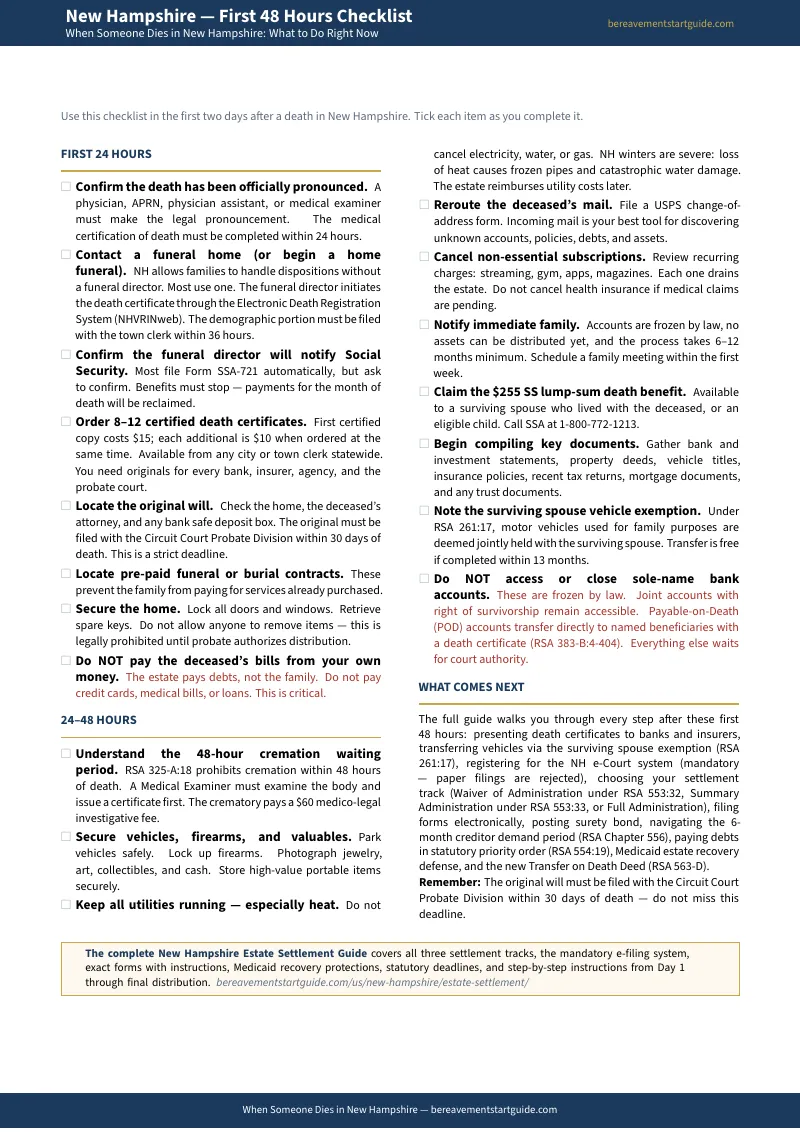
Your download includes the complete guide with appendices, the New Hampshire --- First 48 Hours Checklist, and standalone printable reference sheets --- the Asset Classification Worksheet, Waiver of Administration Diagnostic, Statutory Deadline Calendar, Forms Directory, Vehicle Transfer Decision Tree, and the Creditor Priority Reference Card --- covering every time-sensitive step from securing the estate on day one through the critical 30-day will filing deadline, the six-month creditor claim window, and the 12-month accounting deadline.
30-day money-back guarantee. If the guide does not give you a clear map of every probate shortcut available for your New Hampshire estate, every form you need to file, and every deadline you need to meet --- email us for a full refund. No questions asked.
Not ready for the full guide? Download the free New Hampshire --- First 48 Hours Checklist --- a summary of the most time-sensitive actions, forms, and thresholds that most families do not discover until it is too late. Enough to start the right sequence on day one.
You did not plan for this. But you can plan what happens next. The guide gives you the forms, the deadlines, the statutory shortcuts, and the filing sequence --- so the next six months are spent settling the estate correctly, not discovering what you missed.