New Hampshire Has No Estate Tax. No Inheritance Tax. The Interest and Dividends Tax Was Repealed. And the IRS Still Wants a Final Return, the Probate Court Still Requires a Federal Tax Clearance Before You Can Close the Estate, and Medicaid Is Already Assessing Whether It Can File a Lien on the Family Home.
Someone has died, and everyone keeps telling you New Hampshire is a "tax-friendly state." You heard this at the funeral. You read it on three different websites. Your uncle mentioned it over the phone from Massachusetts. And all of them are technically correct --- New Hampshire has no state estate tax, no inheritance tax, and the Interest and Dividends Tax was fully repealed for tax periods beginning after December 31, 2024. But you are the executor, and none of that eliminated the stack of tax obligations sitting on your kitchen table.
The IRS requires a final individual income tax return (Form 1040) for the deceased, covering all income through the date of death. If the estate generated more than $600 in income while sitting in probate --- rent from the house, dividends from a brokerage account, interest from a savings account --- you owe a separate federal fiduciary income tax return (Form 1041). If the estate has gross business income exceeding $109,000 from activity in New Hampshire, the state wants its own Form NH-1041 for the Business Profits Tax. The house that everyone assumed was "tax-free to inherit" triggers the Real Estate Transfer Tax at $0.75 per $100 of the sale price the moment you sell it to a third party --- and the RSA 78-B:2 exemption that covered the transfer from the deceased to you does not cover the subsequent sale. Meanwhile, the DHHS Estate Recovery Unit is checking whether the deceased received Medicaid, because New Hampshire's definition of recoverable "estate" reaches into revocable living trusts, joint tenancies, and life estates.
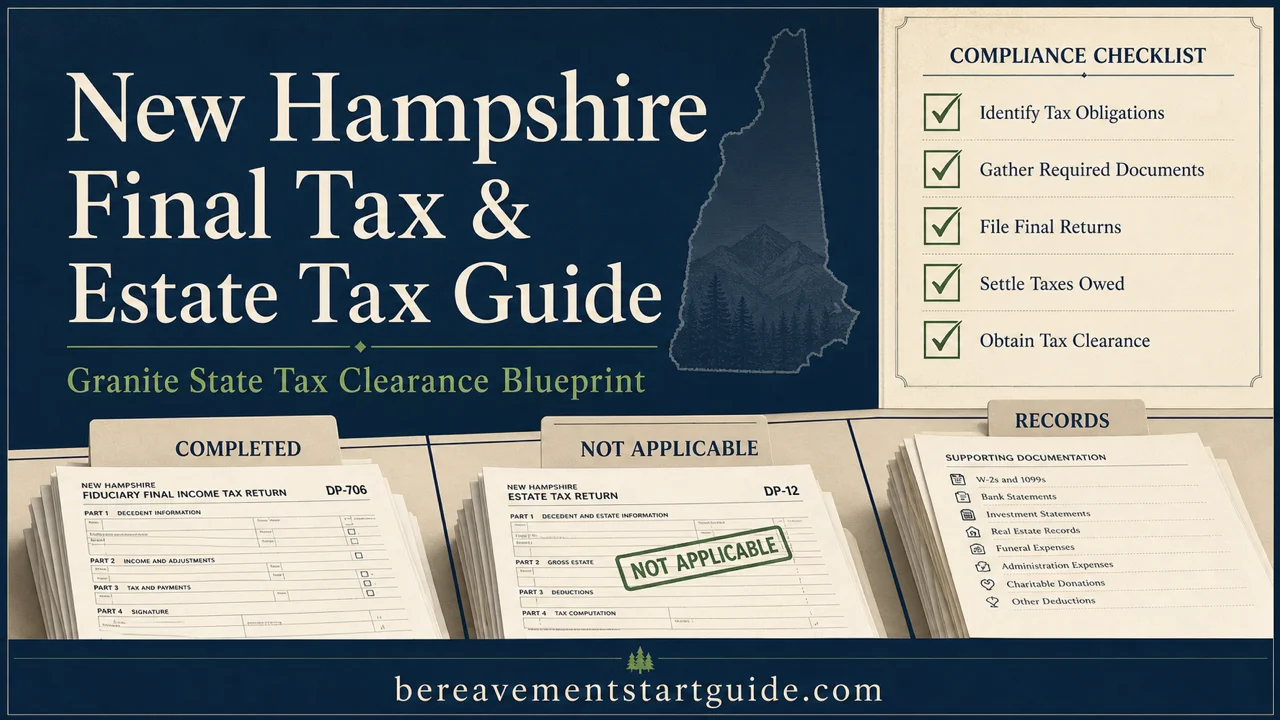
The New Hampshire Final Tax and Estate Tax Guide is a Granite State Tax Clearance Blueprint --- a plain-English, step-by-step reference that maps every federal and state tax obligation that applies when someone dies in New Hampshire. Not a generic article about estate taxes written for all fifty states. Not a blog post that tells you New Hampshire is tax-friendly and stops there. Not a $300-per-hour conversation with an attorney to learn what forms need to be filed. A New Hampshire-specific procedural guide built from current IRS requirements, NH Department of Revenue Administration rules, RSA statutes, and probate court filing standards --- telling you exactly which taxes apply, which forms to file, which deadlines will penalize you if you miss them, and which obligations you can safely ignore because the state actually did eliminate them.
What's Inside the Granite State Tax Clearance Blueprint
A comprehensive guide with checklists, form references, and a printable tax obligations tracker --- covering every tax that touches a New Hampshire estate from the date of death through final distribution:
The Final Income Tax Return (Form 1040)
The deceased's last individual tax return, covering all income from January 1 through the date of death. The guide explains who is legally required to file it, the April 15 deadline, when a surviving spouse can file jointly for a higher standard deduction, how to handle income received after death but earned before it, and the specific IRS rules for reporting income in respect of a decedent (IRD). If the deceased had a refund coming, you need to file Form 1310 --- the guide explains when it is required and when the surviving spouse can skip it.
The Federal Fiduciary Income Tax Return (Form 1041)
If the estate earns more than $600 in gross income during probate, the IRS requires a separate return for the estate itself. The guide walks you through determining whether your estate crosses this threshold, how to obtain an EIN from the IRS (free, instant, and required before you can open an estate bank account), the difference between calendar-year and fiscal-year elections, how income flows through to beneficiaries on Schedule K-1, and the critical interaction between the mandatory 6-month creditor waiting period in New Hampshire probate and the near-certainty that dividend-yielding assets will trigger this filing requirement.
The New Hampshire Business Profits Tax (Form NH-1041)
Most New Hampshire estates will never file this form --- but the guide explains exactly when you must. If the estate or trust conducts business activity within New Hampshire and generates gross business income from all sources exceeding $109,000, the state's Business Profits Tax applies. The guide covers the filing threshold, the interaction with the now-repealed Interest and Dividends Tax, and the specific circumstances (rental properties operated as a business, active farm income, closely held business interests) that push an otherwise simple estate into NH-1041 territory.
The Federal Estate Tax (Form 706)
New Hampshire has no state estate tax. But the federal estate tax still applies if the gross estate exceeds the 2026 exemption threshold of approximately $15 million per individual. The guide explains how to calculate gross estate value (it includes life insurance, retirement accounts, and jointly held property --- not just probate assets), the 9-month filing deadline, and the strategic reason to file a "portability" Form 706 even when the estate falls well below the threshold. When the first spouse dies, filing this form preserves the deceased spousal unused exclusion (DSUE), allowing the surviving spouse to shelter up to $30 million in combined lifetime exemptions. Skipping the portability election can cost a family millions in future taxes.
The Step-Up in Basis
The single most valuable tax provision for beneficiaries inheriting appreciated assets. When someone dies, the tax basis of their property resets to fair market value on the date of death. The guide explains exactly what this means using New Hampshire real estate: if a house was purchased for $120,000 thirty years ago and is worth $480,000 on the date of death, the $360,000 gain is erased. An immediate sale triggers zero federal capital gains tax on that appreciation. The guide covers how to establish fair market value (appraisals, IRS acceptable methods), the alternate valuation date election for large estates, and why you should never sell inherited assets without first confirming the stepped-up basis.
The Real Estate Transfer Tax (RETT)
This is where New Hampshire's "tax-friendly" reputation misleads executors. The state charges $0.75 per $100 of the sale price on both buyer and seller --- $1.50 per $100 total --- for every real estate transaction. The guide maps the critical exemption structure under RSA 78-B:2: transfers by will or intestate succession are exempt, but the subsequent sale of that inherited property to a third party on the open market is fully taxable. On a $400,000 home, the seller's share alone is $3,000. The guide explains who pays, when payment is due, the specific forms required by the county Registry of Deeds, and the exemptions that apply to transfers between spouses, between a trust and its beneficiaries, and in divorce settlements.
The Interest and Dividends Tax --- What You Still Need to Know
New Hampshire fully repealed the I&D Tax for taxable periods beginning after December 31, 2024. For estates settled in 2025 and 2026, this means no state-level tax on interest or dividend income generated by the estate. But if the deceased died in 2024 or earlier and had unfiled returns, or if the estate generated interest and dividend income during a tax period that began before the repeal took effect, a final Form DP-10 may still be required. The guide explains the phase-out timeline (5% for 2023, 4% for 2024, 0% for 2025 onward), the $2,400 filing threshold, and exactly when you can ignore the I&D Tax entirely versus when you must file one last return.
Medicaid Estate Recovery and Tax Clearance
Before you can close an estate in New Hampshire, the probate court requires federal estate tax clearance (Form NHJB-2144-Pe). If the deceased received Medicaid, the DHHS Estate Recovery Unit may file a claim against the estate --- and New Hampshire law defines "estate" broadly enough to reach revocable trusts, joint tenancies, and life estates. The guide explains the intersection of tax clearance requirements and Medicaid recovery, the protections that prevent liens when a surviving spouse occupies the home, and the hardship waiver process (BFA Form 785).
Tax ID, Estate Bank Accounts, and the Administrative Foundation
The deceased's Social Security Number cannot be used for estate transactions. You need an Employer Identification Number (EIN) from the IRS --- free, issued instantly online --- before you can open an estate bank account, file Form 1041, or consolidate the deceased's liquid assets. The guide provides the exact steps, warns you never to pay a third-party "EIN service" for something the IRS provides at no cost, and explains how this EIN connects to every subsequent tax filing.
The Tax Obligations Tracker
Every tax deadline, form number, and filing requirement from this guide consolidated into one printable reference. Organized chronologically from the date of death through final estate closure: the 9-month Form 706 deadline, the April 15 final 1040 deadline, the 6-month creditor waiting period, and the estate income tax returns due after the estate's fiscal year ends. Print it, mark what applies to your estate, cross off each one as you file it.
Who This Guide Is For
- The executor who was told New Hampshire has no death taxes --- and just discovered that is only half the story. You know the state does not levy an estate tax or inheritance tax. You did not know about the final federal 1040, the estate income tax (Form 1041), the Real Estate Transfer Tax on property sales, the Business Profits Tax threshold for estates with business income, or the federal estate tax clearance required before the probate court will let you close the estate. The guide maps every tax obligation that actually applies and tells you exactly which ones you can skip.
- The surviving spouse trying to sell the family home without losing thousands to taxes you did not expect. You assumed the inheritance was tax-free. It is --- until you sell it. The guide explains how the step-up in basis protects you from capital gains, how the Real Estate Transfer Tax applies at $0.75 per $100 of the sale price, and exactly which RETT exemptions you qualify for under RSA 78-B:2. The difference between knowing and not knowing is thousands of dollars at closing.
- The out-of-state adult child settling a parent's New Hampshire estate from Massachusetts, New York, or Connecticut. You live in a high-tax state and are terrified of accidentally triggering cross-border tax liabilities. The guide explains which state's rules apply to which assets, when an out-of-state beneficiary owes tax on a New Hampshire inheritance (almost never, but the exceptions matter), and how to handle estate income that flows through to beneficiaries on Schedule K-1.
- The beneficiary who wants to verify the executor is handling taxes correctly. You are waiting for your inheritance during the mandatory 6-month creditor period, and you want independent confirmation that the executor filed the right returns, preserved the step-up in basis on the family home, and is not going to trigger an unnecessary capital gains event by selling assets before establishing fair market value. The guide gives you the knowledge to verify every tax decision.
- The DIY executor who wants to handle the straightforward filings independently and hire a CPA only for the complex ones. You do not need a $300-per-hour professional to tell you to file a final 1040 or to obtain an EIN. You need someone for the Form 706 portability election or the fiduciary income tax return on an estate with business income. The guide tells you which filings you can handle yourself and which ones justify professional fees.
Why Free Resources Leave You Exposed
Tax information for New Hampshire estates exists online. It is spread across the IRS in one set of forms, the NH Department of Revenue Administration in another, the probate court in a third, the county Registry of Deeds in a fourth, and the DHHS Estate Recovery Unit in a fifth. Here is what happens when you try to navigate all of this yourself:
- SmartAsset and Valur tell you New Hampshire has no estate tax. They stop there. They do not mention the Real Estate Transfer Tax, the Form 1041 filing requirement for estate income over $600, the Business Profits Tax threshold, or the mandatory federal tax clearance before the probate court will close the estate. You leave those sites believing you have no tax obligations --- and you are wrong.
- National legal websites still reference the Interest and Dividends Tax without mentioning the 2025 repeal. Nolo, FindLaw, and similar services routinely provide outdated guidance that includes I&D Tax filing obligations the state eliminated. Following this advice means preparing a Form DP-10 you do not need to file, or worse, paying a CPA to prepare one.
- The IRS provides forms. It does not tell you which ones apply to New Hampshire. The IRS website covers Form 1040, Form 1041, and Form 706 for all fifty states. It does not address the NH Business Profits Tax, the RETT, the I&D Tax repeal, or the probate court's federal tax clearance requirement. You are on your own to figure out which federal forms interact with which state requirements.
- Local CPA firms will prepare your returns. They will not tell you about the step-up in basis, the RETT exemptions, or the portability election. A CPA's scope is the mechanical preparation of tax returns. They do not advise on real estate transaction strategy, probate court filing requirements, or Medicaid estate recovery. You pay for the return and still miss the planning decisions that save the most money.
- Probate attorneys charge $250-$350 per hour to explain the same information you can learn from a guide. For straightforward, uncontested estates, paying an attorney to explain what forms need to be filed, what deadlines apply, and what the step-up in basis means is an enormous expense for what is fundamentally an organizational and educational problem.
Free resources tell you New Hampshire is tax-friendly and stop there. The Granite State Tax Clearance Blueprint tells you which taxes actually apply to your estate, which ones the state genuinely eliminated, and exactly how to handle the ones that remain --- so you do not overpay, underfile, or miss a deadline that triggers penalties.
--- Less Than 15 Minutes of a New Hampshire CPA's Billable Time
Executors in New Hampshire lose money in two directions. They overspend by hiring professionals for simple filings they could have handled independently --- paying a CPA $400 to prepare a straightforward final 1040, or paying an attorney $700 to explain what the step-up in basis means. And they underspend by skipping the filings that matter --- failing to file a portability Form 706 that could shelter millions in future estate taxes, or selling inherited property without establishing fair market value and triggering avoidable capital gains. This guide costs less than any of those mistakes and prevents both kinds.
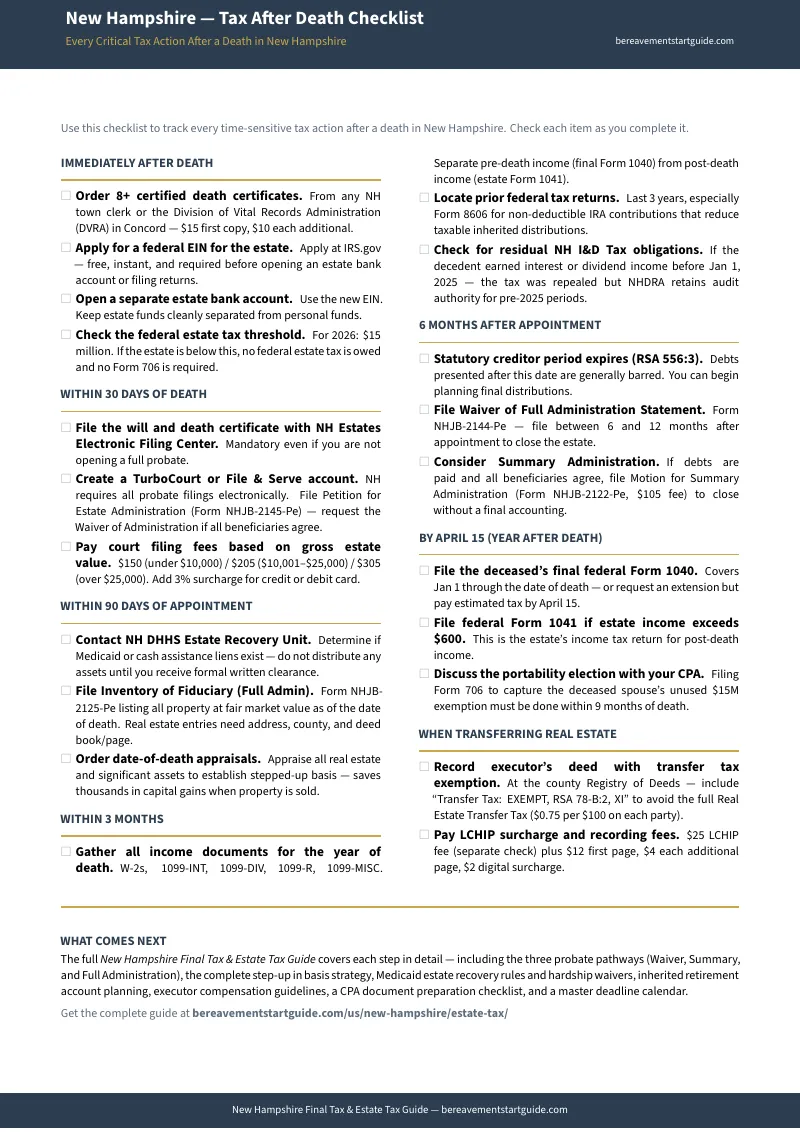
Your download includes 8 PDFs --- the complete New Hampshire Final Tax and Estate Tax Guide, the New Hampshire Tax After Death Checklist, and 6 standalone printable tools: a Tax Deadline Calendar with every statutory deadline, a CPA Handoff Checklist for organizing documents before your first meeting, a Quick Reference Card with key rules and thresholds at a glance, a Real Estate Transfer Tax Exemption Reference mapping RSA 78-B:2 exemptions, a Probate Pathway Decision Tree for identifying which of New Hampshire's three probate pathways applies, and a Portability Decision Worksheet for evaluating whether to file Form 706 to preserve the deceased spouse's unused exemption.
30-day money-back guarantee. If the guide does not give you a clear understanding of every tax obligation that applies to your New Hampshire estate, every form you need to file, and every deadline you need to meet --- email us for a full refund. No questions asked.
Not ready for the full guide? Download the free New Hampshire --- Tax After Death Checklist --- a summary of every tax form, deadline, and filing requirement that applies when someone dies in New Hampshire, so you can see what you are dealing with before deciding how to handle it. The paid guide adds the complete 65-page guide, the tax deadline calendar, CPA handoff checklist, quick reference card, RETT exemption reference, probate pathway decision tree, and portability decision worksheet --- 8 PDFs total.
You were told New Hampshire has no death taxes. That is partially true. The guide tells you the rest of the story --- every tax that actually applies, every one that does not, and exactly what to do about each one --- so you settle the estate correctly, legally, and without leaving money behind.