
Someone You Love Just Died in New Hampshire. The Funeral Director Is Explaining Your Options. You Have No Idea Which Ones Are Legally Required and Which Ones You Can Refuse.
You are sitting across from a funeral director, and everything on the table sounds mandatory. Embalming. A casket for the cremation. A vault for the grave. The bill is climbing past $7,000 and a part of you suspects not all of this is required -- but you are exhausted, you are grieving, and the 36-hour clock to file the death certificate is already ticking. You do not have the bandwidth to cross-reference New Hampshire statutes right now. So you sign.
You are not imagining it. The funeral transaction is the only major purchase in American life where the buyer is in active grief, under a hard legal deadline, and negotiating with the one party who controls access to the body. Federal law requires every New Hampshire funeral home to hand you an itemized General Price List before you agree to anything. Most families never ask for it. Of those who receive one, most cannot tell which charges are state law, which are cemetery policy, and which are pure margin.
Here is what New Hampshire law actually says: embalming is not required. The only exception is a public viewing exceeding 24 hours. The 48-hour mandatory waiting period before cremation is state law under RSA 325-A:18 -- not a funeral home policy. Families have the legal right to serve as "director in charge" and handle everything themselves, from body care to transport to filing the death certificate. And the person who controls every decision about burial, cremation, or other disposition is determined by a specific statutory hierarchy under RSA 290:17 -- not by whoever shows up first or argues loudest at the family meeting.
The New Hampshire Funeral Laws & Consumer Rights Guide is a 48-Hour Defense Manual for every legal right, procedural requirement, and cost-avoidance strategy available to New Hampshire families arranging a funeral, cremation, home burial, or green burial. Not a generic national overview. Not funeral home marketing dressed up as consumer advice. A structured, New Hampshire-specific manual that translates RSA 290, RSA 325-A, RSA 289, RSA 553, and the FTC Funeral Rule into plain English -- so you know exactly what you must pay for, what you can legally refuse, and who holds the authority to make every decision.
What's Inside the 48-Hour Defense Manual
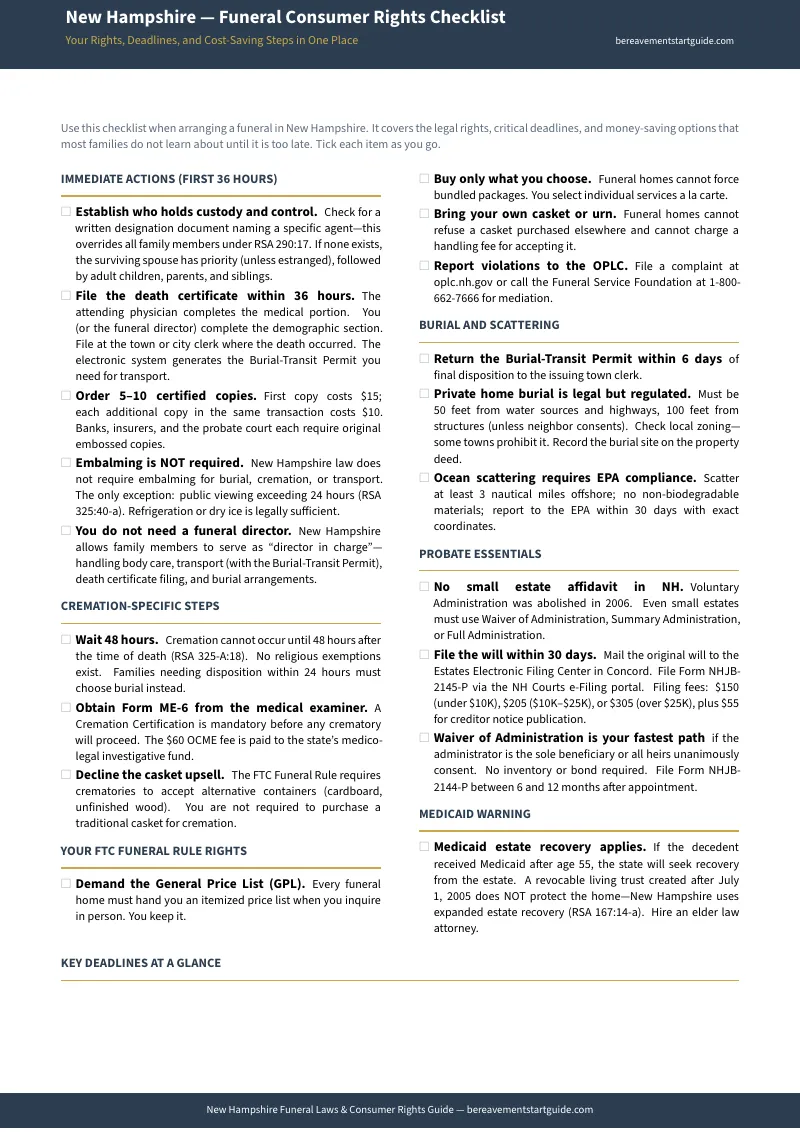
A comprehensive guide and the New Hampshire Funeral Consumer Rights Checklist -- covering every stage from the moment of death through estate settlement, built specifically for New Hampshire statutes and the regulatory rules that make arranging a funeral here different from any other state:
Your Rights at the Funeral Home: The FTC Funeral Rule in New Hampshire
Federal law requires every New Hampshire funeral home to provide you a General Price List the moment you walk in or the moment you ask over the phone. You have the right to an itemized breakdown of every charge. You cannot be forced into a package deal. You cannot be charged a handling fee for bringing in a casket you purchased elsewhere. You have the absolute right to select only the services and merchandise you want. The guide walks you through every line item on a typical New Hampshire GPL, explains what each charge covers, identifies the highest-margin items, and gives you the language to decline services you do not want without feeling like you are disrespecting the deceased.
Embalming: What New Hampshire Law Actually Requires
New Hampshire does not require embalming. That single fact can save your family $1,000 or more, because the vast majority of people walking into a funeral home believe the opposite. What the law does say: embalming is required only if the body will be exposed to the public for more than 24 hours under RSA 325:40-a. For private family vigils or immediate disposition, refrigeration below 40 degrees, dry ice, or air conditioning in a cool room are all legally sufficient. If a funeral director tells you embalming is "required by state law" for a direct cremation or immediate burial, that statement is false, and the guide tells you exactly how to respond.
Custody and Control: Who Makes the Decisions Under RSA 290:17
When family members disagree about burial versus cremation, which funeral home to use, or what kind of service to hold, New Hampshire law does not leave the answer to whoever argues loudest. RSA 290:17 establishes a strict legal hierarchy. A designated agent named in a written, signed document by the decedent holds the highest priority -- above the surviving spouse, above adult children, above everyone. If no agent was designated, authority follows a statutory chain: surviving spouse, adult children (majority vote), parents, siblings, and on down. If the person with authority fails to cooperate with a funeral director for 72 hours, they forfeit their rights entirely. The guide maps the complete hierarchy, explains how estranged spouses lose their authority under RSA 290:18, and covers what to do when the family deadlocks.
Cremation: The 48-Hour Wait and Medical Examiner Clearance
New Hampshire imposes a mandatory 48-hour waiting period between death and cremation under RSA 325-A:18. This is state law, not funeral home policy, and no religious exemption exists. Families requiring disposition within 24 hours must choose burial. Before cremation can proceed, a medical examiner must independently review the death and issue Form ME-6 -- the Cremation Certification -- with a mandatory $60 fee. If the ME finds the death suspicious, cremation can be delayed indefinitely. The guide covers the full authorization process, what happens when siblings disagree, and how the 48-hour clock interacts with weekends and holidays.
Home Funerals: Your Right to Bypass the Funeral Industry Entirely
New Hampshire is a "home funeral friendly" state. You are not required to hire a licensed funeral director. A family member or designated agent can serve as the "director in charge" -- bathing and dressing the body, keeping the body at home for a vigil, transporting the body in a private vehicle with the Burial-Transit Permit, filing the death certificate, and arranging burial or cremation directly. The guide walks you through every step, from securing the medical certification to filing at the town clerk's office within 36 hours.
Home Burial: The Exact Rules for Private Family Burial Grounds
New Hampshire allows private burial on your own residential property under RSA 289, but the rules are strict. Gravesites must be 50 feet from water sources and state highways, 100 feet from structures unless the neighboring property owner gives documented consent. Local zoning can override state law -- some municipalities like Keene prohibit home burial entirely. The burial site must be permanently recorded on the property deed at the county registry. And home burial is restricted to relatives only. The guide gives you the exact sequence of steps: checking zoning, measuring setbacks, preparing the grave, completing the legal paperwork, and recording the deed.
Green Burial and What Is Banned
Because New Hampshire does not mandate embalming and does not require vaults by state law, the state is legally hospitable to green burial. The guide covers biodegradable caskets and shroud burials, lists specific green burial locations -- Life Forest in Hillsborough, Oliverian Everlasting Burial Ground in Benton Flatts, and Chocorua Cemetery in Tamworth -- and explains that Phaneuf Funeral Homes is the only Green Burial Council-certified provider in the state. It also covers what is banned: alkaline hydrolysis (water cremation) was legalized in 2006 but repealed in 2008 under RSA 325-A:30, and human composting remains illegal after the defeat of House Bill 1457-FN. If you want water cremation, you must transport the body to Maine or Vermont.
The Town-vs-County Maze: Who Handles What
New Hampshire operates on a strong town-level governance model that confuses nearly every family settling an estate. Death certificates go through the municipal town clerk. Probate goes through the county Circuit Court. Real estate transfers go through the county Registry of Deeds. Tax assessor notifications go to the municipal assessor via Form NHJB-2142-P. If the decedent owned property in multiple towns, you file a separate notice with each assessor before the probate court will accept your final account. The guide maps every office, every form, and every filing fee so you do not spend weeks bouncing between the wrong agencies.
Probate: No Small Estate Affidavit Exists in New Hampshire
This is the single most dangerous piece of misinformation on the internet about New Hampshire estates. National legal websites routinely tell consumers they can use a "small estate affidavit." New Hampshire abolished its simplified Voluntary Administration process effective January 1, 2006. It does not exist. Instead, all estates must navigate one of three pathways: Waiver of Administration under RSA 553:32, Summary Administration under RSA 553:33, or Full Administration. The guide explains who qualifies for each, the exact forms required, the filing fees ($150 to $305 depending on estate size), and the decision tree to choose the right path.
The Medicaid Threat: What MERP Can Take From Your Family
If the deceased received Medicaid benefits after age 55 for long-term care, the New Hampshire Department of Health and Human Services will pursue estate recovery. The family home that was exempt during Medicaid qualification is no longer protected after death. Worse, New Hampshire uses an "expanded" estate recovery definition -- DHHS can pursue assets in living trusts, joint tenancies, and life estates created after July 1, 2005. A standard revocable living trust does not protect you. The guide explains the mandatory exemptions, when to hire an elder law attorney, and the unlimited irrevocable funeral trust strategy that is one of the most powerful Medicaid spend-down tools available in the state.
Preneed Contracts: Consumer Protections and the Insolvency Risk
If the deceased prepaid for their funeral, or you are considering prepaying for your own, New Hampshire's preneed framework has a critical gap: the state has no consumer guaranty fund. If your funeral home goes bankrupt, your prepaid funds may be permanently lost. The guide explains the difference between revocable and irrevocable contracts, the 15-day cancellation window under RSA 325:46-a, your right to transfer the contract to a different provider, and the Medicaid excess funds trap that redirects trust surpluses to the state instead of your family.
Filing a Complaint When Your Rights Are Violated
If a funeral home refused to provide a General Price List, pressured you into unnecessary services, or lied about embalming being legally required, you have a formal enforcement path. The guide provides the direct complaint portal for the New Hampshire OPLC, the mediation hotline through the Funeral Service Foundation (1-800-662-7666), and the step-by-step process for filing a grievance with the Board of Registration of Funeral Directors and Embalmers under RSA 325.
Who This Guide Is For
- The family sitting in the arrangement room right now who needs to know -- before signing anything -- which charges are legally required, which are optional, and which are cemetery policies being presented as state law
- The surviving spouse or adult child who was just told embalming is required and needs to know that New Hampshire law says otherwise -- and that refrigeration, dry ice, or air conditioning is a legal alternative that saves hundreds of dollars
- The family fighting over burial versus cremation who needs to know exactly who holds legal authority under RSA 290:17, whether a designated agent document supersedes everyone, and what happens after 72 hours of non-cooperation
- The person who wants a simple, affordable funeral and does not know that New Hampshire law allows families to handle everything themselves -- body care, transport, death certificate filing, and burial -- without hiring a funeral director
- The adult child dealing with a parent's prepaid funeral contract who is not sure the funeral home is honoring the original terms, whether the trust funds are properly deposited, or whether the contract can be transferred
- The family facing Medicaid estate recovery who needs to understand that a revocable living trust does not protect the family home, and that New Hampshire's expanded recovery powers reach assets most families assume are safe
- The executor trying to settle a small estate without a lawyer who searched for a "small estate affidavit" and discovered it does not exist in New Hampshire -- and needs to understand the Waiver of Administration, Summary Administration, and Full Administration pathways
- The proactive planner who watched a family member get overcharged at a funeral and is determined to document their own wishes, designate an agent under RSA 290:17, and structure an irrevocable funeral trust for Medicaid protection before it is too late
Why Free Resources Will Not Get You Through This
The information exists. It is scattered across New Hampshire state websites, town clerk offices, federal FTC guidance pages, and funeral home content written to sell services. Here is what you actually encounter when you try to navigate New Hampshire funeral law using free sources alone:
- New Hampshire state websites give you statutes and nothing else. RSA 290, RSA 325-A, RSA 289, and RSA 553 are public domain. They are also written in dense legal language, spread across disjointed platforms. Cross-referencing the custody-and-control statute with cremation authorization rules with the Circuit Court's probate pathways requires legal training most families do not have -- and time that grief does not provide.
- Funeral homes explain the process in a way that sells their services. Phaneuf and other New Hampshire funeral home websites offer helpful-sounding content about cremation timelines and casket selection. They rarely mention that embalming is not legally required, that you can serve as your own funeral director, or that vault requirements come from the cemetery and not from the state. The advice consistently steers families toward purchasing the maximum number of commercial services.
- The grassroots advocacy sites have the right instincts but the wrong format. NH Funeral Resources & Education (nhfuneral.org) is an excellent advocate for home funerals and consumer self-sufficiency. But the website is dated, the information is scattered across disconnected PDFs, and it lacks any guidance on probate, Medicaid recovery, or estate settlement -- the financial decisions that matter most after the funeral.
- Elder law attorneys use complexity to justify retainer fees. New Hampshire probate and elder law firm blogs are accurate on the Medicaid and trust details -- and they are explicitly designed to convince you the regulatory landscape is so dangerous you need to hire them at $300 per hour. For contested estates, that is true. For the family that needs to understand their rights before signing a funeral contract, the answer costs a fraction of one billable hour.
- National publishers get New Hampshire wrong. Nolo.com, EstateExec, and USLegal.com cover funeral law in generic terms. They do not explain that New Hampshire has no small estate affidavit, no consumer guaranty fund for preneed contracts, expanded Medicaid estate recovery that reaches living trusts, a unique town-vs-county jurisdictional split, or the specific conditions under which alkaline hydrolysis is banned. New Hampshire is not a footnote -- it has its own rules, and generic content misses them.
Free resources give you fragments from a dozen sources that contradict each other. The 48-Hour Defense Manual puts every New Hampshire statute, regulation, consumer right, and procedural step into one document, in the order you actually need them.
-- Less Than Twenty Minutes With a New Hampshire Attorney
A single consultation with a New Hampshire elder law or probate attorney costs $300 per hour. Funeral home upsells on services you are not legally required to purchase can add thousands to the final bill. This guide costs less than twenty minutes of professional legal time and gives you the complete New Hampshire consumer protection toolkit -- every statute, every regulation, every right, every deadline, and the negotiation framework that tells you exactly what you can refuse.
Your download includes 8 PDFs -- instant download, no account required:
- The complete guide covering New Hampshire funeral law, consumer rights, custody and control, cremation rules, home funerals, home burial, green burial, probate pathways, Medicaid estate recovery, preneed contracts, and the complaint filing process
- New Hampshire Funeral Consumer Rights Checklist -- the critical actions, deadlines, and rights on one printable page
- FTC Compliance Checklist -- every itemized-pricing right and the language to exercise them at the funeral home
- Custody and Control Reference Card -- the full RSA 290:17 authority hierarchy, the 72-hour forfeiture rule, and the estranged spouse exception
- Embalming Decision Table -- when embalming is legally required versus when refrigeration or dry ice is the cheaper alternative
- Cremation Authorization Checklist -- the 48-hour wait, Form ME-6 requirements, the $60 OCME fee, and authorization hierarchy
- Post-Death Administration Timeline -- every deadline from the first 36 hours through 12 months of estate settlement on one printable page
- Forms and Agencies Reference Card -- every form number, agency contact, and filing fee in one place
30-day money-back guarantee. If the guide does not give you clarity on your rights and confidence that you are making informed decisions, email us for a full refund. No questions asked.
Not ready for the full guide? Download the free New Hampshire Funeral Consumer Rights Checklist -- the critical actions, deadlines, and rights you need to know before signing any funeral home contract. It covers your FTC rights, the embalming truth, the 48-hour cremation waiting period, the custody-and-control hierarchy, and the items you can legally decline. Enough to walk into the arrangement room tonight with confidence.
Nobody should have to negotiate their rights while they are grieving. The guide makes sure you do not have to.