The Bank Froze the Account. The Court Rejected Your Paper Filing. The Clerk Told You She Cannot Explain the Difference Between Common Form and Solemn Form. And There Is No Small Estate Affidavit in New Hampshire.
You went to the bank with the death certificate and they locked the account. The mortgage is due in nine days. You drove to the Circuit Court and the clerk handed you a stack of forms, then told you — politely, firmly — that the court cannot provide legal advice. She cannot explain how to fill in the petition, which probate track applies to your estate, or whether you even need to be in this courthouse. She told you to consult an attorney. Then she mentioned that paper filings are not accepted — you need to e-file everything through the court's electronic portal, even if you do not have a lawyer.
So now you are home with blank forms you cannot submit by hand, a frozen bank account, and a set of questions nobody will answer for free. Maybe you will search online for "New Hampshire small estate affidavit" and discover that it does not exist — New Hampshire repealed it in 2006, and the generic national forms that every legal website offers will be rejected by every clerk in the state. Maybe you will spend weeks preparing for full probate administration when the estate qualifies for a Waiver of Administration under RSA 553:32 — the streamlined track that eliminates the bond, the inventory, and the annual accounting entirely. Maybe you will skip the Notice to Towns requirement under RSA 554:18-a and discover months later that the property tax records were never updated and the buyer's title company is refusing to close. Maybe you will pay a New Hampshire probate attorney an average of $14,000 to handle an uncontested estate that the legislature specifically designed to be manageable without one.
The New Hampshire Probate Process Guide is a Statutory Filing Sequence for every pathway, deadline, form, and decision in a New Hampshire probate case — from the first 48 hours through final accounting and estate closure. Not a generic overview written for all 50 states. Not a blog post designed to convince you that probate requires a retainer. A plain-English, New Hampshire-specific manual that tells you exactly what the court clerk cannot: which forms to e-file, in what order, which probate track applies to your estate, and which mistakes will cost you months or expose you to personal liability.
What's Inside the Statutory Filing Sequence
A 17-chapter guide, a 20-item quick-start checklist, and 6 standalone printable worksheets — 8 PDFs — covering every phase of estate administration in New Hampshire from the first day through final discharge, built on the New Hampshire Revised Statutes Annotated (RSA), the mandatory e-filing system, and the probate-specific procedures that make New Hampshire different from every other state:
Before You File: Does the Estate Actually Need Full Probate?
This is the decision that determines whether you spend twelve months in court or bypass most of the system entirely. Assets titled in joint tenancy, with payable-on-death designations, in a funded trust, or with a Transfer on Death deed (RSA 563-D, effective July 2024) transfer outside probate completely. For the remaining assets, if you are the sole heir or if all heirs consent to your appointment, the Waiver of Administration under RSA 553:32 eliminates the surety bond requirement, the 90-day inventory filing, and the annual accounting — no court hearing, no creditor publication, dramatically less paperwork. But the Waiver has requirements that are not obvious from the form itself: every heir must sign, the will must name you or the heirs must agree, and Medicaid claims can still reach the estate even on the Waiver track. The guide includes a decision flowchart that walks you through the exact criteria so you do not file full administration for an estate that qualifies for the shortcut, and you do not attempt the Waiver on an estate where it will be denied.
Common Form vs. Solemn Form Probate: The Distinction Nobody Explains
New Hampshire is not a Uniform Probate Code state. It uses its own terminology. Common Form probate allows the will to be admitted based on the executor's testimony alone — faster, simpler, no hearing required for the initial admission. Solemn Form requires formal notice to all interested parties and a hearing — slower, but the resulting decree is conclusive and cannot be challenged later. If you file Common Form and a disgruntled heir contests within six months, you may end up relitigating the entire will admission in Solemn Form anyway. If you file Solemn Form unnecessarily on an uncontested estate, you have added weeks of delay and notification costs for no benefit. The guide explains when each form applies, what happens if someone challenges the will, and which one protects you as executor.
E-Filing, the Hybrid Paper Requirement, and the Concord Mail Rule
New Hampshire mandates electronic filing for all probate cases — even for people without attorneys. You must register on the court's e-filing portal, upload your petition and supporting documents electronically, and pay fees online. But here is the catch that trips up nearly every first-time filer: the original will, the original certified death certificate with a raised seal, and the original surety bond (if required) must still be mailed in hard copy to the Estates Electronic Filing Center in Concord at 2 Charles Doe Drive, Suite 2. The court will not issue your Certificate of Appointment until both the electronic filing and the physical originals have been received and matched. The guide maps this hybrid process step by step — what to upload, what to mail, what to expect, and what causes delays.
The Surety Bond: When It Is Required and How to Get It Waived
New Hampshire requires a surety bond for all estates valued over $25,000 — even if the will explicitly waives it. This catches executors off guard. The bond amount equals the total value of personal property in the estate, and the annual premium typically runs 0.5% to 1% of that amount. But the bond can be waived if all beneficiaries consent in writing or if you qualify for the Waiver of Administration. The guide covers the bond calculation, the waiver petition process, which surety companies write probate bonds in New Hampshire, and the specific form language that gets the waiver approved.
The 90-Day Inventory, Creditor Management, and the Six-Month Window
Within 90 days of receiving your Certificate of Appointment, you must file a complete Inventory of Fiduciary (Form NHJB-2125-Pe) listing every asset in the estate with its date-of-death fair market value. Miss this deadline and the court can remove you as fiduciary. Then comes the creditor claim window — six months from the date of your appointment, with a one-year statute of limitations for claims not barred by the six-month notice. You must follow the RSA 554:19 payment priority: administrative costs first, then funeral expenses, then taxes, then medical bills, then everything else. If you distribute assets before this window closes and a valid claim surfaces, you are personally liable for the shortfall. The guide walks you through every notification requirement, every deadline, and the statutory priority order for paying claims.
Real Estate, the Notice to Towns Requirement, and TOD Deeds
New Hampshire has a requirement that catches executors from out of state: RSA 554:18-a mandates that you file a Notice to Towns and Cities (Form NHJB-2142-Pe) with every municipality where the estate owns real property. This is separate from recording the deed at the county Registry of Deeds. Skip it and the property tax records never update — which creates problems when the heirs try to sell. The guide covers both the county deed recording process (including the $15 first page, $4 additional pages, $2 surcharge, and $25 LCHIP fee) and the town-level notification, plus the new Transfer on Death deed statute (RSA 563-D) that took effect in July 2024 as a probate bypass for real estate.
Medicaid Estate Recovery, Tax Obligations, and Closing the Estate
If the deceased received Medicaid benefits through Granite Advantage, OAA, ANB, APTD, MEAD, or BCCP, the New Hampshire DHHS will file an estate recovery claim. The hardship waiver deadline is 30 days from death or from the date DHHS files its claim — whichever comes first. The guide covers the surviving spouse protections, the hardship criteria, and how to respond. New Hampshire has no state estate tax and no state inheritance tax, but the guide walks you through the federal obligations: the decedent's final Form 1040, the estate's Form 1041, and the federal estate tax return if the estate exceeds the federal threshold. It then covers the final accounting — the court-required cash-basis statement of every dollar that entered and left the estate — and the closing process: receipts from every heir, the motion for discharge, and the order that releases you from fiduciary liability. The target is twelve months from appointment to closure.
Who This Guide Is For
- The surviving spouse whose bank account was frozen this morning — who needs to unfreeze accounts and access funds but does not know whether the estate qualifies for the Waiver of Administration under RSA 553:32 or requires full probate, and who cannot afford to wait weeks because the filing was submitted incorrectly or the original documents never arrived in Concord
- The out-of-state executor who just learned New Hampshire requires a Resident Agent — who needs to file an Appointment of Resident Agent (Form NHJB-2120-P) designating someone in New Hampshire to accept legal papers, and who may also need ancillary probate if the deceased lived elsewhere but owned a lake house, ski cabin, or rental property in New Hampshire
- The sole heir handling a modest estate without an attorney — whose estate is too complex for a simple Waiver but too small to justify a $14,000 attorney fee, and who needs to navigate e-filing, the surety bond, the 90-day inventory, and the six-month creditor window without missing a deadline that triggers removal
- The family discovering that assets were left outside the trust — who assumed everything was handled by the revocable trust but just learned that the lake house was never re-titled, or the bank account was never designated POD, and now those assets require probate through a pour-over will or intestate succession even though a trust exists
- The adult child trying to decide whether to hire an attorney or handle it themselves — who needs an honest framework: self-representation is realistic for Waiver of Administration cases and straightforward uncontested estates, achievable for organized individuals handling full administration of modest estates, and strongly inadvisable for contested wills, insolvent estates, or any case involving Medicaid recovery disputes
Why Free Government Forms Do Not Replace a Sequenced Filing Guide
New Hampshire probate information exists. The courts publish forms, the Circuit Court website provides some filing instructions, and dozens of law firms blog about the process. Here is what you actually encounter when you try to navigate probate using free sources:
- New Hampshire abolished the small estate affidavit in 2006 — and national legal websites still offer it. If you search "New Hampshire small estate affidavit," you will find downloadable forms on LegalZoom, Nolo, and a half-dozen other platforms. They are all wrong. New Hampshire uses the Waiver of Administration under RSA 553:32, which has different requirements, different eligibility criteria, and a different process. Filing a "small estate affidavit" in a New Hampshire probate court will result in rejection.
- Court clerks cannot give you legal advice. They can confirm filing fees, verify that your e-filing was received, and tell you the correct courtroom. They cannot tell you which probate track applies, whether you qualify for the Waiver, how to answer specific questions on the petition, or whether Common Form or Solemn Form is appropriate for your situation. If you ask, they will tell you to consult an attorney.
- The mandatory e-filing system has no tutorial for self-represented filers. The portal exists. The forms are available. But no state resource explains the hybrid process — which documents to upload electronically, which originals to mail to Concord, what happens when the electronic and physical filings do not match, or how long the Certificate of Appointment takes to issue after both are received.
- Attorney blog posts are accurate, detailed, and designed to sell you representation. Every probate firm in Concord, Manchester, and Nashua publishes content explaining how complex and dangerous the process is. For contested estates and Medicaid recovery disputes, that is accurate. For the uncontested Waiver case where all heirs agree, those posts never quite tell you that the legislature designed the procedure for exactly your situation. The post always ends with "schedule a consultation."
- National platforms miss New Hampshire-specific rules entirely. They do not cover the abolished small estate affidavit, the mandatory e-filing system, the hybrid Concord mail requirement, the Certificate of Appointment (not "Letters Testamentary"), the RSA 554:18-a Notice to Towns requirement, the surety bond mandate for estates over $25,000 even when the will waives it, or the Common Form vs. Solemn Form distinction. New Hampshire has its own probate code — generic advice does not apply here.
Free resources give you outdated national forms, refusals from the clerks, and fear from attorneys. The Statutory Filing Sequence puts every New Hampshire form, RSA citation, deadline, and court procedure into one document, in the order you actually need them.
— Less Than Fifteen Minutes With a New Hampshire Probate Attorney
A consultation with a New Hampshire probate attorney runs $250 to $400 per hour. Full representation for a straightforward uncontested estate averages $14,000. Contested matters or estates with Medicaid recovery disputes run significantly higher. This guide costs less than fifteen minutes of professional legal time and gives you the complete New Hampshire-specific probate roadmap — every form in sequence, every statutory deadline, every e-filing procedure, and the decision flowchart that tells you whether you need full probate at all.
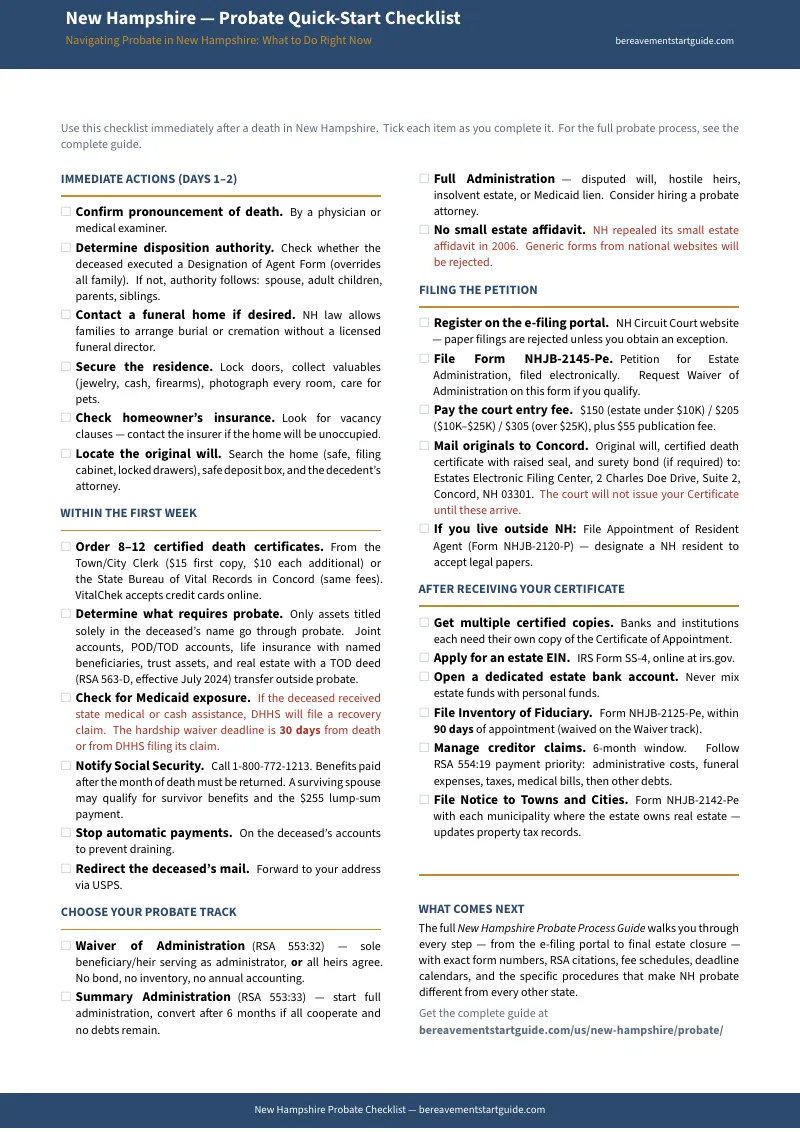
Your download includes 8 PDFs: the complete 17-chapter step-by-step guide, the standalone New Hampshire Probate Quick-Start Checklist with 20 essential steps, plus 6 printable worksheets and reference cards — a Probate Track Decision Tree (Waiver vs. Summary vs. Full Administration), an Estate Inventory Worksheet matching the 90-day NHJB-2125-Pe filing, a Creditor Tracking Worksheet with the RSA 554:19 payment priority, a Statutory Deadline Calendar with fillable dates, a Forms and Fees Quick Reference card, and an E-Filing Quick Reference covering the hybrid upload-and-mail process. Instant download, no account required.
30-day money-back guarantee. If the guide does not give you clarity on what to file, when to file it, and what happens next — email us for a full refund. No questions asked.
Not ready for the full guide? Download the free New Hampshire — Probate Quick-Start Checklist — an overview of the probate process, the key deadlines, the three probate tracks, and the 20 essential steps you need to complete. Enough to understand what you are facing and whether you need the full guide.
Probate is not something you were trained for. But New Hampshire's Waiver of Administration was designed to let capable people handle straightforward estates without a lawyer. The guide gives you the instructions the court cannot — one form, one deadline, one filing at a time.