Someone You Love Just Died in New Jersey. The Funeral Director Is Legally Required to Be There. You Have No Idea What You Are Legally Required to Pay For.
New Jersey is one of the only states in America where you cannot handle a funeral without a licensed funeral director. By law, a funeral director must oversee the disposition of the body and file the death certificate through the state's Electronic Death Registration System. There is no family-directed alternative. No DIY home funeral pathway. The moment someone dies in New Jersey, you are legally locked into a commercial transaction -- and the person on the other side of that transaction understands every line of N.J.S.A. 45:27 while you are still trying to process what just happened.
The median cost for a traditional burial with viewing in New Jersey is $13,193 -- more than $3,000 above the national average. Direct cremation averages $2,500 to $2,900. Embalming alone runs around $1,023. And because the state mandates funeral director involvement, there is no legal way to bypass the industry entirely. You are a captive buyer negotiating with the one party who controls access to the body, the death certificate, and the burial permit.
That does not mean you have no rights. It means your rights matter more than in almost any other state -- and that nobody in the arrangement room is going to explain them to you.
The New Jersey Consumer Protection System
This guide consolidates every New Jersey funeral regulation, federal FTC consumer protection, and post-death administrative procedure into one plain-English manual -- organized around the decisions you actually face, in the order you face them. It is built for a state where the regulatory deck is stacked in the industry's favor: mandatory funeral director involvement, 21 separate county Surrogate courts, an inheritance tax system that freezes bank accounts until you file the correct waiver form, and a Medicaid estate recovery program that pursues assets most families assume are protected.
The result: you walk into the arrangement conference knowing exactly what you must pay for, what you can legally decline, and what recourse you have when the funeral director presents optional services as legal requirements.
The 48-Hour Rule and the Embalming Pressure
New Jersey law requires that a body be buried, cremated, embalmed, or refrigerated to 45 degrees within 48 hours of death. Funeral homes routinely use this timeline to pressure families into embalming -- a $1,023 procedure that is almost never legally required. The only true mandate for embalming in New Jersey is transport by common carrier when the destination will not be reached within 24 hours. For every other scenario -- private viewing, delayed burial, direct cremation -- refrigeration is the legal alternative. The guide maps the 48-hour clock, explains exactly when embalming is and is not required, and gives you the language to decline it without ambiguity.
Disposition Authority: Who Controls the Decisions
When family members disagree about burial versus cremation, which funeral home to use, or how much to spend, New Jersey law does not leave the answer to whoever argues loudest. N.J.S.A. 45:27-22 establishes a strict hierarchy: a Funeral Agent explicitly named in the will holds the highest priority, followed by the legal spouse or civil union partner, then a majority of surviving adult children, surviving parents, a majority of surviving adult siblings, and other next of kin by degree of consanguinity. If the decedent did not appoint a Funeral Agent, they have no legal control over their own arrangements -- no matter what they said in life. The guide maps the complete hierarchy and explains what to do when blended families, estranged relatives, or verbal wishes collide with the statutory order.
Cremation: The 24-Hour Wait and Authorization Requirements
New Jersey imposes a mandatory 24-hour waiting period after death before any cremation can proceed. A standard burial permit is sufficient for authorization -- the requirement for an additional medical examiner's permit was repealed decades ago. Pacemakers must be removed before the procedure. The guide covers the full authorization process, the signature requirements that trip up families with multiple siblings, and the timeline interactions that can delay disposition by days if you are not prepared.
Your FTC Funeral Rule Rights in a Mandatory-Director State
Federal law requires every New Jersey funeral home to provide you a General Price List the moment you ask -- over the phone or in person. You have the right to select only the services you want. You cannot be forced into a package deal. You cannot be charged a handling fee for using a casket purchased from a third-party vendor. And New Jersey adds its own protection: funeral directors must bill all cash advance items -- flowers, clergy honorariums, obituary notices -- at their actual cost, with no surcharges. In a state where the average funeral exceeds $13,000, knowing which charges are legally required versus which are pure margin is the difference between an informed decision and a grief-driven one.
Home Burial: Legal but Heavily Restricted
No state statute explicitly prohibits burial on private property in New Jersey, making it technically legal at the state level. But the practice is heavily restricted by local municipal zoning ordinances and often outright banned. For families who do proceed, the guide covers the requirements: filing a map of the burial ground with the property deed, meeting depth requirements of four feet of earth covering the casket, and the critical fact that New Jersey does not grant a permanent easement for private burials -- future property owners can legally disinter and relocate the remains.
Green Burial and Alternative Disposition
New Jersey currently has only about six cemeteries certified for true green burial -- biodegradable containers or shrouds, no chemical embalming, no concrete vaults or grave liners. Alkaline hydrolysis (water cremation) is not legal for in-state processing, but the guide covers the legal workaround: transporting the body to a compliant provider in another state and having the remains returned. Natural organic reduction (human composting) was legalized under Senate Bill S3007, signed in September 2025, with regulatory implementation effective July 2026. The guide provides the current legal status, the transport protocols for out-of-state alternatives, and the certified green burial locations.
The Inheritance Tax Freeze: Forms L-8, L-9, and 0-1
When someone dies in New Jersey, their bank accounts and real estate are immediately frozen. To release those assets, you must navigate the state's inheritance tax system, which divides heirs into classes. Class A beneficiaries -- spouses, parents, children, grandchildren -- are exempt from the tax but still must file a self-executing waiver (Form L-8 for non-real-estate assets, Form L-9 for resident real property) before banks will release funds. Class C beneficiaries (siblings) face an 11% tax after a $25,000 exemption. Class D beneficiaries (unrelated individuals) face 15% to 16%. The guide walks you through each waiver form, explains which class you fall into, and provides the step-by-step process to unfreeze accounts without waiting months in the Surrogate court queue.
Surrogate Courts: 21 Counties, 21 Sets of Rules
New Jersey has no unified probate court. Instead, each of the state's 21 counties operates its own Surrogate court with its own procedures. Surviving spouses can file an Affidavit of Surviving Spouse only if the estate's total value does not exceed $50,000. Other next of kin are restricted to an Affidavit of Next of Kin capped at $20,000. Anything above those thresholds pushes the family into full probate administration. The guide maps the simplified affidavit pathways, the thresholds that trigger formal probate, and the county-by-county procedural differences that trip up families trying to settle an estate without an attorney.
Medicaid Estate Recovery: Beyond the Federal Minimum
New Jersey's Medicaid Estate Recovery program exceeds federal minimums. The Division of Medical Assistance and Health Services is required to recover funds for all long-term care services received after age 55, and the state pursues both probate and non-probate assets -- including jointly held accounts and certain trust structures that most families assume are protected. The guide covers the irrevocable funeral trust strategy -- New Jersey imposes no maximum dollar limit on the value of an irrevocable funeral trust for Medicaid eligibility -- and explains how to structure the trust to avoid inadvertently surrendering excess funds to the state treasury after the funeral is paid.
Preneed Contracts and the CHOICES Trust Fund
If the deceased prepaid for their funeral, or you are considering prepaying for your own, New Jersey requires all preneed funds to be held in trust -- not in the funeral home's operating account. Revocable contracts are fully refundable and transferable. Irrevocable contracts are permitted only for individuals receiving or expecting to apply for SSI or Medicaid within six months, and they serve as a critical asset spend-down tool. The guide explains the difference, the NJSFDA's CHOICES trust fund, the prohibition on constructive delivery of preneed merchandise, and the excess funds trap that redirects trust surpluses to the state.
Filing a Complaint When Your Rights Are Violated
If a funeral home refused to provide a General Price List, pressured you into unnecessary services, or misrepresented embalming as legally required, you have a formal enforcement path through the State Board of Mortuary Science under the Division of Consumer Affairs. The guide provides the direct complaint portal, the Halsey Street office address in Newark, and the step-by-step process for documenting violations and filing a formal grievance.
Who This Guide Is For
- The family sitting in the arrangement room right now who needs to know -- before signing anything -- which charges are legally required in New Jersey, which are optional, and which are cemetery policies being presented as state law
- The surviving spouse or adult child who was just told embalming is required and needs to know that New Jersey law says otherwise -- and that refrigeration to 45 degrees is the legal alternative that saves over $1,000
- The family fighting over burial versus cremation who needs to know exactly who holds legal authority under N.J.S.A. 45:27-22, whether a Funeral Agent appointment supersedes everyone, and what happens when the statutory hierarchy conflicts with the decedent's verbal wishes
- The executor staring at frozen bank accounts who needs to understand how to file a Form L-8 self-executing waiver for Class A beneficiaries and unfreeze funds without hiring a probate attorney
- The adult child planning a Medicaid spend-down who needs to structure an irrevocable funeral trust that complies with New Jersey's rules -- and avoid the excess funds trap that surrenders the surplus to the state
- The family considering green burial or alternative disposition who needs the certified cemetery locations, the transport protocols for out-of-state alkaline hydrolysis, and the current regulatory status of human composting under S3007
- The proactive planner who watched a family member get overcharged at a New Jersey funeral and is determined to appoint a Funeral Agent, document their wishes legally, and structure a preneed contract before the 48-hour clock starts for someone else
Why Free Resources Will Not Get You Through This
The information exists. It is scattered across state government portals, county Surrogate websites, federal FTC guidance pages, and funeral home marketing content. Here is what you actually encounter when you try to navigate New Jersey funeral law using free sources alone:
- State government websites give you statutes and nothing else. N.J.S.A. 45:27, the Treasury's inheritance tax portal, and 21 separate county Surrogate court websites are all public domain. They are also written in dense legal language, fragmented across disjointed platforms. Cross-referencing the disposition authority statute with the inheritance tax waiver requirements with your specific county Surrogate's filing procedures requires legal training most families do not have -- and time that grief does not provide.
- The NJSFDA explains the process in a way that protects the industry. The New Jersey State Funeral Directors Association website and its CHOICES trust fund marketing are helpful-sounding but inherently designed to steer families toward services that generate revenue. They rarely volunteer that embalming is almost never required, that the FTC guarantees your right to an itemized price list, or that refrigeration is the cheaper legal alternative. The advice consistently channels families toward higher-margin commercial services.
- Law firm blogs give you just enough to justify a retainer. New Jersey elder law and probate attorneys write accurate content about Medicaid recovery and inheritance tax -- and they are explicitly designed to convince you the regulatory landscape is so dangerous you need to hire them at $300 per hour. For contested estates and complex trusts, that is true. For the family that needs to file a Form L-8 waiver or understand their rights before signing a funeral contract, the answer costs a fraction of one billable hour.
- Local funeral home websites present optional services as standard. Corporate and independent funeral homes in New Jersey offer free PDF guides and planning checklists that consistently blur the line between legal requirement and commercial expectation -- presenting embalming, viewing preparation, and vault installation as the normal course of business rather than optional services you have the right to decline.
- National publishers get New Jersey wrong. Nolo.com, USLegal.com, and other national legal sites cover funeral law in generic terms. They do not explain that New Jersey mandates funeral director involvement (eliminating DIY funerals), imposes an inheritance tax with specific waiver forms, operates 21 separate county Surrogate courts, has no maximum limit on irrevocable funeral trusts for Medicaid, and recently legalized human composting with implementation still pending. New Jersey has its own rules, and generic content misses them.
Free resources give you fragments from a dozen sources that contradict each other. The New Jersey Consumer Protection System puts every statute, regulation, consumer right, and procedural step into one document, in the order you actually need them.
-- Less Than Twenty Minutes With a New Jersey Attorney
A single consultation with a New Jersey elder law or probate attorney costs $300 per hour or more. Funeral home upsells on services you are not legally required to purchase can add thousands to the final bill. This guide costs less than twenty minutes of professional legal time and gives you the complete New Jersey consumer protection toolkit -- every statute, every regulation, every right, every deadline, and the framework that tells you exactly what you can refuse.
Your download includes the complete guide, the New Jersey Funeral Consumer Rights Checklist, and three standalone reference tools -- instant download, no account required:
- The complete guide covering New Jersey funeral law, FTC consumer rights, the mandatory funeral director requirement, embalming and refrigeration rules, disposition authority under N.J.S.A. 45:27-22, cremation authorization, home burial restrictions, green burial locations, alternative disposition options, the inheritance tax waiver system (Forms L-8, L-9, and 0-1), Surrogate court pathways, Medicaid estate recovery, preneed contract protections, and the complaint filing process
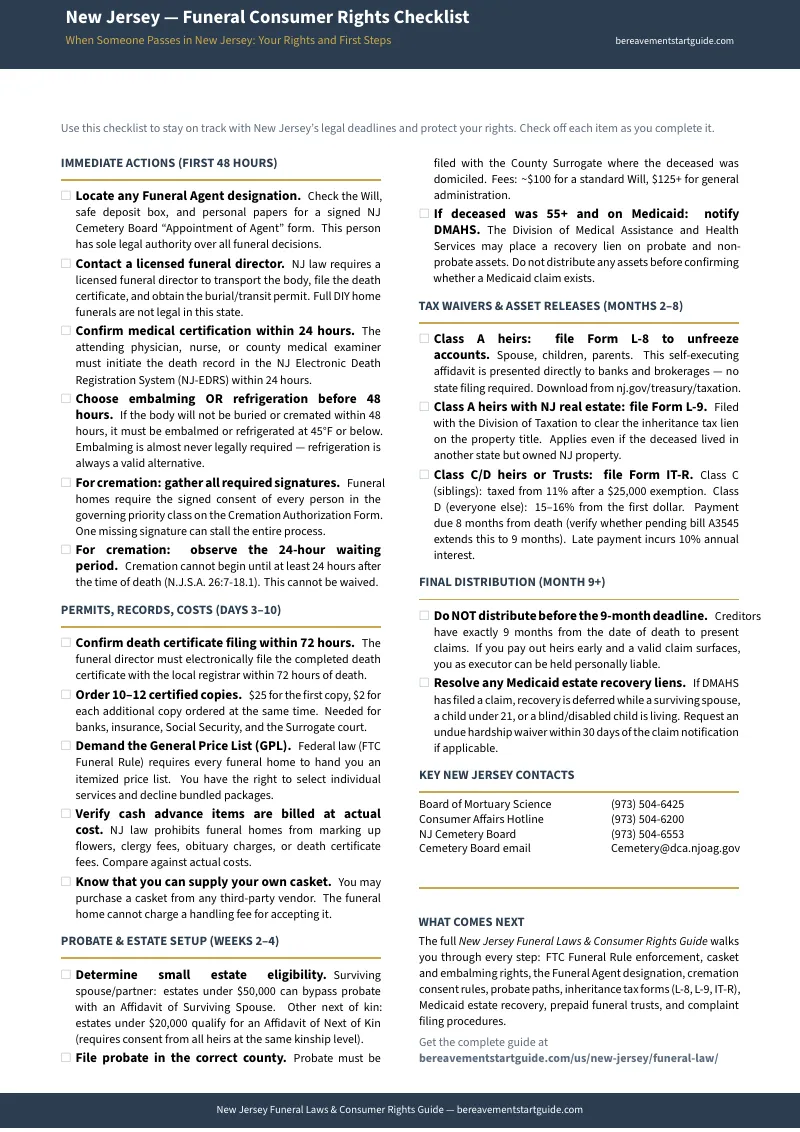
- New Jersey Funeral Consumer Rights Checklist -- the critical actions, deadlines, and rights on one printable page to bring to the arrangement conference
- Cost Comparison Worksheet -- a fillable side-by-side pricing sheet for comparing itemized quotes from multiple funeral homes
- Forms Reference Card -- every NJ-specific form you may need (L-8, L-9, IT-R, Appointment of Agent, Cremation Authorization) with plain-English explanations and where to download each one
- Key Contacts Directory -- direct phone numbers and contact information for the State Board of Mortuary Science, Division of Consumer Affairs, Cemetery Board, and EPA Region 2
30-day money-back guarantee. If the guide does not give you clarity on your rights and confidence that you are making informed decisions, email us for a full refund. No questions asked.
Not ready for the full guide? Download the free New Jersey Funeral Consumer Rights Checklist -- the critical actions, deadlines, and rights you need to know before signing any funeral home contract. It covers your FTC rights, the embalming truth, the 24-hour cremation waiting period, the disposition authority hierarchy, and the items you can legally decline. The full guide adds the complete legal manual plus the Cost Comparison Worksheet, Forms Reference Card, and Key Contacts Directory.
Nobody should have to negotiate their rights while they are grieving. This guide makes sure you do not have to.