The Bank Froze Half the Account Before You Even Finished the Phone Call. The Surrogate Says You Need to Wait 10 Days. The Title Company Demands a Tax Waiver You Have Never Heard Of. The Inheritance Tax Was Supposedly Repealed but Your Brother-in-Law Still Owes 16%. And Nobody Told You That Every Beneficiary Must Sign a Notarized Refunding Bond Before You Can Distribute a Single Dollar.
Your mother died on a Tuesday. By Thursday the funeral director asked how many certified death certificates you need at $25 for the first copy and $2 for each additional. You said six. You will need ten or more. Every bank, every insurance company, every government office requires an original with the raised seal, and the NJ Office of Vital Statistics takes weeks to fill reorders by mail.
You called the bank about her checking account. The representative confirmed the death and immediately froze half the balance. You did not request this. They cited New Jersey Administrative Code 18:26-11.16 and told you the frozen funds cannot be released until you produce something called a "tax waiver." You searched online and found references to Form L-8, Form L-9, Form IT-R, and Form 0-1. Nobody explained which one applies to your situation, what order to file them in, or why New Jersey uses different forms depending on whether the beneficiary is a spouse, a child, a sibling, or a friend.
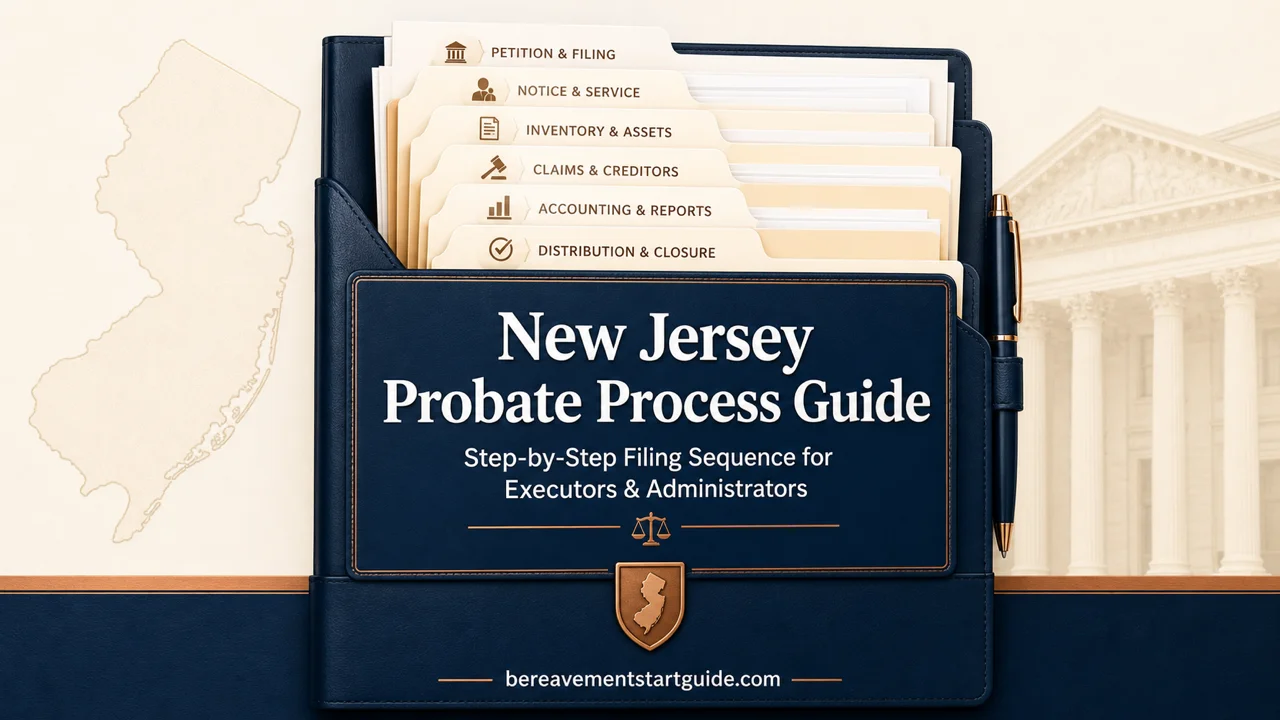
The New Jersey Probate Process Guide is a Probate Filing Sequence built entirely around New Jersey Revised Statutes, the NJ Administrative Code, and the procedures of the 21 County Surrogates. It maps every form, fee, deadline, beneficiary class, tax waiver path, and agency requirement into one chronological sequence. It diagnoses whether your estate qualifies for a Small Estate Affidavit (bypassing formal probate entirely), which tax waiver forms apply to your specific beneficiary classes, how to unfreeze bank accounts without waiting months for the state, and when you actually need an attorney versus when you are paying $350 an hour for tasks you can complete with the correct form and a certified death certificate.
What's Inside the Probate Filing Sequence
A 16-chapter guide with appendices, a printable quick-start checklist, and standalone worksheets — covering every probate track, tax waiver path, creditor defense, and closing procedure available under New Jersey law:
Chapter 1: Determine Your Track — Small Estate, Formal Probate, or No Probate at All
The decision that saves weeks of unnecessary work. If the surviving spouse is the sole heir and solely owned assets are under $50,000, the Surviving Spouse Affidavit (Form 1) skips formal probate entirely. If there is no surviving spouse and solely owned assets are under $20,000, the Next of Kin Affidavit (Form 3) works instead. For estates with a will or assets above these thresholds, formal probate is required. This chapter walks through every scenario with a decision table so you know exactly which track applies before you set foot in the Surrogate's office.
Chapter 2: The Waiting Period and Urgent First Actions
What to do during the mandatory 10-day waiting period before a will can be probated (5 days for intestate estates). How many certified death certificates to order and from where. How to locate the original ink-signed will — because the Surrogate can only accept the original, and a photocopy triggers a costly Superior Court proceeding. How to secure the residence, redirect mail, and continue paying mortgage and insurance without compromising your position as executor.
Chapter 3: Opening the Estate at the Surrogate's Court
Exactly what to bring to the County Surrogate. The filing fee breakdown: $100 for a 2-page will plus $5-$7 per additional page under N.J.S.A. 22A:2-30. How the Surrogate administers your oath, issues Letters Testamentary (testate) or Letters of Administration (intestate), and provides Short Certificates — the daily proof-of-authority document that every bank and institution demands. How many Short Certificates to order ($5 each) and why photocopies are universally rejected. The difference between a Surrogate's appointment and a Superior Court appointment for contested or holographic wills.
Chapter 4: The EIN, Estate Account, and Marshalling Assets
Setting up the estate's financial infrastructure. How to obtain a free Employer Identification Number instantly from irs.gov. Opening a dedicated estate bank account so every dollar of income and expense flows through one traceable ledger. How to marshal assets methodically — requesting date-of-death balance statements from every financial institution, obtaining real estate appraisals, and inventorying personal property. Why commingling estate funds with personal money is the single fastest way to lose your fiduciary protection.
Chapter 5: Creditor Claims — The 9-Month Framework
The timeline that protects you from personal liability. Creditors have exactly 9 months from the date of death to present claims in writing and under oath (N.J.S.A. 3B:22-4). You have 3 months to evaluate each claim. If you dispute it, the creditor has only 30 days to file suit or permanently forfeits the claim. The statutory priority of payments for insolvent estates: funeral expenses first, administration costs second, federal taxes third, medical expenses of the last illness fourth, state taxes and Medicaid liens fifth, unsecured debts last. Why you must never distribute assets before month 10. Why you must never pay a decedent's credit card bill with your own money.
Chapter 6: Federal and State Tax Obligations
Filing the decedent's final Form 1040 and NJ Form NJ-1040 for the year of death. When the estate itself needs its own income tax return (Form 1041 and NJ-1041). How to request a federal estate closing letter from the IRS. The relationship between income tax obligations and the inheritance tax — two separate systems that executors routinely confuse.
Chapter 7: The New Jersey Transfer Inheritance Tax
The chapter that addresses the single most confusing aspect of settling an estate in New Jersey. The four beneficiary classes: Class A (spouse, children, parents, grandchildren — 100% exempt), Class C (siblings, in-laws — $25,000 exemption then 11-16%), Class D (nieces, nephews, friends — no exemption, taxed at 15-16%), and Class E (charities — exempt but still require filing). Why the inheritance tax survived the 2018 estate tax repeal. The fast-track path: if all beneficiaries are Class A, you file Form L-8 directly with the bank to release frozen funds and Form L-9 with the Division of Taxation for real estate. The full-return path: if any beneficiary is Class C or D, you file the comprehensive Form IT-R within 8 months of death, pay all assessed tax, and wait approximately 90 days for Form 0-1 waivers. The 10% annual interest penalty that starts accruing on day 241 with no extensions.
Chapter 8: Medicaid Estate Recovery (DMAHS)
New Jersey's Division of Medical Assistance and Health Services runs one of the most aggressive Medicaid recovery programs in the country. The "expanded estate" definition under N.J.A.C. 10:49-14.1 that reaches beyond probate assets into joint bank accounts, POD accounts, living trust assets, and annuities. The exemptions that protect the family home when a surviving spouse, child under 21, or permanently disabled child lives there. The critical 20-day window to file an undue hardship waiver after receiving a DMAHS recovery notice. Why distributing any expanded estate assets before resolving the lien constitutes a breach of fiduciary duty that exposes you personally.
Chapter 9: Ancillary Probate — Shore Properties and Non-Resident Estates
For out-of-state executors managing a Jersey Shore property or any New Jersey real estate owned by a non-resident decedent. How to obtain an Exemplified Copy of the will from the original probate state and file it with the New Jersey Surrogate in the county where the property sits. Form L-9 NR for non-resident real property tax waivers. Why the title company will not clear the sale until this waiver is recorded with the County Clerk — and how to prevent a massive escrow holdback.
Chapter 10: Contested Probate — Caveats and Court Challenges
What happens when someone objects. A "caveat" filed during the waiting period strips the Surrogate of jurisdiction and transfers the matter to the Superior Court, Chancery Division, Probate Part. Grounds for a will contest under New Jersey law: undue influence, lack of testamentary capacity, fraud, or improper execution. What to expect if you face a caveat — timelines, legal costs, and when settlement is smarter than litigation.
Chapter 11: Fiduciary Compensation — Your Right to Be Paid
New Jersey law entitles executors and administrators to a "corpus commission" calculated on the total value of assets that pass through the estate. The tiered formula: 5% on the first $200,000, 3.5% on the next $800,000, 2% on everything above $1,000,000. Income commissions of 6% on estate income earned during administration. How compensation works when there are co-executors. Why taking your fee before closing the estate can create problems — and the correct sequence to follow.
Chapter 12: Closing the Estate — Accountings, Refunding Bonds, and Final Distribution
The step that most executors have never heard of. After the 9-month creditor window closes, you cannot simply hand out checks. Every beneficiary must sign a notarized Refunding Bond and Release — the document that legally binds them to refund a pro-rata share if an unknown debt surfaces later and shields you from personal liability. How to prepare the informal accounting that beneficiaries review before signing. Filing executed bonds with the Surrogate's Court at $10 per bond. Closing the estate bank account. New Jersey does not require a formal judicial accounting unless a beneficiary demands one.
Chapter 13: Real Estate Transfers
Transferring the decedent's New Jersey property — often the highest-value and most procedurally complex task in the entire estate. Tenancy by the entirety (married couples: automatic transfer, no waiver needed). Property passing to Class A beneficiaries (Form L-9 to the Division of Taxation, then record Form 0-1 with the County Clerk). Property passing to Class C or D beneficiaries (full IT-R required first). County Clerk recording fees. The 15-year statutory tax lien that blocks any sale until a waiver is recorded.
Chapters 14-16: Master Timeline, Forms Reference, and When to Hire a Professional
The complete chronological summary from day one through estate closing. Every statutory deadline mapped: the 10-day waiting period, the 60-day Notice of Probate, the 8-month inheritance tax deadline, the 9-month creditor window, and the 15-year real estate tax lien. A directory of every form referenced in the guide with download links. Clear criteria for when to hire an estate attorney immediately — missing original will, holographic will, filed caveat, beneficiary dispute, Medicaid recovery complications — versus when the forms and this guide are all you need.
Appendices: Intestate Succession and 21-County Surrogate Directory
The complete intestate succession table under N.J.S.A. Title 3B showing exactly who inherits when there is no will — surviving spouse share, children's share, parents, siblings, and more remote relatives. A reference guide to all 21 County Surrogates with addresses, contact information, and notes on filing procedures.
Who This Guide Is For
- The surviving spouse whose bank account was just frozen — who walked into the bank expecting to access the joint checking account and was told that half the balance is locked under state law until a "tax waiver" is filed. You need to know that Form L-8 is the self-executing waiver that releases the funds immediately, that you as a Class A beneficiary owe zero inheritance tax, and that you should have had this form ready before the bank learned of the death.
- The adult child named as executor in the will — who accepted the role years ago without understanding what it entails, has never filed at a County Surrogate's Court, never heard of Form L-8 or Form L-9, and does not know the difference between the inheritance tax (which still exists) and the estate tax (which was repealed in 2018). You need a filing sequence, not a stack of disconnected forms.
- The out-of-state executor managing a Jersey Shore property — who discovered they need ancillary probate in the county where the property sits, a tax waiver from the Division of Taxation before the title company will clear the sale, and county recording fees they did not know existed. You need to know how to obtain an Exemplified Copy of the will and file Form L-9 NR — all from another state.
- The sibling, niece, nephew, or friend who is a Class C or D beneficiary — who just learned they owe between 11% and 16% on their inheritance, and that the executor can be held personally liable if the tax goes unpaid and assets are distributed prematurely. You need to understand the filing timeline and what happens if the 8-month deadline passes without payment.
- The family facing Medicaid estate recovery — who received a DMAHS notice and has exactly 20 days to file an undue hardship waiver. You need to know which statutory exemptions protect the family home and that New Jersey's "expanded estate" definition reaches into joint accounts and POD designations that were supposed to bypass probate.
- The small estate family — trying to close a modest estate without thousands in legal fees. You need to know whether the $50,000 Surviving Spouse Affidavit or the $20,000 Next of Kin Affidavit applies, and how to complete the process at the Surrogate's Court without formal administration.
Why Free Government Forms and Websites Are Not Enough
Every form referenced in this guide is available for free from a New Jersey government website. The Division of Taxation publishes Form L-8, Form L-9, and Form IT-R. The County Surrogates provide small estate affidavit forms. The MVC has Form BA-62 for vehicle transfers. Here is why the forms alone leave you stranded:
- The state provides the forms but not the sequence. The Division of Taxation publishes tax waiver forms. The Surrogate's Court handles probate filings. The MVC handles vehicle titles. DMAHS handles Medicaid recovery. These are four separate bureaucracies that do not coordinate with each other. No single government page tells you what order to file in, what to gather before you start, or how a tax waiver filed with the Division of Taxation connects to a deed recorded at the County Clerk.
- National legal websites miss the NJ-specific traps. Nolo, FindLaw, and similar sites publish generic probate overviews. They do not explain the 50% bank freeze. They do not distinguish between Form L-8 (self-executing, handed directly to the bank) and Form IT-R (filed with the state, 90-day processing time). They do not mention that New Jersey's inheritance tax survived the 2018 estate tax repeal. Families follow these generic guides and discover, weeks later, that New Jersey has rules the national websites never mentioned.
- Law firm websites explain the problem but withhold the solution. New Jersey probate attorneys publish detailed articles about inheritance tax classes, the bank freeze, and Medicaid recovery. The content is accurate and deliberately incomplete — designed to convince you the process is too dangerous to attempt alone. The question is not whether probate is complicated, but whether your estate actually requires an attorney. For many New Jersey estates where all beneficiaries are Class A, the answer is no.
- The 21 County Surrogates each run different procedures. Some require appointments. Some use electronic filing systems. Some demand in-person appearances. Fees are standardized by statute, but auditing and accounting fees scale by estate value in ways that are not obvious from the published fee schedule. A guide built for "New Jersey" generically does not tell you what to expect when you walk into the Camden County Surrogate versus the Somerset County Surrogate.
- Filing out of sequence triggers delays that compound. Notifying the bank before you have Letters Testamentary and a tax waiver freezes your access for months. Filing Form L-9 when you should have filed the IT-R (because a Class D beneficiary exists) restarts the entire process. Distributing assets before the 9-month creditor window closes creates personal liability. The forms exist. The sequence is what turns them into cleared title and money in the right accounts.
Free resources give you one agency at a time, with no sequencing, no cross-referencing, and no way to know what you are missing. The Probate Filing Sequence maps every form, every beneficiary class, every tax waiver path, and every deadline into one chronological guide — so you unfreeze every account, avoid every common rejection, and know whether you actually need an attorney before spending a dollar on one.
— Less Than Twenty Minutes of a New Jersey Probate Attorney's Time
New Jersey families lose weeks and thousands of dollars every year — not because the estate was complicated, but because nobody told them about the shortcuts the law provides. A surviving spouse watches half the joint bank account sit frozen for three months because nobody told them a one-page Form L-8 would release it in a single visit. A family hires an attorney at $350 per hour to gather death certificates, call Social Security, and fill out forms that require no legal expertise. An executor misses the 8-month inheritance tax deadline and triggers the 10% annual interest penalty because they confused the repealed estate tax with the active inheritance tax. A small estate worth $18,000 goes through full probate administration — with its sliding-scale accounting fees — because nobody mentioned the Next of Kin Affidavit. A family home that should be protected from Medicaid recovery goes undefended because nobody explained the surviving spouse exemption or the 20-day hardship waiver window. This guide costs less than any of those mistakes.
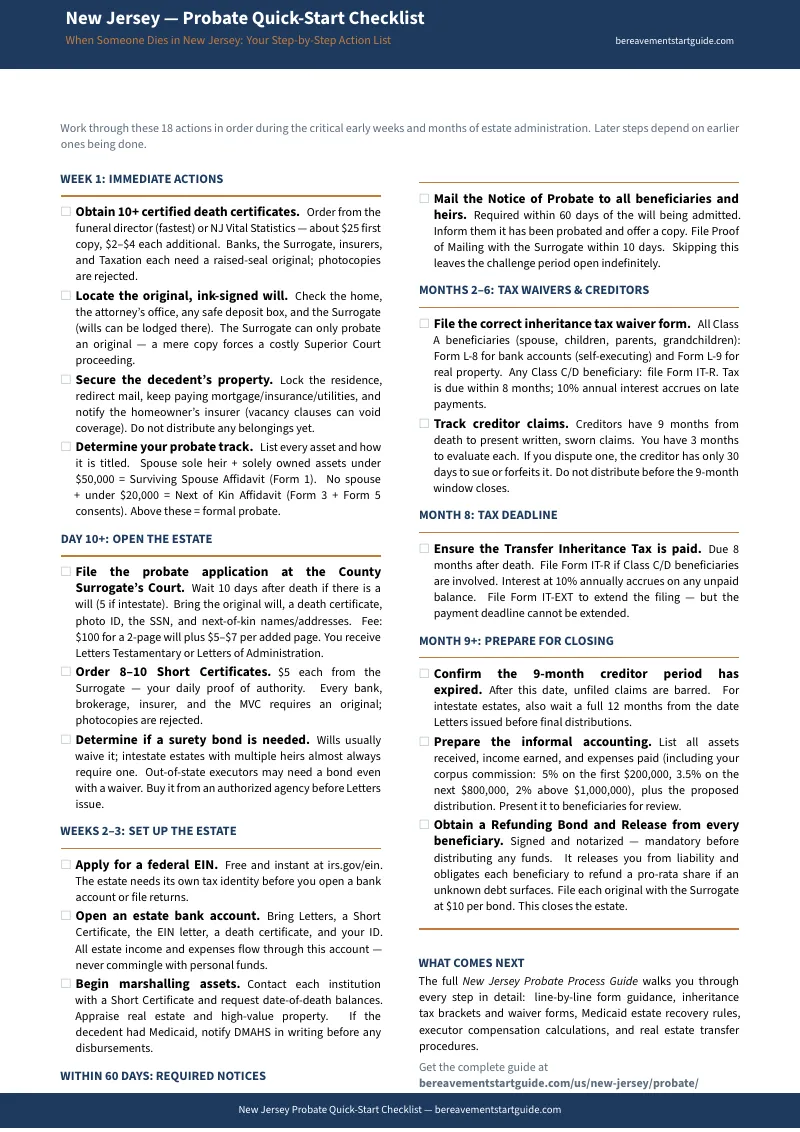
Your download includes 10 printable PDFs: the complete 16-chapter guide with appendices, the New Jersey Probate Quick-Start Checklist (18 items in filing order), and 8 standalone worksheets and reference sheets — a probate track selector, estate inventory worksheet, creditor claim tracker, tax waiver selector (L-8/L-9/IT-R decision flow), executor timeline, forms reference directory, executor commission calculator, and intestate succession reference. Together they cover every time-sensitive step from securing the estate on day one through the 10-day probate waiting period, the 60-day Notice of Probate requirement, the 8-month inheritance tax deadline, the 9-month creditor claim window, and the Refunding Bond closing process.
30-day money-back guarantee. If the guide does not give you a clear map of every tax waiver path available for your New Jersey estate, every form you need to file, and every deadline you need to meet — email us for a full refund. No questions asked.
Not ready for the full guide? Download the free New Jersey Probate Quick-Start Checklist — 18 items covering the most time-sensitive actions, forms, and beneficiary class distinctions that most families do not discover until the bank has already frozen the account. Enough to start the right sequence on day one.
You did not plan for this. But you can plan what happens next. The guide gives you the forms, the deadlines, the tax waiver paths, and the filing sequence — so the next nine months are spent settling the estate correctly, not discovering what you missed.