Your Spouse Died Last Tuesday. The Bank Froze Half the Joint Account. The Pension Office Says It Needs Form P-29 Before It Will Calculate Anything. The Health Insurance Runs Out in 60 Days. The Municipal Assessor Told You About a Property Tax Deduction You Have Never Heard Of. And Nobody Mentioned That the Workers' Comp Death Benefit Ends Permanently If You Remarry.
You called Social Security and learned the lump-sum death payment is $255 -- if you file the right paperwork. You called the bank and discovered that New Jersey law automatically freezes 50% of every jointly held account when one owner dies, even if you are the surviving spouse. The representative mentioned something about a "tax waiver" and told you the funds cannot be released until you produce one. You searched online and found Form L-8 on the Division of Taxation website, but the instructions assume you already know which beneficiary class you belong to and what "Class A" means.
You called your spouse's employer about the pension. They said someone needs to submit Form P-29 through the EPIC system. You do not know what the EPIC system is. You do not know whether to expect a lump sum or a monthly survivor pension, or whether the pension option your spouse selected years ago means you get nothing. Meanwhile, the health insurance you have been using through your spouse's employer is about to end, and the 60-day deadline to elect COBRA or State Health Benefits Program continuation is ticking.
The property tax assessor mentioned that surviving spouses may qualify for a $250 annual deduction -- but only if you meet age, residency, and income requirements, and the income limit excludes Social Security and pension payments in ways the form does not make obvious. You did not know to ask about the 100% disabled veteran exemption that could eliminate your entire property tax bill. You did not know that the ANCHOR program, Senior Freeze, and the new Stay NJ credit are all filed on a single Form PAS-1.
Each of these benefits is real. Each has its own office, its own deadline, its own forms, and its own eligibility rules. No single New Jersey agency will tell you about any of the others.
The New Jersey Survivor Benefits Navigator is a Benefit Recovery System built around New Jersey statutes, the Division of Pensions and Benefits, the Division of Taxation, the Division of Workers' Compensation, county welfare offices, and municipal tax assessors. It maps every benefit, form, deadline, and eligibility rule into one chronological sequence -- so you claim what you are owed, in the right order, without missing the windows that close permanently.
What's Inside the Benefit Recovery System
A 15-chapter guide with worksheets, decision trees, a deadline calendar, and a complete forms directory -- covering every survivor benefit available under New Jersey law:
Chapter 1: The First 48 Hours -- Death Certificates and Immediate Obligations
How many certified copies to order (10-15 minimum -- at $25 for the first and $2 each additional), why photocopies are rejected by every New Jersey institution, and which agencies to notify immediately. The mandatory role of a licensed funeral director under New Jersey law, your rights under the FTC Funeral Rule, and what to do if the deceased was receiving WFNJ, SSI, or Medicaid (you must contact the county Board of Social Services before signing any funeral contract or the state will automatically deny assistance). Includes a 10-item First 48 Hours worksheet.
Chapter 2: The Mandatory Waiting Period -- What You Can and Cannot Do
New Jersey imposes an 11-day waiting period before a will can be probated and a 6-day wait before an intestate administrator can be appointed. This chapter tells you exactly what you can accomplish during this forced pause: gathering documents, identifying the correct County Surrogate among New Jersey's 21 counties, obtaining an EIN from the IRS, contacting employers about pension and life insurance, and building the preliminary inventory that saves weeks later.
Chapter 3: Establishing Legal Authority Over the Estate
The decision tree that determines your path. If the surviving spouse is the sole heir and assets are under $50,000, the Surviving Spouse Affidavit skips formal probate entirely. If there is no spouse and the estate is under $20,000, the Heirship Affidavit applies. Above those thresholds or when a will exists, formal probate is required at the County Surrogate Court -- $100 base fee, $5 per page beyond two, and multiple Short Certificates at $5 each that every bank and title company demands.
Chapter 4: Unlocking Frozen Assets -- The Tax Waiver System
The chapter that solves the most common crisis. Form L-8 releases frozen bank accounts immediately -- you hand it directly to the bank, not to the state. Form L-9 clears the real estate title for Class A beneficiaries (filed with the Division of Taxation in Trenton, not with the County Clerk). When any beneficiary is Class C or D, you need the full Inheritance Tax Return and Form 0-1 waivers instead. Includes a quick-reference table matching every situation to the correct form and filing location.
Chapter 5: Health Insurance Continuation
The 60-day deadline that cannot be extended. COBRA for private employers (36 months, but at 102% of the full premium). New Jersey's own continuation law for small employers. The State Health Benefits Program for public employees, including the recent Senate Bill 458 that allows PFRS surviving spouses to keep coverage after remarriage. A decision worksheet that compares your continuation cost against marketplace alternatives -- because the right answer is to elect continuation within 60 days even if you plan to switch later.
Chapter 6: Public Employee Survivor Pensions
The chapter that matters if your spouse worked for any New Jersey state, county, or municipal employer. PERS, TPAF, PFRS, and SPRS each have different rules. Form P-29 must be submitted by the employer through the EPIC system to trigger the benefit calculation. The critical distinction between the Maximum Option (monthly payments end at death -- you receive only unrecovered contributions) and Option 4 (reduced lifetime monthly payments continue to you). Group life insurance for active and retired members. The PFRS remarriage penalty that was eliminated by Senate Bill 458.
Chapter 7: Social Security Survivor Benefits -- NJ Considerations
The $255 lump-sum death payment requires a proactive application. Monthly survivor benefits for spouses age 60+, spouses of any age caring for children under 16, unmarried children under 18, and disabled children. The New Jersey tax treatment that most people miss: Social Security survivor benefits are fully exempt from the NJ Transfer Inheritance Tax, excluded from state income tax, and excluded from the income calculation for the $250 property tax deduction.
Chapter 8: Workers' Compensation Death Benefits
When the death was work-related. Weekly benefits at 70% of the deceased's average weekly wage (up to $1,199/week in 2026), plus up to $5,000 in funeral reimbursement. Surviving spouses and children in the household are conclusively presumed dependents -- no proof required. Benefits last a lifetime for spouses and until age 23 for full-time students. The remarriage penalty that still applies to workers' comp (unlike PFRS pensions) and the lump-sum calculation you must understand before remarrying.
Chapter 9: Property Tax Relief
The most financially significant annual benefit for surviving spouses in a state with the nation's highest property taxes. The $250 deduction (Form PTD) with eligibility rules that are more generous than they appear -- Social Security and pension income are excluded from the $10,000 income limit. The 100% disabled veteran exemption (Form DVSSE) that completely eliminates property tax on the primary residence. The combined PAS-1 application for ANCHOR rebates, Senior Freeze, and the new Stay NJ credit. The anti-double-dipping rule that caps total relief at actual taxes paid.
Chapters 10-15: Public Assistance Funerals, Crime Victim Compensation, Medicaid Estate Recovery, Creditor Management, Deadline Calendar, and When to Hire a Professional
The public assistance funeral process and the supplementation trap that reduces state funding dollar-for-dollar if family contributions exceed $1,570. VCCO claims up to $25,000 (including $7,500 for funeral costs and $20,000 for mental health counseling). Medicaid estate recovery protections when a surviving spouse, minor child, or disabled child exists. The nine-month creditor window and why distributing assets before it closes creates personal liability. A complete deadline calendar from day one through year three. Clear criteria for when you need an attorney versus when you can handle the process with the correct forms.
Who This Guide Is For
- The surviving spouse whose bank account was just frozen -- who walked into the bank expecting to access the joint checking account and was told that half the balance is locked under New Jersey law until a "tax waiver" is filed. You need to know that Form L-8 releases the funds immediately, that you as a Class A beneficiary owe zero inheritance tax, and that you should have had this form ready before the bank learned of the death.
- The surviving spouse of a public employee -- who does not know whether the pension pays a monthly benefit for life or stops entirely, because nobody explained the difference between the Maximum Option and Option 4 before the member retired. You need the pension chapter and the Form P-29 process before the Division of Pensions will calculate anything.
- The surviving spouse about to lose health insurance -- who has exactly 60 days to elect COBRA or State Health Benefits continuation and does not yet know the full premium cost or whether a marketplace plan would be cheaper. You need the health insurance decision worksheet before the deadline passes permanently.
- The family of a worker killed on the job -- who is entitled to 70% of the deceased's weekly wage for life but does not know how to file with the Division of Workers' Compensation, what the current statutory maximum is, or that remarriage terminates benefits with only a lump-sum payout. You need the workers' comp chapter and the remarriage calculation before making any decisions.
- The surviving spouse paying the highest property taxes in the nation -- who does not know about the $250 deduction, the disabled veteran exemption, or the combined PAS-1 application that covers three separate relief programs. You need the property tax chapter and the correct forms filed with your municipal assessor.
- The low-income family arranging a funeral -- who will permanently lose state assistance if anyone pays the funeral home before getting conditional approval from the county Board of Social Services. You need to know the supplementation cap and the mandatory process before signing any contract.
Why Free Government Websites Are Not Enough
Every benefit in this guide is published somewhere on a New Jersey government website. The Division of Taxation has the tax waiver forms. The Division of Pensions has the pension claim process. The Division of Workers' Compensation handles death claims. Municipal assessors administer property tax relief. The VCCO runs crime victim compensation. Here is why the information alone leaves you stranded:
- The state provides the benefits but not the sequence. The Division of Taxation does not mention pensions. The Division of Pensions does not mention property tax relief. Municipal assessors do not mention workers' compensation. These are six separate bureaucracies that do not coordinate with each other, do not cross-reference each other's programs, and will never tell you about benefits administered by a different office. A surviving spouse who contacts only the pension office will never learn about the property tax deduction, the VCCO, or the ANCHOR rebate.
- National websites miss the NJ-specific benefits entirely. Generic survivor benefits guides cover Social Security and maybe COBRA. They do not cover the L-8 bank account release, the $250 surviving spouse property tax deduction, the Stay NJ credit, the PFRS remarriage rule change, or the public assistance funeral supplementation trap. Families follow these guides and miss thousands of dollars in state-specific benefits they were legally entitled to claim.
- Law firms explain the complexity but not the solution. New Jersey elder law and estate planning firms publish detailed articles about survivor pensions, tax waivers, and Medicaid recovery. The content is accurate and intentionally incomplete -- designed to convince you the process requires a $400-to-$850-per-hour attorney. For many surviving spouses where all beneficiaries are Class A, the forms are straightforward and the attorney is unnecessary.
- Missing one deadline forfeits the benefit permanently. The 60-day COBRA election window does not extend. The public assistance funeral process requires conditional approval before any payment is made. The VCCO has a 3-year filing window. The inheritance tax return triggers interest penalties after 8 months. These deadlines are scattered across different agencies, different websites, and different calendar periods -- and no single source consolidates them.
Free resources give you one agency at a time, with no sequencing, no cross-referencing, and no way to know what you are missing. The Benefit Recovery System maps every form, every eligibility rule, every deadline, and every filing location into one chronological guide -- so you claim every benefit you are owed, in the right order, before the windows close.
-- Less Than Thirty Minutes of a New Jersey Attorney's Time
New Jersey families leave thousands of dollars unclaimed every year -- not because the benefits do not exist, but because nobody told them what to file, where to file it, or when the deadline expires. A surviving spouse watches half the joint bank account sit frozen for months because nobody mentioned a one-page Form L-8. A public employee's widow receives only a lump sum of unrecovered contributions because nobody explained that the Maximum Option means the monthly pension stopped at death. A family loses health coverage because nobody told them about the 60-day COBRA election deadline until day 61. A qualifying surviving spouse pays full property tax for years without knowing about the $250 deduction or the combined PAS-1 application. A low-income family permanently forfeits state funeral assistance because someone paid the funeral home before getting conditional approval from the county. Each of these mistakes costs more than this guide.
Your download includes 9 ready-to-use PDFs: the complete 15-chapter guide, a first-48-hours worksheet, a tax waiver quick-reference, a health insurance decision worksheet, a pension decoder, a property tax relief filing map, a deadline calendar spanning day one through year three, and a complete forms directory covering Form L-8, Form L-9, Form P-29, Form PTD, Form DVSSE, Form PAS-1, and every other form referenced in the guide -- with instructions on where to get each one and where to submit it.
30-day money-back guarantee. If the guide does not give you a clear map of every survivor benefit available in New Jersey, every form you need to file, and every deadline you need to meet -- email us for a full refund. No questions asked.
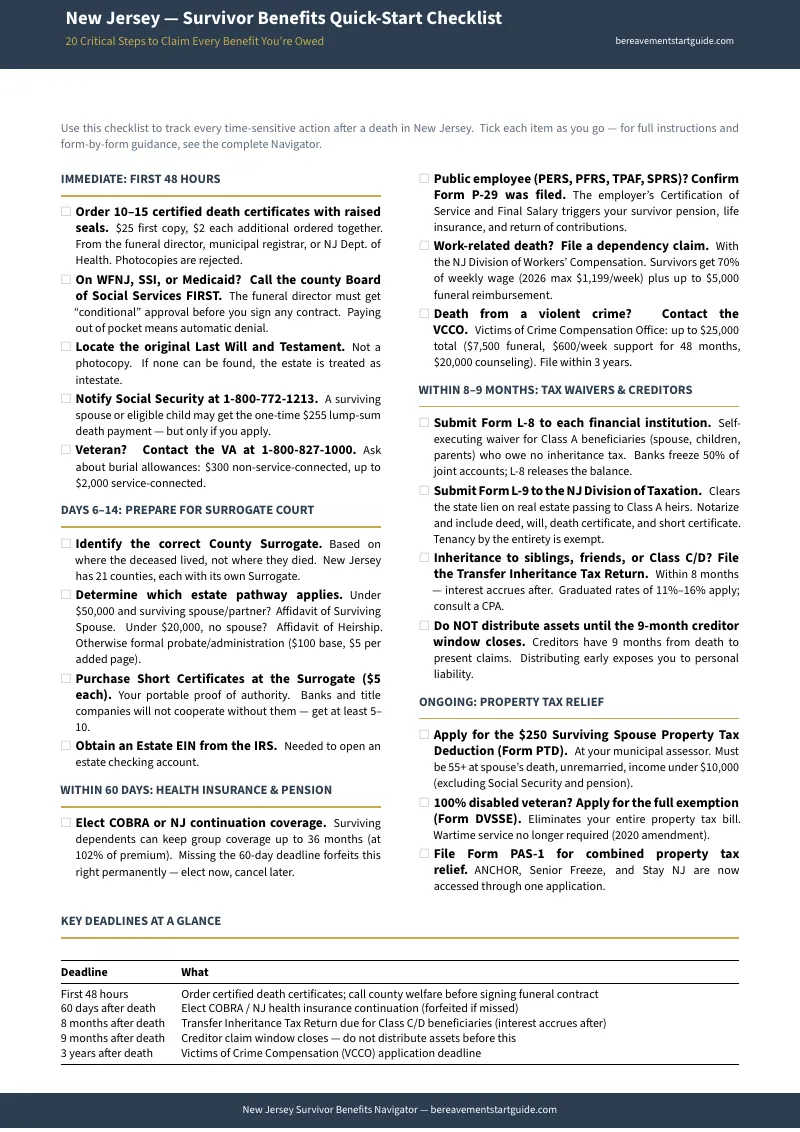
Not ready for the full guide? Download the free New Jersey Survivor Benefits Checklist -- a one-page overview of the most time-sensitive benefits, deadlines, and forms that most families do not discover until the bank has already frozen the account and the health insurance election window has closed.
You did not plan for this. But you can plan what happens next. The guide gives you the benefits, the deadlines, the forms, and the filing sequence -- so the next twelve months are spent claiming what your family is owed, not discovering what you missed.