Someone You Love Just Died in New Mexico. The Court Clerk Cannot Tell You What to Do Next. The Probate Attorney Wants $3,000 to Open a File. You Are Standing in the Gap Between Free Forms and Expensive Lawyers With No Idea Which Way to Go.
You are holding a stack of paperwork you did not ask for. The funeral director wants to know how many death certificates to order. The bank told you the accounts are frozen and they cannot release a dollar until you produce something called Letters Testamentary. A credit card company mailed a statement for a balance you did not know existed. Your siblings want to know what happens to the house. And you are standing in the kitchen of a person who is no longer here, trying to figure out the single most urgent thing you are supposed to do next.
Here is the part nobody tells you: New Mexico will hand you every form you need for free. The state Supreme Court publishes pro se probate forms online. Bernalillo County sells the packet for $5. But the moment you sit down with those blank pages and try to figure out what to write, where to file them, and in what order — you hit the wall. New Mexico law explicitly prohibits court clerks from giving you instructions, answering procedural questions, or telling you what happens after you file. They will hand you the paper and wish you luck. That is where their job ends and your confusion begins.
The alternative is a probate attorney. Retainers start at $3,000 to $5,000 in New Mexico, and complex estates absorb 3% to 8% of the total value in legal fees. For a family with a $40,000 estate that might not even need probate, the math does not work.
The When Someone Dies in New Mexico — Estate Settlement Guide is a 120-Hour Settlement Sequencing System for every legal, financial, and administrative step from the moment of death through final distribution. The name comes from New Mexico's unique 120-hour rule — state law imposes a mandatory five-day waiting period before any informal probate can begin or any personal representative can be appointed. During those five days, families feel desperate pressure to act but are legally barred from official estate business. This guide fills that gap and every gap after it. Not a law textbook. Not a generic checklist from a national website that does not know New Mexico from New Jersey. A structured, New Mexico-specific manual that separates what must be done in the first 48 hours from what cannot legally happen until Day 6, Day 30, or Month 6 — so you stop guessing, stop panicking, and start working through this in the right order.
What's Inside the 120-Hour Settlement Sequencing System
A 15-chapter guide, the First 48 Hours Checklist, and a complete forms reference — covering every stage from the moment of death through final asset distribution, built specifically for New Mexico statutes, county courts, the Motor Vehicle Division, and the state-specific rules that make settling an estate here different from any other state:
The First 48 Hours: Death Certificates, the OMI, and Immediate Actions
The funeral director is going to ask how many certified death certificates to order, and most families guess wrong. You need originals — not photocopies — for every bank, every insurance company, the probate court, the Motor Vehicle Division, and every county where the deceased owned property. Certified copies cost $5 each from the Bureau of Vital Records in Santa Fe, but the office does not accept cash or credit cards — only certified checks or money orders. If you need copies urgently, VitalChek charges $21 to $39.50 per copy for credit card processing. Order the right number now, or wait weeks for more later. This chapter also covers New Mexico's Office of the Medical Investigator, which can delay death certificate issuance for up to 90 days when it takes jurisdiction — and it takes jurisdiction more often than you expect, including for every cremation in the state, which requires a mandatory $230 OMI permit fee.
Days 3 to 30: Securing Property and Identifying Assets
Before any court gives you legal authority, you need to secure the deceased's home, vehicles, valuables, and financial records. This chapter covers locking the residence, forwarding mail (your best forensic tool for discovering unknown accounts and debts), categorizing every asset as probate or non-probate, and contacting Social Security, employers, and financial institutions. It also addresses the family members who have already started helping themselves to the house — the most common source of probate disputes in every state.
Vehicle Title Transfers: The MVD Forms Nobody Explains
The New Mexico Motor Vehicle Division maintains two entirely separate paths for transferring a vehicle after death, and using the wrong one gets your paperwork rejected. If no probate is pending and 30 days have passed, you use MVD Form 10011 — Certificate of Transfer Without Probate. If you are using the small estate affidavit process, you need MVD Form 10013 — Affidavit of Claiming Successor — plus Form MVD-10187 for the Odometer Disclosure. The guide names every form, explains which path applies to your situation, and tells you exactly what to bring to the MVD office. New Mexico allows online title transfers, but you still need the original death certificate verified.
The Small Estate Shortcut: Skipping Probate for Estates Under $50,000
If the total estate value is under $50,000, New Mexico law allows you to skip probate entirely using an Affidavit of Successor in Interest. No court, no attorney, no filing fees. But here is the catch that trips up nearly every family: the $50,000 threshold strictly excludes real property. A house, a lot, a parcel of land — none of it qualifies under the small estate affidavit, regardless of value. This chapter walks you through the exact criteria, the mandatory 30-day waiting period, and what to do when the estate is close to the line.
Spousal Transfer of the Family Home: The Six-Month Affidavit
For surviving spouses, New Mexico provides a powerful tool that most families never discover. Under NM Statute 45-3-1205, a surviving spouse can transfer the family homestead — valued up to $500,000 — completely outside of court using an Affidavit of Surviving Spouse. The property must have been held as community property, and six months must have elapsed since the death. No probate, no attorney required. This single provision can save a family thousands of dollars and months of court proceedings. The guide explains the exact requirements, the affidavit process, and the recording steps at the county clerk.
When Probate Is Required: The Full Process
If the estate does not qualify for the small estate affidavit or the spousal homestead transfer, this chapter walks you through the complete probate process under New Mexico's Uniform Probate Code. Filing the application, the 120-hour waiting period, receiving Letters Testamentary or Letters of Administration, the mandatory 30-day notice to heirs and devisees, the 90-day asset inventory, publishing the Notice to Creditors, managing the creditor claim window, and the final closing statement. New Mexico's system is designed to be executor-friendly — most proceedings are handled by the court clerk without a hearing — but only if you know the exact sequence.
Taxes, Medicaid Recovery, and Creditor Management
The estate pays the debts, not the family. Heirs are not personally liable. But when the estate does not have enough money to pay everyone, New Mexico law dictates a strict priority. This section covers the deceased's final tax returns (New Mexico has no state estate or inheritance tax), the Medicaid Estate Recovery Program and its 90-day hardship waiver window, the creditor claim timelines (one year without notice, four months with published notice, two months with mailed notice), and the $30,000 Family Allowance and $150,000 Homestead Exemption that protect the surviving spouse and children before general creditors receive anything.
Tribal and Trust Land, Business Closures, and Edge Cases
New Mexico hosts 23 federally recognized tribes, pueblos, and nations — more than nearly any other state. If the deceased owned trust or restricted land, state probate law does not apply; the estate is governed by the American Indian Probate Reform Act or specific tribal probate codes. This section also covers closing a New Mexico business (Gross Receipts Tax closure via TAP, tax clearance certificates), the Elizabeth Whitefield End-of-Life Options Act and its insurance protections, and the specific circumstances where this guide tells you plainly that you need an attorney.
The Complete Timeline: Every Statutory Deadline in One Calendar
From Day 1 through Year 3 and beyond, every New Mexico statutory deadline in one sequential reference. The 120-hour waiting period before informal probate. The 30-day wait for the small estate affidavit. The 30-day notice to heirs after appointment. The 90-day inventory deadline. The 90-day Medicaid hardship waiver window. The creditor claim periods. The six-month spousal homestead affidavit eligibility. Every deadline that matters, in the order it appears, with clear language about what happens if you miss it.
Who This Guide Is For
- The surviving spouse whose partner just died and whose bank accounts were frozen this morning — who needs to know which accounts stay accessible, which ones require court paperwork, and how to claim the $30,000 Family Allowance and the $500,000 spousal homestead transfer that New Mexico law guarantees before any creditor gets paid
- The out-of-state adult child named as executor who has never been through probate, lives in Texas or California, and is trying to manage a New Mexico estate remotely — who needs the complete sequence of fiduciary duties, court deadlines, MVD forms, and county filing requirements in one document
- The family with no will who just learned that New Mexico's intestate succession and community property laws will decide everything — who needs to understand exactly who inherits what, whether the house must go through probate, and whether the small estate shortcut or spousal homestead affidavit applies to their situation
- The person who just got rejected at the bank trying to access their deceased parent's checking account — who needs to know whether a POD designation, a joint account, or the $50,000 small estate affidavit can bypass probate entirely, or whether Letters Testamentary are the only path forward
- The family dealing with Medicaid recovery who received a notice from the New Mexico Human Services Department demanding reimbursement for nursing home costs — who needs to understand the 90-day hardship waiver window, the assets that are protected from recovery, and the statutory deferrals for surviving spouses and minor children
- The family navigating tribal jurisdiction who needs to understand when state probate law applies and when the American Indian Probate Reform Act or tribal court governs — and what happens when land, assets, or family members cross those jurisdictional lines
Why Free Resources Will Not Get You Through This
The information exists. It is scattered across the New Mexico Courts website, the Bureau of Vital Records, the Motor Vehicle Division, county clerk offices in 33 counties, the Human Services Department, the Office of the Medical Investigator, and a dozen federal agency portals that do not reference each other. Here is what you actually encounter when you try to settle an estate using free sources alone:
- The state courts give you forms and refuse to explain them. The New Mexico Supreme Court publishes pro se probate forms — the 4B series of applications — for free online. Bernalillo County sells the packet for $5. But every court website and every clerk's office explicitly states it "cannot provide legal advice, procedural instructions, or answer specific questions." If you fill out a form incorrectly, they will reject it without telling you why. You get the raw materials without a single instruction.
- Local probate attorneys highlight complexity to justify retainer fees. Law firm blog posts about New Mexico probate are accurate and detailed — and they are explicitly designed to convince you that the process is too dangerous to handle alone. For contested estates, that is true. For the majority of straightforward estates, the answer costs a fraction of what an attorney charges.
- National legal platforms miss New Mexico-specific details. Nolo, FindLaw, and EstateExec provide broad overviews of probate that are templated across 50 states. They do not cover the MVD Form 10011 and 10013 vehicle transfer process, the $230 OMI cremation permit fee, the $500,000 spousal homestead affidavit, the 120-hour waiting period, or the specific county recording fees ($25 for the first 10 entries in Bernalillo and Santa Fe). New Mexico is not a footnote — it is a community property state with its own Uniform Probate Code implementation, and generic tools miss the details that matter.
- Funeral homes give you surface-level advice designed for the first 48 hours. Bereavement pages from New Mexico funeral homes tell you to order death certificates and notify Social Security. They do not explain the small estate affidavit process, the spousal homestead transfer, the Medicaid recovery timeline, or the creditor priority hierarchy. Their advice ends where the hard questions begin.
- Legal aid is income-restricted and focused on pre-death planning. New Mexico Legal Aid and the Senior Citizens Law Office provide excellent resources for low-income residents, but access is limited by strict income qualifications. Their published materials focus on wills and basic planning, not the step-by-step crisis management you need when someone has already died.
Free resources give you fragments from a dozen different sources that do not reference each other. The 120-Hour Settlement Sequencing System puts every New Mexico-specific statute, form, deadline, and procedure into one document, in the order you actually need them.
— Less Than Thirty Minutes With a New Mexico Probate Attorney
A single consultation with a New Mexico probate attorney costs $150 to $300 per hour. Standard probate representation runs $3,000 to $5,000. National estate software platforms charge $149 per year in recurring subscription fees. This guide costs less than thirty minutes of professional legal time and gives you the complete New Mexico-specific roadmap — every statute, every deadline, every form, every MVD procedure, and the decision tree that tells you whether you even need an attorney at all.
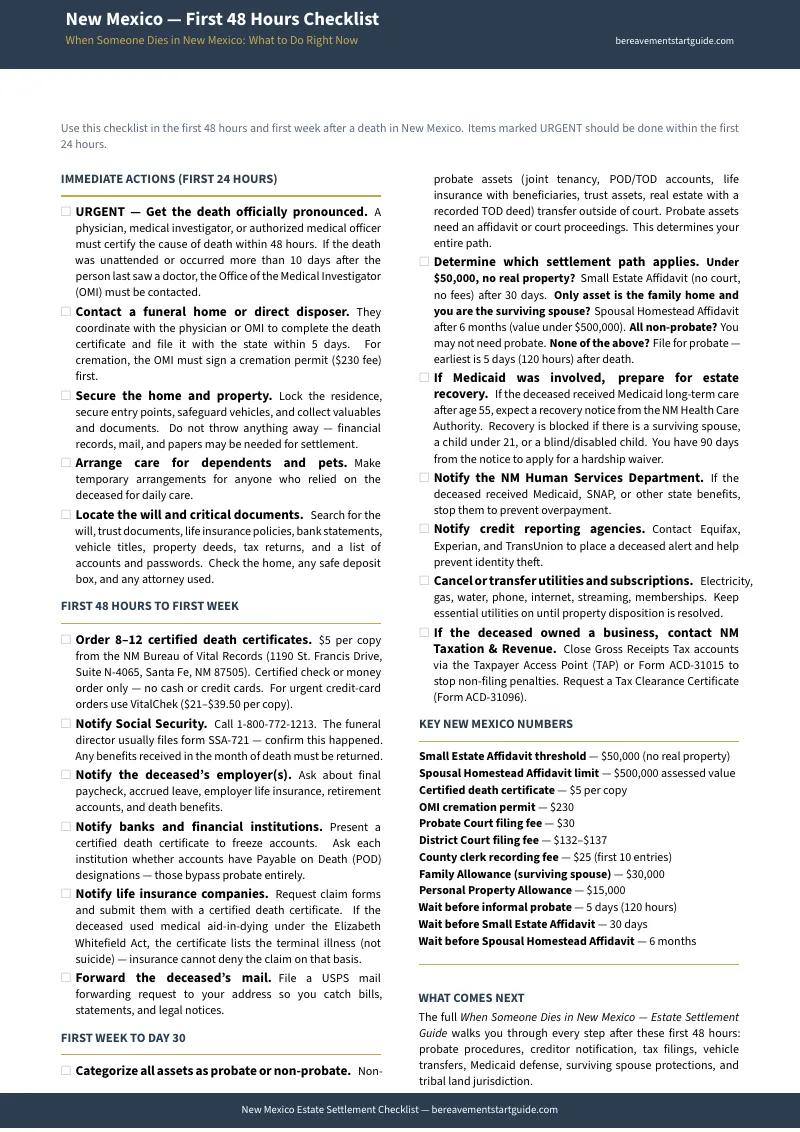
Your download includes 7 PDFs: the complete 15-chapter guide with agency contact appendix, the standalone New Mexico First 48 Hours Checklist, and 5 printable reference tools — the Probate Decision Tree (small estate vs. spousal homestead vs. full probate), the MVD Vehicle Title Transfer Walkthrough (both forms, both paths, what to bring), the Statutory Deadline Calendar (every deadline from Day 1 through Year 3), the Medicaid Estate Recovery Reference (deferrals, waivers, the 90-day window), and the Estate Settlement Cost Worksheet (track every expense and potential savings). Instant download, no account required.
30-day money-back guarantee. If the guide does not give you clarity on what to do next and confidence that you are doing it in the right order, email us for a full refund. No questions asked.
Not ready for the full guide? Download the free New Mexico First 48 Hours Checklist — 18 items covering everything that must happen in the first two days and first week after a death in New Mexico: death certificates, the OMI, securing the home, notifying Social Security, identifying your settlement path, and what not to pay. It is enough to get through tonight and tomorrow.
You did not ask for this job. But you can do it. The guide shows you how, one step at a time.